
- CARC 4 reads: “The procedure code is inconsistent with the modifier used, or a required modifier is missing.” CO-4 means the payer treated it as a contractual adjustment — the write-off is yours unless you fix the claim.
- CO-4 is a soft denial: most are resolved with a corrected claim (frequency code 7) carrying the right modifier, not a formal appeal.
- The most frequent triggers are a missing 26/TC split on global-billed diagnostics, a missing 59/X modifier on an NCCI edit pair, missing anatomic modifiers (LT/RT, F- and T-digits), and payment modifiers used on codes that do not allow them.
- Root-cause every CO-4 against the NCCI edit tables and the Medicare Physician Fee Schedule indicators (bilateral, PC/TC split, global days) — the fee schedule tells you which modifiers a code can even accept.
- If the modifier you billed was clinically correct and supported, appeal with documentation instead of stripping it — removing a valid 59 or 25 to force payment is unbundling in reverse.
- A pre-submission scrubber rule set mapped to your top 20 codes eliminates the large majority of CO-4s before they leave the building.
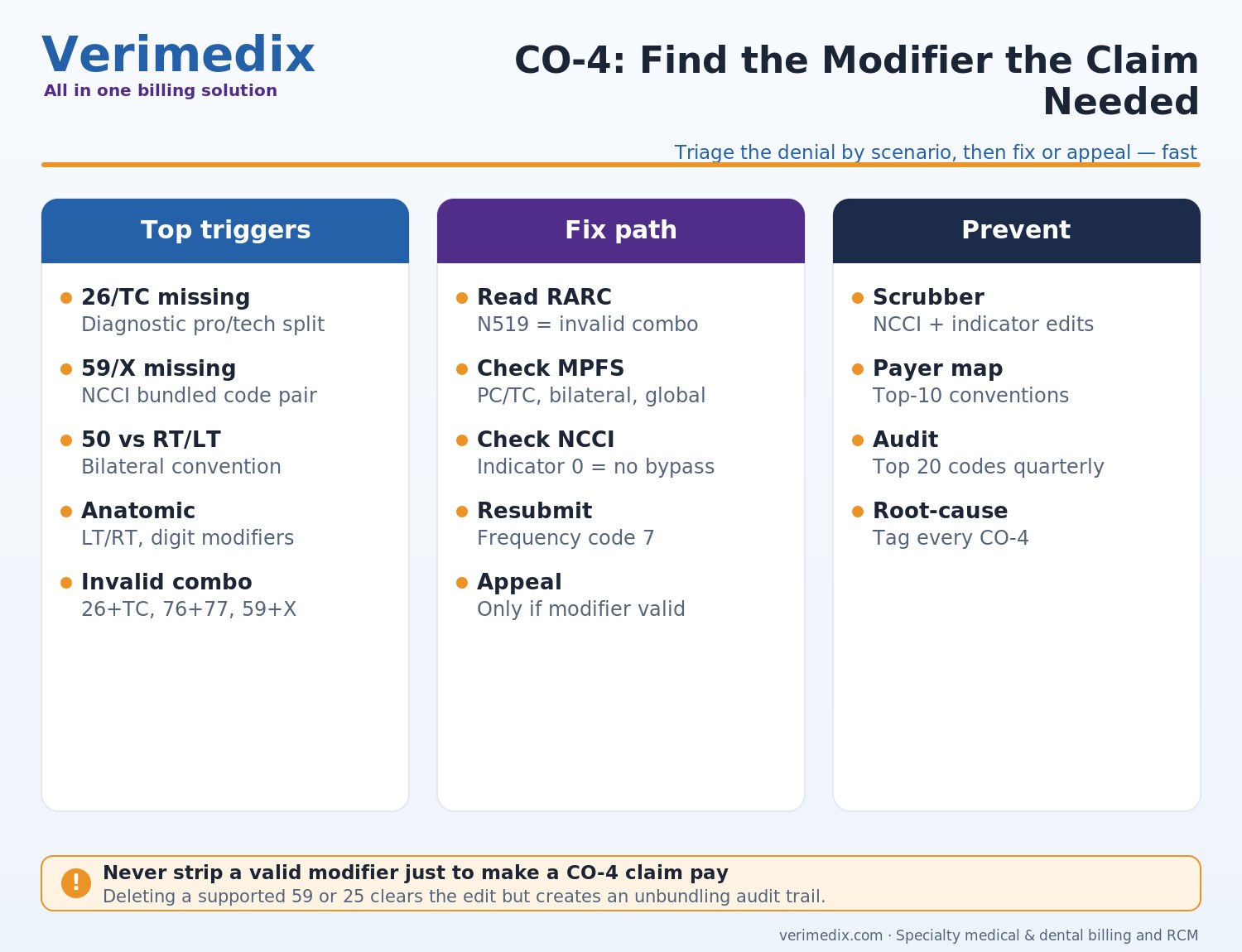
What the CO-4 denial code actually means
When a remittance shows group code CO with claim adjustment reason code 4, the payer's edit system compared your CPT/HCPCS code against the modifier field and found a mismatch — either a modifier that cannot go with that code, or a code that cannot be paid without a modifier you left off. It is one of the most mechanical denials in the CARC list (see our CARC & RARC code guide for how the code families work), and that is good news: mechanical denials have mechanical fixes.
Read the companion remark codes on the 835 before touching anything. RARCs such as N519 (invalid combination of HCPCS modifiers) or M78 point you to whether the payer objected to a missing modifier, an invalid one, or an invalid pairing. Also note the group code: CO-4 is provider liability; if the same reason ever arrives as PR-4, the payer is assigning it to the patient — rare, and worth challenging.
The five root causes behind almost every CO-4
- Required modifier missing. The code demands a modifier for adjudication: professional-only reads of diagnostics billed without 26, bilateral-eligible procedures billed without 50 or RT/LT per payer convention, therapy codes without required therapy or KX threshold modifiers, drug claims missing JW/JZ wastage reporting.
- Modifier invalid for the code. Examples: modifier 50 on a code whose fee-schedule bilateral indicator disallows it; 26 on a code with no professional/technical split; an E/M-only modifier like 25 on a surgical code; 33 sent to a payer that does not recognize it.
- Invalid modifier combination. Mutually exclusive pairs on one line — 26 with TC, 76 with 77, or an X{EPSU} modifier stacked with 59.
- Anatomic modifier conflicts. LT/RT or finger/toe modifiers that contradict the CPT description or the diagnosis laterality.
- Payer-specific conventions. Some payers want RT/LT on two lines instead of 50 on one, or require HCPCS pricing modifiers Medicare does not. Same code, different payer, different modifier — this is why CO-4 spikes when a practice adds a new plan.
Modifier-to-denial matrix: which guide fixes which CO-4
Use this matrix as the triage sheet for a CO-4 work queue. Each row links to the full billing guide for that modifier family.
| Denial scenario on the 835 | Modifier in play | Correct usage | Deep-dive guide |
|---|---|---|---|
| E/M denied when billed with a minor procedure same day | 25 | Significant, separately identifiable E/M by the same provider on the same date | Modifier 25 guide |
| Second procedure denied as bundled (NCCI edit pair) | 59 / XE, XS, XP, XU | Distinct procedural service; use the specific X modifier when the payer accepts them | Modifier 59 & X modifiers guide |
| E/M during a post-op period denied as global | 24 | Unrelated E/M by the same provider during the global period | Modifier 24 guide |
| Imaging/diagnostic paid at zero or wrong amount | 26 / TC | Split professional interpretation from technical component; never both on one line | Modifier 26 vs TC guide |
| Bilateral procedure denied or paid unilaterally | 50 (or RT/LT) | Check the fee-schedule bilateral indicator and the payer's one-line vs two-line convention | Modifier 50 guide |
| Multiple procedures cut or denied at adjudication | 51 vs 59 | 51 flags multiple procedures for pricing; 59 flags distinct services for bundling edits — not interchangeable | Modifier 51 vs 59 guide |
| E/M that led to surgery denied into the global package | 57 vs 25 | 57 for the decision-for-major-surgery E/M (90-day global); 25 for minor procedures (0–10 day) | Modifier 57 vs 25 guide |
| Repeat test or procedure same day denied as duplicate | 76 vs 77 | 76 for repeat by the same provider, 77 by a different provider | Modifier 76 vs 77 guide |
| Preventive service applied to patient cost-share or denied | 33 / PT | 33 for ACA preventive on commercial; PT for Medicare screening-to-diagnostic colonoscopy | Modifier 33 guide |
| Drug HCPCS denied for missing wastage reporting | JW / JZ | JW for discarded amounts from single-dose vials; JZ attests zero wastage | JW & JZ modifier guide |
| Medicare non-covered service liability disputed | GA / GX / GY / GZ | Match the modifier to ABN status or statutory exclusion | ABN modifier guide |
| Unusually extensive procedure denied or underpaid | 22 | Substantially greater work, documented and sent with supporting op note | Modifier 22 guide |
| Telehealth claim denied for place-of-service/modifier conflict | 95 vs 93 | 95 for audio-video, 93 for audio-only, matched to the payer's POS rules | Modifier 95 vs 93 guide |
Fix workflow: corrected claim or appeal?
Work each CO-4 through four checkpoints. First, pull the code's row from the Medicare Physician Fee Schedule (or the payer's fee schedule) and read the indicators — PC/TC split, bilateral indicator, global days. Second, run the code pair through the current NCCI edit tables to see whether a bypass modifier is allowed at all (modifier indicator 1) or never allowed (indicator 0). Third, compare against the payer's published modifier policy. Then choose a path:
| Finding | Action | How |
|---|---|---|
| Modifier was genuinely wrong or missing | Corrected claim — no appeal needed | Resubmit with claim frequency code 7 and the original claim number; document the coder-level cause |
| Modifier was correct; payer edit misfired | Appeal / reconsideration | Short letter stating why the modifier is valid, with notes, NCCI citation, and payer policy reference — our claim appeal guide has the template structure |
| NCCI indicator 0 — no modifier can unbundle | Write off the column-2 code correctly | Do not shop modifiers; adjust and fix charge capture so the pair is not billed separately again |
| Payer-specific convention (e.g., RT/LT vs 50) | Corrected claim + edit-library update | Add a payer-scoped scrubber rule so the translation happens automatically next time |
One warning: never resolve a CO-4 by deleting a clinically supported modifier just because the claim then pays. Stripping a valid 59 or 25 may clear this denial while creating an audit finding later. Fix the claim to match the documentation, not the edit.
What CO-4 leakage costs: a worked example
Illustrative numbers. A two-provider cardiology practice bills 60 echocardiograms (93306) a month, reading studies performed at the hospital. The biller omits modifier 26 on a fourth of them. Fifteen claims deny CO-4; each professional-component allowable is roughly $130, so about $1,950 per month sits in denial status. If the team reworks ten (at 20–30 minutes of staff time each) and five slip past the corrected-claim window, the practice loses about $650 monthly to write-offs plus roughly $75–$110 in rework labor — over $8,700 a year from one missing two-character modifier on one code. The scrubber rule that prevents it takes ten minutes to build.
Prevention scorecard
Score your process 0–2 on each item (2 = fully in place). Under 8 means CO-4 is a standing leak:
- Edit library: NCCI and fee-schedule-indicator checks run in the PM system or clearinghouse before submission.
- Payer map: documented modifier conventions (50 vs RT/LT, X-modifier acceptance, 33 recognition) for your top ten payers.
- Top-code audit: quarterly modifier audit of your 20 highest-volume codes.
- Feedback loop: every CO-4 gets a root-cause tag (coder, charge entry, payer edit) and the trend is reviewed monthly, as part of a broader denial management process.
- Training cadence: coders re-trained when CPT or NCCI updates change modifier rules (quarterly NCCI refreshes matter here).
Quick Answers
What does denial code CO-4 mean? The procedure code is inconsistent with the modifier used, or a required modifier is missing. The payer's edits found a mismatch between the CPT/HCPCS code and the modifier field.
Is CO-4 a hard denial? No, it is a soft denial. Most CO-4s are fixed by resubmitting a corrected claim (frequency code 7) with the correct modifier rather than by formal appeal.
Can the patient be billed for a CO-4 denial? Generally no. The CO group code marks it a contractual obligation, meaning the provider absorbs it unless the claim is corrected and repaid.
Which modifiers cause the most CO-4 denials? Missing 26/TC on diagnostic tests, missing 59/X modifiers on NCCI code pairs, bilateral modifier 50 misuse, and missing anatomic modifiers such as LT/RT are the most common triggers.
How do I know if a code needs a modifier? Check the fee schedule indicators (PC/TC split, bilateral, global days) and the NCCI edit tables. They define which modifiers a code accepts and which pairs need a bypass modifier.
How fast should CO-4 denials be worked? Within days, not weeks. Corrected claims still have to land inside the payer's timely filing or corrected-claim window — miss it and a fixable CO-4 becomes an unfixable CO-29.
Frequently asked questions
CO-4 is specific: the modifier field conflicts with the procedure code. CO-16 is the catch-all for claims lacking information, identified by its remark codes. If you get CO-16 with a modifier-related remark code, treat it like a CO-4 and fix the modifier before resubmitting.
Usually not. If the modifier was wrong or missing, a corrected claim with frequency code 7 resolves it. Reserve appeals for cases where the modifier you billed was correct and documented, and the payer's edit — not your claim — is the problem.
Payers often pair CARC 4 with remittance advice remark codes such as N519 (invalid combination of HCPCS modifiers) or other modifier-related RARCs. Always read the RARC — it tells you whether the issue is a missing modifier, an invalid one, or a bad combination.
Yes. Corrected claims must still arrive within the payer's corrected-claim or timely filing window. A CO-4 left in a queue for months can expire into a CO-29 timely filing denial, which is far harder to overturn.
NCCI procedure-to-procedure edits define which code pairs are bundled and whether a bypass modifier (59 or an X modifier) is allowed. Billing a bundled pair without an allowed modifier, or with one where the indicator is 0, commonly surfaces as CO-4 or CO-97 denials.