
- Modifier 50 reports the same procedure performed on both sides of the body in one session — and for Medicare, it belongs only on codes with bilateral indicator 1.
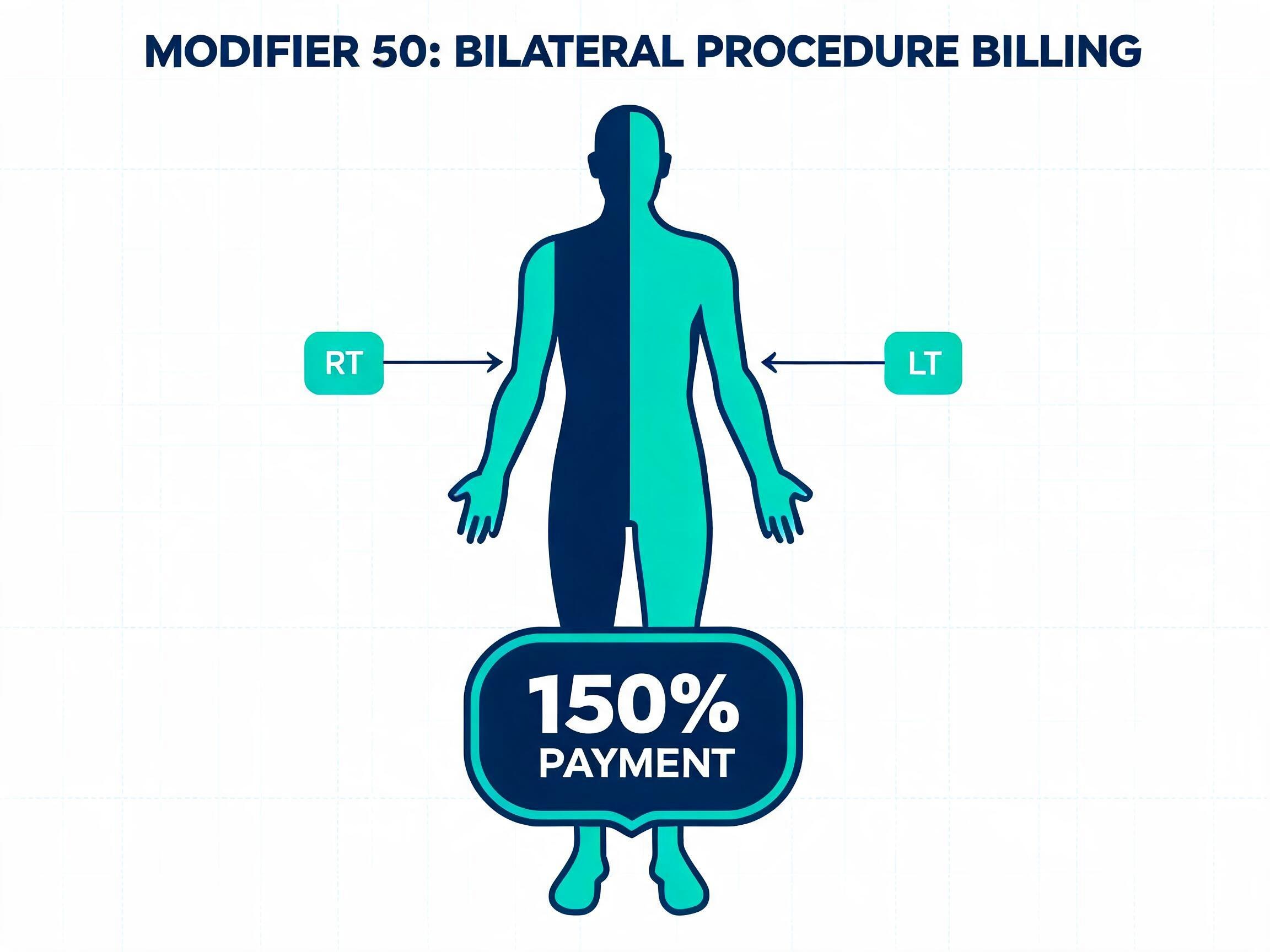
- Indicator-1 codes billed with modifier 50 on one line with one unit pay the lesser of the billed charge or 150% of the fee schedule amount.
- Indicators 0, 2, and 9 mean no bilateral adjustment: rules don't apply (0/9) or the code is already priced bilaterally (2).
- Indicator-3 codes — mostly diagnostic tests — are reported as two lines with RT and LT and each side is paid at 100%.
- Never combine modifier 50 with RT/LT on the same line; the mix is a common rejection trigger.
- Commercial payers split three ways on format — one line/1 unit, one line/2 units, or two RT/LT lines — so payer-specific conventions decide how you submit.
Modifier 50: the quick answer
Bilateral billing goes wrong for a predictable reason: coders treat modifier 50 as a clinical description ("we did both knees") when payers treat it as a payment instruction tied to a specific flag in the Medicare Physician Fee Schedule. Every CPT code carries a BILAT SURG indicator — 0, 1, 2, 3, or 9 — and that indicator, not the operative note, dictates whether modifier 50 is allowed, how many lines and units to submit, and what the payment should be. Check the indicator first, then the payer's format preference, and most bilateral denials never happen.
The payoff is concrete: indicator-1 codes billed correctly capture a 50% premium over the unilateral allowable. Billed wrong, that premium becomes an underpayment, an overstated-units denial, or a rejected claim.
What modifier 50 means
Modifier 50 (bilateral procedure) reports that the identical procedure was performed on both sides of the body — paired structures such as eyes, ears, breasts, kidneys, or extremities — during the same operative session. Two things it does not mean:
- It is not for two different procedures on opposite sides — those are separate codes, potentially with modifier 51 or 59 depending on the edit situation.
- It is not for codes whose descriptors already say "bilateral" or "unilateral or bilateral" — those are indicator-2 codes, already priced for both sides, and adding 50 can cause rejection or incorrect payment.
Documentation must confirm both sides were completed in the same session; if the right side was done Tuesday and the left on Friday, that is two unilateral claims on two dates, not a bilateral claim.
The MPFS bilateral indicator, decoded
The bilateral surgery indicator lives in the Medicare Physician Fee Schedule database, searchable via the CMS fee schedule lookup. Per CMS and Medicare contractor guidance (for example, Noridian's bilateral surgery instructions):
| Indicator | Meaning | How to bill (Medicare) | Payment result |
|---|---|---|---|
| 0 | Bilateral rules do not apply | No modifier 50 | 100% of fee schedule; no bilateral adjustment |
| 1 | Eligible for bilateral payment adjustment | One line, modifier 50, one unit | Lesser of billed charge or 150% of fee schedule |
| 2 | Code already priced as bilateral | No modifier 50; one line, one unit | 100% — the allowable already covers both sides |
| 3 | Typically radiology/diagnostic tests | Two lines with RT and LT (or per payer instruction) | Each side paid at 100% of the fee schedule |
| 9 | Concept does not apply | No bilateral billing | No bilateral adjustment |
The single highest-yield habit in bilateral billing: look this indicator up before the claim goes out. It prevents most modifier 50 denials and takes under a minute.
The 150% payment rule, and a charge-entry trap
For indicator-1 codes, Medicare pays the lesser of the actual billed charge or 150% of the fee schedule amount. That "lesser of" clause creates a quiet underpayment trap: if your charge master sends the one-line modifier 50 claim out with the unilateral charge amount, the payer pays that lower figure — and no denial ever alerts you. The one-line bilateral charge should reflect both sides so the 150% allowable is reachable.
Also note the interaction with multiple procedure logic: when a bilateral procedure is billed alongside other procedures in the same session, payers generally apply the 150% bilateral adjustment first, then rank the result with the other procedures for any multiple-procedure reduction, depending on payer methodology.
Modifier 50 vs RT/LT: payer format conventions
RT and LT are informational anatomic modifiers; modifier 50 is a payment modifier. Which one a bilateral claim needs depends on the payer and the indicator:
| Payer convention | Claim format for indicator-1 bilateral | Notes |
|---|---|---|
| Medicare (standard) | One line, modifier 50, 1 unit, combined charge | Pays lesser of charge or 150% |
| Many commercial payers | One line, modifier 50, 1 unit | Mirrors Medicare; confirm in the payer manual |
| Some commercial payers | One line, modifier 50, 2 units | Same service, different units convention — 1 unit here can halve payment |
| Some payers (incl. certain Blues plans) | Two lines: code-RT and code-LT, 1 unit each | Modifier 50 not recognized; RT/LT replaces it |
| Indicator-3 diagnostics (most payers) | Two lines, RT and LT | Each line paid at 100%; no 150% math |
Two rules keep this manageable. First, never mix systems on one line — code-50-RT-LT is a rejection waiting to happen. Second, build a payer-by-payer bilateral grid (format, units, charge convention) and keep it where charge entry can see it; this is the kind of payer-rule matrix a professional coding team maintains as standard practice.
Worked dollar example: carpal tunnel, both wrists
Illustrative numbers, not a fee quote. An orthopedic surgeon releases both carpal tunnels in one session (64721, bilateral indicator 1). Assume a $400 unilateral fee schedule allowable and a charge master rate of $560 per side.
- Correct (Medicare format): 64721-50, one line, one unit, charge $1,120 → payment = lesser of $1,120 or 150% × $400 = $600.
- Charge-entry trap: same line billed with the unilateral $560 charge → payment = lesser of $560 or $600 = $560. Silent $40 underpayment, no denial generated.
- Units error: 64721-50 × 2 units → many systems deny for units/modifier mismatch, sending the claim to rework.
- Commercial payer requiring RT/LT: 64721-RT and 64721-LT, one unit each → the payer applies its own bilateral pricing (often 100% + 50%). Submitting modifier 50 to this payer instead may reject outright.
One procedure, four outcomes, and only one of them is fully paid without rework.
A four-step bilateral billing framework
- Step 1 — Look up the bilateral indicator on the current MPFS for the exact CPT code.
- Indicator 1 → bilateral adjustment available; continue.
- Indicator 2 → bill the code alone; it already includes both sides.
- Indicator 3 → two lines, RT/LT, each paid at 100%.
- Indicator 0 or 9 → no bilateral billing.
- Step 2 — Check the payer's format: one line/1 unit with 50, one line/2 units with 50, or RT/LT lines.
- Step 3 — Set the charge to cover both sides on single-line claims so the "lesser of" rule cannot underpay you.
- Step 4 — Confirm documentation states both sides, same session, with laterality in the note matching the claim.
Common bilateral denials: cause and fix
| Denial/underpayment | Root cause | Fix |
|---|---|---|
| Units/modifier mismatch rejection | Modifier 50 with 2 units where payer expects 1 (or vice versa) | Rebill in the payer's published units convention; add the payer to your bilateral grid |
| Claim rejected at front end | Modifier 50 combined with RT/LT on one line | Strip to one system: 50 alone, or RT/LT lines alone |
| Paid at 100% instead of 150% | Unilateral charge on the bilateral line, or indicator misread | Verify indicator is 1; rebill or appeal with corrected charge; audit charge master |
| Modifier 50 denied outright | Code has indicator 0, 2, or 9 — or payer doesn't recognize 50 | Check the indicator; for non-recognizing payers, resubmit as RT/LT per policy |
| Second side denied as duplicate | Two identical lines with no laterality modifiers | Resubmit with RT/LT (or single-line 50) so the lines are distinguishable |
Underpayments deserve the same rigor as denials: run a quarterly report of indicator-1 procedures and compare actual payment to 150% of the allowable. Persistent gaps are appealable — see our step-by-step claim appeal guide — and persistent patterns are a denial management project.
Quick Answers
What does modifier 50 mean? Modifier 50 reports a bilateral procedure — the same service performed on both sides of the body during one session. For Medicare, it is used only on codes with bilateral indicator 1, billed on one line with one unit.
Does modifier 50 pay 150%? Yes, for bilateral indicator-1 codes: payment is the lesser of the billed charge or 150% of the fee schedule amount. That is why the single-line charge must reflect both sides — a unilateral charge caps payment below the 150% allowable.
When should I use RT and LT instead of modifier 50? Use RT/LT for indicator-3 codes (mostly diagnostics, each side paid at 100%) and for payers whose policies state they do not recognize modifier 50. Never report RT/LT together with modifier 50 on the same line.
What is a BILAT SURG indicator? It is the Medicare Physician Fee Schedule flag (0, 1, 2, 3, or 9) that determines whether a code qualifies for bilateral payment adjustment and how it should be billed.
How many units do I bill with modifier 50? For Medicare, one unit on one line. Some commercial payers instead require two units or two RT/LT lines — the payer's published convention controls, so verify before submitting.
What to check before you bill
- Bilateral indicator for the exact CPT code on the current-year MPFS — indicators can change between annual updates.
- Payer format: 50 with 1 unit, 50 with 2 units, or RT/LT lines — in writing, per payer.
- Charge amount on single-line claims covers both sides.
- Operative note documents both sides in the same session, matching the claim's laterality.
- No RT/LT stacked on a modifier 50 line.
- Remits on indicator-1 claims audited against the 150% expectation, not just for denials.
Related modifiers worth keeping straight
Bilateral billing sits alongside two neighboring modifier decisions. When multiple different procedures share a session, the choice between modifier 51 (multiple procedures) and 59 (distinct procedural service) governs — not modifier 50. And on diagnostic services, laterality billing interacts with the split between the professional and technical components (modifier 26 vs TC): an indicator-3 bilateral X-ray read, for example, may carry both a laterality modifier and modifier 26 depending on who owns the equipment.
Site of service changes the arithmetic too. When the same bilateral procedure is performed at a surgery center, the facility side is billed on a UB-04 under the ASC payment system with its own multiple-procedure and bilateral adjustments, entirely separate from the surgeon's professional claim — which is why ambulatory surgery center billing is treated as its own discipline rather than an extension of physician coding.
Frequently asked questions
For Medicare bilateral indicator-1 codes, yes: the claim pays the lesser of your billed charge or 150% of the fee schedule amount when billed on one line with modifier 50 and one unit. If your billed charge only reflects one side, payment is capped at that charge — a common silent underpayment.
Indicator-0 and 9 codes are not eligible for bilateral adjustment, so the claim is likely to deny or pay incorrectly. Indicator-2 codes are already priced as bilateral, so adding modifier 50 risks rejection or skewed payment. In both cases, bill the code without modifier 50.
Use RT/LT for indicator-3 codes — typically radiology and other diagnostics, where each side is billed on its own line and paid at 100% — and for payers, including certain Blues plans, whose policies say they do not recognize modifier 50. Get each payer's bilateral format preference in writing.
Medicare wants one line, one unit, with a charge covering both sides. Some commercial payers require the same line with two units, and others want two RT/LT lines. Billing the wrong units convention is a leading cause of bilateral claim rejections, so confirm per payer.
It is most common for paired structures — eyes, ears, kidneys, extremities — but eligibility is determined by the fee schedule, not anatomy: any code the MPFS flags with bilateral indicator 1 can be billed bilaterally, and codes without that flag cannot, regardless of the body part.