
- CO-16 (Claim/service lacks information or has submission/billing error) is a claim-level denial that requires a corrected claim, not an appeal letter.
- Always read the accompanying RARC — it identifies the specific missing element (NPI, place of service, rendering provider, etc.).
- CO-16 is typically a payer error prevention mechanism, not a coverage determination — most CO-16 denials are recoverable once the missing data is corrected.
- Timely filing clocks keep running during a CO-16 denial — correct and resubmit quickly.
- High CO-16 rates signal front-end eligibility, credentialing, or claim-scrubbing gaps that need systemic fixes, not just per-claim patches.
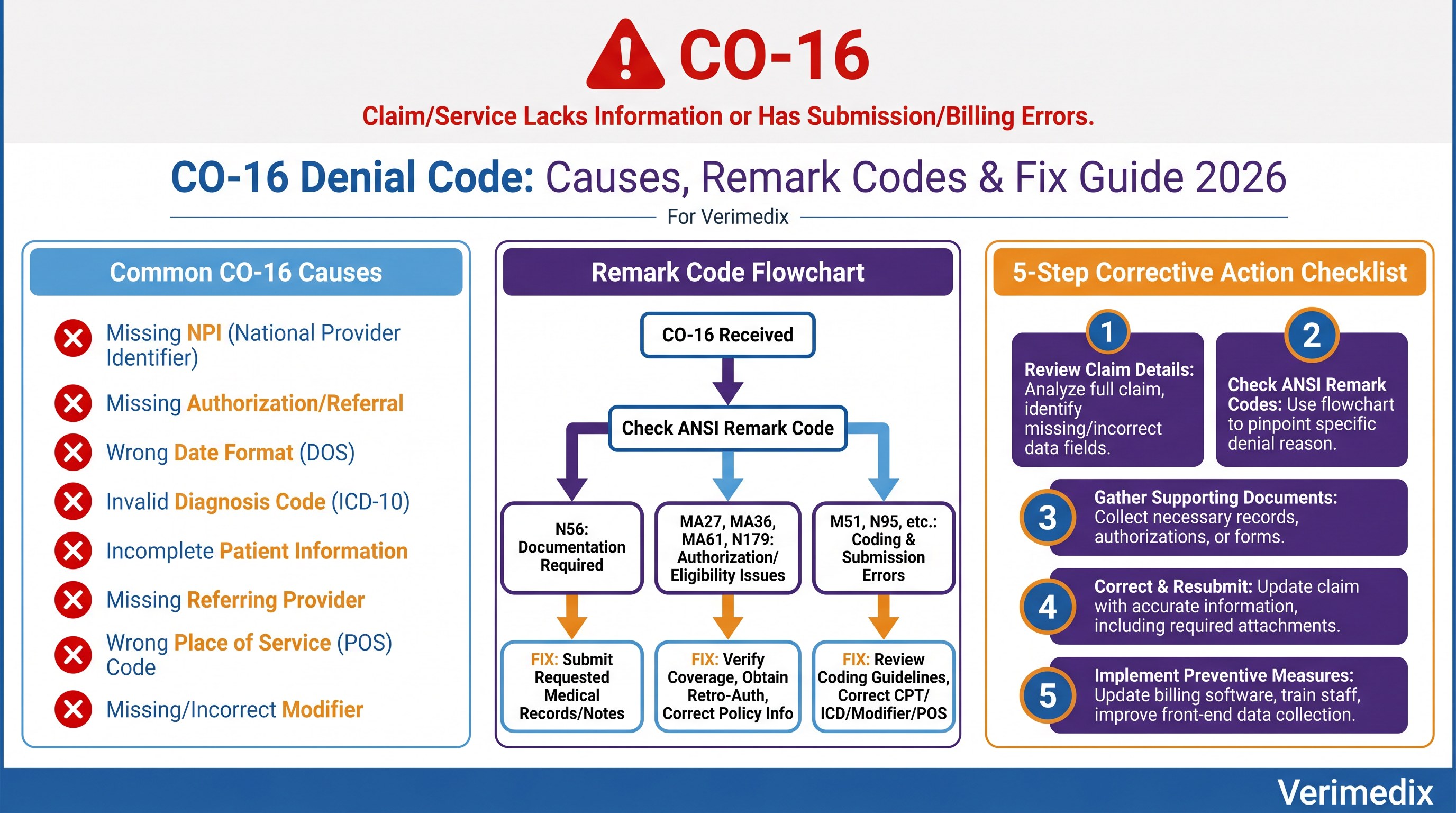
Claim Adjustment Reason Code CO-16 — officially: "Claim/service lacks information or has submission/billing error(s). Usage: Do not use this code for claims attachment(s)/other documentation. At least one Remark Code must be provided (may be comprised of either the NCPDP Reject Reason Code, or Remittance Advice Remark Code that is not an ALERT.)" — is published by the CAQH CORE X12 835 transaction set and used by virtually every payer in the U.S. to flag claims that could not be adjudicated due to missing or erroneous information.
How to read the RARC with CO-16
CO-16 is a container denial code — it tells you a data element is missing or wrong, but not which one. The RARC appended to CO-16 on the ERA (Electronic Remittance Advice) or EOB specifies the exact field. Without reading the RARC, correcting and resubmitting is guesswork. Most practice management systems display the RARC in the denial detail line alongside the CO code. If not, pull the raw 835 transaction and look for the CAS (Claim Adjustment Segment) or MOA (Monetary Amount) segment for the remark code.
Common RARCs paired with CO-16
| RARC | Meaning | Most common cause |
|---|---|---|
| MA130 | Your claim contains incomplete and/or invalid information | Generic data error — review entire claim for missing fields |
| N382 | Missing/incomplete/invalid patient identifier | Wrong or missing member ID, missing date of birth, or name mismatch |
| N286 | Missing/incomplete/invalid rendering provider information | Rendering NPI not on file, not credentialed, or missing from Box 24J (CMS-1500) |
| N290 | Missing/incomplete/invalid referring provider primary identifier | Referring NPI missing or not recognized by payer |
| N4 | Missing/incomplete/invalid procedure code | CPT or CDT code blank, invalid for date of service, or outside payer's covered list |
| N115 | Missing/incomplete/invalid ordering provider information | Ordering provider NPI or name missing on lab or DME claims |
| MA61 | Missing/incomplete/invalid social security number or health insurance claim number | Medicare HIC number replaced by MBI but old number still on claim |
| N657 | Missing/incomplete/invalid place of service | POS code missing, wrong code for service type (e.g., wrong telehealth POS) |
Most common causes of CO-16
- Wrong or missing NPI. The rendering, referring, ordering, or billing NPI is not on file with the payer, is not linked to the correct group NPI, or the provider is not yet credentialed.
- Incorrect or missing patient identifier. Member ID entered incorrectly, date of birth mismatch, or name on the claim does not match payer records.
- Wrong place of service code. A telehealth service billed with POS 11 (office) instead of POS 02 or 10, or a procedure billed at the wrong facility type.
- Missing diagnosis code. ICD-10 code missing from Box 21, or the diagnosis code is not linked to the procedure code in the claim form.
- Expired or invalid authorization number. Prior authorization number missing or not matching the procedure billed.
- Coordination of benefits (COB) errors. Missing primary payer payment information on a secondary claim.
Step-by-step fix for CO-16 denials
- Pull the ERA/EOB and identify the RARC. Do not attempt to correct until you know which field triggered CO-16.
- Locate the claim in your PM system and compare every field against the payer-specific requirements for that RARC.
- Correct the specific error. Update the NPI, fix the member ID, add the missing POS code, link the diagnosis, or obtain the authorization number.
- Re-verify eligibility if the denial involves a patient identifier or coverage issue. Outdated eligibility data at time of service is a leading CO-16 driver.
- Submit a corrected claim (frequency code 7 on the 837 / Box 22 on the CMS-1500) — not a new original claim and not an appeal letter. CO-16 is a billing error, not a clinical coverage denial.
- Track the resubmission date against your timely filing window. CO-16 denials do not pause the timely filing clock at most payers.
Systemic prevention
| Root cause | Prevention |
|---|---|
| High NPI-related CO-16 rate | Audit provider credentialing roster quarterly; confirm each rendering NPI is linked to the billing NPI at every payer |
| Patient identifier mismatches | Verify insurance eligibility in real time at check-in; match name, DOB, and member ID to payer records |
| POS errors on telehealth claims | Build POS 02 and POS 10 into telehealth claim templates; train staff on the 2026 POS rules |
| Missing authorizations | Implement prior-auth tracking in PM system; flag procedures that require auth before scheduling |
| COB errors on secondary claims | Map primary payer payment data into secondary claim automatically; validate 835 data before secondary submission |
CO-16 is the denial code with the highest recovery rate in RCM because it is almost never a coverage issue — it is a data issue. A well-run billing team treats a CO-16 as a same-day correction ticket, not a dispute. The goal is to eliminate the underlying data entry or workflow gap so the same error never reaches the payer again. That correction-plus-prevention loop is the core of professional denial management services, and it works best when eligibility, charge capture, and claim scrubbing sit inside one revenue cycle management workflow.
Frequently asked questions
CO-16 is technically a correctable denial (soft denial). It results from missing or erroneous claim data, not a coverage determination. In most cases you correct and resubmit a corrected claim rather than file a formal appeal. However, timely filing deadlines apply from the original date of service, not the denial date.
Per CAQH X12 835 standards, CO-16 must be accompanied by at least one RARC. If your ERA shows CO-16 without a RARC, the issue may be in how your PM system is parsing the 835 transaction. Pull the raw 835 and look for the CAS segment for the remark code. If the payer truly omitted the RARC, call the provider relations line to request clarification.
Standard appeals are generally not the right path for CO-16. Submit a corrected claim (frequency code 7) with the specific data correction. If you believe the CO-16 was issued in error and your original claim was complete, you may file an appeal; otherwise, correcting and resubmitting is faster and more effective.
Timely filing windows vary by payer — Medicare allows 12 months from the date of service; many commercial payers allow 90–180 days. CO-16 denials do not reset the timely filing clock. Calculate your remaining window from the original date of service and resubmit corrected claims promptly.
CO-4 means a specific modifier or code combination was incorrect or missing (usually a procedure code requiring a modifier). CO-16 is broader and covers any missing or erroneous claim information. Both require corrected claims rather than appeals, but the specific fix differs: CO-4 requires a modifier correction; CO-16 requires fixing whichever data element the RARC specifies.