
- Modifier 95 = synchronous audio-video telehealth; modifier 93 = synchronous audio-only. Bill the modality that actually happened.
- POS 10 (patient at home) generally pays the higher non-facility rate; POS 02 (patient not at home) pays the lower facility rate — often a $30–$55 difference per E/M visit.
- Medicare fee-for-service identifies telehealth primarily by the POS code; most commercial and Medicare Advantage plans still want modifier 95 or 93 on the claim line.
- Audio-only Medicare billing generally requires that the practitioner was capable of two-way video but the patient could not, or did not consent to, use it — and the note should say so.
- If video fails mid-visit and cannot be restored, document the times and bill the encounter as it was actually delivered, which usually means audio-only with modifier 93.
- Medicare telehealth flexibilities run through December 31, 2027 per the Consolidated Appropriations Act, 2026 — but commercial parity still varies by payer.
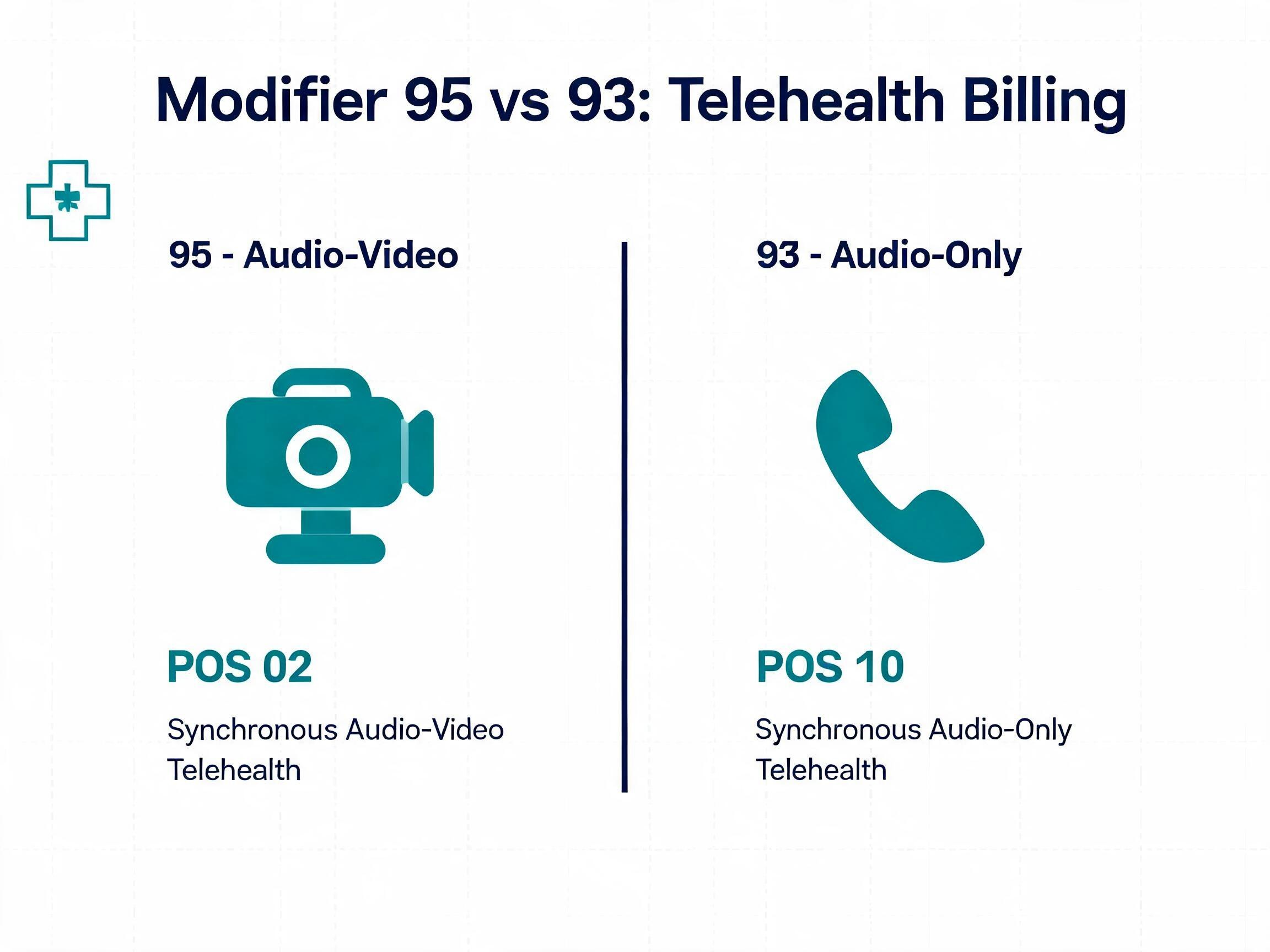
Every telehealth claim answers two separate questions, and mixing them up is where most denials start. The modifier — 95 or 93 — answers how the visit happened: two-way audio-video, or audio only. The POS code — 10 or 02 — answers where the patient was: home, or somewhere else. Keep those questions separate and nearly any telehealth coding decision resolves in under a minute.
What modifiers 95 and 93 actually mean
Modifier 95 is defined as a synchronous telemedicine service rendered via a real-time interactive audio and video telecommunications system. Two conditions matter: the interaction is live, and video genuinely connected and functioned. Modifier 93 is its audio-only counterpart: a real-time interactive encounter by telephone or another audio-only channel, where audio carries the medically relevant exchange.
The compliance trap is defaulting to modifier 95 "to be safe." If the note cannot support that video was on, billing 95 misrepresents the encounter. Per CMS guidance, Medicare audio-only billing also carries its own condition: the distant-site practitioner must have been capable of an audio-video connection, but the patient either could not use video or did not consent to it. That reason belongs in the note, in one sentence, every time.
Also note that CPT now includes dedicated telemedicine E/M codes — 98000–98015 for audio-video and 98016 for a brief audio-only check-in — which some commercial payers accept, while Medicare has generally kept telehealth on 99202–99215. Our guide to the new telehealth E/M codes 98000–98016 covers when each code set applies.
| Element | Modifier 95 (audio-video) | Modifier 93 (audio-only) |
|---|---|---|
| Modality | Real-time interactive audio + video | Real-time interactive audio only |
| Core requirement | Video connected and functioned for the visit | Provider capable of video; patient unable or unwilling; audio carried the encounter |
| Medicare FFS use | POS code drives telehealth identification; 95 often optional on professional claims | Modifier 93 (or FQ for certain behavioral claims) required to flag audio-only |
| Commercial / MA use | Usually required on the claim line | Accepted only for payer-listed CPT codes; coverage varies widely |
| Typical POS pairing | POS 10 (home) or POS 02 (not home) | Same POS logic — modality does not change patient location |
POS 02 vs POS 10: the payment difference nobody should ignore
Medicare splits telehealth place of service into POS 02 (patient anywhere other than home) and POS 10 (patient at home). The distinction is financial: POS 10 claims are generally priced at the non-facility rate — the same as an in-office visit — while POS 02 claims are generally priced at the lower facility rate. For how POS codes drive pricing, see our place of service codes guide (POS 11 vs 22).
Worked dollar example (illustrative). Using approximate CY2026 national Medicare amounts, a 99214 pays about $135.61 non-facility versus $96.34 facility — a $39.27 gap per encounter. Scale it: a practice runs 60 home-based video visits a month, but its EHR defaults every telehealth claim to POS 02. Each claim underpays by about $39, so the practice leaves roughly $2,356 a month — about $28,000 a year — on the table with no denial ever appearing on a remittance. Figures are illustrative and locality-adjusted, but the direction is consistent: a wrong POS default is silent revenue leakage — the kind a billing review exists to catch.
| Code (CY2026, illustrative national rates) | POS 10 — non-facility | POS 02 — facility | Difference per visit |
|---|---|---|---|
| 99213 | ~$95.19 | ~$63.92 | ~$31.27 |
| 99214 | ~$135.61 | ~$96.34 | ~$39.27 |
| 99215 | ~$192.39 | ~$137.84 | ~$54.55 |
Payer parity in 2026: who accepts what
Telehealth "parity" is not one national rule — it is a patchwork of federal policy, state parity laws, and individual payer medical policies, and modifier 93 sits at the center of the variance.
| Payer type | Modifier 95 (audio-video) | Modifier 93 (audio-only) | Practical note |
|---|---|---|---|
| Medicare FFS | POS 02/10 identifies telehealth; 95 generally not the pricing driver | 93 (or FQ) required when audio-only conditions are met | Flexibilities extended through Dec 31, 2027 |
| Medicare Advantage | Usually required on the line | Plan-specific covered-code lists; often narrower than FFS | Confirm the plan's telehealth policy, not just Medicare's |
| Medicaid (state programs) | Commonly required; some states retain GT conventions | Varies by state parity statute | Check the state fee schedule and telehealth bulletin |
| Commercial plans | Standard expectation with POS 02/10 | Most variable — many plans limit 93 to specific CPT ranges (often behavioral health) | Load payer-specific rules into claim edits |
The operational takeaway: build a one-page payer grid — each major payer's modifier requirement, audio-only policy, and POS handling. It prevents batch errors and doubles as appeal evidence when a payer misapplies its own policy. Our 2026 telehealth CPT code guide pairs well with it.
The mid-visit video failure: how to bill it
The scenario every telehealth practice eventually faces: the visit starts on video, the connection degrades, and the last twenty minutes happen by phone. Bill what was actually delivered, and let the timeline in the note make the case. If video dropped early and could not be restored, the encounter was in substance audio-only — modifier 93. If video carried the substantive portion and only the tail end moved to audio, many payers accept audio-video coding, but the note should state when video failed and what was completed afterward. What a practice should never do is bill 95 on autopilot while the note says "completed by phone" — that contradiction is exactly what payer audits sample for. A template line solves it: "Visit initiated via audio-video at [time]; video lost at [time]; remainder completed via audio with patient consent."
Common telehealth modifier denials — cause and fix
| Denial pattern | Likely cause | Fix |
|---|---|---|
| CO-4 (modifier inconsistent) | Modifier 93 on a CPT code the payer does not list as audio-only eligible | Check the payer's audio-only list; rebill with a covered code or corrected coding |
| CO-5 / CO-58 (POS inconsistent) | POS 02/10 mismatch with the service or a payer that wants POS 11 + modifier for telehealth | Verify payer POS convention; correct POS and resubmit |
| Paid, but short | POS 02 billed for an at-home patient — facility rate applied | Submit a corrected claim with POS 10; recover the non-facility difference |
| CO-96 (non-covered) | Plan does not cover telehealth for that service or provider type | Verify telehealth benefits at eligibility check, before the visit |
| CO-16 (missing information) | No telehealth modifier where the payer requires 95/93 | Rebill with the required modifier; add a payer-level claim edit so it cannot recur |
The 60-second decision tree
- 1. Did two-way video connect and function?
- Yes → audio-video visit. Go to step 2 with modifier 95 (or the payer's audio-video telemedicine code set).
- No, audio only → confirm the payer covers that CPT code audio-only; document why video was not used; use modifier 93. Go to step 2.
- Started with video, lost it → bill the modality that substantively carried the visit; document drop time. Go to step 2.
- 2. Where was the patient physically located?
- Home → POS 10 (expect non-facility pricing).
- Anywhere else (clinic, SNF, workplace) → POS 02 (expect facility pricing).
- 3. What does this payer require on the line?
- Medicare FFS → POS drives it; add 93/FQ for audio-only where required.
- Commercial / MA / Medicaid → apply the payer grid: modifier 95 or 93 per policy, correct POS convention, covered-code check.
Quick Answers
What is the difference between modifier 95 and modifier 93? Modifier 95 reports synchronous telehealth via real-time interactive audio and video; modifier 93 reports a synchronous service via audio only. The choice turns entirely on whether functioning two-way video was part of the encounter.
Does modifier 95 require POS 02? No. The modifier reports modality and the POS code reports patient location: POS 10 when the patient is at home, POS 02 when the patient is anywhere else. Modifier 95 can validly appear with either.
Does POS 10 pay more than POS 02? Generally yes under Medicare. POS 10 is typically priced at the non-facility rate and POS 02 at the facility rate — a gap of roughly $30–$55 on common office E/M codes, varying by locality.
Is audio-only telehealth billable to Medicare in 2026? Often yes — when the practitioner had audio-video capability but the patient could not or would not use video, the service is on Medicare's telehealth list, and modifier 93 (or FQ) is appended. Flexibilities run through December 31, 2027.
Do commercial payers all accept modifier 93? No — many restrict modifier 93 to specific code ranges, frequently behavioral health. Confirm each payer's list before billing.
What to check before submitting a telehealth claim
- Does the note state the modality explicitly — and does it match the modifier on the claim?
- For audio-only: is the reason video was not used documented, and is the CPT code on this payer's audio-only list?
- Was the patient at home (POS 10) or elsewhere (POS 02) — and does the EHR default match reality?
- Does this payer want modifier 95/93, GT, or POS-only identification?
- Is patient consent to telehealth documented per state and payer rules?
- Is payment posting catching POS 02 underpayments, not just denials?
Related codes and modifiers
Telehealth claims frequently interact with CPT telemedicine codes 98000–98016, the FQ and GT modifiers, and originating-site HCPCS code Q3014. Telebehavioral practices should also watch the in-person-visit rules that periodically attach to behavioral health billing services. If telehealth denials fit a broader pattern, structured denial management will show whether the root cause is modifiers, POS defaults, or payer policy drift.
Frequently asked questions
Bill the modality that substantively carried the encounter. If video failed early and the visit was completed by phone, modifier 93 usually fits better; if video covered the substantive portion, many payers accept audio-video coding. Either way, document when the video failed and what happened afterward.
For Medicare fee-for-service, the POS code (02 or 10) is the primary telehealth identifier on professional claims, and modifier 95 is often not the pricing driver. Commercial and Medicare Advantage plans, however, usually still require modifier 95 on the claim line, so payer-specific edits matter.
Often yes. The practitioner must have been capable of a two-way audio-video connection while the patient could not use or did not consent to video, the service must be on the Medicare telehealth list, and modifier 93 (or FQ where applicable) must be appended. Flexibilities were extended through December 31, 2027.
Generally yes under Medicare pricing logic: POS 10 (patient at home) is typically paid at the non-facility rate while POS 02 is paid at the facility rate. On common E/M codes the difference runs roughly $30 to $55 per visit before locality adjustment, so a wrong POS default compounds quickly.
Only codes a payer has designated as audio-only eligible — there is no universal list. Medicare maintains audio-only indicators on its telehealth code list, while commercial plans often limit modifier 93 to behavioral health and select E/M services. Verify the specific payer policy before appending it.