
- Modifier 26 (Professional Component) = physician's supervision, interpretation, and written report only — attach to the CPT code when billing without the technical component.
- Modifier TC (Technical Component) = equipment, staff, supplies, and facility overhead — attach when billing without the professional component.
- A code billed with no modifier = the global service — both components were provided by the same entity.
- Only codes with PC/TC indicator 1 on the Medicare Physician Fee Schedule can be split; indicator 2 (professional-only) and indicator 3 (technical-only) codes cannot accept the opposite modifier.
- 2026 saw new CPT codes (70471-70473, 75577, 77436, 77439, 91124, 91125) added to the PC/TC-splittable list.
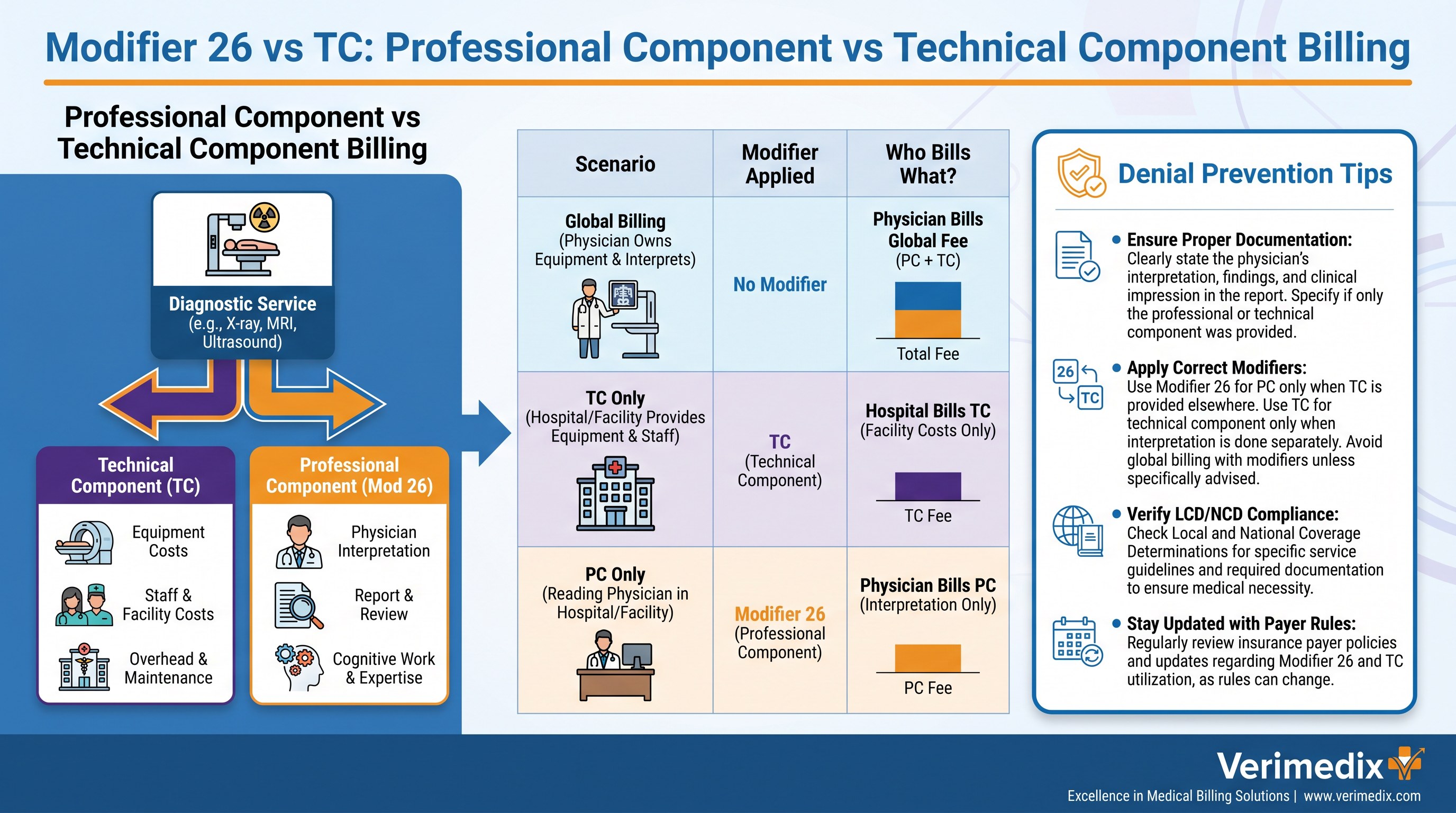
Most diagnostic imaging, radiology, cardiology, sleep and some pathology procedures involve two separate entities: a facility that provides the equipment and trained staff to perform the test, and a physician who reviews the results and produces a written interpretation. CMS and CPT recognize this split with the PC/TC billing framework. When the physician and facility are different billing entities, each submits a separate claim for its portion.
The PC/TC split matters most in read-heavy specialties — our cardiology billing services, pathology billing services, and interventional radiology billing pages cover the specialty-specific modifier rules. Sleep labs hit the same split whenever the facility owns the recording equipment and an independent physician reads the study — our sleep medicine billing services page covers how TC and 26 are assigned across polysomnography and home sleep tests.
Defining the two components
The professional component (PC), flagged by modifier 26, encompasses the physician's work: supervising the test, reviewing the output, analyzing findings, and producing a written report that becomes part of the patient record. The technical component (TC) encompasses the facility resources: the equipment, technicians, supplies, room, and overhead required to perform the procedure. Together, PC + TC = the global service. When a physician-owned practice owns the equipment and employs the technician who performs the test, the practice bills no modifier and captures the full global payment.
PC/TC indicator: how to know if a code is splittable
Not every CPT code is PC/TC-splittable. CMS publishes a PC/TC indicator in the Medicare Physician Fee Schedule (MPFS) Relative Value File for every code. Only codes with indicator 1 may be billed with modifier 26 or TC. Indicator 2 codes are professional-component-only stand-alone codes (e.g., 93010 — ECG interpretation only) and cannot accept modifier 26 because the global code already omits the technical component. Indicator 3 codes are technical-component-only. Before appending modifier 26 or TC, always verify the MPFS indicator for the CPT code in question.
New 2026 PC/TC-splittable codes
CMS added the following CPT codes to the PC/TC-splittable list for 2026, requiring practices to update their billing protocols accordingly: 70471, 70472, 70473 (CT maxillofacial); 75577 (CT angiography); 77436, 77439 (radiation treatment management); 91124, 91125 (esophageal motility). For these codes, hospitals should bill the CPT with modifier TC and physician groups should bill with modifier 26 when services are split.
When to use each modifier
| Scenario | Who bills what | Modifier |
|---|---|---|
| Physician-owned practice owns equipment and employs tech | Practice bills global service | No modifier |
| Physician reads images from a hospital's MRI | Physician bills interpretation; hospital bills equipment | Physician: CPT-26; Hospital: CPT-TC |
| Teleradiology group reads scans sent from a clinic | Teleradiology group bills interpretation; clinic bills equipment | Teleradiology: CPT-26; Clinic: CPT-TC |
| Hospitalist interprets an EKG on hospital equipment | Physician bills 93010 (stand-alone professional code) — not 93000-26 | No modifier needed on 93010 |
Date of service rules
The technical component date of service is the date the patient received the test. The professional component date of service is either the date of interpretation or the date the technical component was performed — CMS allows either. If reviewing images on a later date, the PC claim may carry that later date. Most payers accept this; however, some private payers require both components to share the same date of service. Always confirm your payer's requirement before billing a different date for the professional component.
Common denials and how to fix them
| Denial | Why it happens | Fix |
|---|---|---|
| CO-4 (modifier required) | Code has PC/TC indicator 1 but billed globally when only one component was performed | Append correct modifier (26 or TC) and resubmit |
| CO-97 (duplicate of global) | One entity billed the global service; same or other entity also billed a component | Determine who performed each component; remove the duplicate and rebill correctly |
| Modifier 26 on a professional-only code | Trying to append 26 to a stand-alone PC code like 93010 | Remove modifier 26; stand-alone professional codes already exclude the TC |
| Overpayment demand | Physician group billed global (no modifier) when TC was already billed by hospital | Rebill the physician claim as 26-only; refund the overpayment if the global was paid |
Compliance note
- Billing the global service when you only performed one component is overbilling.
- Modifier TC must be placed in the first modifier field; if a second modifier is needed, TC moves to the second position.
- Written interpretation reports are required documentation for modifier 26 claims — a verbal read or an unsigned preliminary report is not sufficient for payment or audit defense.
Frequently asked questions
Modifier 26 identifies only the professional component — the physician's interpretation and written report. Modifier TC identifies only the technical component — the equipment, staff, and facility resources. A claim with no modifier claims the full global service (both components).
Check the PC/TC indicator in the CMS Medicare Physician Fee Schedule Relative Value File. Only codes with indicator 1 are splittable. Codes with indicator 2 are professional-component-only stand-alone codes (no modifier 26 needed); codes with indicator 3 are technical-only.
Only if the same entity genuinely performed both components, in which case no modifier is needed at all (global service). Billing both -26 and -TC on the same claim by one provider is an error and will result in duplicate payment.
For 2026, CMS added CPT codes 70471, 70472, 70473, 75577, 77436, 77439, 91124, and 91125 to the PC/TC-splittable list. Practices billing these codes should update workflows to append modifier 26 or TC where applicable.
Modifier TC must be in the first modifier field. For modifier 26, it should also be placed in the first modifier field unless a functional modifier (such as a location or rendering modifier) must go first per payer rules. Check your MAC or payer instructions for exact modifier sequencing requirements.