
- Modifier 22 is defined in CPT® Appendix A as work substantially greater than typically required — supported by increased intensity, time, technical difficulty, patient severity, or physical and mental effort.
- It applies only to procedure codes with a 0-, 10-, or 90-day global period (plus maternity codes) — never to E/M visits, which use prolonged-service codes instead.
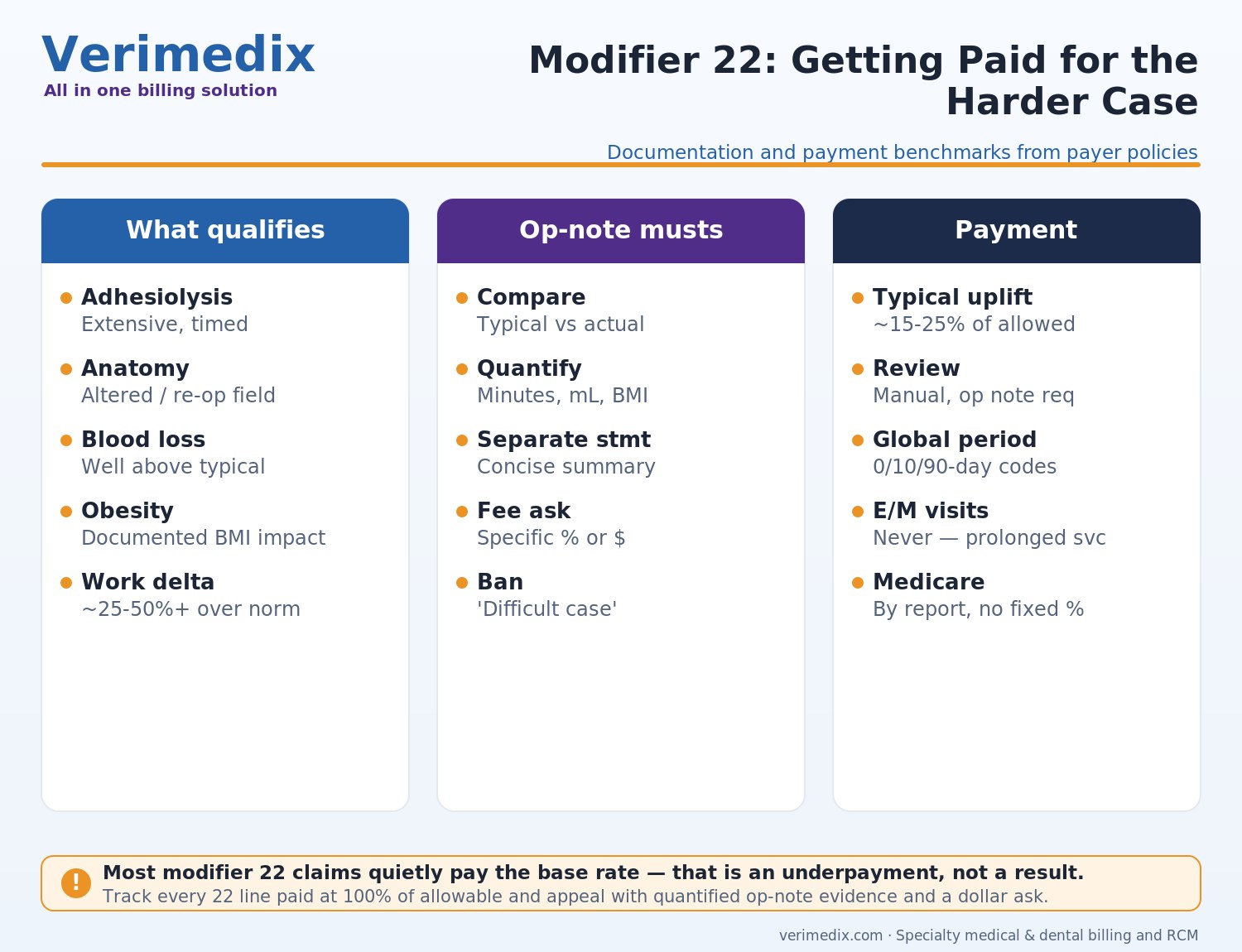
- Payers price these claims by manual review: submit the full operative report and a separate concise statement comparing this case to a typical one.
- Published payer policies that allow extra payment commonly add about 15-25% above the standard allowable; Medicare prices claims individually with no fixed percentage.
- Quantify everything — minutes over typical time, estimated blood loss, adhesion extent, BMI — and state the additional fee you are requesting.
- Expect an initial base-rate payment or denial; a documented appeal with a specific dollar request is where most modifier 22 revenue is actually won.
Surgeons routinely give away their hardest cases for free. A colectomy that should take two and a half hours stretches past four in an abdomen fused with adhesions — and the claim goes out with the same CPT code, at the same rate, as the textbook version. Modifier 22 exists for that gap, but a bare 22 with no supporting narrative is either ignored or flagged. Here is what qualifies, what the op note must contain, how payment gets negotiated, and how to appeal when the payer shrugs.
What modifier 22 means — and where it applies
CPT® Appendix A defines modifier 22 as increased procedural services: when the work required to provide a service is substantially greater than typically required. Documentation must support the substantial additional work and the reason for it — increased intensity, time, technical difficulty of the procedure, severity of the patient's condition, or physical and mental effort required. Three boundaries matter:
- Surgical and procedural codes only. Most payers, following CMS logic, limit eligibility to codes with a global period indicator of 0, 10, or 90 days, plus maternity codes with a delivery component. Appending 22 does not change the global period itself.
- Never on E/M codes. CPT instructs that modifier 22 is not used with evaluation and management services — extended visits are reported with prolonged-service codes instead. (For the related visit-day modifiers, see our modifier 25 guide.)
- Not a substitute for a better code. If a more specific CPT code, an add-on code, or a separately reportable procedure describes the extra work, report that instead — modifier 22 is the option of last resort. When two distinct procedures were performed, that is modifier 51 or 59 territory, not 22.
What qualifies — and what does not
The unofficial benchmark many coders and published payer policies use is work at least 25-50% beyond the typical case, though no national threshold exists. The pattern that wins is a patient-specific obstacle that measurably increased the work.
| Scenario | Usually supports 22? | What the note must capture |
|---|---|---|
| Extensive lysis of adhesions not separately reportable | Yes | Time spent on adhesiolysis (e.g., 45+ minutes), density, organs involved |
| Morbid obesity complicating access or exposure | Often | Documented BMI, specific technical impact (retraction, depth of field, positioning) |
| Excessive hemorrhage requiring significant added effort | Often | Estimated blood loss versus typical for the procedure, control measures, added time |
| Distorted or anomalous anatomy, re-operative or scarred field, trauma | Yes | Prior surgeries, the anomaly found, how it changed the operative plan |
| Laparoscopic converted to open, by itself | No | Bill the open code; add 22 only if the open portion itself involved documented excess work |
| Surgeon inexperience, equipment delays, routine case difficulty | No | Payers exclude difficulty inherent to the procedure or operational causes |
| Complication managed with a separately billable procedure | No | Report the additional procedure code instead |
Op-note documentation standards
Reviewers skim; they do not hunt. Payer policies consistently require two documents — the full operative report and a concise statement of how the service exceeded typical. Build both around this five-part framework:
- Name the obstacle. One sentence identifying the patient-specific factor: dense adhesions from two prior laparotomies, BMI of 52, aberrant vasculature.
- Compare to typical. State the norm and the deviation explicitly: "This procedure typically requires 120-150 minutes; total operative time was 250 minutes, including 70 minutes of adhesiolysis."
- Quantify. Minutes, estimated blood loss in mL, adhesion grade, size and depth, number of prior operations. Numbers convert an adjective into evidence.
- Describe the added work in the body of the note — not just the header. Narrate the extra dissection, exposure, or repair as it happened.
- State the ask. In the cover statement, request a specific increase: "We request consideration of an additional 25% based on approximately 65% greater operative time."
The phrase to ban from your op notes: "difficult case." Unquantified difficulty is precisely what reviewers are instructed to disregard.
How payment actually works
There is no automatic fee bump for modifier 22. Claims suspend for manual review, and outcomes vary sharply by payer:
| Payer approach | How the claim is priced | Practical implication |
|---|---|---|
| Medicare (MACs) | Priced by report — the contractor reviews documentation and may allow an individually determined increase; no published fixed percentage | Submit documentation with the claim or respond quickly to development requests; unsupported 22s pay the base rate |
| Commercial payers with published 22 policies | Many regional plans' published policies allow roughly 15-25% above the standard allowable when documentation supports it | Pull each contracted payer's modifier 22 policy and cite it back to them in appeals |
| Payers with silent or restrictive policies | Frequently pay the base allowable and ignore the modifier unless appealed | Track 22 claims separately; the appeal, not the first submission, is the real negotiation |
Two billing mechanics follow from this. First, raise the billed charge on the line to reflect the extra work — if you bill your standard fee, some payers treat that as evidence no extra payment is warranted. Second, calibrate the request to the documentation: a defensible ask ties the percentage to the quantified excess (time is the easiest currency), and 20-25% requests aligned with published policy ranges settle far more often than 50% round numbers.
A worked dollar example (illustrative)
An open colectomy has a contracted allowable of $1,450 and typically runs about 150 minutes. Because of dense adhesions from prior surgery, the case takes 250 minutes, including 70 minutes of documented adhesiolysis that was not separately reportable — roughly 65% more operative time.
- Billed charge: the practice bills the line at $1,885 with modifier 22 (standard charge plus ~30%), attaching the op note and comparative statement requesting a 25% increase.
- If the payer allows 25%: payment rises by about $362 on this one case.
- At scale: a surgical group with even 6 legitimately qualifying cases per month at similar allowables is leaving roughly $26,000 per year unclaimed if it never appends — or never defends — modifier 22.
These figures are illustrative; actual allowables, uplift percentages, and approval rates depend entirely on your contracts and documentation.
Appealing modifier 22 denials and base-rate payments
Most modifier 22 claims are not denied outright — they are quietly paid at the base rate. Treat any 22 line paid at 100% of the standard allowable as an underpayment to work, not a closed claim. An effective appeal letter makes these points, in this order:
- Cite the definition. Quote CPT® Appendix A: the work was substantially greater than typically required, and identify which factors applied (time, intensity, technical difficulty, severity).
- Quote the op note. Excerpt the comparative language verbatim — total minutes versus typical, EBL, adhesion time — with the full report attached.
- Benchmark the typical case. One sentence establishing what the standard procedure involves, so the delta is unmistakable.
- Cite the payer's own policy. If their published modifier 22 policy allows 20-25% with documentation, reference it by number.
- Request a specific amount. Not "additional reimbursement" — a dollar figure tied to your quantified percentage.
- Escalate deliberately. Request peer-to-peer or medical-director review at second level; surgeon-to-reviewer conversations resolve many of these.
File within the appeal window and track outcomes by payer — who pays, who ignores, and who folds should shape which cases you fight. Our step-by-step claim appeal guide covers deadlines, letter structure, and escalation in full. Thoracic and cardiothoracic cases are where modifier 22 is most often earned and most often rejected — conversions from VATS to open thoracotomy, extensive adhesiolysis and re-operative chests all produce real extra work that never reaches the payer without a comparison statement in the note, which is why thoracic surgery billing services treat operative-report substantiation as a claim-preparation step rather than an appeal tactic.
Common modifier 22 errors that sink payment
- Appending 22 to routine difficulty. Every gallbladder is somewhat different; payers pay for the outlier, not the ordinary spread.
- No separate statement. An op note alone — even a good one — often pays base rate because nobody summarized the excess work or asked for a figure.
- Overuse. A surgeon whose 22 rate is far above peers invites prepayment review of every claim; reserve it for genuinely exceptional cases.
- Using 22 when a code exists. Separately reportable procedures, add-on codes, or unlisted codes may capture the work more cleanly — and more profitably.
- Billing the standard charge. Signal the request in the charge amount and the cover statement, then defend it on appeal.
Quick Answers
What is modifier 22? Modifier 22 reports increased procedural services — work substantially greater than a procedure typically requires, supported by documented increased time, intensity, technical difficulty, patient severity, or effort, per CPT® Appendix A.
How much more does modifier 22 pay? Nothing automatically. Payers review documentation manually; published commercial policies that allow extra payment commonly add about 15-25% to the allowable, while Medicare contractors price qualifying claims individually.
What documentation does modifier 22 require? The complete operative report plus a concise separate statement comparing the case to a typical one — quantifying extra minutes, blood loss, or anatomic obstacles — and stating the additional payment requested.
Can modifier 22 be used on E/M codes? No. CPT restricts it to procedures; prolonged or complex visits are reported with the prolonged-services codes. Most payers also limit it to codes with 0-, 10-, or 90-day global periods.
How much extra work justifies modifier 22? There is no official threshold, but many coders and payer policies look for roughly 25-50% more work than typical — always patient-specific, always quantified in the record.
Frequently asked questions
No. Modifier 22 requests additional payment for the intraoperative work but leaves the 0-, 10-, or 90-day global period untouched. All routine postoperative care remains bundled into the surgical package exactly as it would be without the modifier.
Yes, most billing experts recommend it. Raising the line charge — commonly by 20-30% to mirror the documented extra work — signals the request, and some payers will not consider additional payment on a claim billed at the standard fee. Your contracted allowable still caps what a payer ultimately approves.
Most payers suspend 22 claims for manual review and default to the base allowable when the documentation does not quantify the extra work — or was never reviewed at all. Treat base-rate payment as an underpayment: appeal with the op note, a comparative statement, and a specific dollar request.
Not for the conversion alone — you bill the open procedure code, and the added work of converting is considered inherent. Append 22 only when the open portion itself involved documented, quantified work well beyond a typical open case, such as extensive adhesiolysis.
There is no published cap, but it should be the exception — genuinely unusual cases, not a pattern. Utilization far above specialty peers is a known audit trigger and can land every claim from that surgeon in prepayment review, so reserve it for cases the op note can defend.