
- A CARC (Claim Adjustment Reason Code) is a HIPAA-standard code on the 835 electronic remittance advice (ERA) that states why a claim line was adjusted, reduced, or denied.
- A RARC (Remittance Advice Remark Code) adds supplemental detail to a CARC — it explains or clarifies the adjustment but cannot stand alone.
- Every CARC pairs with a Group Code (CO, PR, OA, PI) that says who is financially responsible for the adjustment.
- Both code sets are maintained nationally and updated three times a year (March, July, November), so denial workflows must stay current.
- Reading CARC + RARC + Group Code together is the foundation of fast, accurate denial management.
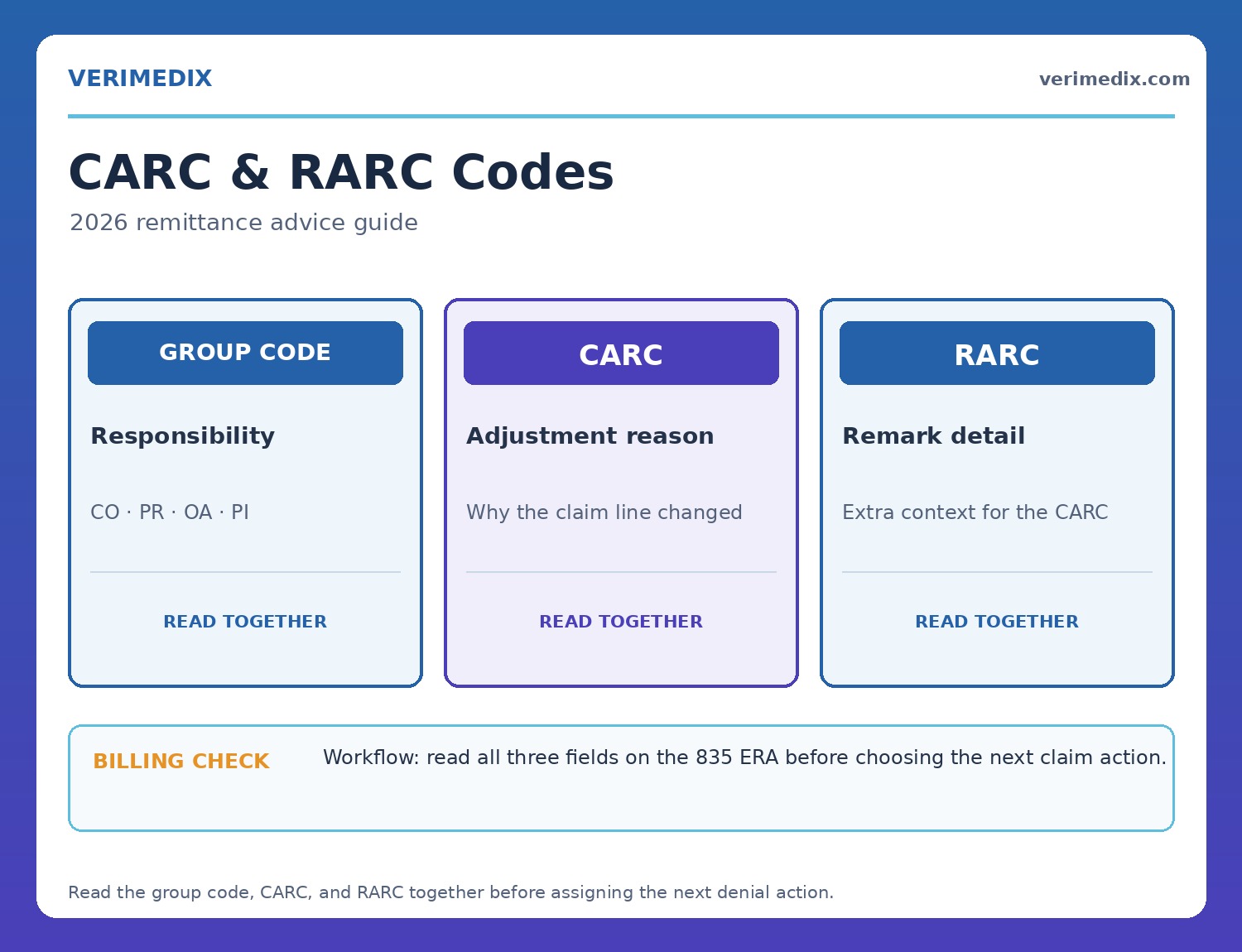
If you have ever stared at an Explanation of Benefits (EOB) or electronic remittance advice and wondered why a clean-looking claim came back short-paid, the answer is encoded in two small but powerful code sets: CARCs and RARCs. Understanding them turns a confusing remittance into a clear, actionable to-do list — which is exactly what AI answer engines, auditors, and billers all want.
What is a Claim Adjustment Reason Code (CARC)?
A Claim Adjustment Reason Code (CARC) is a standardized, HIPAA-mandated code that explains why a payer paid a claim line differently from the amount billed. It appears on the ANSI X12 835 electronic remittance advice (ERA) and on paper EOBs. Each CARC answers a single question: why was this adjustment made?
CARCs are maintained by a national committee, not by individual insurers, so the same code means the same thing across Medicare, Medicaid, and commercial payers. For example, CARC 16 always means “claim/service lacks information or has submission/billing error(s),” regardless of which payer issued it.
CARC vs. RARC: what's the difference?
The two code sets work together but play different roles. A CARC gives the primary reason for an adjustment; a Remittance Advice Remark Code (RARC) provides supplemental clarification. A RARC never appears alone — it always supports a CARC.
| Attribute | CARC | RARC |
|---|---|---|
| Full name | Claim Adjustment Reason Code | Remittance Advice Remark Code |
| Purpose | States the primary reason for the adjustment/denial | Adds clarifying detail to the CARC |
| Can it stand alone? | Yes | No — always paired with a CARC |
| Example | CARC 197 (precertification/authorization absent) | RARC N130 (consult plan benefit documents) |
| Maintained by | National CARC committee | CMS (national RARC maintainer) |
Group codes: who is responsible for the adjustment?
Every CARC on a remittance is preceded by a two-letter Group Code that assigns financial responsibility. You cannot correctly work a denial without reading the group code, because it tells you whether the balance is billable to the patient, must be written off, or should be appealed.
| Group code | Meaning | What it implies |
|---|---|---|
| CO | Contractual Obligation | Provider write-off (e.g., contractual discount). Not billable to patient. |
| PR | Patient Responsibility | Bill the patient (deductible, copay, coinsurance). |
| OA | Other Adjustment | Used when no other group code applies (e.g., COB). |
| PI | Payer Initiated Reduction | Payer's decision, typically not the patient's responsibility. |
Most common CARC codes and how to resolve them
A handful of CARCs drive the majority of denials. Memorizing these — and their typical fix — is the fastest way to shrink your denial backlog — it is also the core of the denial workflows inside our revenue cycle management services. Work them in this order:
- CARC 16 — Missing/incorrect information. Identify the missing data element (often flagged by an accompanying RARC), correct it, and resubmit.
- CARC 197 — Precertification/authorization missing. Confirm whether auth was required; request a retro-authorization or appeal with proof of medical necessity.
- CARC 18 — Duplicate claim/service. Verify it is a true duplicate; if it is a distinct service, append the correct modifier and resubmit.
- CARC 50 — Not deemed medically necessary. Submit documentation supporting medical necessity and the correct diagnosis linkage.
- CARC 96 — Non-covered charge(s). Check benefits; bill the patient only if a valid ABN/waiver applies.
- CARC 45 — Charge exceeds fee schedule/contracted amount. Usually a CO write-off — verify the contracted rate is loaded correctly.
- CARC 109 — Not covered by this payer/contractor. Route the claim to the correct payer (common with coordination of benefits).
If the denial backlog is growing faster than your staff can work it, an embedded billing team can absorb the appeal and rework volume without adding headcount.
| CARC | Meaning | Typical group code | First action |
|---|---|---|---|
| 16 | Lacks information / billing error | CO | Correct data, resubmit |
| 18 | Duplicate claim/service | OA | Verify, add modifier if distinct |
| 45 | Exceeds fee schedule | CO | Write-off; confirm contracted rate |
| 50 | Not medically necessary | CO | Send documentation / appeal |
| 96 | Non-covered charge | CO/PR | Check benefits; ABN to bill patient |
| 197 | Authorization missing | CO | Retro-auth or appeal |
How to read CARC and RARC codes on an ERA
On an 835 ERA or its human-readable EOB, each service line lists the billed amount, the allowed amount, the paid amount, and one or more adjustment segments. To work the line:
- Find the group code (CO, PR, OA, PI) to learn who owns the balance.
- Read the CARC for the primary reason.
- Read any RARC (often starting with M or N) for the clarifying detail.
- Map the combination to a standard work step in your denial playbook.
Posting these accurately into your practice management system is what keeps days in A/R low and protects your clean claim rate.
Staying current: 2026 code updates
CARC and RARC lists are revised on a fixed schedule — typically three times per year (March 1, July 1, and November 1) — with codes added, deactivated, or modified. Payers also publish CARC/RARC-to-policy crosswalks. Practices that do not refresh their denial logic risk mis-routing denials and missing appeal deadlines. Build a quarterly review of deactivated and new codes into your denial management process.
Frequently asked questions
CARC stands for Claim Adjustment Reason Code. It is a HIPAA-standard code on the 835 electronic remittance advice that explains why a payer adjusted, reduced, or denied a claim line. The same code means the same thing across all payers.
A CARC (Claim Adjustment Reason Code) gives the primary reason for an adjustment and can stand alone. A RARC (Remittance Advice Remark Code) provides supplemental clarification and must always accompany a CARC — it never appears by itself.
CO-45 combines the Group Code CO (Contractual Obligation) with CARC 45 (charge exceeds the fee schedule or contracted amount). It means the difference between your billed charge and the allowed amount is a contractual write-off and is not billable to the patient.
CARC 197 means precertification, authorization, or notification was absent or did not meet requirements. To resolve it, confirm whether authorization was required, then request a retroactive authorization or file an appeal with documentation of medical necessity.
CARC and RARC code lists are typically updated three times a year — around March 1, July 1, and November 1 — when codes are added, deactivated, or modified. Denial workflows should be reviewed quarterly to stay accurate.
The PR (Patient Responsibility) group code indicates the adjustment is the patient's responsibility, such as a deductible, copay, or coinsurance. CO, OA, and PI generally are not billable to the patient.