
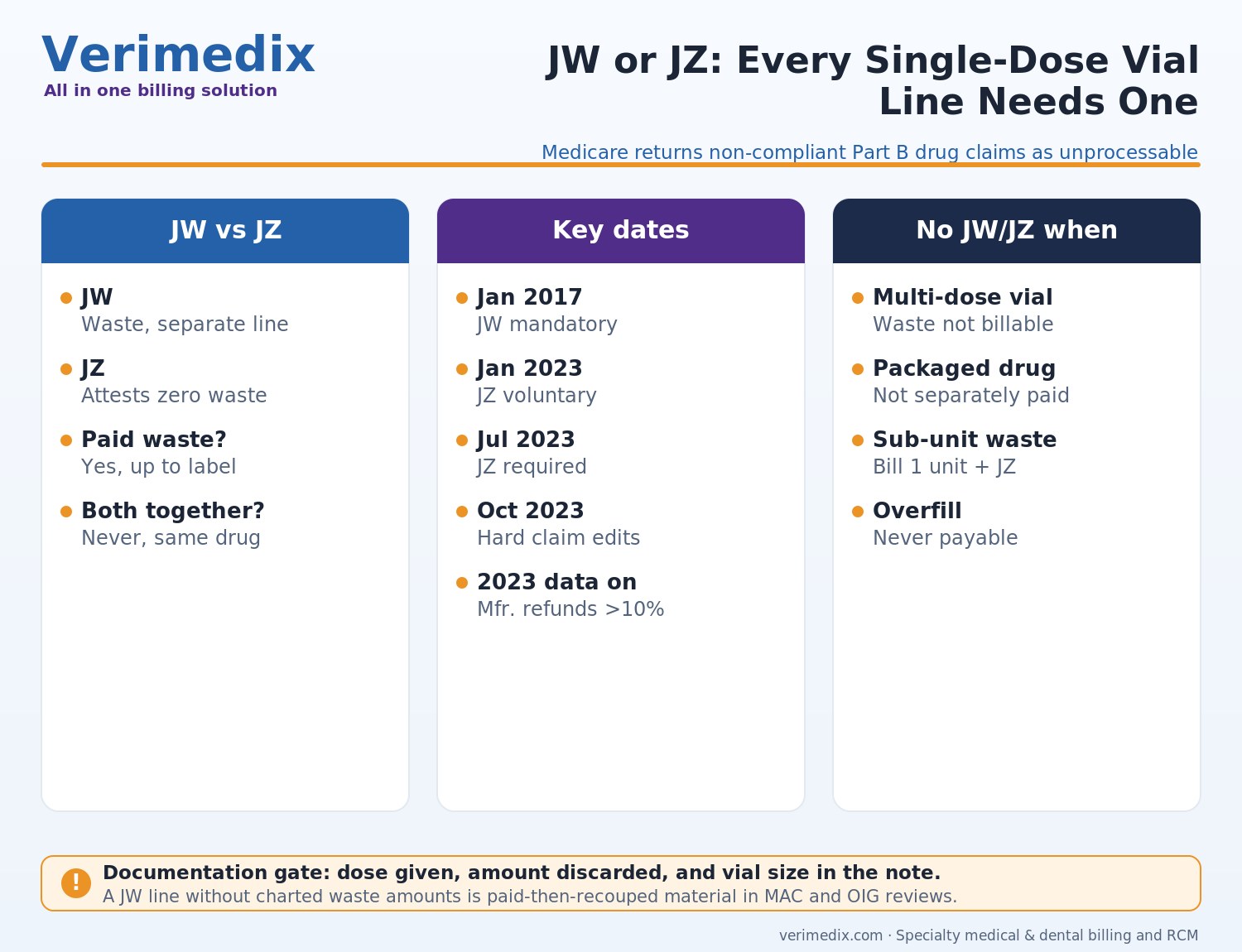
- Every Medicare Part B claim line for a separately payable drug from a single-dose container must carry either JW (waste discarded, billed on its own line) or JZ (attesting zero waste).
- JW has been mandatory since January 1, 2017; JZ became required July 1, 2023, and since October 1, 2023 Medicare returns non-compliant single-dose vial claims as unprocessable.
- JW and JZ never apply to multiple-dose vials — and waste from multi-dose vials is never billable at all.
- Medicare pays for properly documented waste up to the labeled vial amount, but the JW line is only defensible when the note records administered dose, discarded amount, and vial size.
- When the discarded remainder is less than one billing unit, CMS guidance says do not use JW — report the line with JZ.
- JW/JZ data feeds the Discarded Drug Refund Program: manufacturers owe CMS refunds when waste exceeds 10% of a drug's total charges, so accuracy is under active scrutiny.
Since late 2023, Medicare has run a hard edit that catches thousands of drug claims a day: any separately payable Part B drug billed from a single-dose vial without a JW or JZ modifier comes back unprocessable. What used to be a documentation nicety is now a binary gate on payment — and because the same modifier data now drives manufacturer refund obligations under federal law, the accuracy bar keeps rising. Practices that administer injectables of any kind, from Kenalog in a knee to biologics in an infusion chair, need the logic wired into charge entry rather than left to memory.
This guide covers what each modifier means, the policy timeline, when each is required (and when neither applies), the billing mechanics, audit-proof documentation, and the top denial scenarios. Several commercial payers and Medicaid programs have adopted parallel rules — verify each payer's current policy.
JW vs JZ: what each modifier means
Both modifiers exist to account for every milligram in a single-dose container of a drug that Medicare Part B pays for separately (drugs billed with J-codes and certain other HCPCS codes).
| JW modifier | JZ modifier | |
|---|---|---|
| Meaning | Drug amount discarded / not administered to any patient | Attestation that no amount was discarded |
| Where it goes | On a separate claim line reporting only the wasted units | On the single drug line reporting administered units |
| Paid? | Yes — Medicare pays for documented waste up to the labeled vial amount | N/A — it changes no payment, only attests |
| Required since | January 1, 2017 | July 1, 2023 (claims edits from October 1, 2023) |
| Applies to | Separately payable Part B drugs from single-dose containers or single-use packages only | |
The two are mutually exclusive on a given encounter's drug billing: if anything was discarded, you have an unmodified (or JW-flagged) structure with a JW line; if nothing was discarded, one line with JZ. Reporting both JW and JZ for the same drug on the same date is a contradiction that fails edits.
How the policy got here — and the refund program behind it
CMS estimated it paid roughly $720 million in 2020 for discarded amounts of single-dose drugs. Congress responded in the Infrastructure Investment and Jobs Act (Section 90004) by creating the Discarded Drug Refund Program: beginning with 2023 data, manufacturers must refund CMS for discarded amounts of a refundable single-dose drug that exceed 10% of the drug's total allowed charges (a higher applicable percentage applies to certain drugs). The refund math runs entirely on JW and JZ claims data — which is why CMS made JZ mandatory and turned on automated edits.
The timeline that matters for billing teams:
- Jan 1, 2017 — JW becomes mandatory for Medicare Part B single-dose vial waste.
- Jan 1, 2023 — JZ available for voluntary use.
- Jul 1, 2023 — JZ required on all no-waste single-dose vial claims.
- Oct 1, 2023 — MACs begin returning non-compliant claims as unprocessable.
- 2025 forward — CMS extended JW reporting expectations to amounts discarded during preparation in certain supplier scenarios, and continues updating the JW/JZ applicable-HCPCS list — check the current CMS Discarded Drugs page rather than a cached list.
Practical consequence: your JW/JZ pattern is now visible in a federal dataset that manufacturers audit, because it costs them money. Sloppy JZ-by-default habits or inflated JW lines are easier to detect than ever.
When each modifier is required — and when neither applies
| Scenario | Correct reporting |
|---|---|
| Single-dose vial, part administered, part discarded | Line 1: administered units (no wastage modifier). Line 2: same code + JW with discarded units. |
| Single-dose vial, entire labeled amount administered | One line, all units, JZ. |
| Discarded remainder smaller than one billing unit (e.g., 7 mg given from a 10 mg-unit code) | Bill 1 unit with JZ; per CMS FAQs, JW is not used for sub-unit waste. |
| Multiple-dose vial | No JW, no JZ — bill only the administered amount; waste is never billable. |
| Drug not separately payable (e.g., packaged under OPPS) | JW/JZ not required. |
| Vial overfill beyond the labeled amount | Never billable — payment for waste caps at the label. |
| Two patients dosed from one single-dose vial | Not compliant use; if it occurs, no JW for amounts given to another patient. |
Thirty-second decision tree for any injectable line:
- Is the drug separately payable by Part B? No → stop, no JW/JZ.
- Single-dose container or single-use package? No (multi-dose) → bill administered amount only, no modifier.
- Was any amount discarded? No → JZ on the drug line.
- Discarded amount ≥ 1 billing unit? Yes → separate JW line with wasted units. No → single line, JZ.
- Is the discard documented (dose given, amount wasted, vial size)? If not, fix the note before the claim.
Claim mechanics and a worked example
The wasted-drug line uses the same HCPCS code, the same date of service, and the JW modifier, with units equal to the discarded amount converted into billing units. Medicare pays both lines at the same ASP-based rate. Rounding follows the code's unit size: waste is billable only in whole billing units, with sub-unit remainders folded per the JZ rule above.
Worked example (illustrative numbers only). An infusion practice administers 70 mg of a biologic supplied in a 100 mg single-dose vial. The HCPCS code is defined per 10 mg, and the illustrative payment rate is $60 per unit:
| Line | Code | Units | Illustrative payment |
|---|---|---|---|
| 1 | JXXXX (administered) | 7 (70 mg) | 7 × $60 = $420 |
| 2 | JXXXX-JW (discarded) | 3 (30 mg) | 3 × $60 = $180 |
| Total | $600 | ||
Omit the JW line and the practice absorbs $180 of drug cost. Omit both modifiers and the entire $600 claim comes back unprocessable. Scale that across an oncology or rheumatology infusion schedule and this becomes the difference between profitable and underwater buy-and-bill. The same logic applies at small scale to office steroids: a 1 mL single-dose Kenalog-40 vial with 20 mg given and 20 mg wasted bills J3301 × 2 plus J3301-JW × 2, as detailed in our J3301 Kenalog billing guide.
Documentation that survives an audit
MACs and OIG auditors reviewing JW lines look for four elements in the medical record, ideally in the procedure or infusion note itself:
- Drug, vial size, and number of vials opened — e.g., "one 100 mg single-dose vial."
- Exact dose administered, in the drug's units (mg, mcg, or units — not just volume).
- Exact amount discarded and that it was not administered to any other patient.
- Date, time, and signature of the clinician performing or supervising administration.
Two practices strengthen the record further: standardized EHR smart-phrases that force the administered/discarded fields, and periodic reconciliation of purchase invoices against billed units (administered + JW) — the same test auditors run. A JZ attestation carries audit weight too: attesting zero waste while purchasing single-dose vials larger than your typical doses is a pattern reviewers notice.
Denial scenarios and fixes
| Scenario | What happens | Fix |
|---|---|---|
| Single-dose vial line with no JW or JZ | Claim returned as unprocessable (CO-16 class) since Oct 2023 | Add the correct modifier and resubmit; build a hard-stop edit in the billing system — see our CO-16 guide |
| JW and JZ on the same drug/date | Contradictory reporting — rejection or return | Determine whether waste occurred; keep JW structure or single JZ line, never both |
| JW on a multiple-dose vial drug | Denial; recoupment risk if paid | Remove the JW line; multi-dose waste is not billable |
| JW units exceed vial label math | Denial or audit flag (administered + wasted > labeled amount) | Recalculate; overfill is never billable |
| JW line without supporting documentation | Paid, then recouped on record review | Amend workflows so discard amount and vial size are charted at time of service |
| Sub-unit waste billed with JW | Denied or flagged per CMS FAQ guidance | Bill one unit with JZ when the remainder is under one billing unit |
Wastage modifiers interact with everything else on the drug line — units, NDC, and the paired administration code such as CPT 20610 for joint injections — so a claim-scrubber rule that checks all four together catches far more than four separate rules do.
Quick Answers
What is the JW modifier? JW reports the discarded portion of a separately payable Part B drug from a single-dose container. It goes on its own claim line with the wasted units, and Medicare pays it up to the labeled vial amount when documented.
What is the JZ modifier? JZ is a mandatory attestation that no amount of a single-dose container drug was discarded. It has been required on Medicare claims since July 1, 2023.
What happens if I forget JW or JZ? Since October 1, 2023, Medicare returns single-dose vial drug claims without one of the two modifiers as unprocessable — the claim must be corrected and resubmitted before anything pays.
Do JW and JZ apply to multi-dose vials? No. Neither modifier is reported for multiple-dose containers, and discarded amounts from them are never billable — only the administered amount is reported.
Does Medicare pay for wasted drug? Yes — when the drug came from a single-dose container, the waste is documented, and it is billed on a separate JW line, Medicare pays the discarded units at the same rate, capped at the labeled vial amount.
Why does CMS require JZ? JW/JZ data calculates manufacturer refunds under the Discarded Drug Refund Program, which charges manufacturers when discarded amounts exceed 10% of a drug's total Part B charges.
Frequently asked questions
Not for the same drug on the same date — they are mutually exclusive by definition, since one reports waste and the other attests there was none. A claim can carry JW for one drug and JZ for a different drug administered the same day. Reporting both on the same drug line fails Medicare edits.
Many do — a number of Medicaid programs and commercial plans have adopted the CMS framework or their own wastage policies, though effective dates and edit behavior differ. Some pay JW lines and some do not. Treat Medicare rules as the floor and verify each major payer's drug wastage policy in writing.
Per CMS FAQ guidance, the JW modifier is not used when the discarded remainder is smaller than one billing unit. Bill the administered amount rounded to one unit and report JZ on the line. Document the exact administered and discarded amounts in the record regardless.
Yes — Medicare pays discarded units at the same ASP-based rate as administered units, up to the amount on the vial label. Overfill beyond the labeled amount is never payable, and the combined administered-plus-wasted units cannot exceed the label math for the vials opened.
Separately payable Medicare Part B drugs and biologicals supplied in single-dose containers or single-use packages — the bulk of buy-and-bill J-codes. Drugs from multiple-dose vials, drugs packaged into a procedure payment under OPPS, and drugs not separately payable are excluded. CMS maintains and updates an applicable-HCPCS list on its Discarded Drugs page.