
- The CY2026 KX modifier threshold is $2,480 for PT and SLP combined and a separate $2,480 for OT, indexed annually by the Medicare Economic Index.
- KX is an attestation, not a request: it certifies that services above the threshold are medically necessary and that documentation in the record proves it.
- A second line sits at $3,000: the targeted medical review threshold, fixed through 2028 — not every claim above it is reviewed, but selection starts there.
- Thresholds accrue on Medicare allowed amounts — including deductible and coinsurance — across all outpatient therapy settings, not on billed charges.
- Forgetting KX after the threshold typically returns a CO-119 benefit-maximum denial; the fix is usually a corrected claim, not an appeal.
- GP, GO, and GN discipline modifiers are mandatory on therapy lines and determine which bucket each dollar accrues to.
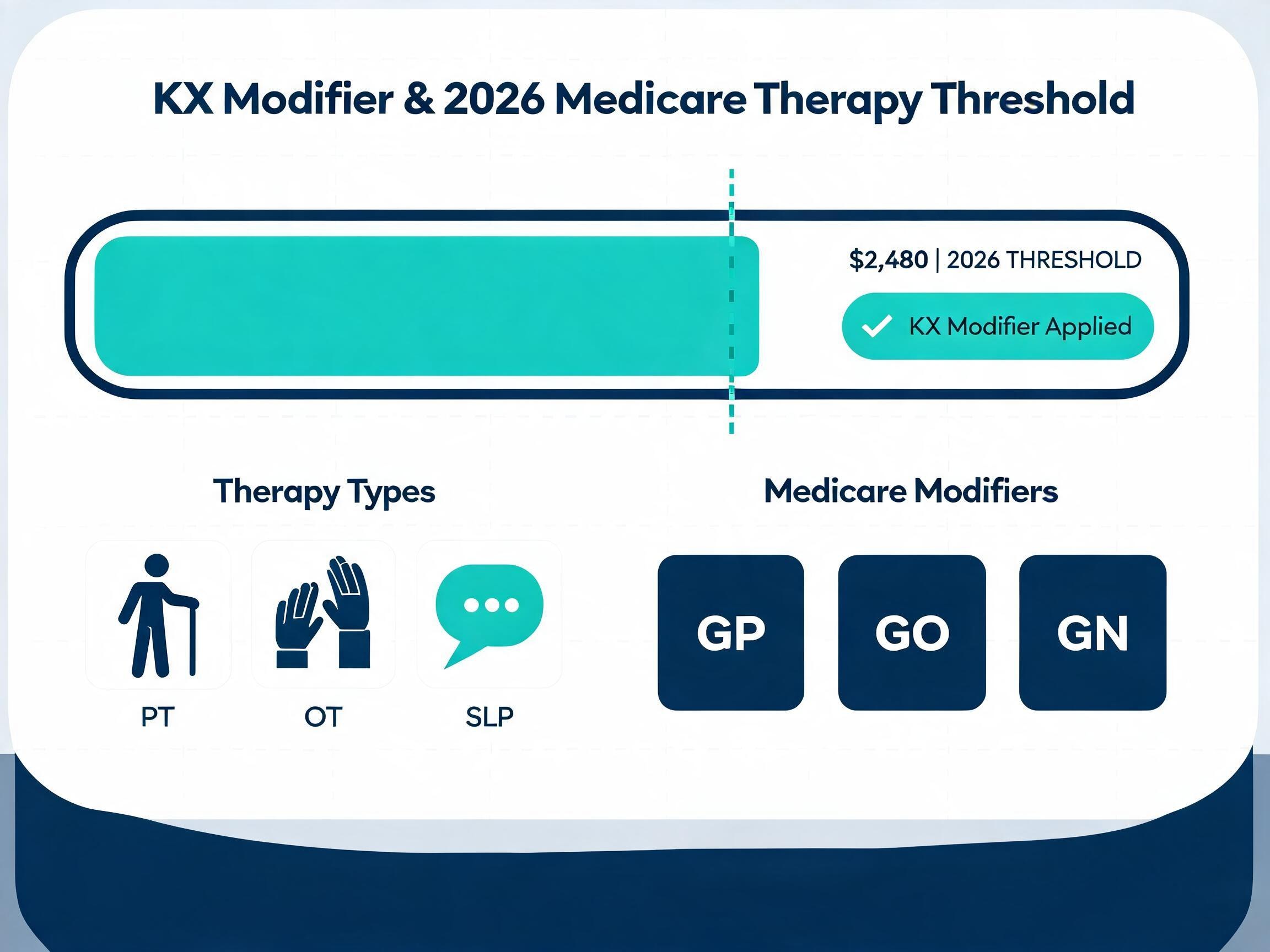
Since Congress repealed the hard therapy cap in 2018, Medicare has run outpatient therapy on a two-line system, and 2026's lines are set: once combined PT and speech-language pathology allowed charges pass $2,480 (OT tracked separately at its own $2,480), every further claim line needs the KX modifier to be payable. Past $3,000, claims enter the targeted medical review pool. Neither line stops treatment — they stop undocumented treatment. Practices that track accrual in real time bill straight through both without one interrupted claim.
What the KX modifier actually attests
Appending KX to a therapy line makes a specific statement to the Medicare contractor: services beyond the annual threshold are reasonable and medically necessary, and justification is documented in the record. Nothing extra is submitted — no attached notes, no pre-authorization. That convenience is the compliance exposure: because KX is self-attested, contractors police it retrospectively. Per CMS guidance it is a condition of payment above the threshold, not a guarantee of it — the contractor makes the final payability call if records are requested.
Two usage rules follow. First, add KX only once accrual actually crosses the threshold — KX on every claim from visit one is a recognized misuse pattern. Second, never add KX as a denial-clearing reflex: if the chart cannot support continued skilled care (progress toward goals, or skilled maintenance under Jimmo v. Sebelius), the answer is a conversation with the treating therapist, not a modifier.
The 2026 threshold amounts — and how they accrue
The threshold is calendar-year, per beneficiary, and based on allowed amounts across every outpatient therapy setting the patient touches: private practice, rehab agency, hospital outpatient, SNF Part B, home health Part B. That last point catches practices constantly — a patient with a spring hospital outpatient episode arrives at your clinic in the fall already carrying accrued dollars you never billed.
| Year | PT + SLP combined | OT (separate) | Targeted medical review |
|---|---|---|---|
| 2022 | $2,150 | $2,150 | $3,000 |
| 2023 | $2,230 | $2,230 | $3,000 |
| 2024 | $2,330 | $2,330 | $3,000 |
| 2025 | $2,410 | $2,410 | $3,000 |
| 2026 | $2,480 | $2,480 | $3,000 (fixed through 2028) |
Note the structural quirk inherited from the old cap: PT and SLP share one bucket while OT has its own. A stroke patient receiving both PT and speech therapy burns the shared $2,480 roughly twice as fast as a PT-only patient — why interdisciplinary practices hit the threshold earliest and need the tightest tracking.
The $3,000 targeted medical review line
Above $3,000, claims become eligible for targeted medical review, fixed at that level through 2028 under the Bipartisan Budget Act of 2018 framework. "Targeted" is the operative word: the contractor does not review everything. Selection weighs billing patterns — patients clustered just above the threshold, aberrant units per visit, high KX use versus specialty peers — alongside claim-level factors. For a practice with clean documentation, crossing $3,000 usually changes nothing day to day. For one with thin notes, it is where an Additional Documentation Request (ADR) becomes realistic mail — and an unanswered ADR becomes a recoupment.
GP, GO, GN — and the rest of the therapy modifier set
| Modifier | Meaning | Billing note |
|---|---|---|
| GP | Service under a physical therapy plan of care | Accrues to the shared PT/SLP bucket |
| GO | Service under an occupational therapy plan of care | Accrues to the separate OT bucket |
| GN | Service under a speech-language pathology plan of care | Accrues to the shared PT/SLP bucket |
| KX | Threshold exceeded; medical necessity documented | Add once accrual passes $2,480 in the relevant bucket |
| CQ / CO | Service furnished in whole or part by a PTA / OTA | Triggers the 85% assistant differential; billed with GP/GO |
| 59 / X{EPSU} | Distinct service on NCCI-edited therapy code pairs | Separate issue from thresholds — see NCCI guidance |
The discipline modifier routes each dollar to the right bucket, so a GO keyed as GP quietly corrupts threshold math for both buckets — one reason quarterly modifier audits belong in every rehab practice's revenue cycle management routine.
A tracking workflow that beats the threshold
- Capture accrual at intake. Run Medicare eligibility at evaluation and pull year-to-date therapy dollars (available via HETS-based eligibility responses and MAC portals). Record both buckets.
- Convert dollars to visits. Divide remaining headroom by your average allowed amount per visit (often $85–$110 for PT clinics). "Nine visits until KX" is a number a front desk can act on.
- Set two alerts. Flag charts at roughly 80% of $2,480, and again at crossing. The first prompts a documentation check and a progress note supporting continued skilled care; the second flips KX on.
- Re-verify monthly for active plans of care. Outside accrual from other settings moves the number without warning.
- Audit KX quarterly. Share of Medicare visits carrying KX, patients clustered near $3,000, discipline-modifier accuracy — the same lenses a review contractor uses.
Worked example: crossing the threshold mid-plan of care
Illustrative numbers. A Medicare patient starts PT in August for post-surgical rehab, arriving with $1,860 already accrued in the PT/SLP bucket from a spring hospital outpatient episode. The clinic's typical visit — 97110 × 2 plus 97140 — runs about $95 allowed.
- Headroom to the KX line: $2,480 − $1,860 = $620 → $620 / $95 ≈ 6.5 visits.
- Visits 1–6: billed normally with GP. Accrual reaches $1,860 + (6 × $95) = $2,430.
- Visit 7 crosses the line ($2,525). From this claim forward every line carries GP + KX, and the chart holds a current progress note tying care to functional goals.
- The plan runs 16 visits; around visit 12 accrual passes $3,000 ($2,430 + 6 × $95 = $3,000) — targeted-review territory. Nothing changes on the claim, but documentation quality is now the whole ballgame.
Total through the plan: roughly $3,380 allowed — fully payable, threshold and all, because KX arrived on time and the record supported it.
Denial scenarios: cause and fix
| Denial signal | Likely cause | Fix |
|---|---|---|
| CO-119 (benefit maximum reached) | Threshold crossed; KX missing from the line | If necessity is documented, submit a corrected claim with KX — no formal appeal usually needed |
| CO-50 (not medically necessary) | ADR answered with thin documentation, or KX claims lacking chart support | Appeal with progress notes, objective measures, and certification; tighten note templates |
| CO-16 (missing information) | No GP/GO/GN discipline modifier on a therapy code | Rebill with the correct discipline modifier; add a claim-scrubber edit |
| Recoupment after review | KX appended routinely without supporting records | Self-audit KX use; retrain; answer every ADR by deadline — silence guarantees recoupment |
For the appeal path on medical-necessity denials, see our step-by-step appeal guide; for decoding the remittance codes, our CARC/RARC guide.
Decision tree: does this claim need KX?
- 1. Is the patient's year-to-date allowed amount in the relevant bucket (PT/SLP, or OT) at or above $2,480?
- No → bill with GP/GO/GN only. Set the 80% alert.
- Yes → go to 2.
- 2. Does the record currently support continued skilled therapy — progress toward goals or skilled maintenance need?
- Yes → append KX (with the discipline modifier) and continue treating.
- No / unclear → clinical review before billing: update the progress note and certification, or transition the patient (discharge, or ABN where Medicare denial is expected).
- 3. Is accrual approaching $3,000?
- Yes → keep billing with KX, but write every note as if a reviewer will read it — objective measures, frequency/duration rationale, signed certifications.
Quick Answers
What is the KX modifier threshold for 2026? $2,480 in Medicare allowed charges for PT and SLP combined, and a separate $2,480 for OT, per CMS CY2026 guidance. Claims above these amounts require the KX modifier.
What does the KX modifier mean? It is the provider's attestation that outpatient therapy services above the annual threshold are medically necessary and that documentation supporting continued skilled care exists in the patient's record.
What happens at $3,000 in therapy charges? Claims become eligible for targeted medical review, fixed at $3,000 through 2028. Not all claims above it are reviewed — selection is driven by billing patterns and history.
Does KX guarantee payment? No — the contractor can still request records and deny claims where documentation does not support necessity. KX is a condition of payment above the threshold, not a promise of it.
Do PT and OT share one threshold? No. PT and SLP share a combined $2,480 bucket for 2026, while OT accrues against its own separate $2,480.
What to check before billing therapy claims near the threshold
- Year-to-date allowed amounts for both buckets, from eligibility data — not just your charges.
- Accrual from other settings (hospital outpatient, SNF Part B, home health Part B).
- Correct discipline modifier (GP/GO/GN) on every therapy line.
- KX present on lines past $2,480 — and absent before it.
- A progress note within the payer's expected interval that supports continued skilled care.
- Current physician/NPP certification of the plan of care.
Related codes and notes
KX also appears in DMEPOS billing with a different meaning (coverage criteria met), so keep therapy and equipment logic separate in your scrubber. Timed therapy units follow the 8-minute rule, and PTA/OTA services carry CQ/CO with an 85% differential — covered in our physical therapy billing overview. If threshold denials are stacking up, a dedicated denial management workflow separates correctable CO-119s from documentation problems.
Frequently asked questions
CMS set the CY2026 threshold at $2,480 in allowed charges for physical therapy and speech-language pathology services combined, with a separate $2,480 for occupational therapy. The amounts are indexed annually to the Medicare Economic Index, which is why they rise each January.
On the first claim line after the patient's year-to-date allowed amount in the relevant bucket crosses $2,480 — and not before. Appending KX from visit one is a flagged misuse pattern, while adding it late produces avoidable CO-119 denials that then need corrected claims.
The claim enters targeted medical review eligibility, which is fixed at $3,000 through 2028. Medicare's review contractor selects claims based on billing patterns rather than auditing everything, so well-documented practices usually notice no change — but records must be ready if an Additional Documentation Request arrives.
No. KX is an attestation that medical necessity is documented, and it makes claims above the threshold payable — but the Medicare contractor can still request records and deny or recoup payment if the documentation does not support continued skilled therapy.
No. Physical therapy and speech-language pathology share one combined $2,480 bucket for 2026, while occupational therapy accrues against its own separate $2,480. A patient receiving both PT and SLP reaches the shared threshold faster than a single-discipline patient.