
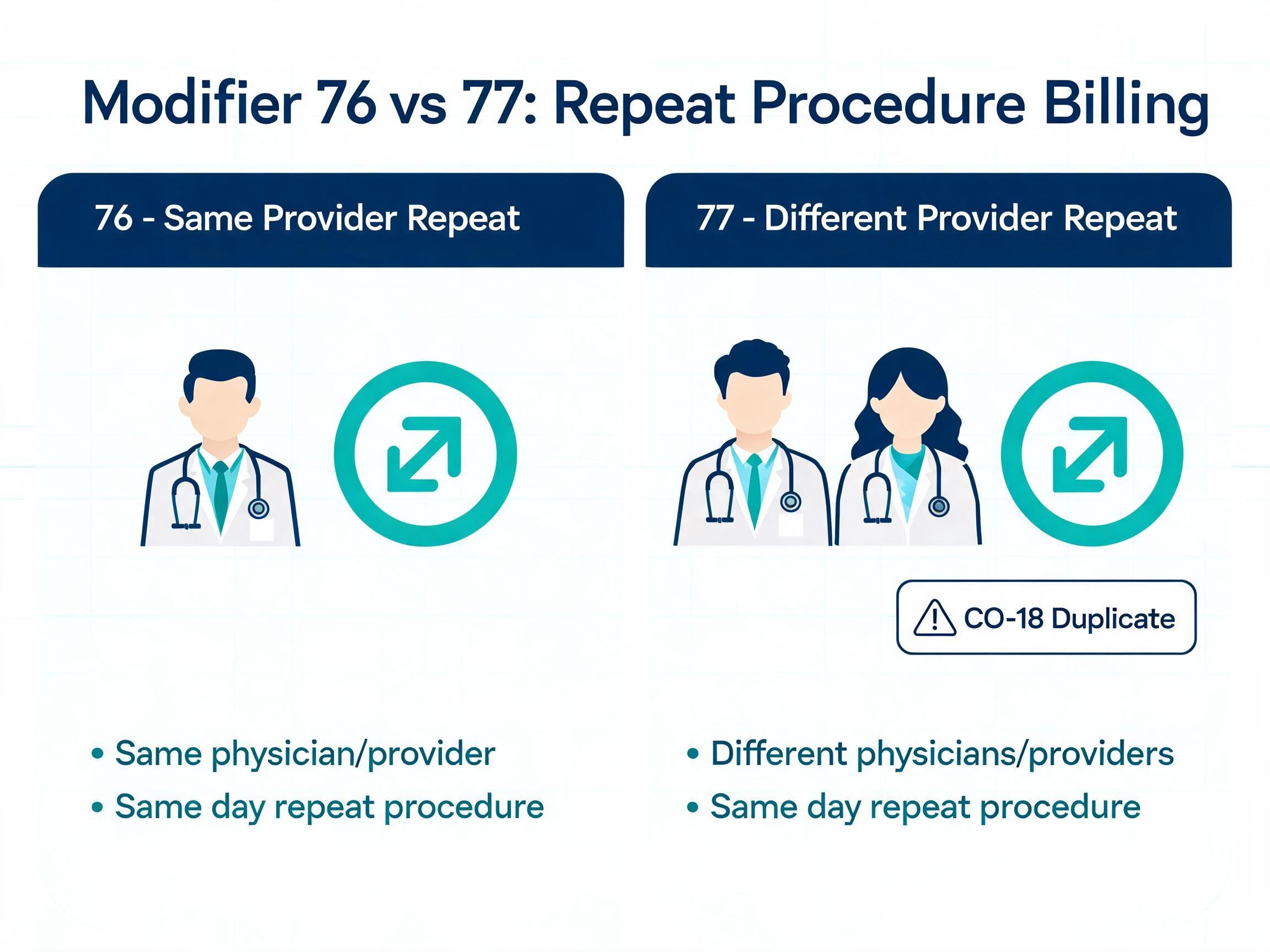
- Modifier 76: the same physician or qualified healthcare professional repeats a procedure or service, typically on the same day.
- Modifier 77: a different provider repeats the same procedure that day.
- Both exist to tell the payer's duplicate edit "this is a legitimate repeat, not a double-bill" — without one, the second line usually denies as CO-18 (exact duplicate).
- Documentation must show why the repeat was medically necessary — times, changed clinical status, or a failed first attempt — not just that it happened twice.
- These modifiers apply to procedures and diagnostic services (X-rays, EKGs), not E/M visits, which use the 25/57 family instead.
- Repeat clinical laboratory tests use modifier 91, not 76 — a distinction payer auditors check.
Modifier 76 vs 77: the quick answer
When the same CPT code legitimately appears twice for one patient on one date of service, the payer's claim system cannot tell a genuine repeat from an accidental double-bill — unless you flag it. That flag is modifier 76 when the same provider performed both instances, and modifier 77 when a different provider performed the repeat. Choose by provider identity, nothing else: same rendering provider (or same group/specialty, under many payer policies) means 76; different provider means 77. Skip the modifier and the second line will almost always bounce back as a duplicate.
The stakes are operational. A repeat chest X-ray after chest tube placement is clearly necessary care — but billed bare, it looks identical to a keying error, and payer software assumes the error.
What modifier 76 means: same provider repeats
Modifier 76 ("repeat procedure or service by same physician or other qualified health care professional") is appended to the second and subsequent instances of a code when the original provider repeats the service. Classic triggers, per Medicare contractor guidance such as NGS and First Coast:
- A chest X-ray repeated after a procedure to confirm line or tube placement.
- An EKG repeated hours later to track evolving chest pain.
- A procedure repeated because the first attempt failed for technical reasons (poor image quality, equipment failure) — with the reason documented.
Billing mechanics: report the first service on line one with no modifier, then each repeat on its own line with 76 appended. Many payers also want distinct times in the documentation (and some in the claim notes field) so a reviewer can see two separate events rather than one service billed twice.
What modifier 77 means: different provider repeats
Modifier 77 ("repeat procedure by another physician or other qualified health care professional") covers the same situation with one change: someone else performs the repeat. A common example from Medicare contractor education: a patient gets an EKG at 10 a.m. interpreted by Dr. A, then a second EKG at 1:30 p.m. interpreted by Dr. B. Dr. B's claim carries modifier 77. Without it, Dr. B's charge collides with Dr. A's in the payer's duplicate logic — especially when both bill under the same group NPI.
Modifier 77 matters most in hospital-based settings — radiology, cardiology, emergency coverage — where shift changes make cross-provider repeats routine. Groups where all providers bill under one tax ID should assume the payer sees them as "the same biller" for duplicate-edit purposes and modifier accordingly.
Repeat vs duplicate: how payer edit logic works
Understanding the edit explains the fix. Most payer systems screen incoming claims against history using a match key that typically includes: patient ID, date of service, rendering or billing NPI, procedure code, and the modifiers on the line. When an incoming line matches a paid or pending line on every element, the system flags it as an exact duplicate and denies it — commonly with CARC 18 (CO-18/OA-18, "exact duplicate claim/service"). CMS billing guidance on repeat services (for example, article A53482) exists precisely because legitimate repeats fail this match constantly.
Modifier 76 or 77 changes the match key: the repeat line no longer looks identical, so it passes the automatic edit and routes to normal adjudication. Three practical consequences follow:
- Resubmitting the same denied line unchanged never works — it just generates a second CO-18. The line must be corrected with the right modifier.
- The modifier goes on the repeat, not the original. If both lines carry 76, or neither does, the edit can still fire.
- Units matter. Billing one line with 2 units instead of two lines with a repeat modifier is a different (and often wrong) representation — many payers' MUE and duplicate logic treats it differently. Follow the payer's published convention.
For the broader denial-code landscape, see our CARC and RARC code guide; for claims rejected up front for missing information, the CO-16 denial guide covers the companion problem of claims that never reach adjudication cleanly.
Modifier 76 vs 77 vs 91 side by side
| Element | Modifier 76 | Modifier 77 | Modifier 91 |
|---|---|---|---|
| Who repeats | Same provider | Different provider | Lab (any) — repeat clinical diagnostic test |
| Applies to | Procedures, imaging, diagnostics | Procedures, imaging, diagnostics | Clinical laboratory tests only |
| Typical use | Repeat X-ray/EKG same day, failed first attempt | Cross-shift or cross-provider repeat | Serial labs (e.g., repeat potassium after treatment) |
| Denial it prevents | CO-18 duplicate | CO-18 duplicate | CO-18 / bundling of repeat labs |
| Never used for | E/M visits; rebilling denied claims | E/M visits | Rerun due to specimen/equipment error |
Documentation that survives review
Payers may pay a 76/77 claim automatically and audit later, or suspend it for records first. Either way, the chart needs four elements:
- Time of each service. Two entries, two clock times. This alone defeats most "duplicate" presumptions.
- Reason for the repeat. Changed clinical status, post-procedure verification, failed or non-diagnostic first attempt — stated explicitly, not implied.
- Separate findings or reports. A repeat X-ray or EKG should have its own interpretation, not an addendum to the first.
- Provider identity. For 77, the record should make clear a different provider performed or interpreted the repeat — this is what justifies the modifier choice.
"Repeat CXR — reconfirm" with no time and no distinct report is the kind of note that turns a payable repeat into a post-payment refund request.
Worked dollar example: one modifier, real money
Illustrative numbers. A hospital-affiliated cardiology practice performs 93000 (EKG with interpretation, roughly $17 allowable) and a portable chest X-ray 71045 (roughly $30 global allowable). A chest pain patient gets both at 9 a.m., then a repeat EKG at 2 p.m. after symptoms change, and a repeat X-ray after a central line is placed.
- Billed bare: lines 1–2 pay (~$47); the two repeat lines deny CO-18 → about $47 lost per patient episode until reworked.
- Billed with 76 (same providers repeated both): all four lines adjudicate → roughly $94 paid on first pass.
- At volume: a facility-based group generating ten repeat diagnostics a day is putting roughly $300–$500/day into rework or write-off without these modifiers — well over $100,000 a year in touched claims, for a fix that costs one field on the claim line.
CO-18 denials on repeats: cause and fix
| Denial pattern | Root cause | Fix |
|---|---|---|
| Second line denies CO-18 | Repeat billed with no modifier | Corrected claim with 76 or 77 on the repeat line — do not simply resubmit |
| Both lines deny or suspend | Modifier on the wrong line, or on both lines | Original line clean; modifier on repeat line(s) only |
| CO-18 despite modifier 77 | Payer matches at group NPI level and edit still fires | Appeal with documentation of two providers/times; ask payer for its duplicate-logic policy |
| Repeat lab denied | 76 used where payer requires 91 | Rebill repeat clinical lab tests with modifier 91 |
| Paid, then recouped on audit | Notes lack times or medical necessity for repeat | Strengthen templates: time-stamp each instance and state the reason for repeating |
A clean correction workflow, numbered:
- Pull the remit and confirm the denial is CARC 18 (duplicate), not a bundling or frequency edit.
- Verify in the chart that two distinct services occurred, with times and reasons.
- Determine provider identity: same provider → 76; different provider → 77; repeat clinical lab → 91.
- Submit a corrected claim with the modifier on the repeat line(s), keeping the original line unchanged.
- If the corrected claim still denies, appeal with both reports and a cover note explaining the clinical sequence — our claim appeal guide covers packet structure and deadlines.
- Track repeat-service denials as their own category in your billing workflow so the front-end fix (modifier at charge entry) actually happens.
Quick Answers
What is modifier 76 used for? Modifier 76 indicates the same provider repeated a procedure or service — commonly a same-day repeat X-ray or EKG — so the payer's duplicate edit does not deny the second instance as a double-bill.
When do I use modifier 77 instead of 76? Use 77 when a different physician or qualified healthcare professional performed the repeat. Provider identity is the only distinction between the two modifiers.
Why did my repeat procedure deny as CO-18? Because the repeat line matched the original on patient, date, code, and provider, the payer's system flagged it as an exact duplicate. Correct the claim by adding modifier 76 or 77 to the repeat line; resubmitting unchanged will only generate another CO-18.
Can modifier 76 or 77 be used on E/M codes? No. Repeat-procedure modifiers apply to procedures and diagnostic services. Same-day E/M questions are handled by the 25/57 family — see our guide to modifier 57 vs 25.
Do modifiers 76 and 77 change the payment amount? Generally no — they bypass the duplicate edit so the line can adjudicate normally. Payment still follows the fee schedule, and medical necessity review still applies, depending on payer policy.
What to check before you bill
- Is this truly a repeat of the same code, same day — or a different service that maps to a different code?
- Same provider or different provider? Confirm the rendering NPI on each line matches the documentation.
- Is it a clinical lab test? Then the modifier is 91, not 76.
- Do both notes carry times and a stated reason for the repeat?
- Does this payer want repeats as separate lines with 76/77 (most do) or another convention? Get it in writing.
- Is prior authorization or notification required for repeats in the same encounter? Some payers require it.
Related modifiers: the repeat/post-op family
Modifiers 76 and 77 are part of a larger procedure-side system: 58 (staged or related procedure during the global period), 78 (unplanned return to the OR for a related procedure), and 79 (unrelated procedure during the global period). Pick from the repeat family for same-day repeats outside a global-period context, and from the 58/78/79 family when a surgical global period is running. E/M services never take any of these — they use 24, 25, and 57.
Frequently asked questions
Yes — repeat diagnostic imaging and EKGs are the textbook use case. Report the first service without a modifier and each same-day repeat on its own line with modifier 76 (same provider) or 77 (different provider), with times and the clinical reason documented for each instance.
Some payer systems match duplicates at the group NPI or tax ID level, so two providers in the same group can still trip the edit. Appeal with documentation showing two distinct services, providers, and times, and request the payer's duplicate-edit policy so future claims can be formatted to pass it.
Most payers, including Medicare contractors, want the repeat on its own line with modifier 76 or 77 rather than doubled units on one line. Unit-stacking can trip MUE or duplicate logic differently by payer, so follow each payer's published convention.
Modifier 76 covers repeat procedures and diagnostic services such as imaging and EKGs; modifier 91 is specifically for repeat clinical laboratory tests that are medically necessary (like serial potassium levels). Using 76 on a repeat lab is a common correction payers request.
No — they only prevent the automatic duplicate denial so the claim can be adjudicated. The repeat must still be medically necessary and documented; payers may review records and can deny or recoup if the notes do not justify performing the service twice.