
- Modifier 33 tells a commercial payer that a service qualifies as an ACA-mandated preventive benefit, so patient cost-sharing (deductible, copay, coinsurance) should be waived on non-grandfathered plans.
- It applies when the service carries a USPSTF grade A or B recommendation, an ACIP-recommended immunization, or an HRSA-supported guideline for women's or children's preventive care.
- Do not send modifier 33 to Medicare — Medicare uses dedicated G-codes for screenings and modifier PT when a screening colonoscopy converts to a diagnostic procedure.
- Inherently preventive codes such as 99381–99397 preventive medicine visits generally do not need modifier 33; append it when a code could be either preventive or diagnostic.
- The highest-value use case is a screening colonoscopy that becomes therapeutic (polyp removal) — modifier 33 preserves $0 patient responsibility on commercial claims.
- Missing modifier 33 does not usually deny the claim; it silently shifts hundreds of dollars to the patient, creating refund work and complaints.
What modifier 33 does on a claim
Append modifier 33 to a CPT code and you are telling the health plan: the primary purpose of this service was the delivery of an evidence-based preventive service, so process it under the plan's first-dollar preventive benefit. The modifier was created by the AMA after the Affordable Care Act's Section 2713 required non-grandfathered plans to cover a defined set of preventive services with no member cost-sharing. Without a way to flag preventive intent on codes that can be either screening or diagnostic, payers were applying deductibles to services that should have been free to the patient — modifier 33 closed that gap. The AMA made an editorial revision to the descriptor in the 2026 CPT code set, but the clinical application is unchanged.
Two things modifier 33 is not: it is not a payment-increasing modifier (the allowed amount does not change — only who pays it), and it is not a Medicare modifier. Medicare has its own preventive benefit structure built on HCPCS G-codes, covered in our Medicare Annual Wellness Visit billing guide (G0438/G0439).
The ACA preventive list: which services qualify
A service earns modifier 33 when it maps to one of four recommendation sources named in the ACA. If the service is not on one of these lists, the modifier is inappropriate no matter how “preventive” the visit felt.
| Recommendation source | What it covers | Common examples (verify current recommendations) |
|---|---|---|
| USPSTF grade A or B | Evidence-based screenings and counseling for adults | Colorectal cancer screening (ages 45–75), screening mammography, cervical cancer screening, lung cancer screening with low-dose CT for qualifying smokers, depression screening, statin/aspirin counseling |
| ACIP (CDC immunization schedule) | Routine immunizations for children and adults | Influenza, Tdap, HPV, shingles (per age criteria), pneumococcal vaccines |
| HRSA women's preventive guidelines | Women's health services | Well-woman visits, contraception counseling and FDA-approved methods, breastfeeding support, screening for interpersonal violence |
| HRSA Bright Futures | Infant, child and adolescent care | Well-child visits, developmental screening, vision and hearing screening, fluoride varnish |
Recommendations change — the USPSTF lowered the colorectal screening start age from 50 to 45 in 2021, for example — so tie your charge-capture rules to the current published lists rather than a static internal cheat sheet.
When to append modifier 33 — and when to skip it
The decision hinges on whether the CPT code is ambiguous about intent.
- Append 33 when a code could be preventive or diagnostic and this encounter was preventive: 45378 screening colonoscopy on a commercial plan, tobacco cessation counseling (99406–99407) delivered as USPSTF-recommended prevention, or screening labs ordered for an asymptomatic patient per guideline.
- Append 33 when a scheduled screening turned into an intervention during the same session — the classic screening colonoscopy with polypectomy (e.g., 45385).
- Skip it on inherently preventive codes: preventive medicine E/M visits 99381–99397 and screening-specific codes such as 77067 (screening mammography) are already preventive by definition. Many payers ignore a redundant 33; payer policies (Premera publishes one, for instance) differ on whether they want it anyway — follow the payer's published policy.
- Never use it when the visit was diagnostic — the patient had symptoms or an abnormal finding was being followed. Appending 33 to dodge a deductible is a compliance risk, not a courtesy.
- Never send it to Medicare or most Medicaid plans; and note that grandfathered commercial plans and some self-funded carve-outs are exempt from ACA cost-sharing rules, so a correctly coded claim may still process with member liability.
Modifier 33 vs modifier PT
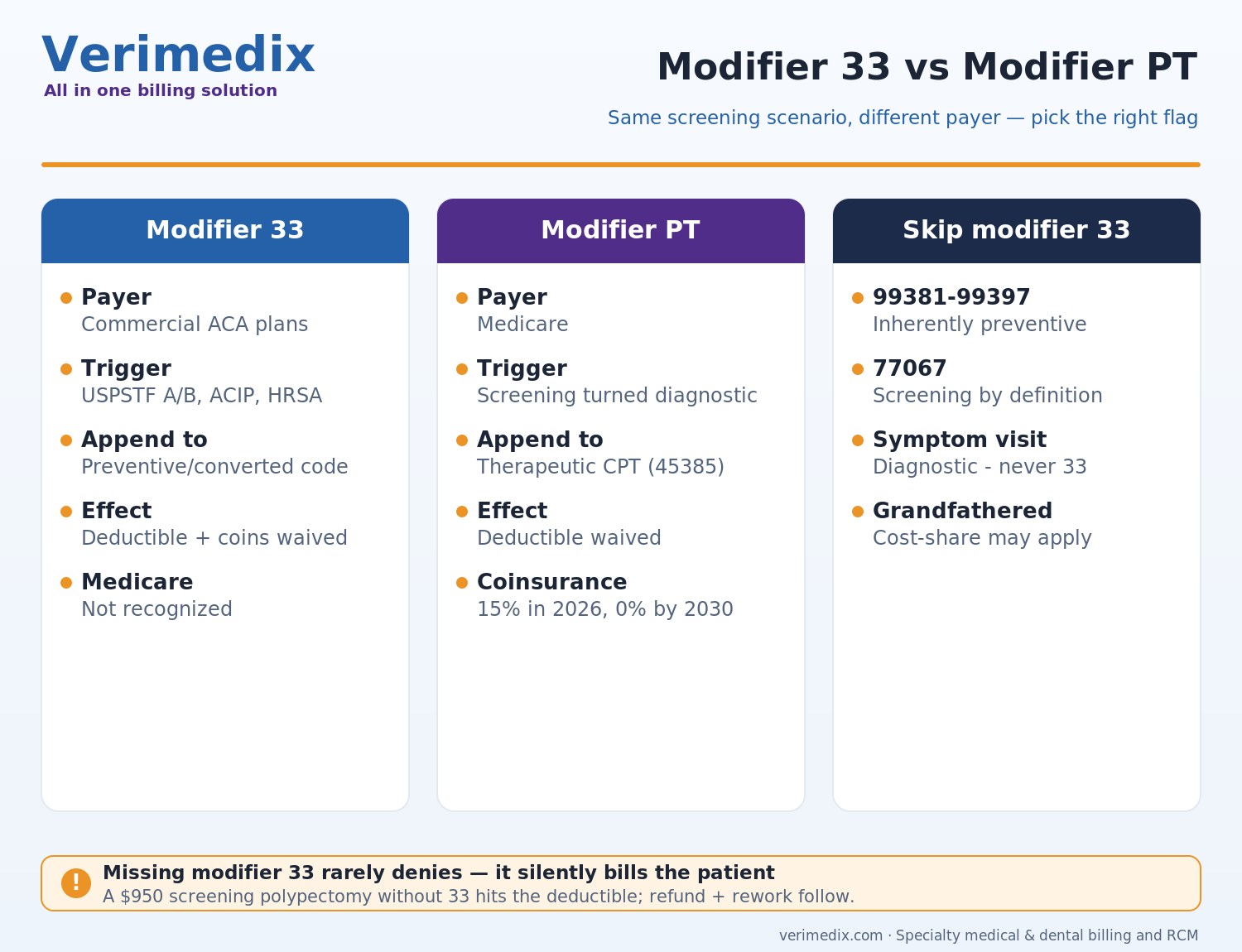
These two modifiers solve the same clinical scenario for different payer types, and mixing them up is the most common error we see in gastroenterology and multi-payer primary care billing.
| Modifier 33 | Modifier PT | |
|---|---|---|
| Payer | Commercial ACA-compliant plans | Medicare (and Medicare Advantage per plan policy) |
| Trigger | Any qualifying ACA preventive service, including screening-to-therapeutic conversions | Colorectal cancer screening test that converts to a diagnostic or therapeutic procedure |
| Append to | The preventive service code, or the surgical code when screening converted | The diagnostic/therapeutic CPT code (e.g., 45385), never the G-code |
| Patient effect | Deductible, copay and coinsurance waived | Deductible waived; coinsurance on converted screenings is phasing down under federal law (15% in 2026, scheduled to reach 0% by 2030) |
| Wrong-payer result | Medicare ignores or rejects it | Commercial payers may deny or misprice |
Cost-sharing waiver rules and the conversion scenario
On a non-grandfathered commercial plan, an in-network qualifying preventive service must be covered without member cost-sharing. Three nuances trip practices up. First, network status matters: plans are generally not required to waive cost-sharing out of network. Second, diagnosis pointers matter: pair the service with a screening ICD-10 code (Z12.11 for screening colonoscopy, Z00.00/Z00.01 for adult exams) — a first-listed symptom diagnosis contradicts the modifier and payers will process the claim as diagnostic. Third, conversion does not destroy preventive status: federal guidance treats a polypectomy performed during a screening colonoscopy as part of the preventive service on commercial plans, so bill the surgical code (45385) with modifier 33 and the screening diagnosis first-listed, per payer policy.
Worked example (illustrative numbers). A 52-year-old with a commercial PPO ($1,500 remaining deductible, then 20% coinsurance) has a screening colonoscopy; one polyp is removed. Allowed amount for 45385: $950.
- Billed without modifier 33: the payer adjudicates as diagnostic — $950 goes to deductible. The patient owes $950, the practice now carries patient AR, statement costs, and an angry phone call. When the error surfaces, you refund or trigger re-adjudication.
- Billed with modifier 33 + Z12.11: plan pays $950 at 100%; patient owes $0. Same reimbursement, no rework.
Multiply that rework across one endoscopy day per week and the modifier is worth thousands per month in avoided patient-AR churn — even though it never changes the allowed amount.
Quick decision framework
Run every potential preventive claim through five questions:
- Is the payer commercial? No → use Medicare's G-codes/PT rules (see the AWV G0438/G0439 guide) or the Medicaid plan's policy. Yes → continue.
- Is the service on a qualifying list (USPSTF A/B, ACIP, HRSA)? No → stop; bill normally.
- Was the intent screening/preventive (asymptomatic patient, guideline interval)? No → stop; bill diagnostic.
- Is the code inherently preventive (99381–99397, 77067)? Yes → usually no 33 needed; check payer policy. No → append 33.
- Did screening convert to treatment? Yes → append 33 to the therapeutic code and keep the screening diagnosis primary, per payer policy.
If a preventive service and a significant problem-oriented E/M happen on the same day, that is a modifier 25 question, not a modifier 33 question — see our modifier 25 billing guide. And when you expect Medicare to deny a non-covered service, the GA, GX, GY and GZ ABN modifier rules govern patient liability instead.
Fixing modifier 33 problems on processed claims
| Problem | Likely cause | Fix |
|---|---|---|
| Patient charged deductible on a screening | Modifier 33 omitted, or symptom diagnosis first-listed | Submit a corrected claim (frequency code 7) with 33 and screening ICD-10 primary; refund any patient collection after re-adjudication |
| CO-4 denial (code inconsistent with modifier) | 33 sent on a code the payer excludes, or sent to Medicare | Remove or replace per payer policy — Medicare colorectal conversions take PT; see our CO-4 denial code guide |
| Claim paid but cost-share applied anyway | Grandfathered/exempt plan, out-of-network, or plan edit error | Verify plan status; if non-grandfathered and in-network, appeal citing ACA preventive coverage with the USPSTF/ACIP/HRSA citation |
| Payer processes surveillance colonoscopy as diagnostic | Payer-specific policy on high-risk/surveillance intervals | Follow payer medical policy; commercial payers often — not always — treat surveillance after polyp history as preventive, so confirm in writing |
Quick Answers
What does modifier 33 mean? Modifier 33 identifies a service as an ACA-mandated preventive service (USPSTF grade A/B, ACIP immunization, or HRSA guideline) so a commercial plan waives the patient's deductible, copay and coinsurance.
Does Medicare accept modifier 33? No for most services. Medicare structures preventive benefits through HCPCS G-codes and uses modifier PT when a screening colonoscopy becomes diagnostic or therapeutic.
Does modifier 33 increase reimbursement? No. The allowed amount is unchanged; the modifier only shifts responsibility from the patient's cost-sharing to the plan's preventive benefit.
Do preventive visit codes 99381–99397 need modifier 33? Generally no — they are inherently preventive. Append 33 to codes that could be either preventive or diagnostic, such as screening colonoscopies or counseling codes.
What modifier is used when a screening colonoscopy finds a polyp? On commercial claims, bill the therapeutic code (e.g., 45385) with modifier 33. On Medicare claims, bill it with modifier PT.
Can every plan waive cost-sharing with modifier 33? No. Grandfathered plans and certain exempt self-funded plans are not bound by ACA preventive rules, and out-of-network preventive services may still carry cost-sharing.
Frequently asked questions
Effectively yes. It was built for ACA-compliant commercial plans. Medicare does not recognize it for most services because Medicare preventive benefits run through dedicated G-codes and modifier PT. Medicaid recognition varies by state and managed-care plan, so check each plan's policy.
Pair it with a screening or encounter-for diagnosis such as Z12.11 for screening colonoscopy or Z00.00 for a general adult exam. A first-listed symptom diagnosis contradicts preventive intent and will usually cause the payer to apply cost-sharing regardless of the modifier.
Yes, if the service genuinely met preventive criteria. Submit a corrected claim with the modifier and correct screening diagnosis, then refund the patient after the payer re-adjudicates. Do not add it retroactively to a service that was diagnostic in intent.
They should not appear together for the same payer. Modifier 33 belongs on commercial claims and PT on Medicare claims for converted colorectal screenings. Sending the wrong one commonly triggers a CO-4 modifier-inconsistency denial or silent misadjudication.
No. Grandfathered plans, some self-funded plans, out-of-network services, and services outside the USPSTF/ACIP/HRSA lists can still carry cost-sharing. The modifier asserts preventive status; the plan's benefit design determines the final patient responsibility.