
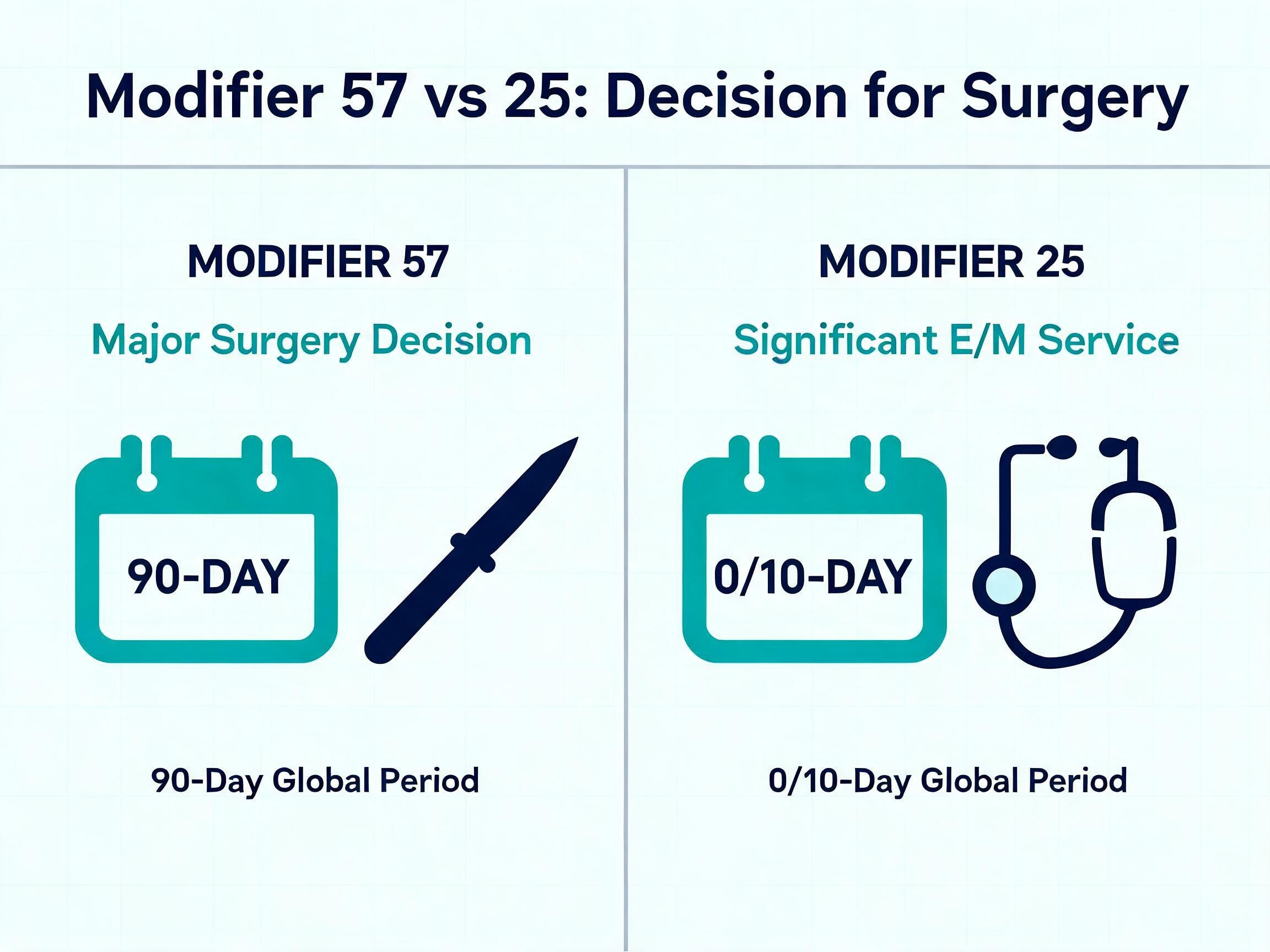
- Modifier 57: the E/M where the initial decision for a major surgery (90-day global) is made, day of or day before that surgery.
- Modifier 25: a significant, separately identifiable E/M the same day as a minor procedure (0- or 10-day global).
- The procedure's global period — not coder judgment — determines which modifier applies. Look it up before you pick.
- Pre-op visits after the decision for surgery has been made are bundled into the global package — not separately billable.
- Per the Medicare Claims Processing Manual (Chapter 12, Section 30.6.6), an E/M on the day of or day before a 90-day global procedure is paid only when modifier 57 shows the visit produced the decision to operate.
- Swapping 57 and 25 is a common self-inflicted E/M denial — and one of the easiest to appeal when documentation is solid.
Modifier 57 vs 25: the quick answer
One rule settles nearly every modifier 57 vs 25 question: check the global period first. A 90-day global procedure makes the decision-to-operate E/M a modifier 57 claim — valid only day of or day before surgery. A 0- or 10-day global procedure makes a same-day E/M that goes beyond the built-in evaluation a modifier 25 claim. There is no overlap, and payers enforce the split mechanically: claim edits read the CPT code's global period on the fee schedule, not the story in your documentation.
That mechanical enforcement is why this pair produces so many avoidable denials: a well-documented decision visit billed with 25 against a 90-day global code will often deny, and a 57 attached to a 10-day global repair usually will too. Same documentation, wrong flag, lost revenue.
What modifier 57 means: decision for major surgery
Modifier 57 ("decision for surgery") marks the E/M encounter where the physician made the initial decision to perform a major procedure. Because the 90-day global package begins the day before surgery, an E/M on that day or the day of surgery would normally be absorbed into it; modifier 57 certifies the visit was the decision point, not routine pre-op work, so it is paid separately.
Three conditions must all be true, and payers may audit each:
- Major procedure: the surgery has a 90-day global period on the Medicare Physician Fee Schedule (or the payer's equivalent schedule).
- Timing: the E/M occurred the day of surgery or the calendar day immediately before. Two or more days out, no modifier is needed — the visit sits outside the global window.
- Initial decision: the note shows the decision to operate was made at this visit. If it was made last week and today is history-and-physical clearance, the visit is bundled and modifier 57 cannot rescue it.
Modifier 57 always rides on the E/M code (99203, 99214, ED codes like 99284) — never on the surgery code.
Where modifier 25 fits: minor procedures
Modifier 25 is the mirror image on the minor-procedure side. Codes with 0- or 10-day globals include a small built-in evaluation — assessing the site, confirming the plan, obtaining consent. When the same-day E/M goes significantly beyond that inherent work, modifier 25 lets it be paid alongside the procedure. Our full modifier 25 billing guide covers documentation standards and payer edits in depth; the short version: the E/M must stand on its own if you mentally delete the procedure note.
What modifier 25 cannot do is substitute for 57 on a major surgery — most payer systems bundle or reject a 25 claim in that position.
Global periods decide the modifier — not judgment
This is the classification logic payers apply; every surgical CPT code carries a global period indicator on the Medicare Physician Fee Schedule.
| Global period indicator | Classification | Same-day E/M modifier | Typical examples |
|---|---|---|---|
| 000 (0-day) | Minor procedure | Modifier 25 (if E/M is significant and separately identifiable) | Many endoscopies, injections |
| 010 (10-day) | Minor procedure | Modifier 25 (if E/M is significant and separately identifiable) | Laceration repairs |
| 090 (90-day) | Major surgery | Modifier 57 (decision for surgery, day of or day before) | Joint replacement, most open surgery |
| XXX / ZZZ | Global concept does not apply / add-on code | Neither modifier applies via global logic | Many diagnostic and add-on codes |
Modifier 57 vs 25 side by side
| Element | Modifier 57 | Modifier 25 |
|---|---|---|
| Global period of procedure | 90-day (major surgery) | 0- or 10-day (minor procedure) |
| Timing of E/M | Day of or day before surgery | Same day as the procedure |
| What it certifies | Visit produced the initial decision to operate | E/M significant and separately identifiable from the procedure |
| Goes on | The E/M code only | The E/M code only |
| Common misuse | Used on a minor procedure, or on a pre-op visit after the decision | Used on the decision visit before a major surgery |
| Denial language you'll see | E/M bundled into global surgical package | E/M included in procedure allowance |
Same-day E/M scenarios walked through
Scenario 1 — ED consult, surgery that night. A surgeon evaluates acute appendicitis in the ED and operates that evening (appendectomy, 90-day global). The E/M gets modifier 57; without it, the visit bundles into the global package.
Scenario 2 — lesion destroyed on the spot. A suspicious lesion is evaluated and destroyed at one visit (10-day global). If the E/M was only the look-and-decide for that lesion, no separate E/M is billable; if the provider also worked up an unrelated rash with its own plan, the E/M takes modifier 25.
Scenario 3 — decision last week, H&P the day before surgery. The decision to operate happened eight days ago (billed then, no modifier). Today's day-before visit is pre-op clearance: bundled. Neither 57 nor 25 makes it payable.
Scenario 4 — fracture care. A wrist fracture is evaluated and reduced the same day. Closed fracture treatment codes often carry a 90-day global — a modifier 57 event with no operating room involved. "Major" means 90-day global, not "performed in an OR."
A three-question decision tree
- 1. What is the procedure's global period?
- 90-day → go to question 2.
- 0- or 10-day → go to question 3.
- XXX/ZZZ → global-period E/M modifiers don't apply; evaluate other coding rules.
- 2. Was the initial decision for surgery made at this E/M, on the day of or day before the procedure?
- Yes → append modifier 57 to the E/M.
- No, decision was made earlier → the day-of/day-before visit is bundled; do not bill it separately.
- The E/M is 2+ days before surgery → bill the E/M with no global-period modifier.
- 3. Was the E/M significant and separately identifiable beyond the minor procedure's inherent evaluation?
- Yes, documentation stands on its own → append modifier 25 to the E/M.
- No → bill the procedure only.
Common denials and how to appeal
| Denial scenario | Root cause | Fix |
|---|---|---|
| E/M denied as included in global surgery | Decision-for-surgery visit billed without modifier 57 (or with 25 instead) | Correct the modifier and resubmit; near timely-filing, appeal with the note showing the decision date |
| E/M with 57 denied on a minor procedure | Modifier 57 used on a 0/10-day global code | Re-evaluate under modifier 25 criteria; rebill with 25 only if the E/M is truly separately identifiable |
| E/M with 57 denied despite major surgery | E/M dated 2+ days pre-op, or note shows decision was made earlier | If the decision truly occurred at this visit, appeal with documentation; otherwise the visit is bundled |
| Payer downcodes or requests records | Pattern of modifier 57/25 on a high percentage of procedure claims | Run an internal audit; payers profile modifier utilization and may flag outliers |
An appeal packet needs four things: the claim, the E/M note with the decision (or separate problem) highlighted, the fee schedule printout showing the global period, and a cover letter citing Medicare Claims Processing Manual Chapter 12, Section 30.6.6. See our guide to appealing a denied medical claim for deadlines and levels; structured denial management keeps these from recurring.
Worked dollar example: what a swapped modifier costs
Illustrative numbers, not a fee quote. A retina specialist evaluates sudden vision loss (99204, roughly a $165 Medicare allowable), diagnoses retinal detachment, and schedules repair for the next morning (67108, 90-day global, allowable around $1,200–$1,400).
- Billed correctly: 99204-57 on the visit date plus 67108 on the surgery date → both paid; total roughly $1,365–$1,565.
- Billed with modifier 25 instead: the E/M is likely bundled into the global package → about $165 lost on this one encounter unless corrected or appealed.
- At scale: three swapped decision visits a week is roughly $25,000 a year in earned E/M revenue lost — recoverable only through rework that costs staff time on top.
Quick Answers
What is modifier 57 used for? Modifier 57 is appended to an E/M service that produced the initial decision to perform a major surgery (90-day global period) when the E/M occurs the day of or day before that surgery, so the payer pays the visit instead of bundling it into the global package.
What is the difference between modifier 25 and 57? Modifier 57 applies to the decision-for-surgery E/M before major surgeries (90-day global); modifier 25 applies to significant, separately identifiable E/M on the same day as minor procedures (0- or 10-day global). The global period determines which is correct.
Can I bill an E/M the day before surgery? Yes, if that visit is where the initial decision for the 90-day global surgery was made — append modifier 57. If the decision came earlier, the visit is pre-op clearance and is bundled.
Does modifier 57 apply to minor procedures? No. For 0- and 10-day global procedures the applicable modifier is 25, and only when the E/M is significant and separately identifiable.
What to check before you bill
- Look up the global period on the CMS physician fee schedule tool — every time, before choosing.
- Confirm the E/M date is the day of or day before surgery for modifier 57 claims.
- Verify the note documents the initial decision to operate at that visit — an explicit statement in the plan helps reviewers.
- For modifier 25 claims, confirm the E/M documentation stands alone without the procedure note.
- Check payer policy: most commercial payers mirror Medicare's framework, but some publish their own modifier 57 timing language.
- Audit 57/25 utilization quarterly — outlier rates invite prepayment review; a certified medical coding review can benchmark you.
Related global-period modifiers
Modifiers 57 and 25 handle E/M services heading into a global period. Once it is running, a different family takes over: modifier 24 covers unrelated E/M during the post-operative global period, while 58, 78, and 79 handle staged, complication-related, and unrelated procedures post-op. Keeping decision-side (25/57) and post-op-side (24/58/78/79) straight prevents most global package errors. Major thoracic resections are the clearest case for modifier 57: the consult that establishes a lobectomy or esophagectomy is the decision for surgery, not a bundled pre-operative visit, and thoracic surgery billing services routinely recover it when it has been written off as global.
Frequently asked questions
No. Modifier 57 applies only to an E/M performed the day of or the day immediately before a major (90-day global) surgery. An E/M two or more days before surgery falls outside the global window and is billed on its own with no global-period modifier — provided it is otherwise payable.
No. Procedures with 0- or 10-day global periods are minor procedures, and the same-day E/M modifier for them is 25 — and only when the E/M is significant and separately identifiable. Modifier 57 is reserved for 90-day global procedures.
The E/M note should clearly show that the initial decision to perform the surgery was made at that visit: the evaluation findings, the assessment, and an explicit plan to proceed to surgery. If the record shows the decision was made at an earlier encounter, modifier 57 will not hold up on review.
Most commercial payers align with Medicare's global period framework, but some publish their own timing or documentation requirements for modifier 57. Confirm each major payer's surgical modifier policy in writing rather than assuming Medicare rules transfer exactly.
Always on the E/M code — for example 99204-57 or 99284-57. The surgical procedure code is billed without modifier 57. The same placement rule applies to modifier 25: it also rides only on the E/M service.