
- Modifier 51 = "multiple procedures, same session" — it drives payment sequencing under MPPR and never unbundles anything.
- Modifier 59 = "this normally-bundled service was genuinely distinct" — it can bypass an NCCI PTP edit, but only when the pair's modifier indicator is 1.
- Indicator 0 pairs can never be unbundled; indicator 9 means the edit no longer applies.
- CMS prefers the X{EPSU} modifiers (XE, XS, XP, XU) over 59 whenever one of them fits — 59 is the modifier of last resort.
- Medicare applies MPPR automatically (100% highest-valued procedure, 50% subsequent), so many MACs do not want 51 appended at all.
- Neither 59 nor the X modifiers exempt a claim from MPPR — unbundling and payment reduction are separate machines.
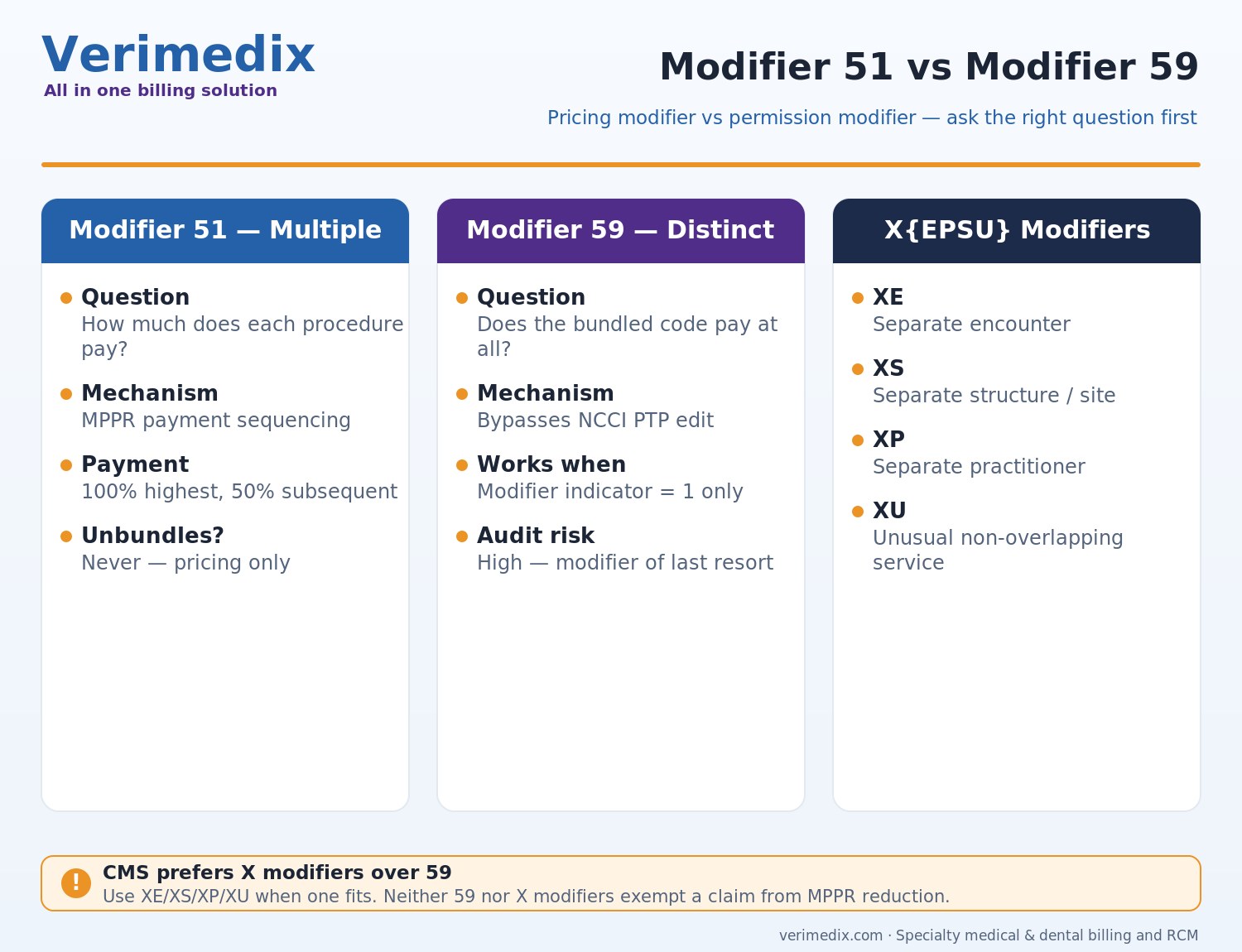
The cleanest way to keep modifier 51 and modifier 59 straight: 51 is a pricing modifier, 59 is a permission modifier. When two procedures are independently payable and simply share a session, 51 (or the payer's automatic logic) sequences the payment reduction. When an NCCI edit bundles them but they were truly distinct — different site, session, or lesion — 59 or an X modifier asks permission to pay both. Ask "pricing question or bundling question?" first and the right modifier picks itself.
Definitions: what each modifier does
Modifier 51 (Multiple Procedures) indicates the same provider performed more than one procedure in the same session, excluding E/M services and add-on codes. It exists for sequencing: the highest-valued procedure is listed first and paid in full, and 51 flags the additional procedures subject to reduction.
Modifier 59 (Distinct Procedural Service) indicates a procedure was distinct and independent from another same-day service — different session, anatomic site, incision, lesion, or injury. Its practical function is to bypass an NCCI procedure-to-procedure (PTP) edit that would otherwise deny the secondary code as bundled. Because it overrides bundling logic it is heavily audited, and CMS instructs that it be used only when no more descriptive modifier is available. Our deep dive on modifier 59, X modifiers, and NCCI unbundling covers the edit tables themselves.
| Element | Modifier 51 | Modifier 59 |
|---|---|---|
| Question it answers | How much does each procedure pay? | Does the bundled procedure pay at all? |
| Mechanism | Multiple procedure payment reduction (MPPR) sequencing | NCCI PTP edit bypass (indicator 1 pairs only) |
| Payment effect | Subsequent procedures typically cut to 50% under Medicare surgical rules | Enables separate payment that bundling would deny |
| Use with E/M codes | Never | Never — use modifier 25 on the E/M instead |
| Use with add-on codes | Never — add-ons are MPPR-exempt | Rarely; only if an NCCI edit applies and criteria are met |
| Medicare handling | MACs apply MPPR automatically; many prefer no 51 | Accepted, but X{EPSU} preferred when one fits |
NCCI PTP edits and the modifier indicator
The National Correct Coding Initiative publishes quarterly Column 1/Column 2 code-pair tables of services not normally payable together. Every pair carries a modifier indicator, and that single digit decides whether modifier 59 can even work:
| Indicator | Meaning | What you can do |
|---|---|---|
| 0 | Edit cannot be bypassed under any circumstances | No modifier unbundles the pair — only the Column 1 code is payable |
| 1 | Edit may be bypassed when services were genuinely distinct | Append 59 or the fitting X modifier if documentation proves a separate site, session, lesion, or injury |
| 9 | Edit deleted / not applicable | No edit is in play — bill normally, no modifier needed |
The workflow implication: check the pair in the CMS NCCI lookup before appending anything. 59 on an indicator-0 pair does not rescue the claim, and habitual 59 on indicator-1 pairs without distinct-service documentation is exactly the pattern payer analytics flag. When a bundling denial lands it usually surfaces as CO-97 — our guide to the CO-97 denial code walks through that remittance scenario.
The X{EPSU} modifiers and the specificity hierarchy
CMS's four HCPCS subdivisions of modifier 59 should be used whenever one applies:
- XE — Separate Encounter: distinct encounters on the same date (morning visit, evening return).
- XS — Separate Structure: distinct organ or anatomic structure (left knee injection, right shoulder aspiration).
- XP — Separate Practitioner: a different practitioner performed the second service.
- XU — Unusual Non-Overlapping Service: no overlap with the usual components of the primary code.
The hierarchy worth pinning above every coder's desk: first, an anatomic or situational modifier if one exists (50 bilateral, RT/LT, F1–FA, T1–TA, 76/77 repeat, 91 repeat lab); second, the X modifier that explains the distinctness; last, 59 when nothing more specific fits. Medicare accepts either 59 or X on indicator-1 pairs, but several large commercial payers now edit for specificity, and an XS with matching op-note anatomy survives appeal far better than a bare 59.
MPPR sequencing: the worked dollar example
Under Medicare's standard multiple surgery rules, the highest-valued procedure pays 100% of the allowable and each subsequent same-session procedure pays 50% (special rules apply past the fifth procedure and to designated code families). The math on a three-procedure session — figures illustrative:
| Line (ranked by allowable) | Fee schedule allowable | MPPR applied | Expected payment |
|---|---|---|---|
| Procedure A (highest) | $500.00 | 100% | $500.00 |
| Procedure B + 51 | $300.00 | 50% | $150.00 |
| Procedure C + 51 | $200.00 | 50% | $100.00 |
| Total | $1,000.00 | — | $750.00 |
Two lessons hide in that table. First, sequencing is money: rank Procedure B first by mistake and the 50% cut lands on the $500 code — the practice collects $650 instead of $750, a $100 underpayment no denial will ever announce. Most payer systems re-rank automatically, but not all, which is why the pattern often only surfaces in a revenue cycle review. Second, modifier 59 does not change this math: a properly unbundled pair still flows through MPPR, so "distinct" never means "full price for everything."
Payer-specific handling of modifier 51
Medicare contractors largely treat modifier 51 as informational — their systems rank procedures and apply MPPR without it, and several MACs explicitly say not to append it. Commercial payers are split: some require 51 on secondary procedures, some strip it silently, and a few stack double reductions when both 51 and payer-side logic fire. Three defensive habits: keep a payer matrix noting who wants 51 and who forbids it; always list procedures in descending allowable order; and audit multi-procedure remittances quarterly for stacked reductions, which are appealable. Practices without bandwidth often fold this into outsourced medical coding services.
Denial scenarios: cause and fix
| Denial / outcome | Likely cause | Fix |
|---|---|---|
| CO-97 (bundled service) | NCCI PTP pair billed without a bypass modifier, or indicator-0 pair billed hoping for payment | If indicator 1 and truly distinct, rebill with 59/X plus documentation; if indicator 0, the bundle stands |
| CO-4 (modifier inconsistent) | 51 on an E/M or add-on code, or 59 on a code with no edit relationship | Remove the inappropriate modifier and resubmit clean |
| Paid at unexpected 25–50% less | MPPR applied to a mis-sequenced claim, or payer stacked reductions | Verify ranking on the remit; submit a corrected claim or reconsideration with fee schedule math |
| Post-payment audit letter | High 59/XU utilization vs specialty peers | Self-audit a sample; retrain on the hierarchy; correct per compliance policy |
Decision tree: 51, 59, X — or nothing
- 1. Are both procedures normally payable together (no NCCI edit)?
- Yes → bundling is not the issue. Rank by allowable; append 51 only if this payer wants it. Done.
- No — an NCCI PTP edit exists → go to 2.
- 2. What is the pair's modifier indicator?
- 0 → stop. No modifier unbundles it; only Column 1 pays.
- 9 → edit deleted; bill normally.
- 1 → go to 3.
- 3. Were the services genuinely distinct (site, session, lesion, injury, practitioner)?
- No → bill only the comprehensive code. Appending 59 anyway is the audit trigger.
- Yes → go to 4.
- 4. Does a more specific modifier fit?
- Anatomic (50, RT/LT, F/T digits) or repeat (76/77/91) → use it.
- XE / XS / XP / XU describes the distinctness → use that.
- Nothing more specific → modifier 59, with the separate site/session named in the op note.
Quick Answers
What is the difference between modifier 51 and modifier 59? Modifier 51 reports multiple same-session procedures and affects payment sequencing under MPPR; modifier 59 reports a distinct procedural service and can bypass an NCCI edit so a normally-bundled code pays separately.
Does modifier 51 reduce payment? It signals multiple-procedure pricing: the highest-valued procedure pays in full and subsequent ones are typically reduced, often to 50% under Medicare surgical rules. The reduction comes from MPPR policy, not the modifier — many payers apply it automatically.
When is modifier 59 the modifier of last resort? Always — CMS and CPT guidance direct coders to a more descriptive option first (bilateral or anatomic modifiers, or XE, XS, XP, XU), reserving 59 for distinct services no other modifier describes.
What does NCCI modifier indicator 0 mean? The edit cannot be bypassed by any modifier — only the Column 1 code is payable, regardless of documentation.
Are X modifiers required instead of 59? Medicare accepts either on indicator-1 pairs, but CMS prefers the X modifiers when one applies, and some commercial payers now deny bare 59 where an X modifier fits.
What to check before submitting a multi-procedure claim
- Run the code pair through the current-quarter NCCI PTP lookup — edits change quarterly.
- Confirm the modifier indicator before appending 59 or any X modifier.
- Verify the op note names the separate site, session, lesion, or practitioner.
- Rank procedures by allowable, highest first.
- Check the payer matrix: does this payer want 51, ignore it, or reject it?
- Confirm no add-on code carries 51 and no E/M code carries 51 or 59.
Related modifiers worth knowing
Modifier 25 handles the E/M-plus-procedure version of the "distinct service" question — see our modifier 25 billing guide. Modifiers 76/77 (repeat procedures), 91 (repeat labs), and 50/RT/LT (laterality) all outrank 59 in the hierarchy. When an unbundling denial has landed and documentation supports payment, escalate through a structured appeal — our step-by-step 2026 appeal guide covers packet contents and deadlines.
Frequently asked questions
Use modifier 59 only when an NCCI edit bundles the code pair, the pair's modifier indicator is 1, the services were genuinely distinct, and no more specific modifier (X{EPSU}, 50, RT/LT) fits. If no NCCI edit exists and both codes are independently payable, it is a sequencing situation — modifier 51 territory, not 59.
The reduction comes from multiple procedure payment reduction policy rather than the modifier itself: under Medicare surgical rules the highest-valued procedure pays 100% and subsequent procedures typically pay 50%. Many payers, including most Medicare contractors, apply MPPR automatically whether or not 51 appears on the claim.
It means the procedure-to-procedure edit can never be bypassed — no modifier, 59 or otherwise, will make the Column 2 code payable with the Column 1 code. Only the comprehensive code pays, and appending 59 to an indicator-0 pair simply creates an incorrect claim.
It is uncommon but possible in principle: 59 addresses the bundling relationship while 51 addresses multi-procedure pricing. In practice most payer systems apply MPPR automatically, so 59 (or an X modifier) alone is usually sufficient. Check payer-specific edit logic before stacking them.
Medicare currently accepts either on indicator-1 pairs, but CMS guidance prefers the more specific X modifier whenever one describes the situation — separate encounter, structure, practitioner, or unusual non-overlapping service. A growing number of commercial payers edit against bare 59, so defaulting to the X series is the safer habit.