
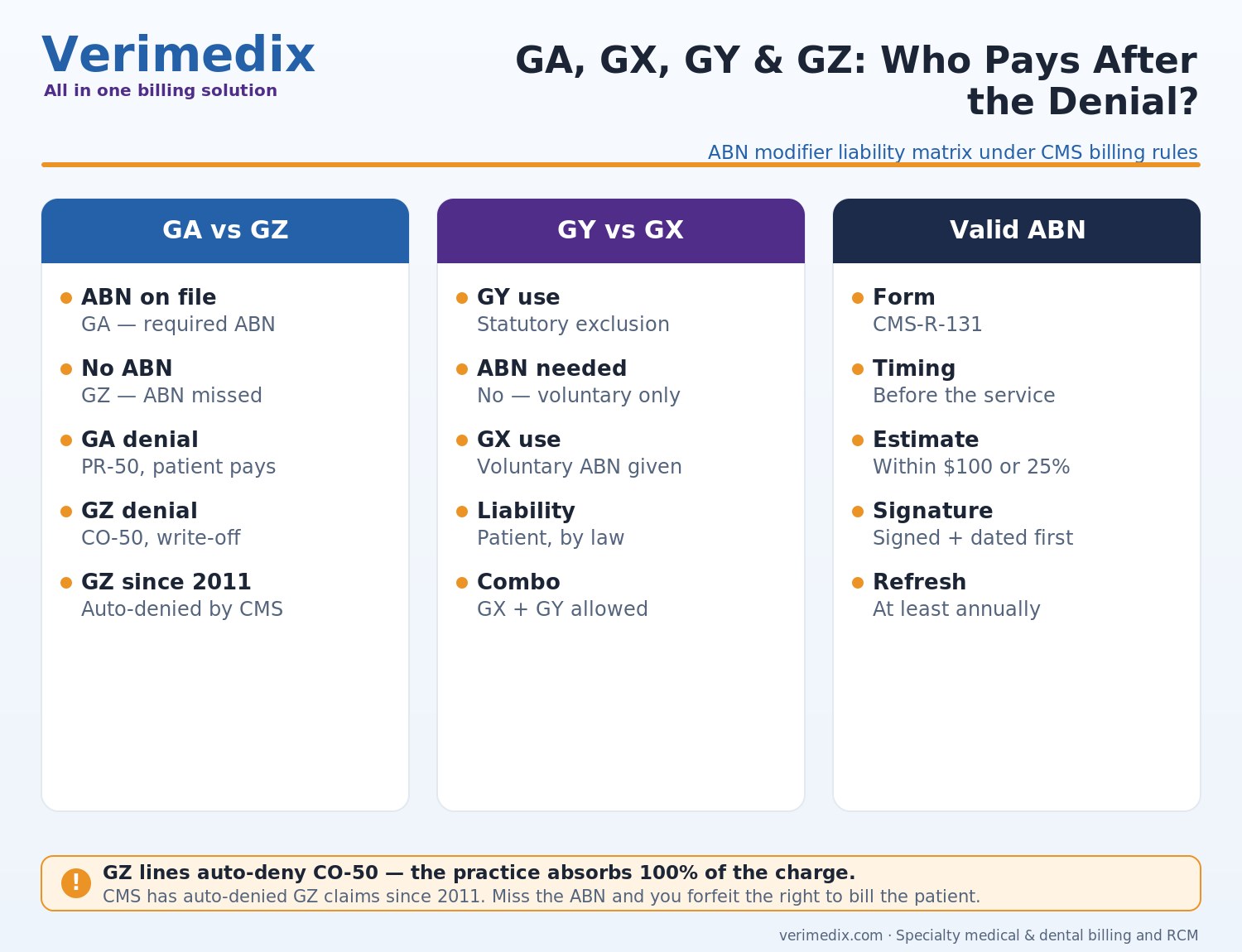
- GA means a required ABN is signed and on file — Medicare denies the line as PR-50 and the patient legally owes the balance.
- GZ means a required ABN was not obtained — Medicare auto-denies the line CO-50 and your practice absorbs the full charge.
- GY flags services statutorily excluded from Medicare (never covered); no ABN is required and the patient is liable.
- GX reports a voluntary ABN issued as a courtesy for excluded services, and it can be combined with GY on the same line.
- A valid ABN uses form CMS-R-131, is signed before the service, and carries a good-faith cost estimate — the revised form took effect March 13, 2026.
- The group code is the whole game: PR shifts the dollars to the patient; CO turns them into a write-off you cannot bill anyone for.
Every claim line Medicare refuses to pay lands in one of two buckets on the remittance: patient responsibility (PR), which you may collect from the beneficiary, or contractual obligation (CO), which you must absorb. These four two-letter codes are how you tell Medicare — in advance — which bucket a predictable denial belongs in. Choose correctly and the denial becomes collectible patient revenue; skip the Advance Beneficiary Notice and the same denial becomes money your practice can never recover.
What the four ABN modifiers actually do
All four revolve around one document: the Advance Beneficiary Notice of Noncoverage (ABN), form CMS-R-131 — a written warning, delivered before the service, that Medicare is expected to deny payment and the patient agrees to pay if it does. GA and GZ apply to services Medicare usually covers but is expected to deny in a specific case, typically for medical necessity or frequency. GY and GX apply to services Medicare never covers by statute — hearing aids, most routine dental work, cosmetic procedures, refractive eye exams.
The ABN is only mandatory for the first group; for statutory exclusions, notice is optional because beneficiaries are liable by law. Many practices still issue a voluntary ABN for excluded services to prevent billing disputes — GX documents that they did.
When an ABN is required — and when it is voluntary
A mandatory ABN requires a genuine, specific reason to expect denial of a normally covered service — a blanket ABN handed to every Medicare patient is invalid and a compliance red flag. Common triggers: LCD/NCD criteria, frequency limits, and therapy beyond the KX threshold that may not meet medical necessity (see our KX modifier guide).
| Situation | ABN type | Modifier to append | Examples |
|---|---|---|---|
| Covered service, denial expected for medical necessity or frequency | Mandatory — required to bill the patient | GA (ABN signed) / GZ (ABN missed) | Routine foot care without a qualifying systemic condition; screening labs beyond frequency limits; therapy visits unlikely to meet necessity; non-covered diagnoses under an LCD |
| Statutorily excluded service (never covered) | Voluntary — courtesy notice only | GY (alone) or GX + GY | Hearing aids, cosmetic surgery, most routine dental care, eye refractions, personal comfort items |
| Covered service expected to pay | None — do not issue an ABN | No liability modifier | Any service meeting coverage rules; routine blanket ABNs are prohibited |
GA vs GX vs GY vs GZ: the liability matrix
Here is the matrix worth taping to every biller's monitor. The two columns that drive revenue are the group code on the remittance and whether you can pursue the patient.
| Modifier | ABN status | When to use it | How the denial posts | Who pays |
|---|---|---|---|---|
| GA | Mandatory ABN signed and on file | Covered service, specific reason to expect a medical-necessity or frequency denial | Typically PR-50 (not medically necessary, patient responsibility) | Patient — you may bill the beneficiary |
| GZ | Mandatory ABN required but NOT obtained | Same denial expectation as GA, but no valid ABN exists | Auto-denied CO-50 — CMS instructed contractors to deny GZ lines automatically (CR 7228, effective July 2011) | Provider — write-off; billing the patient is prohibited |
| GY | No ABN required (statutory exclusion) | Service excluded from Medicare by law; claim filed to generate a denial for secondary insurance or patient records | Denies as not covered, patient liable (often PR group with remark codes) | Patient — liability exists with or without notice |
| GX | Voluntary ABN issued as a courtesy | Excluded service where you gave written notice anyway; may be combined with GY | Line denies as not covered; GX on a covered service causes the line to be rejected | Patient |
Two practical notes. Never submit the ABN document itself with the claim — keep it in the record and produce it on request. And while this matrix is Medicare fee-for-service logic, it is spreading: several Medicare Advantage and commercial payers now mirror these liability rules, and UnitedHealthcare's 2026 commercial policies require Medicare-style waiver documentation before members can be held liable. Confirm each plan's policy before billing a patient.
The 7-point valid ABN checklist
An ABN only shifts liability if it would survive an auditor's review. CMS is specific about what makes a notice defective, and a defective ABN converts your GA claim into a GZ outcome. Run every notice against this checklist:
- Current official form. Use form CMS-R-131. A revised version became effective March 13, 2026; CMS allowed the prior version through May 12, 2026, and the current form shows an expiration date of March 31, 2029.
- Delivered before the service — never after, and never during an emergency or under duress.
- Specific service listed, in language the patient can understand — not "labs" but the actual test or procedure.
- Specific reason Medicare is expected to deny (e.g., "Medicare does not pay for this test this often").
- Good-faith cost estimate. CMS guidance expects the estimate to fall within $100 or 25% of the actual cost.
- Option box selected, signed, and dated by the patient, with a copy given to them. Option 1 (bill Medicare) is what supports a GA claim.
- Refreshed at least annually. For repetitive services, one ABN can cover a course of treatment for up to one year; after that, or if the treatment plan changes, issue a new one.
How the denials post: PR-50 vs CO-50 and what to do next
On the 835 remittance, the modifier you chose upstream determines the group code downstream. The most common landing spot is adjustment reason code 50 — "not deemed a medical necessity" — which we break down fully in our CO-50 denial code guide. The crosswalk below shows the usual outcomes and the correct next move for each.
| Scenario on the claim | Typical remit result | Bill the patient? | Correct next step |
|---|---|---|---|
| GA appended, valid ABN on file | PR-50 denial | Yes — the charge estimated on the ABN | Move the balance to patient responsibility; send a statement referencing the signed ABN |
| GZ appended (ABN missed) | Automatic CO-50 denial | No | Write off; fix the front-end screening gap that missed the ABN trigger |
| GY appended (statutory exclusion) | Not-covered denial, patient liable | Yes | Forward the denial to secondary insurance if any, then bill the patient |
| No modifier, claim denies for necessity | CO-50 | No — liability was never shifted | Appeal only if the service genuinely met coverage criteria; otherwise write off |
| GA appended but ABN is defective or late | PR-50 initially, but liability collapses on audit | Risky — refunds and penalties possible | Treat as GZ internally; do not pursue the patient |
Worth internalizing: GZ is not an admission that hurts you — it is the honest flag that protects you. Billing GA without a valid ABN, or omitting liability modifiers to dodge scrutiny, is the pattern that draws false-claims attention. For the full group-code taxonomy, see our CARC and RARC guide.
What ABN discipline is worth: a worked example
The numbers below are illustrative, but the mechanism is real in podiatry, therapy, labs, and primary care alike. Suppose a practice furnishes 30 services per month that Medicare predictably denies — routine foot care, frequency-capped tests, maintenance therapy — at an average charge of $95.
- With an ABN workflow (GA): all 30 lines deny PR-50. The practice bills patients $2,850 and, at a realistic 70% patient-collection rate, recovers about $1,995 per month — roughly $23,900 per year.
- Without one (GZ): the same 30 lines auto-deny CO-50. Collectible revenue: $0, plus the write-off work.
- The worst case (no modifier, no ABN): same $0 — with added audit exposure if the pattern suggests the practice knew denials were likely.
The entire difference is a two-minute front-desk conversation and a signature, captured before the patient is seen.
Common ABN modifier mistakes
- Blanket ABNs. Routine notices for every Medicare patient invalidate the document and can trigger beneficiary complaints.
- Swapping GY and GZ. GY is for services never covered by statute; GZ is for covered services missing a required ABN. Confusing them either forfeits collectible balances or bills patients improperly.
- Using GX on covered services. Medicare rejects those lines outright.
- Letting ABNs age out. A notice signed 14 months ago does not protect this week's visit in a repetitive course.
- Assuming commercial payers work the same way. Many require their own waiver forms; verify each plan's policy before billing members.
Quick Answers
What does the GA modifier mean? GA reports that a mandatory ABN was signed before a covered service that Medicare is expected to deny for medical necessity. When the denial arrives as PR-50, the patient is financially responsible.
What is the difference between GA and GZ? Both anticipate a medical-necessity denial on a normally covered service. GA means a valid ABN is on file, so the patient pays; GZ means no ABN was obtained, so Medicare auto-denies the line CO-50 and the provider absorbs the cost.
When should I use the GY modifier? Use GY when the service is statutorily excluded from Medicare — such as hearing aids or most routine dental care — and you are filing the claim to obtain a formal denial for secondary insurance or the patient's records. No ABN is required.
What is the GX modifier used for? GX reports that you issued a voluntary ABN for a service Medicare never covers. It is frequently billed together with GY and cannot be used on covered services.
Do ABN modifiers apply to commercial insurance? They are Medicare fee-for-service modifiers, but many Medicare Advantage plans and some commercial payers — including UnitedHealthcare under its 2026 policy alignment — apply similar waiver-of-liability logic. Check each plan's policy.
Frequently asked questions
No. Services excluded by statute — hearing aids, cosmetic procedures, most routine dental care — never require an ABN because the patient is liable by law. You may issue a voluntary ABN as a courtesy and report it with the GX modifier, usually alongside GY.
No. GZ tells Medicare a required ABN was not obtained, and the contractor automatically denies the line as CO-50, a provider-liable contractual obligation. Billing the beneficiary after a GZ denial is prohibited and the balance must be written off.
No. Keep the signed CMS-R-131 in the patient's record and append the GA modifier to the claim line. Medicare or an auditor can request the document later, and you must be able to produce it — a missing or defective ABN collapses the patient's liability.
For a repetitive course of treatment, a single ABN can remain effective for up to one year, provided the services, reason for expected denial, and treatment plan stay the same. After a year — or any material change — you must issue a new notice before liability shifts to the patient.
GA claims typically deny PR-50 (patient responsible), GZ lines auto-deny CO-50 (provider write-off), and GY or GX lines deny as statutorily non-covered with the beneficiary liable. The group code — PR versus CO — determines whether you can pursue the patient.