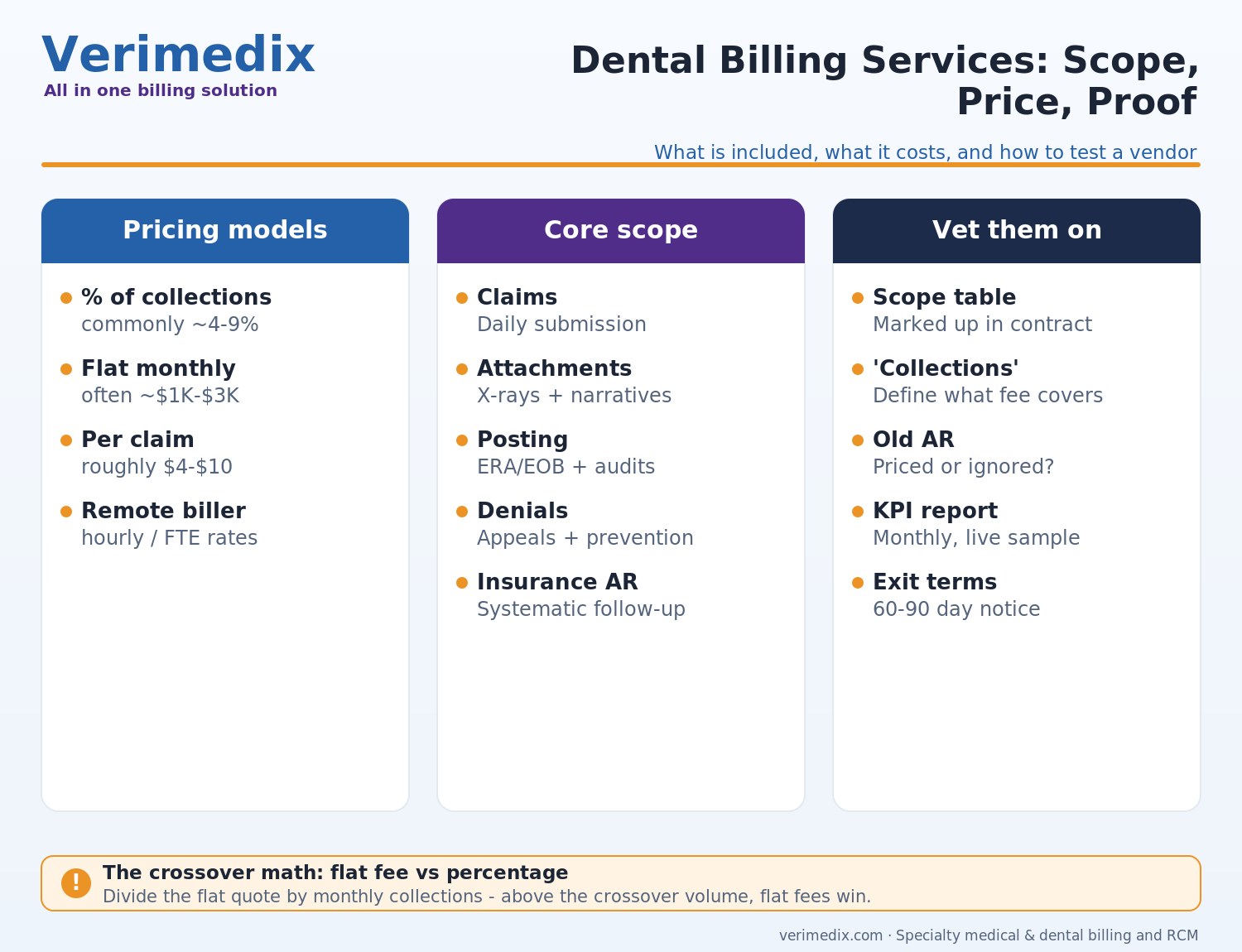
- Core dental billing service scope is payer-facing: claim batching and submission, attachments and narratives, ERA/EOB posting, denial appeals, and insurance AR follow-up. Verification and patient billing are usually add-ons.
- Three dominant pricing models: percentage of collections (commonly ~4–9%, with published ranges spanning roughly 3–10%), flat monthly fees (often ~$1,000–$3,000 by practice size), and per-claim fees (roughly $4–$10).
- Scope drives price more than vendor brand does — a claims-only engagement should not cost what full revenue cycle management costs.
- The vetting list matters more than the sales demo: PMS access model, denial workflow, old-AR handling, what counts as “collections,” and exit terms are where bad contracts hide.
- Judge candidates against benchmark outcomes — 98%+ collection rate, 95%+ clean claim rate — and require a monthly KPI report as a contract term.
- All fee figures are illustrative industry ranges; get current written quotes and confirm scope line by line.
What dental billing services actually include
Strip away the marketing language and a dental billing engagement is a set of payer-facing tasks performed daily inside (or alongside) your practice management system. The table below separates the near-universal core from the add-ons that vary by vendor — the source of most “I thought you handled that” disputes.
| Scope tier | Tasks | Usually included? |
|---|---|---|
| Core claims work | Daily claim batching and submission, clearinghouse rejection work, CDT code and attachment review (radiographs, perio charts, narratives) | Yes — the definition of the service |
| Payment posting | ERA/EOB posting, adjustment accuracy, underpayment flagging against fee schedules | Almost always |
| Denials & insurance AR | Denial categorization, appeals with supporting documentation, systematic follow-up on unpaid claims | Usually — but ask how old AR at start-up is handled |
| Insurance verification | Eligibility checks and full benefit breakdowns before visits | Add-on or separate service; see our verification services cost guide |
| Patient billing | Statements, payment plans, patient collections cadence | Add-on; standard only in full dental RCM engagements |
| Credentialing & fee schedules | Payer enrollment, fee schedule entry and audits, PPO analysis | Separate service at most firms |
The daily-work detail worth probing: does the vendor work rejections every day and submit claims within 24–48 hours of the date of service? Charge lag and unworked rejections are the two quiet killers of dental collections, and they are pure process discipline. You can see how Verimedix scopes these tiers on our dental billing specialty page.
Dental billing service pricing in 2026
Ranges below reflect rates published across the dental billing industry in 2025–2026 — including vendor pricing pages and cost surveys — and they overlap heavily; the same practice can receive quotes under all three models. Treat them as planning figures, not promises.
| Model | Typical range | Best for | Watch for |
|---|---|---|---|
| Percentage of collections | Commonly ~4–9% (published ranges span roughly 3–10%) | Practices that want vendor incentives tied to results | What counts as “collections” — patient payments your own desk collects should be negotiated out |
| Flat monthly fee | Often ~$1,000–$3,000 by size and scope; startup practices sometimes lower | High-collection practices where a percentage would overpay | Volume caps and overage clauses; fee creep at renewal |
| Per-claim | Roughly $4–$10 per claim | Low-volume or specialty workflows | Whether denials, appeals and resubmissions are included or billed again |
| Dedicated remote biller | Hourly/FTE pricing; varies widely onshore vs offshore | Practices that want a named person inside their systems | Training and oversight stay with you; turnover coverage |
Scope moves price more than model does: claims-only sits at the bottom of the percentage range, while engagements adding verification and patient billing climb toward the top. We break down the fee mechanics — including effective-rate math that shows when a flat fee beats a percentage — in our companion guide to dental billing company pricing models, and survey the broader landscape in dental billing outsourcing models and costs.
The CDT competence test: where billing services earn their fee
Any service can submit a prophy claim. The fee is earned on the codes payers fight about. Use this table as a competence probe — ask candidate vendors how they handle each row and listen for specifics.
| CDT area | Common denial trigger | What a good service does |
|---|---|---|
| D4341/D4342 SRP | Missing perio charting, pocket depths below payer thresholds | Submits full perio chart + radiographs; checks frequency history first |
| D2740/D2750 crowns | No pre-op radiograph/narrative proving decay or fracture | Attaches diagnostic imaging and clinical narrative on first submission |
| D2950 buildups | Bundled into crown as “inclusive” | Documents structural necessity separately; appeals bundling denials |
| D4910 perio maintenance | Billed without SRP history on file with the payer | Verifies perio history before scheduling gets billed |
| D7140/D7210 extractions | Surgical extraction downcoded without sectioning/bone removal documented | Narrative states elevation of flap or bone removal explicitly |
A vendor who answers these rows fluently — payer thresholds, attachment requirements, appeal language — will out-collect a cheaper generalist by more than the fee difference. For the denial side of this competence, our guide to the most common dental claim denials is the checklist their workflow should mirror.
The 10-question vetting list
We published a shorter pre-signing screen in how to choose a dental billing company; the list below extends it into a full due-diligence script for final-round candidates.
- Exactly which tasks in the scope table above are included at the quoted price? Get the marked-up table in the contract.
- What counts as “collections” for your fee? Insurance only, or every dollar including cash patients my desk collects?
- Who works my existing AR backlog, and at what price? Go-forward-only quotes leave your oldest money dying.
- Do you work inside my PMS with audit-trailed logins, or export my data elsewhere?
- What is your claim submission SLA and rejection turnaround? Daily submission, rejections worked within 24–48 hours.
- Show me your denial workflow — categorization, appeal templates, and how root causes get fixed, not just appealed.
- What KPI report do I get monthly, and can I see a live sample? Collection rate, clean claim rate, days in AR, aging buckets.
- Who exactly touches my accounts — dedicated or pooled staff, onshore or offshore, under what HIPAA training and BAA?
- What are the contract term, minimum fees, rate-change clauses, and exit terms? Ninety days notice or less is reasonable; long lock-ins are not.
- Give me two references on my PMS and payer mix — Medicaid-heavy and PPO-heavy practices are different jobs.
Worked example: comparing two real-shaped quotes
Illustrative numbers. A practice collects $80,000 a month from insurance. Vendor A quotes 5% of collections, claims-plus-AR scope. Vendor B quotes a $2,400 flat monthly fee for the same scope.
- Vendor A: $80,000 × 5% = $4,000/month ($48,000/year)
- Vendor B: $2,400/month ($28,800/year) — an effective 3.0% at current volume
- Crossover: $2,400 ÷ 0.05 = $48,000. Below $48K/month in collections, the percentage deal is cheaper; above it, the flat fee wins
But finish the math: if Vendor A’s denial and AR work lifts collections just 3% (to $82,400), it generates $28,800 a year in new revenue — offsetting most of the fee gap. The cheaper vendor is only cheaper if performance is equal, which is exactly what the 10 questions and the CDT competence test are designed to find out. Practices comparing named vendors can start from our roundup of the 10 best dental billing companies, and see full outsourcing mechanics in the complete outsourcing guide.
For a payer-aware periodontal antimicrobial workflow, see our guide to the Arestin dental code before you submit a claim.
Quick Answers
What do dental billing services do? They handle payer-facing revenue work: claim submission with attachments, ERA/EOB posting, denial appeals, and insurance AR follow-up — with verification, patient billing, and credentialing as common add-ons.
How much do dental billing services cost? Most commonly a percentage of collections, typically quoted around 4–9%, or a flat monthly fee often in the $1,000–$3,000 range; per-claim pricing runs roughly $4–$10. Scope and practice size move the number.
Are dental billing services worth it? When your collection rate sits meaningfully below 98%, denials go unappealed, or AR over 90 days keeps growing, recovered revenue frequently exceeds the fee. At 98%+ already, you are buying staff resilience, not found money.
How do I choose a dental billing service? Match scope to your leak, test CDT competence on codes like SRP and crowns, require monthly KPI reporting, and run the 10-question vetting list before signing.
Do dental billing services work in my software? Reputable ones work inside Dentrix, Eaglesoft, Open Dental, Curve and similar systems under audit-trailed logins — treat any vendor that must move your data into their own platform as a separate risk decision.
Frequently asked questions
Billing services own the payer-facing middle of the cycle — claims, posting, denials, insurance AR. RCM services add front-end verification, back-end patient billing, and cross-cycle analytics. The labels are used loosely, so compare marked-up scope tables rather than service names.
Most established services work inside the major systems — Dentrix, Eaglesoft, Open Dental, Curve — through remote logins with audit trails. Confirm your specific PMS and version, ask for references using it, and clarify who pays for any additional user licenses.
Typically 2–4 weeks for access, fee schedule review, and workflow setup, with the first full month running in parallel with your team. Collections improvements usually follow the arc of the work: cleaner claims within 30–60 days, AR movement over 60–120 days.
Divide the flat quote by your monthly collections to get its effective percentage, then compare. Lower-collection practices usually do better on percentage; higher-collection practices on flat fees — but only when scope and performance are genuinely equal between the quotes.
Exit terms are a top-five contract issue: look for 60–90 day notice, explicit data-return commitments in your PMS (not a proprietary export), and no fees on claims collected after departure that you did not agree to. Get transition responsibilities in writing before signing, not when leaving.