- Percentage-of-collections is the dominant model; industry-published ranges span roughly 3–10%, with most full-service quotes landing around 4–9% depending on scope and practice size.
- The contract definition of “collections” is worth more than the headline rate: a 5% fee on all collections (including cash your front desk takes) can cost more than 7% on insurance collections only.
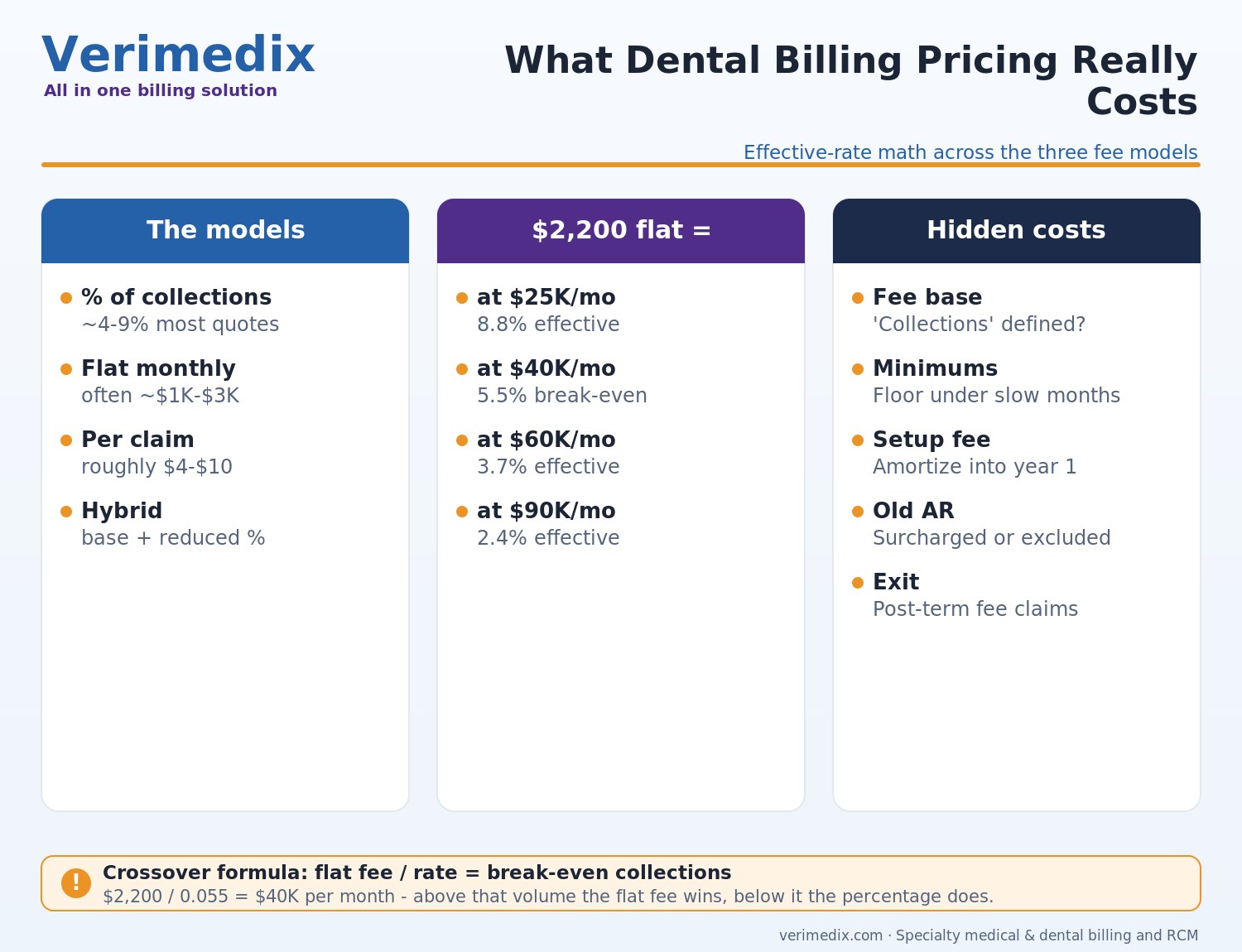
- Flat fees beat percentages above a crossover volume you can compute in one line: flat fee ÷ percentage rate = the monthly collections where the two models cost the same.
- Per-claim pricing looks cheap until denials arrive — always ask whether resubmissions and appeals are included or billed as new claims.
- Setup fees, monthly minimums, old-AR surcharges, and rate-escalation clauses can add 1–2 effective points to any quoted rate; model the all-in first-year cost, not the headline.
- All figures are illustrative industry ranges from published 2025–2026 rates; obtain current written quotes.
The three pricing models, mechanically
Before comparing quotes, understand what each structure actually charges for. The table summarizes mechanics and failure modes; the sections after it go deeper on the two models that dominate real contracts.
Pricing is only half the vendor decision — for a ranked market view, see our list of the best dental billing companies before negotiating any fee model.
| Model | Typical published range | You pay for | Failure mode |
|---|---|---|---|
| % of collections | ~4–9% common; ~3–10% across the market | Results — the fee scales with dollars actually collected | Loose “collections” definitions; fees on money the vendor never touched |
| Flat monthly fee | Often ~$1,000–$3,000 by size/scope | Capacity — a defined workload each month | Volume caps, overage clauses, no incentive on the marginal claim |
| Per-claim | Roughly $4–$10 per claim | Transactions — each submission | Denied claim reworked = second fee, unless contracted otherwise |
| Hybrid | Small base + reduced % | Vendor’s fixed costs plus performance upside | Complexity; two numbers to audit instead of one |
Percentage of collections: the questions inside the rate
Three contract questions determine what a percentage quote really costs.
1. Percentage of what? The defensible base is collections the vendor’s work produced — insurance payments and patient balances they billed and pursued. Some contracts charge on total practice collections, including hygiene cash, in-house membership plans, and copays your front desk collects at checkout. On a practice collecting $30,000 a month at the desk, a 5% fee on that untouched money is $1,500 a month for nothing. Negotiate the base explicitly.
2. When is the fee earned? Fees should follow posted collections, not submitted charges. Confirm how refunds, takebacks, and credit balances net against the fee, and what happens to claims collected after termination.
3. What scope sits inside the rate? A 4% claims-only quote and a 8% quote including verification, patient billing and credentialing support are not the same product at different prices — they are different products. Scope tiers are mapped in our companion buyer’s guide to dental billing services.
The model’s genuine strength is alignment: the vendor earns more only when you collect more, which is why it dominates among established firms. Its weakness is that well-run, high-collection practices end up paying the most dollars for the least marginal effort — which is exactly when flat fees deserve a look.
Flat fees and per-claim rates: when structure beats alignment
Flat monthly fees suit practices with high, stable collections: the workload is predictable and a percentage would overpay. Published flat rates cluster around $1,000–$3,000 monthly for single locations depending on scope, with some startup-practice programs priced lower during ramp-up while claim volume builds. Check three clauses: the claim-volume cap and overage rate, the renewal escalation, and whether denial appeals are inside the fee.
Per-claim pricing (roughly $4–$10 per claim across published rates) fits low-volume or specialty situations — a startup’s first months, an ortho practice with contract billing, an oral surgery office splitting work across medical and dental payers. The decisive question: is a rejected, corrected, and resubmitted claim one fee or two? And are appeals included at all? A $5 per-claim rate that bills every touch can quietly exceed a 6% percentage deal on a denial-heavy payer mix.
For the broader landscape these models sit inside — onshore vs offshore teams, dedicated billers, full RCM — see our overview of dental billing outsourcing models and costs.
Effective-rate math: one worked example
Illustrative example — swap in your own numbers. Two practices receive identical quotes: 5.5% of collections, or $2,200 flat per month. Same scope, same vendor quality.
| Monthly insurance collections | 5.5% fee | $2,200 flat — effective rate | Cheaper model |
|---|---|---|---|
| $40,000 | $2,200 | 5.5% | Break-even |
| $60,000 | $3,300 | 3.7% | Flat |
| $90,000 | $4,950 | 2.4% | Flat |
| $25,000 | $1,375 | 8.8% | Percentage |
The crossover formula: flat fee ÷ rate = break-even collections ($2,200 ÷ 0.055 = $40,000). Then adjust for the all-in cost: add setup fees (commonly a few hundred to a couple thousand dollars, amortized over year one), any monthly minimum on the percentage deal, and old-AR cleanup if priced separately. A quoted 5.5% with a $1,800 minimum behaves like a flat fee in slow months — the worst of both structures for a seasonal practice.
One more adjustment matters most: expected performance. If the percentage vendor’s denial and AR work credibly lifts collections 2–3% and the flat vendor’s does not, the “more expensive” model can net more cash. Fee minimization and revenue maximization are different objectives; decide which one you are buying.
Which model fits: a 4-question decision tree
- Are monthly insurance collections under ~$40–50K? Percentage pricing usually costs less in dollars and keeps the vendor motivated while volume grows.
- Collections high and stable, cycle already healthy? Flat fee — compute the effective rate and hold it under the percentage quotes.
- Volume low, irregular, or specialty-shaped? Per-claim, with resubmissions and appeals contractually included.
- Collections underperforming (rate below ~98%, AR over 90 days above ~10–15%)? Bias toward percentage with a performance-aligned vendor — you are buying recovery, not throughput. Benchmarks and scope for that fuller engagement are covered in our dental RCM services guide.
Whichever branch you land on, run the vendor through the pre-signing screen in how to choose a dental billing company, and compare the quote against the scope and vetting framework on our dental billing specialty page. Price negotiations go better when the vendor knows you have computed your own effective rate.
Five contract terms that change the real price
- Monthly minimums: a floor under percentage fees; fine if modest, punitive if set near your average month.
- Setup/onboarding fees: amortize into year-one cost when comparing vendors; some waive them in negotiation.
- Old-AR surcharges: backlog cleanup at a higher rate (or excluded entirely) — clarify before signing, because your oldest claims are the ones aging toward timely-filing death.
- Rate escalation: automatic annual increases or renewal-time renegotiation clauses.
- Termination mechanics: notice period, fees on post-termination collections, and data return format. Ninety days and a clean PMS handback is a fair ask.
When comparing quotes, note that full-service dental billing partners such as Verimedix price on transparent percentage-of-collections with credentialing support included — the effective-rate math below is the fairest way to compare any two proposals.
Quick Answers
What percentage do dental billing companies charge? Published rates most commonly fall around 4–9% of collections, with the wider market spanning roughly 3–10% depending on scope, practice size, and payer mix. Always confirm current quotes in writing.
Is a flat fee cheaper than a percentage of collections? Above the crossover volume — flat fee divided by the percentage rate — yes. A $2,200 flat fee beats a 5.5% rate once monthly collections exceed $40,000, all else equal.
What should count as “collections” in a percentage contract? Dollars the vendor’s work produced: insurance payments and balances they billed and pursued. Cash and copays your own front desk collects should be negotiated out of the fee base.
Do dental billing companies charge setup fees? Many charge onboarding fees ranging from a few hundred to a couple thousand dollars, and some price old-AR cleanup separately; fold both into your first-year cost comparison.
Is per-claim pricing a good deal? Only when resubmissions and appeals are contractually included. A low per-claim rate that charges for every touch can exceed a mid-range percentage on a denial-heavy mix.
Frequently asked questions
Scope is the biggest driver: claims-only engagements sit at the bottom of the range while full-cycle work including verification and patient billing sits at the top. Practice size matters too — larger collection bases command lower rates — along with payer mix, since Medicaid- and denial-heavy practices take more labor per collected dollar.
The incentive runs the right direction — they earn more when you collect more — but it should never reach coding. Clinical coding decisions belong to the treating dentist; a billing partner optimizes documentation, attachments, and follow-up. Any vendor suggesting more aggressive coding to lift the fee base is a compliance risk, not a growth strategy.
Only to patient balances the vendor actually bills and pursues — statements they send, payment plans they manage. Copays and treatment payments your front desk collects at checkout involve no vendor labor, and a well-negotiated contract excludes them from the fee base.
Convert everything to an effective percentage: divide each all-in monthly cost (fee plus amortized setup, minimums, and expected overages) by your average monthly collections. Then weigh residual differences — scope, reporting, references — at equal effective rates.
Yes, and you should: percentage models get more expensive in dollars every year your collections grow while the vendor's marginal work barely changes. Volume-tiered rates or a shift to flat pricing at renewal are both common asks; a vendor unwilling to discuss either at meaningful volume is pricing on inertia.