- Full-cycle dental RCM covers seven linked stages, from pre-visit verification through reporting — and revenue leaks at the handoffs between stages, which is exactly what a full-cycle service is built to close.
- RCM services differ from plain billing services in scope: billing services typically own claims and insurance AR, while RCM engagements add verification, patient billing, fee schedule maintenance, and analytics.
- Hold any partner to benchmark KPIs: 98%+ net collection rate, clean claim rate of 95%+, days in AR around 30–45 or better, and aged AR over 90 days below roughly 10–15% of total.
- Delivery models are in-house, fully outsourced, or hybrid — the hybrid (your team owns patient-facing steps, the vendor owns payer-facing steps) is often the practical winner for single-location practices.
- Full-cycle pricing usually runs as a percentage of collections, commonly in the 4–9% range depending on scope, with flat-fee and per-claim variants for narrower engagements; verify current quotes.
- Worked example below (illustrative): moving a $95K/month practice from a 91% to a 97% collection rate is worth roughly $68K a year — more than most full-cycle fees.
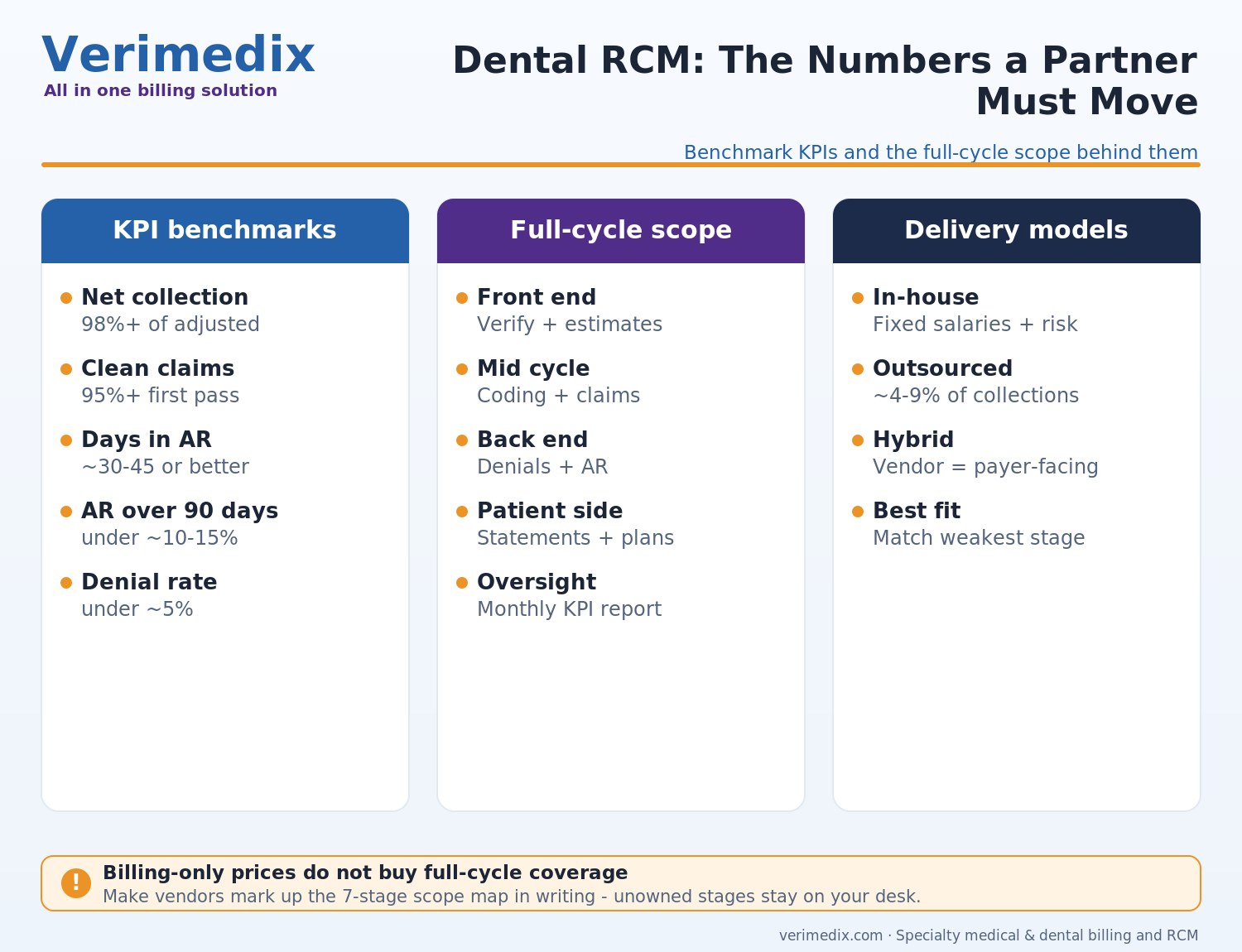
The full-cycle scope map: what dental RCM services cover
Think of the revenue cycle as a relay race that starts before the patient arrives and ends when the last dollar is posted and reconciled. A genuine full-cycle engagement assigns an owner to every leg. Here is the scope map to hold against any vendor proposal — anything they do not own stays on your team’s desk.
| Stage | What it includes | Where revenue leaks without an owner |
|---|---|---|
| 1. Pre-visit | Insurance verification, benefit breakdowns, patient cost estimates | Coverage surprises, frequency denials, uncollectable balances |
| 2. Documentation & coding | CDT code review, narratives, attachments (radiographs, perio charting) | Downcoding, attachment-related denials, audit exposure |
| 3. Claim submission | Daily batching, clearinghouse edits, rejection work | Charge lag, timely filing losses, silent rejections |
| 4. Payment posting | EOB/ERA posting, adjustment accuracy, credit balance handling | Misposted write-offs hiding underpayments |
| 5. Denial management | Denial categorization, appeals with documentation, root-cause fixes | Denials aging out unworked; repeat denials never prevented |
| 6. Patient billing | Statements, text/email payment options, payment plans, collections cadence | Patient AR drifting past 90 days and dying |
| 7. AR & reporting | Insurance AR follow-up, aging worklists, KPI dashboards, fee schedule maintenance | Nobody notices the trend until the year-end accountant does |
For a deeper conceptual walkthrough of each stage — the informational companion to this buyer’s guide — see our complete dental RCM guide. This article assumes you understand the cycle and are deciding who should run it.
RCM services vs dental billing services: scope is the difference
Vendors use these labels loosely, so contracts matter more than marketing pages. A typical dental billing service owns stages 3 through 5 for insurance claims — submission, posting, and insurance AR — and stops there. A full-cycle RCM engagement adds verification on the front end, patient billing on the back end, and the analytics layer across everything. Some also take on fee schedule audits and PPO participation analysis, which connect directly to PPO reimbursement strategy.
Neither is inherently better. A practice with a strong front desk and weak claims follow-up needs billing-only; a short-staffed practice bleeding at both ends needs full-cycle. The expensive mistake is paying billing-only prices while assuming full-cycle coverage — then discovering six months in that nobody owned patient AR. Make the vendor mark up this exact scope map, stage by stage, in writing.
The KPIs a dental RCM partner should move
Every credible RCM service reports monthly against benchmarks. These targets align with the ones we use in our dental AR reduction guide and are consistent with figures published across the dental billing industry; treat exact thresholds as goals, not guarantees.
| KPI | Benchmark | What it tells you |
|---|---|---|
| Net collection rate | 98%+ of adjusted production | The single most important number: of what you were entitled to collect, how much arrived |
| Clean claim rate | 95%+ accepted first pass | Quality of verification, coding, and attachments upstream |
| Days in AR | ~30–45 or better | Speed of the whole cycle; see how days in AR is calculated |
| AR over 90 days | Under ~10–15% of total AR | Whether old claims are worked or quietly dying |
| Denial rate | Under ~5% of claims | Prevention discipline, not just appeal hustle |
| Verification rate | 100% of scheduled patients | Front-end leak protection |
Two vetting implications. First, ask every candidate vendor for a sample monthly report before signing — if it does not show these KPIs with trend lines, the service is doing tasks, not managing revenue. Second, insist on a baseline measurement of your current numbers in the first month; without it, you will never know whether the fee is buying improvement or just activity.
In-house vs outsourced vs hybrid
| Factor | In-house team | Fully outsourced RCM | Hybrid |
|---|---|---|---|
| Cost shape | Fixed salaries + software + training | Usually % of collections (commonly 4–9% by scope) | Salaries for front office + smaller vendor fee |
| Expertise depth | Depends on who you can hire and keep | Specialist teams across payers and CDT updates | Vendor depth on payer-facing work |
| Turnover risk | High — one resignation can stall the cycle | Vendor absorbs it | Reduced; patient-facing roles still yours |
| Control & visibility | Maximum, if you have time to look | Depends on reporting quality — contract for it | Balanced |
| Best fit | Larger practices/DSOs with dedicated billing managers | Short-staffed practices; owners who want one accountable partner | Single-location practices with a solid front desk |
The hybrid deserves emphasis because it matches how dental teams actually break: front desks are usually good at patient-facing work (scheduling, estimates, chairside conversations) and chronically underwater on payer-facing work (claims follow-up, appeals, insurance AR). Handing the payer-facing half to a specialist team while keeping patient relationships in-house preserves the practice’s voice and fixes the part that was actually failing. Staffing pressure is often the deciding variable — our guide to dental staffing challenges covers how shortages translate into revenue loss.
What full-cycle RCM is worth: a worked example
Illustrative numbers — substitute your own. A practice produces $95,000 a month after adjustments and currently collects 91% of it, a common profile when claims follow-up and patient AR are running behind. That is $8,550 a month left on the table.
- Current collections: $95,000 × 91% = $86,450/month
- At a 97% collection rate: $95,000 × 97% = $92,150/month
- Recovered revenue: $5,700/month ≈ $68,400/year
- Full-cycle fee at 6% of collections: about $5,530/month on the improved base
In this scenario the fee and the recovery are the same order of magnitude — which is the honest way to frame RCM outsourcing. It clears its cost when your current collection rate has real room to improve, when unworked aging AR exists to recover, or when the alternative is hiring: a biller’s salary plus benefits plus turnover risk often exceeds the vendor fee for a practice this size. If you are already collecting 98%+ with current staff, a full-cycle engagement buys resilience and time, not found money — a legitimate purchase, but a different one.
How to choose a dental RCM partner: a 7-question screen
- Which stages of the scope map do you own, in writing? Ambiguity here is where engagements fail.
- What KPIs do you report monthly, and can I see a sample report?
- Who works my old AR at start-up, and is backlog cleanup priced separately? Many vendors quote go-forward work only.
- Do you work inside my PMS (Dentrix, Eaglesoft, Open Dental, Curve) or export data to your own system?
- How do you handle denials — appeals only, or root-cause prevention with documented fixes?
- What is the fee, what counts as “collections,” and what are the minimums and exit terms? Pricing mechanics are covered in depth in our guide to dental billing company pricing models.
- Who exactly touches my accounts — dedicated team or shared pool, onshore or offshore, and under what HIPAA controls?
Practices comparing full-cycle partners can also review the scope Verimedix covers on our dental billing specialty page, and cross-check candidates against our roundup of the best dental billing companies.
Quick Answers
What are dental RCM services? Full-cycle management of a dental practice’s revenue: insurance verification, coding review, claim submission, payment posting, denial management, patient billing, AR follow-up, and KPI reporting under one accountable partner.
How is RCM different from dental billing? Billing services typically own claims and insurance AR; RCM adds front-end verification, back-end patient billing, and analytics across the whole cycle.
What do dental RCM services cost? Full-cycle engagements are most often priced as a percentage of collections, commonly in the 4–9% range depending on scope and practice size; flat-fee and per-claim models exist for narrower work. Get current quotes.
What KPIs should a dental RCM company hit? Net collection rate of 98%+, clean claim rate of 95%+, days in AR around 30–45, AR over 90 days under roughly 10–15%, and denial rate below about 5%.
Should a small practice outsource RCM fully or partially? A hybrid — vendor owns payer-facing work, your front desk owns patient-facing work — is often the best fit for single-location practices with a capable front office.
Frequently asked questions
No. Even in a fully outsourced model, scheduling, chairside financial conversations, and treatment acceptance stay with your team. RCM services replace the payer-facing and follow-up workload — the hours your front desk currently spends on hold with insurance companies — not the patient relationship.
Expect a realistic arc: rejections and clean claim rate improve within the first 30–60 days, insurance AR and days in AR move over 60–120 days, and old-AR recovery depends on how much workable backlog exists. Any vendor promising dramatic first-month collections gains should be asked to show the mechanism.
Yes, and full-cycle RCM is often most valuable there, because centralizing verification, billing, and reporting across locations removes duplicated roles and gives ownership one consolidated dashboard. Ask vendors specifically about multi-location reporting and per-location KPI visibility.
Most practices redeploy rather than cut: front-desk time freed from payer calls moves to treatment-plan follow-up, recall, and patient AR conversations — the revenue work that only in-person staff can do. Hybrid models are designed around exactly this division.
Percentage fees scale with results and align incentives, but verify what counts as collections — patient payments collected by your own front desk should arguably be excluded. Flat fees can be cheaper for high-collection practices. Model both against your actual monthly collections before choosing.