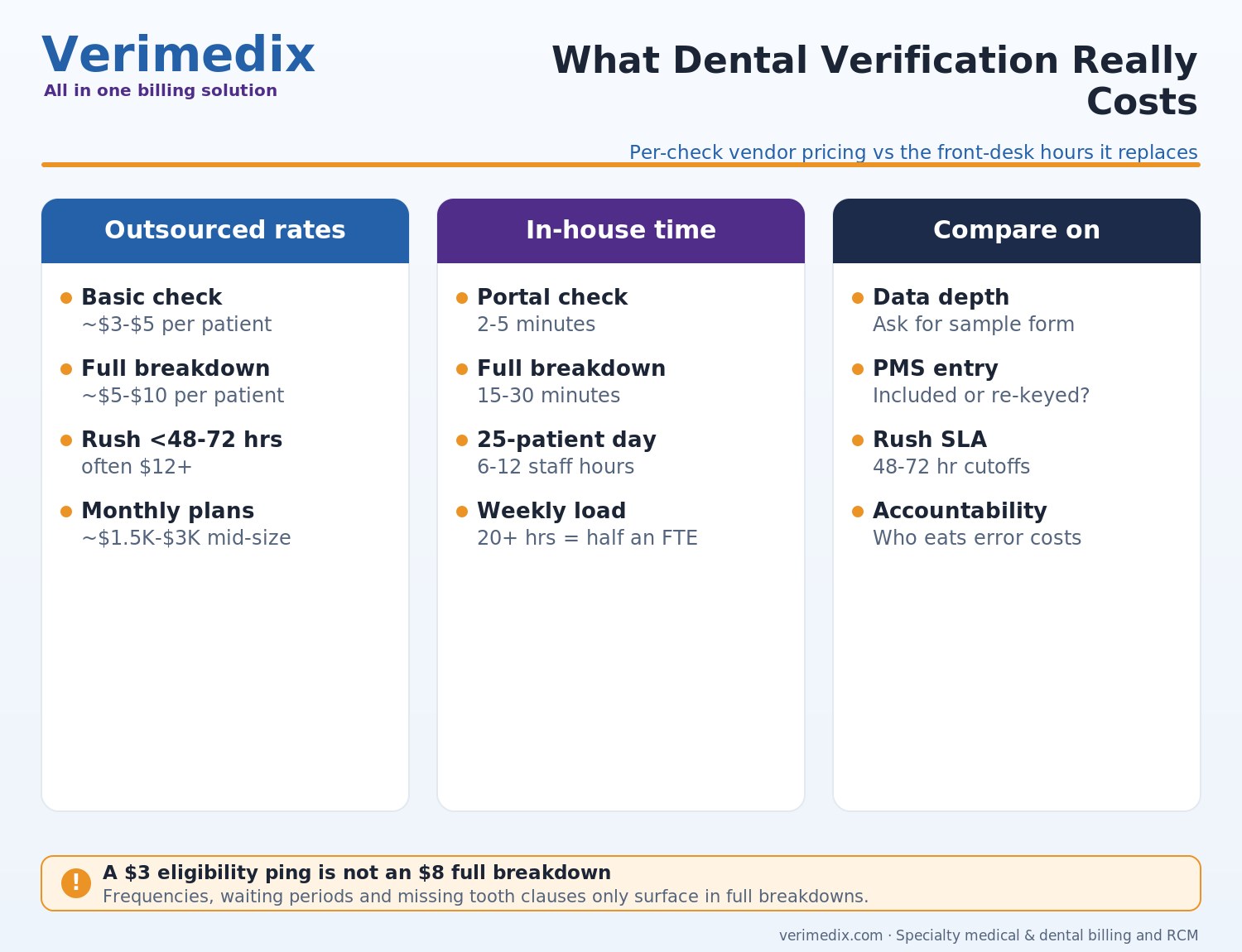
- Published vendor rates for outsourced dental insurance verification generally fall between $3 and $10 per patient check; several vendors quote $6.50–$8.25 for full-breakdown work, and short-notice or emergency adds often run $12 or more.
- Basic eligibility (is the plan active, what plan type) and a full benefit breakdown (frequencies, waiting periods, missing tooth clause, downgrades) are different products at different prices — compare vendors on the same depth.
- In-house, a portal-only check takes a few minutes, but a complete breakdown with phone follow-up commonly takes 15–30 minutes per patient — 6–12 staff hours a day in a busy practice.
- The real cost of skipping depth is downstream: eligibility and coverage surprises are among the most common causes of dental claim denials and awkward patient balance conversations.
- Vet services on data depth, turnaround for patients added inside 48–72 hours, whether results are entered into your PMS, and who is accountable when a bad verification causes a write-off — not on per-check price alone.
- All dollar figures here are illustrative planning ranges; confirm current pricing directly with vendors and coverage rules with each payer.
What dental insurance verification services actually do
An outsourced verification team works from your schedule, not your front desk. Each evening (or several days ahead), the service pulls tomorrow’s patients, contacts each payer through portals, EDI eligibility transactions, and phone calls, and returns either a confirmed eligibility status or a completed benefit breakdown — ideally entered directly into Dentrix, Eaglesoft, Open Dental, or whatever practice management system you run. Better vendors also flag problems early: terminated coverage, plan changes since the last visit, and patients whose remaining annual maximum will not cover planned treatment.
This article is a buyer’s guide — what these services cost and how to compare them. If you want the step-by-step process your own team would follow, including the exact fields a breakdown form should capture, see our complete dental insurance verification how-to guide.
Typical service scope includes eligibility confirmation, full new-patient breakdowns, re-verification at recall or plan-year rollover, history checks (last prophy, last FMX, last SRP dates), and short-notice verification for same-week add-ons. Some vendors deliver a form; others own the data all the way into your PMS — a difference that can justify a higher per-check price.
Basic eligibility vs full breakdown: not the same product
The most common buyer mistake is comparing a $3 eligibility ping against an $8 full breakdown as if they were the same service. They are not, and the cheaper one does not prevent the denials that hurt.
| Dimension | Basic eligibility check | Full benefit breakdown |
|---|---|---|
| Core question answered | Is coverage active today, and what plan/group is it? | Exactly what will this plan pay for the planned treatment? |
| Typical data points | Active/termed status, plan type (PPO/HMO), payer ID, group number | Deductible and remaining maximum, preventive/basic/major percentages, frequency limits (e.g., D1110, D0274, D0210 intervals), waiting periods, missing tooth clause, downgrade provisions, ortho lifetime max, COB status |
| Typical in-house time | 2–5 minutes via portal or clearinghouse | 15–30 minutes; longer when payer phone calls are required |
| Typical outsourced price | Roughly $3–$5 per check, varying by vendor and volume | Roughly $5–$10 per check; rush adds often $12+ |
| When it is enough | Established recall patients with no plan change mid-year | New patients, new plans, plan-year rollovers, and any visit with major or high-dollar treatment planned |
Frequency limits, waiting periods, and clauses are where money is actually lost. A crown seated for a patient whose plan carries a missing tooth clause, or an SRP billed inside a frequency window, produces a denial no appeal will rescue — the verification was the only chance to catch it. That is why depth, not price, should lead the comparison.
The true cost of in-house verification: worked math
Here is an illustrative model for a general practice seeing 25 patients a day, 4.5 days a week. Assume 10 of those patients need a full breakdown or substantive re-verification (new patients, plan changes, major treatment planned) at an average 20 minutes each, and 15 need only a basic status re-check at 5 minutes each. Dedicated verification staffing is a fourth option: Verimedix places trained dental verification specialists who work inside the practice's own PMS and payer portals under the practice's brand — full-breakdown verification without per-check fees or software migration.
- Full breakdowns: 10 × 20 min = 3.3 hours/day
- Basic re-checks: 15 × 5 min = 1.25 hours/day
- Total: roughly 4.5 staff hours per day ≈ 20+ hours per week — half a full-time front desk role
At a $22/hour wage with roughly 25% added for taxes and benefits (about $27.50 loaded), that is roughly $600 per week — around $2,500 per month of labor on verification alone, before counting payer hold time during patient-facing hours or the checks skipped in busy weeks. Industry estimates cited by dental software vendors put manual verification at roughly 12–13 minutes per patient on average,climbing to 15–30 minutes when phone calls are needed — so this model is conservative for phone-heavy payer mixes. (Illustrative example — substitute your own patient counts and wages.)
The honest comparison: 500 outsourced verifications a month at a blended $4–$6 lands in a similar $2,000–$3,000 range. Outsourcing rarely wins on raw invoice price. It wins on three other lines: the 20 recovered front-desk hours redirected to scheduling, treatment-plan follow-up, and collections; the consistency of a team that verifies every patient every time, including the busy weeks; and fewer of the coverage surprises that become the most common dental claim denials.
What outsourced verification costs in 2026
Pricing models cluster into four shapes. Ranges below reflect vendor-published rates and industry cost surveys from 2025–2026; treat them as planning figures and get current quotes, since volume discounts and scope differences move real prices meaningfully.
| Pricing model | Typical range | How it works | Watch for |
|---|---|---|---|
| Per-verification | ~$3–$10 per patient check | Pay per completed check; full breakdowns price higher than basic eligibility | Rush fees ($12+ inside 48–72 hours); whether PMS data entry is included or extra |
| Monthly subscription | Often ~$1,500–$3,000/month mid-size practice | Flat fee for all scheduled patients up to a volume tier | Overage rates; what counts toward the tier; minimum terms |
| Dedicated verifier / VA | Hourly; offshore commonly $10–$20/hr, domestic higher | A named remote person works your schedule daily | Training burden sits with you; coverage gaps for sick days and turnover |
| Software / AI automation | Per-location subscription, wide range | Automated eligibility pulls and breakdown parsing from payer portals | Coverage varies by payer; human phone follow-up still needed for complex plans |
At the low end of per-check pricing, your team usually still keys results into the PMS — the labor savings shrink.And verification is frequently bundled inside broader dental billing services or full revenue cycle engagements, where it is effectively priced into a percentage-of-collections fee; if you already outsource billing, ask what verification depth is included before buying it separately.
In-house vs outsourced vs software: the decision table
| Factor | In-house | Outsourced service | Automation software |
|---|---|---|---|
| Cost basis | Staff hours (~$2,000–$3,000/mo of labor in the model above) | Per check or monthly plan | Subscription per location |
| Depth on complex plans | High if trained and given time | High — it is the vendor’s core job | Limited; portals do not expose every clause |
| Short-notice patients | Handled, but interrupts other work | Rush SLA required; premium priced | Instant for supported payers |
| Consistency in busy weeks | Weakest point — checks get skipped | Strong; contractual | Strong for supported payers |
| Best fit | Small schedules (<15 verifications/day) with stable staff | Busy or short-staffed practices; multi-location groups | A layer under either model, not a full replacement |
A practical rule: if verification consumes more than roughly 15–20 front-desk hours a week, or checks get skipped, outsourcing or a hybrid (software for pings, humans for breakdowns) usually pays for itself. Below that, a disciplined in-house protocol plus eligibility software is often cheaper. Practices weighing this alongside broader support can compare options on our dental billing services page.
How to choose a verification service: an 8-point vetting checklist
Price-per-check tells you the least. Work through these eight questions with every vendor:
- Show me a completed breakdown form. Count the fields. Frequencies, waiting periods, missing tooth clause, downgrades, and remaining maximum must be on it — not just “active/inactive.”
- Where does the data land? Entered into my PMS, or delivered as a spreadsheet my team re-keys?
- What is the turnaround SLA for the standard schedule, and what happens with a patient added tomorrow morning?
- Portal-only, or phone too? Complex plans and history checks often require calls; portal-only vendors quietly return incomplete data.
- Who is accountable for errors? If a verification error causes a denial or an uncollectable patient balance, is there a credit or remediation policy?
- How is PHI handled? Signed BAA, access controls, and where the team is located.
- How do you handle my payer mix? Medicaid plans, HMO capitation rosters, and leased PPO networks all verify differently — ask for direct experience.
- References on my PMS. A vendor fluent in Open Dental may fumble Eaglesoft workflows.
Vendors differ most on points 1, 2, and 5 — depth, data entry, and accountability. Those three are where a cheap service becomes expensive.
Quick Answers
How much do dental insurance verification services cost? Most services charge roughly $3–$10 per patient check depending on depth and turnaround, with full benefit breakdowns at the higher end and monthly plans for mid-size practices commonly landing around $1,500–$3,000. Confirm current pricing with vendors directly.
Is outsourcing verification cheaper than doing it in-house? Often only slightly on raw cost — the bigger gains are recovered front-desk hours, checks that never get skipped, and fewer coverage-surprise denials.
What is the difference between eligibility and a full breakdown? Eligibility confirms coverage is active; a full breakdown documents percentages, deductibles, remaining maximums, frequency limits, waiting periods, and clauses like missing tooth provisions.
How long does dental insurance verification take in-house? A portal eligibility check takes a few minutes; a complete breakdown commonly takes 15–30 minutes per patient once phone follow-up is included.
When should a practice outsource verification? When verification consumes more than about 15–20 staff hours weekly, when checks are being skipped in busy weeks, or when turnover keeps erasing trained verifiers.
Frequently asked questions
Many do, and it is worth paying for. Vendors that deliver spreadsheets or PDFs leave your team re-keying data, which erases much of the labor savings and reintroduces transcription errors. Ask specifically whether the vendor works inside Dentrix, Eaglesoft, Open Dental, or your PMS, and whether data entry is included in the quoted per-check price.
Most services verify 2–5 business days ahead of the appointment, with a re-check for anything scheduled earlier than that. Verifying too early risks missing plan terminations or benefit usage between the check and the visit; many practices pair an early full breakdown with a day-before eligibility ping.
Not yet for full breakdowns. Automation handles eligibility status and standard benefit fields well for supported payers, but frequency histories, waiting periods, and clause details often require portal digging or phone calls. The strongest current setups layer software for volume with humans for complexity.
Most vendors offer rush verification at a premium — often $12 or more per check inside a 48–72 hour window — or your front desk handles walk-ins in-house. Clarify the rush SLA and price before signing, because emergency-heavy practices can see rush fees reshape the whole cost comparison.
It reduces the denial categories tied to coverage: terminated plans, frequency-limit rejections, waiting-period denials, and missing tooth clause surprises. It does not touch denials caused by documentation, attachments, or coding — those live in the billing workflow, which is a separate service decision.