- Full-service dental RCM outsourcing typically runs on a percentage-of-collections model, similar to medical billing.
- White-label dental staffing places a dedicated CDT-coding-trained biller inside your existing Open Dental or Dentrix setup, starting at $1,000–$1,500+/month for specialized roles, minimum 2 resources.
- Dental billing outsourcing CPCs run as high as $87+ — a signal of high buyer intent among DSOs and dental billing companies deciding how to add capacity.
- White-label staff work under the dental billing company's or DSO's own brand — patients and referring offices never see a third party.
- A real dental partner engagement shows the model in practice: a dedicated aging specialist worked down an AR backlog inside the client's existing systems.
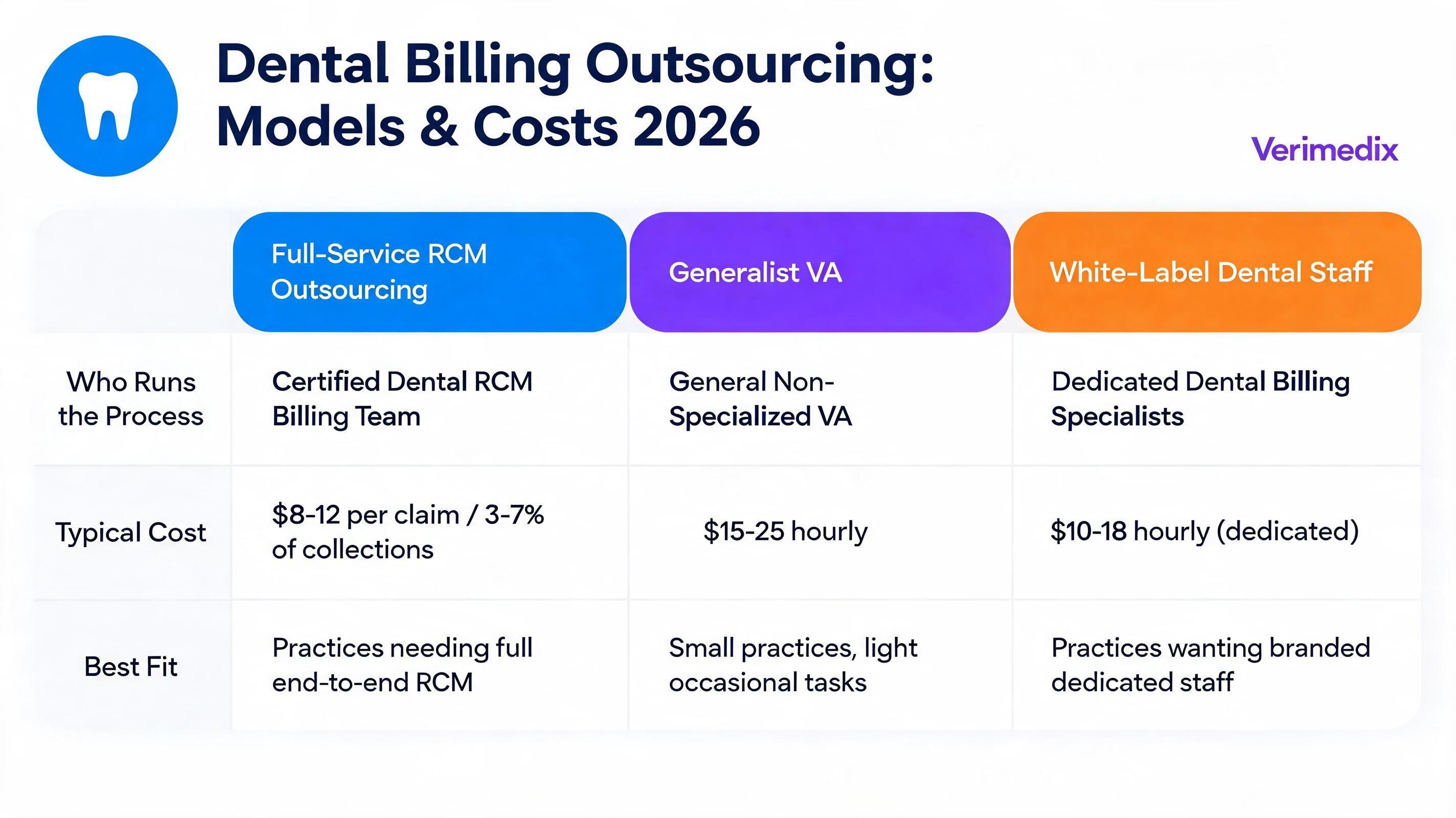
Dental Billing Outsourcing Models Compared
| Model | Who runs the process | Typical cost | Best fit |
|---|---|---|---|
| Full-service dental RCM outsourcing | Vendor's own process/brand | % of collections | Practices wanting to hand off the entire cycle |
| Generalist VA | Client's process, admin-only | $500–$1,500/mo | Scheduling, basic admin |
| White-label dental billing staff | Client's own systems and brand | $1,000–$1,500+/mo specialized, $500–$700/mo admin, min. 2 resources | DSOs and dental billing companies needing execution capacity, not a new process |
Why Dental Billing Companies Choose White-Label
Dental billing companies and DSOs already have their client relationships, pricing, and workflows built. White-label billing workforce providers such as Verimedix place dedicated, trained dental billers who work inside the client's systems — including Open Dental — under the client's brand, starting at two resources, closing capacity gaps without disrupting existing processes.
Once the model is chosen, shortlisting matters more than rate — our ranked review of the best dental billing companies is the companion to this guide.
What a Dental Billing Engagement Actually Covers
Whichever model you choose, confirm the scope line by line — dental billing is not one task but a chain: insurance verification and benefit breakdowns before the visit; CDT code selection and claim preparation with the right attachments (radiographs, perio charting, narratives — the missing-attachment denial is dental billing's most preventable loss); primary and secondary claim submission; EOB/ERA posting and adjustment accuracy; denial work and resubmission; and aging follow-up on the 60/90+ buckets. Full-service vendors quote the whole chain as a bundle. White-label staffing lets a dental billing company or DSO buy capacity for the specific links that are breaking — most commonly aging follow-up and denial work — while keeping the rest of the chain exactly as it runs today.
Five Questions DSOs and Dental Billing Companies Should Ask
- Where does the process live? If the vendor's answer involves migrating you to their workflow or portal, that's outsourcing — fine if you want it, wrong if you only need hands.
- Who appears in front of our offices and patients? Statements, calls, and portal messages should carry your brand; ask to see exactly how that's configured.
- Which platforms has the team actually worked? Open Dental and Dentrix experience should be demonstrable, not aspirational — ask how platform fit is verified during staffing match.
- How is CDT accuracy maintained? CDT updates annually; ask who trains the team on code changes and payer-specific documentation rules each year.
- What does scale-down look like? Client volume moves. Role-based engagements with a 2-resource minimum flex more gracefully than percentage-of-collections contracts with term commitments.
The Cost Math for a Dental Billing Company
Percentage-of-collections pricing scales with revenue — which is exactly the problem once your volume grows. A DSO or dental billing company collecting $2M annually pays $80,000–$140,000/year at a typical 4–7% rate, whether or not the vendor's effort grew with it. A two-resource white-label pod (say, a dental biller plus an aging specialist at $1,000–$1,500+/month each) runs roughly $24,000–$36,000+/year at flat, predictable cost — and the capacity is dedicated to your accounts rather than shared across the vendor's book. The percentage model still makes sense for small practices that want zero involvement; past a certain volume, role-based staffing is usually the cheaper structure for organizations that already run their own process.
Real-World Example
A U.S.-based dental billing company needed dedicated capacity to work down an aging accounts receivable backlog without pulling internal staff off active client work. Verimedix placed a trained dental billing resource focused specifically on AR and aging follow-up, working inside the client's existing systems and under the client's brand. The client reported measurable improvement in aging position and cited the added capacity as a factor in retaining their own end-client relationships.
Frequently asked questions
Yes — dental billing roles are staffed with experience in platforms including Open Dental, with broad familiarity across major dental PMS platforms scoped during staffing match.
Full-service outsourcing runs on a percentage-of-collections basis; white-label dedicated dental billers start around $1,000–$1,500+/month per specialized role, with a 2-resource minimum.
No — white-label dental billing staff operate entirely under the hiring company's brand.
Full outsourcing routes work through the vendor's own process and often its brand; white-label places staff inside your existing systems and brand instead.
Timelines depend on role complexity and system access; providers typically scope a specific timeline once role and platforms are confirmed.