
- D7140 — erupted tooth or exposed root removed by elevation and/or forceps only. No flap, no bone removal, no sectioning.
- D7210 — erupted tooth requiring removal of bone and/or sectioning of tooth, with elevation of mucoperiosteal flap if indicated. At least one surgical intervention is required.
- D7210 is the most-downgraded surgical code in dental billing — carriers recode it to D7140 when the operative note does not document flap, bone, or sectioning.
- D7210 does not cover impacted teeth (use D7220, D7230, D7240, D7241) or residual roots requiring cutting (use D7250).
- The CDT code is based on the technique actually used, not the difficulty or time required.
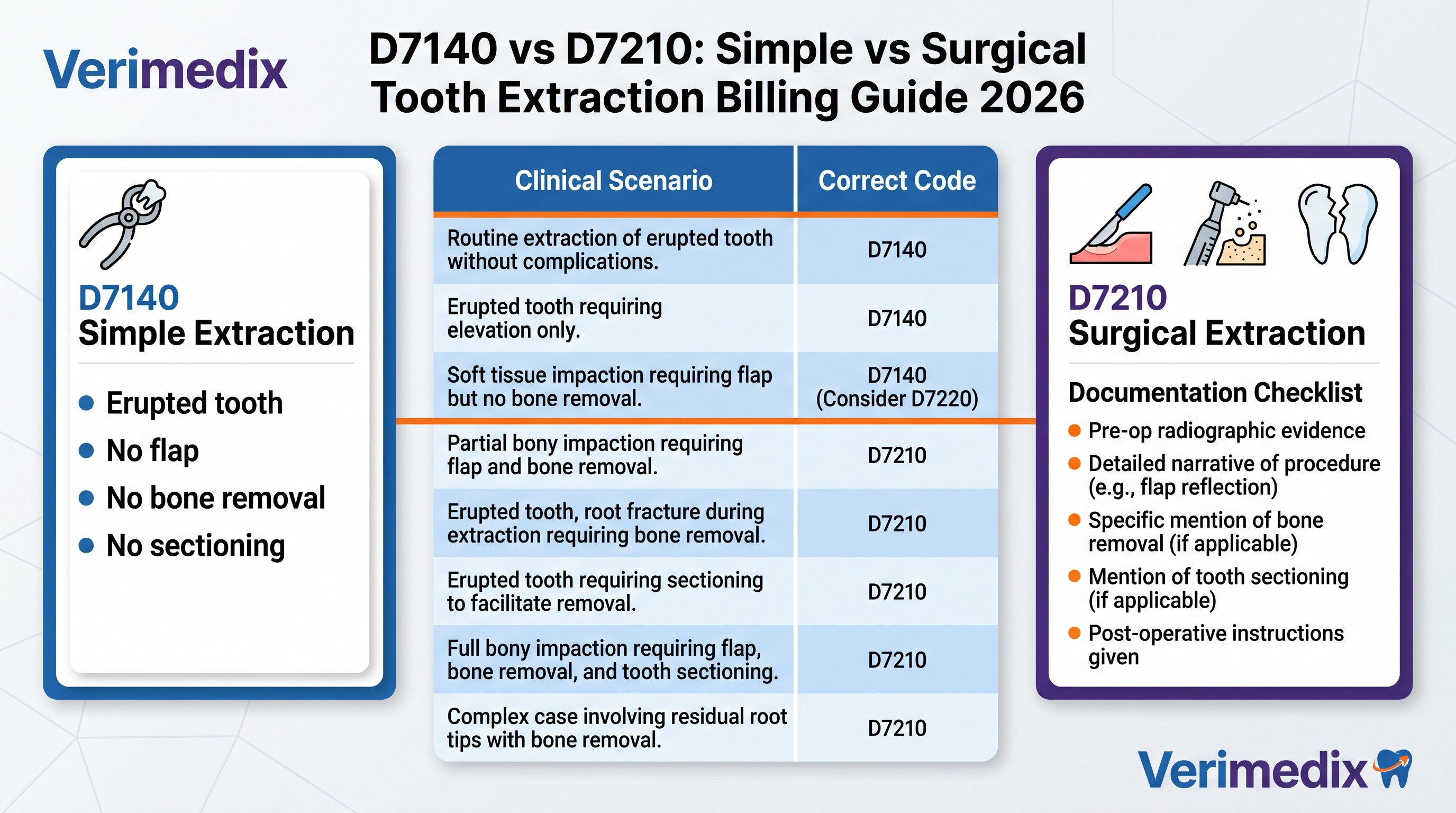
The American Dental Association's CDT manual is explicit about the distinction: D7140 is "extraction, erupted tooth or exposed root (elevation and/or forceps removal)" and includes minor smoothing of socket bone and closure as necessary. D7210 is "extraction, erupted tooth requiring removal of bone and/or sectioning of tooth, and including elevation of mucoperiosteal flap if indicated" — it includes related cutting of gingival and bone, removal of tooth structure, minor smoothing of socket, and closure. The defining question for code selection is not whether the extraction was hard — it is whether a surgical technique was required to deliver the tooth.
D7140: when to bill it
Bill D7140 when the entire erupted tooth or exposed root is delivered using only elevation and/or forceps, with no incision into gum tissue to create a flap, no removal of supporting bone with a bur or chisel, and no sectioning of the tooth or root to facilitate removal. A difficult or time-consuming forceps extraction is still D7140. A case where the crown and root separate during the procedure but no bone removal or cutting is required to retrieve the root is also D7140 (per ADA guidance). D7140 is also used when a separated root that is exposed can be removed by elevation or forceps without cutting.
D7210: when to bill it
Bill D7210 when the tooth is fully erupted (visible in the oral cavity) but at least one of the following is required to deliver it: elevation of a mucoperiosteal flap; removal of alveolar bone using a bur, chisel, or similar instrument; or sectioning (cutting) of the tooth so pieces can be individually removed. The tooth must be erupted — if it is impacted at any level, the impaction codes apply. If the crown and root separated during the extraction and retrieval of the root required bone removal, D7210 applies for that encounter.
D7140 vs D7210 at a glance
| Criterion | D7140 | D7210 |
|---|---|---|
| Tooth eruption status | Erupted or exposed root | Erupted (not impacted) |
| Flap elevation | No | Required or indicated |
| Bone removal | No (minor socket smoothing only) | Yes — one defining criterion |
| Tooth sectioning | No | Yes — one defining criterion |
| Difficult forceps-only extraction | Still D7140 | Not D7210 without surgical intervention |
| Crown separates, root removed by elevation | D7140 | — |
| Crown separates, root requires bone removal | — | D7210 |
| Impacted tooth | — | Use D7220/D7230/D7240/D7241 |
| Residual root requiring cutting | — | Use D7250 |
Why D7210 gets downgraded and how to prevent it
Carriers recode (downgrade) D7210 claims to D7140 when the submitted operative note does not contain language documenting the specific surgical intervention that qualifies the procedure as D7210. If the note simply states "tooth #14 extracted" or "difficult extraction," the payer's automated system has no basis to pay the surgical code and defaults to D7140. The fix is a brief, specific operative note written at the time of service.
The operative note that protects D7210
A defensible D7210 operative note should include: the tooth number and clinical eruption status; the specific surgical technique used (e.g., "full-thickness mucoperiosteal flap elevated buccally; bur used to remove buccal plate to expose cervical portion of root; tooth delivered after sectioning into mesial and distal roots"); estimated blood loss or anesthesia used (optional but adds clinical depth); post-extraction findings and socket management; and closure technique. The note does not need to be lengthy — it needs to be specific about the surgical steps.
Common denials and fixes
| Denial | Cause | Fix |
|---|---|---|
| Downgrade to D7140 | Operative note does not document flap, bone removal, or sectioning | Appeal with corrected operative note documenting specific surgical technique; attach periapical radiograph showing bone loss or difficult anatomy |
| Frequency limit denial | Bilateral same-day extractions flagged as duplicate | Submit each extraction on a separate claim line with the tooth number; most carriers accept multiple extractions per date when each tooth is individually identified |
| Not covered — impaction codes required | D7210 submitted for a partially or fully impacted tooth | Re-code to the appropriate impaction code (D7220, D7230, D7240, or D7241) based on clinical and radiographic findings |
Frequently asked questions
D7140 is a forceps-and-elevation-only extraction of an erupted tooth with no surgical intervention. D7210 is an extraction of an erupted tooth that required at least one of: mucoperiosteal flap elevation, bone removal with a bur or chisel, or sectioning of the tooth. Difficulty or time alone does not convert a D7140 to a D7210.
No. Impacted teeth are reported with impaction codes D7220 (soft tissue), D7230 (partial bony), D7240 (complete bony), or D7241 (complete bony with unusual surgical complications). D7210 is for erupted teeth only.
It depends on how the root was retrieved. If the separated root was removed by elevation or forceps without cutting tissue or bone, use D7140. If bone had to be removed or tissue cut to deliver the root, use D7210. The ADA CDT guide and its Q&A section addresses this scenario explicitly.
Submit an appeal with the complete operative note documenting the specific surgical steps that qualify the procedure as D7210: which surfaces the flap was elevated on, what bone was removed and with what instrument, or how and where the tooth was sectioned. Attach periapical radiographs if they show difficult anatomy that supports the surgical approach.
No. D7250 is for removal of residual roots that remained after a previous extraction attempt, not for roots addressed as part of the same extraction encounter. Billing D7250 alongside D7210 for the same tooth on the same date would represent double-billing.