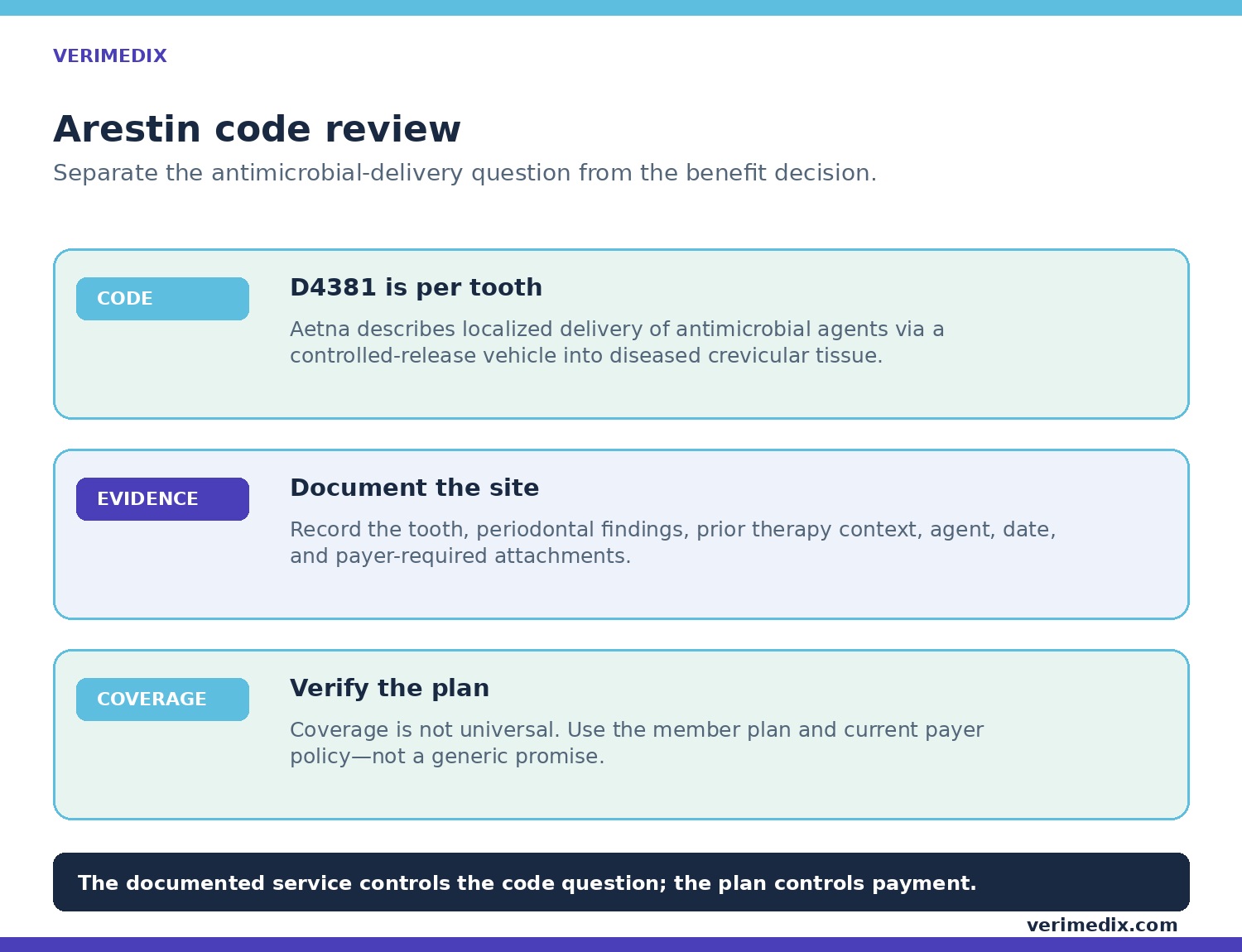
- When the documented service is localized delivery of an antimicrobial agent via a controlled-release vehicle into diseased crevicular tissue, CDT D4381 is the code to investigate; Aetna describes its reporting unit as per tooth.
- Arestin’s manufacturer materials also discuss periodontal procedure codes 4341, 4342, and 4910 in treatment and ordering workflows. Do not substitute a periodontal procedure code for the documented antimicrobial-delivery service.
- Coverage is not universal. Aetna says D4381 is not covered in most of its dental plans and applies plan-specific criteria where covered.
- Document the tooth, periodontal findings, prior-treatment context, agent and delivery date, and the payer’s required evidence before filing.
- Use the member’s current benefit plan and payer policy; never turn one insurer’s coverage rule into a universal CDT rule.
What is the Arestin dental code?
For the localized antimicrobial-delivery service, the Aetna dental policy identifies CDT D4381 as “Local Delivery of Antimicrobial Agents via a Controlled-Release Vehicle into Diseased Crevicular Tissue, per Tooth.” That wording makes the service unit and the treated tissue part of the coding question. It does not mean every use of the Arestin product is covered or that D4381 should be reported without checking the current CDT code set and payer instructions.
The manufacturer’s Arestin Professional billing and access page separately references procedure codes 4342, 4910, and 4341 in its treatment workflows and describes insurance-information and prior-authorization support. Those references help explain the surrounding periodontal workflow; they are not a substitute for the current CDT descriptor, the clinical record, or the member’s benefit plan.
How does D4381 differ from related periodontal codes?
| Billing question | What to verify | Control |
|---|---|---|
| Antimicrobial delivery | Whether the documented service matches D4381’s controlled-release delivery description | Tooth-level record and current CDT reference |
| Periodontal therapy | Which periodontal procedure was performed before or alongside the agent delivery | Procedure note, date, and payer edits |
| Benefit coverage | Whether the member plan covers local antimicrobial delivery | Eligibility, plan document, and current policy |
| Reporting unit | How the payer expects the code and tooth information transmitted | Claim instructions; Aetna describes D4381 as per tooth in its policy |
Do not force a single line-item answer onto a multi-step periodontal visit. The claim should distinguish the treatment performed, the tooth or site information, and any payer rule about related services. If the record cannot separate the services, send a documentation query before billing rather than guessing.
What documentation supports D4381?
A payer-aware record should make it possible for a reviewer to understand why the localized delivery was performed, where it was performed, and how the claim unit was selected. Depending on the plan and clinical workflow, capture:
- The tooth or treated site and the periodontal findings supporting the service.
- The diagnosis, treatment date, and the clinician’s treatment rationale.
- The agent delivered, delivery method, and whether the product was placed into diseased crevicular tissue.
- Relevant scaling and root planing or periodontal-maintenance history, including dates when the payer requests it.
- Radiographs, periodontal charting, or other attachments only when required by the payer or appropriate to support the record.
- The benefit verification, authorization result, and current payer policy used in the claim review.
Aetna’s policy is one example of why specificity matters: where its plan covers D4381, the policy describes isolated refractory sites and criteria including periodontal pockets of at least 5 millimeters after an adequate healing period following scaling and root planing. That is an Aetna policy statement, not a universal clinical or coverage rule. Follow the member’s plan and the treating clinician’s documentation.
Does dental insurance cover Arestin?
Coverage depends on the member’s plan, payer, network, effective date, and clinical documentation. Aetna states that localized delivery is not covered in most of its dental plans and that, where covered, D4381 is subject to strict criteria. Its policy also says the benefit plan governs when it differs from the policy and that the most appropriate code as of the submission effective date must be used.
The Arestin Professional page tells practices to provide insurance information for coverage checks and notes that its support process can help navigate prior-authorization requirements. Treat that as a product-support workflow, not a promise of reimbursement. Verify the patient’s benefits and retain the reference number or authorization result in the billing record.
How can a practice prevent Arestin denials?
Make the first edit a service-to-record match: does the note support localized antimicrobial delivery, identify the tooth, and describe the periodontal context? Next check the current CDT reference, payer plan, benefit status, authorization, frequency or exclusion rules, and any required attachments. Finally, confirm the claim’s units and tooth information match payer instructions.
When a denial arrives, separate coding, benefit, medical-necessity, documentation, and administrative causes. An exclusion is not fixed by changing D4381 to a nearby periodontal code; a missing chart entry is not fixed by resubmitting the same unsupported line. Query the clinician or payer for the missing fact and record the decision for future claims.
For claim operations, pair the code review with Verimedix's dental billing services guide and dental denial-prevention checklist.
Frequently asked questions
For localized delivery of an antimicrobial agent via a controlled-release vehicle into diseased crevicular tissue, D4381 is the CDT entry to investigate. Confirm the current CDT descriptor and payer requirements before submission.
Aetna’s current dental policy describes D4381 as per tooth. Other payers may have different claim instructions, so verify the member plan and tooth-level documentation.
Coverage is plan-specific. Aetna states that localized antimicrobial delivery is not covered in most of its dental plans and applies strict criteria where it is covered.
Document the treated tooth or site, periodontal findings, diagnosis and rationale, product and delivery details, relevant prior periodontal treatment, and the payer’s benefit or authorization check.
The Arestin Professional page references 4341, 4342, and 4910 in periodontal treatment workflows. Code selection still depends on the service documented, the current CDT set, and payer instructions; do not substitute one code automatically.