
- D2950 is the CDT entry for a core buildup, including pins when required, when material is placed because the tooth lacks enough strength and retention for the planned crown.
- The ADA says not to report D2950 when the work only fills an undercut, box form, or concave irregularity in the preparation.
- D2950 does not describe the final crown. Match the claim to the documented service, tooth, date, and restoration plan.
- There is no universal “50% rule” in the ADA descriptor. Benefit thresholds, bundling, frequency, attachments, and predetermination rules are plan-specific.
- Use the current CDT entry and the applicable payer policy; a correct code does not guarantee coverage or payment.
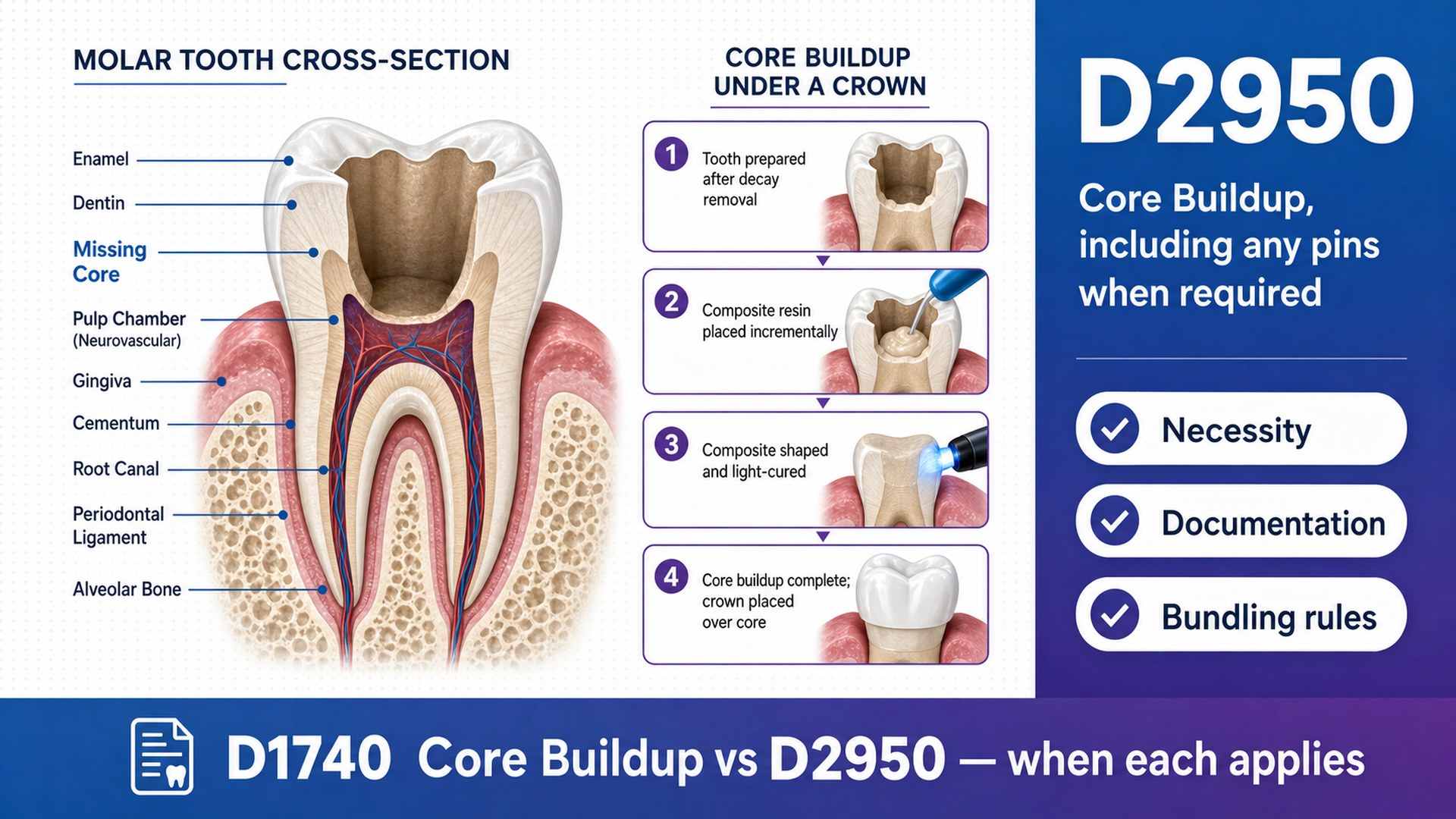
What is D2950?
D2950 is “Core buildup, including any pins when required.” The American Dental Association’s D2950 guidance describes placing material in the tooth preparation for a crown when there is insufficient tooth strength and retention for the crown procedure. The descriptor also states that D2950 should not be reported when the work only fills an undercut, box form, or concave irregularity in the preparation.
That distinction matters in a billing record. The note should explain why the tooth needed a buildup and connect the work to the planned restoration. D2950 is not the crown itself, and pins required to retain the core material are included in the D2950 descriptor rather than treated as a separate add-on in this article’s workflow.
When is D2950 separately reportable?
Start with the actual service, not the crown fee or a template. A separate D2950 review is reasonable when the record supports a core buildup needed to restore strength or retention before the planned crown. It is not a substitute for documenting a routine preparation adjustment.
| Record question | What the billing team should confirm | Why it matters |
|---|---|---|
| What was missing? | Describe the structural loss and the tooth treated; use the dentist’s clinical documentation rather than a copied percentage. | Shows why foundation support was needed. |
| What was performed? | Identify the buildup material and any included retention described in the operative record. | Connects the code to the service actually delivered. |
| What is the restoration plan? | Record the planned crown and whether treatment is completed or staged. | Prevents a buildup line from appearing detached from the restorative plan. |
| Does the plan pay separately? | Check the member’s benefit language, bundling edits, frequency limits, waiting periods, and predetermination process. | Separates correct coding from expected reimbursement. |
Do not turn a payer’s internal threshold into an ADA rule. If a plan uses a structural-loss threshold or requires specific attachments, quote the current plan or policy in the office workflow and verify it for the date of service.
What documentation supports D2950?
Build the record before submission. The exact attachment list varies by payer, but a defensible packet commonly includes:
- Tooth and date: identify the tooth, date of service, and whether the crown is planned, staged, or already placed.
- Clinical reason: document the decay, fracture, lost structure, or other condition that made a buildup necessary for strength or retention.
- Procedure note: describe the material placed and the work performed, including any retention used as part of the buildup.
- Supporting records: attach the pre-operative radiograph, photograph, narrative, or other item only when requested or required by the plan, and make sure it matches the tooth and date.
- Restoration context: connect D2950 to the crown plan without implying that the buildup guarantees coverage.
A pre-operative image can be useful evidence, but it is not a universal ADA attachment rule. Follow the applicable payer’s current documentation instructions and retain the source record according to the practice’s compliance policy.
What payer checks should happen before submission?
Eligibility and benefits verification should answer more than “is the patient active?” Ask whether the plan covers a core buildup, whether it treats D2950 as bundled with the crown, whether a waiting or replacement period applies, whether predetermination is available or required, and which records must accompany the claim. Verify the effective date and document the representative, portal result, or policy reference used.
When a payer’s policy conflicts with a template or a vendor’s general rule, use the payer’s current written guidance for that member and date of service. If the plan is silent, do not promise separate payment; route the case for a documented coverage decision.
How can practices prevent D2950 denials?
| Denial risk | Control before filing |
|---|---|
| Preparation cleanup coded as a buildup | Have the dentist’s note state the structural need for strength or retention; do not rely on a crown-preparation template. |
| Missing or mismatched evidence | Match the tooth number, date, narrative, image, and restoration plan before attaching records. |
| Bundling or frequency edit | Check the plan’s current benefit language and obtain predetermination when it is available or required. |
| Staged treatment confusion | Explain why the buildup and crown occur on different dates and retain the treatment sequence. |
| Unsupported appeal | Appeal with the original clinical note, relevant image or radiograph, policy reference, and a concise explanation of medical necessity for the restorative foundation. |
For broader denial workflow, see Verimedix’s dental claim denial guide. For the restoration side, compare the dental crown code guide and the D2740 versus D2750 crown billing guide.
How does D2950 relate to crown services?
D2950 addresses the buildup; the final restoration is a separate coding and coverage question. The crown code must match the documented restoration material and service, and the claim should not use a generic crown label to stand in for the buildup record. Before submission, reconcile the tooth, material, dates, narrative, attachments, and plan response across the buildup and crown lines.
For help organizing eligibility, dental claim submission, documentation, and denial follow-up, see Verimedix dental billing services and the dental billing pricing and services guide.
Frequently asked questions
D2950 is the CDT entry for a core buildup, including pins when required, when material is placed because the tooth lacks enough strength and retention for the planned crown. The ADA says it should not be reported when the work only fills an undercut, box form, or concave preparation irregularity.
The D2950 descriptor includes any pins when required. Follow the current CDT entry and the applicable payer instructions rather than adding a separate pin charge based on a template.
Document the tooth, date, structural condition, reason the buildup was needed for strength or retention, material placed, restoration plan, and any records the payer requests. Match every image or narrative to the same tooth and date.
No universal ADA percentage should be treated as the coverage rule. Some plans may use a structural-loss threshold, but benefit language, bundling, attachments, and predetermination requirements vary. Verify the current plan before promising separate payment.
D2950 describes the buildup and the crown is a separate restoration question. Whether the plan pays both lines separately depends on the documented services and the member’s benefit policy, so verify bundling and frequency rules for the date of service.
No. Coverage depends on the member’s plan, documentation, frequency and replacement rules, bundling edits, and payer processing. A correct CDT descriptor is necessary but does not guarantee reimbursement.