
- Thoracic surgery billing lives or dies on three mechanics: 90-day global periods on major 32-series procedures, modifier 22 for genuinely harder cases, and co-surgeon/assistant modifiers (62, 80, 82, AS).
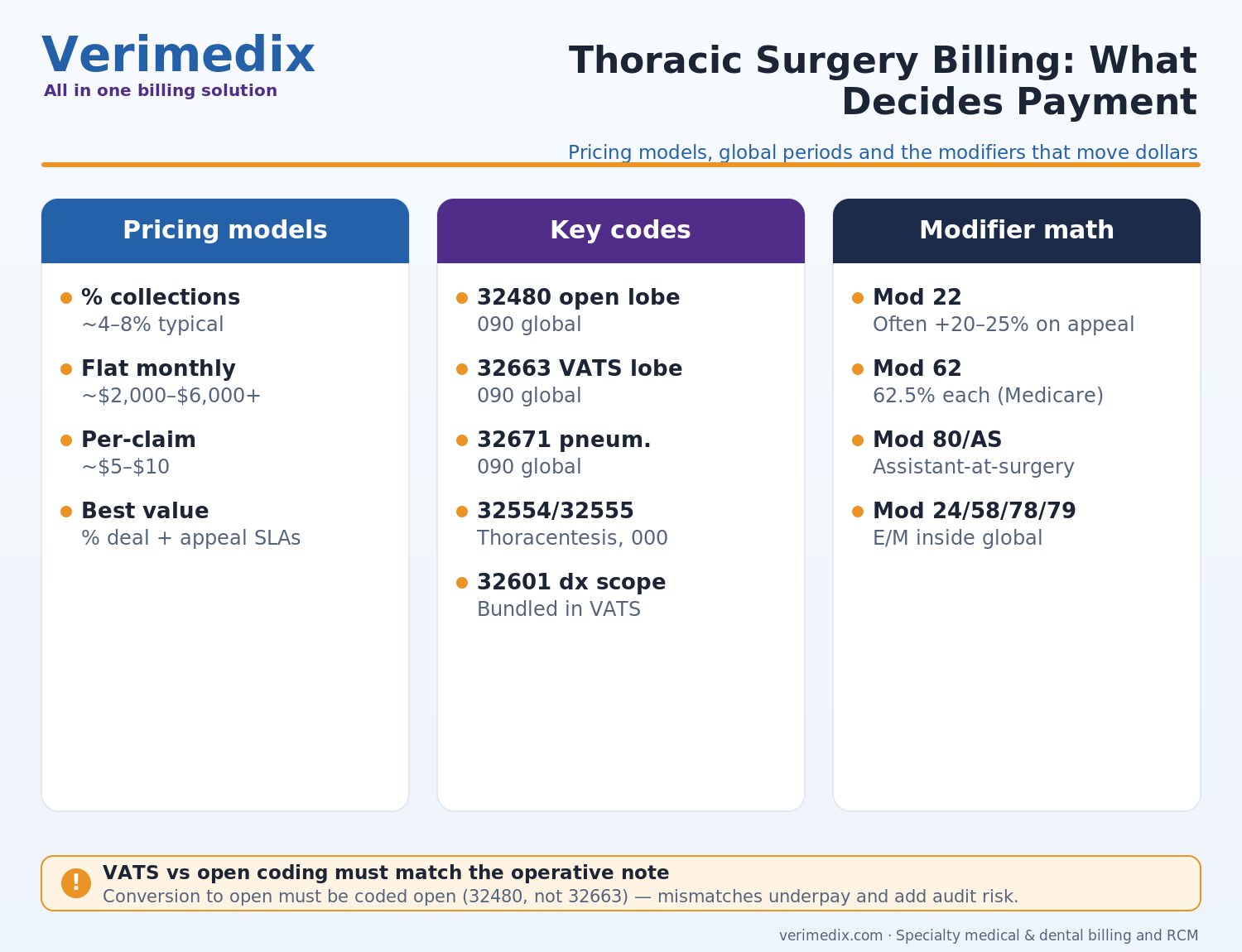
- Outsourced thoracic surgery billing typically prices at roughly 4–8% of collections, with flat monthly retainers (~$2,000–$6,000) and per-claim fees (~$5–$10) as alternatives.
- A well-documented modifier 22 claim often adds 20–25% to the allowable on a major resection — but only when the operative note quantifies the extra work.
- Approach coding is a silent revenue leak: VATS codes (32663, 32666) and open codes (32480, 32505) are not interchangeable, and a documented conversion to open must be coded as open.
- E/M during the 90-day global is payable only with the right modifier story — 24 for unrelated visits, 57 for the surgery decision, 58/78/79 for return trips to the OR.
- Vet vendors on thoracic specifics — global-period tracking, modifier 22 appeal history, co-surgeon splits — not generic RCM promises.
Why thoracic cases fail on documentation, not code choice
Picture a lobectomy that runs six hours instead of three because of dense adhesions from prior radiation. On a standard claim, the payer reimburses it exactly like the routine case — the fee schedule has no idea what happened in the OR. Capturing that difference is the whole job of thoracic surgery billing, and it depends on operative-note detail, modifier discipline, and appeal stamina that general billing teams rarely have.
Three features make the specialty unforgiving: nearly every major resection carries a 90-day global period, so months of post-op care are bundled unless correctly modified; payable events are few and large, so one denied lobectomy is a five-figure hole; and complex cases often involve two surgeons or an assistant, where the 62/80/82/AS modifier set decides whether the second surgeon gets paid at all.
Our companion page on thoracic surgery billing services covers Verimedix's specialty offering; this guide is the buyer's-eye view — what any vendor should include, what it should cost, and how to test thoracic competence before you sign.
The controls a thoracic revenue workflow needs
A full-scope engagement covers operative report coding (CPT and ICD-10-CM with approach and laterality), charge entry, NCCI-aware claim scrubbing, prior authorization tracking for elective resections, payment posting, denial appeals, patient billing, and monthly reporting on days in AR, clean claim rate, and net collection rate. Specialty-specific line items to demand in writing:
- Global period calendar management — flagging every E/M inside a 90-day window and applying modifier 24/58/78/79 logic before submission, not after denial.
- Modifier 22 workflow — coder flags qualifying op notes, drafts a comparison statement (typical vs. actual time/effort), submits with documentation, and escalates to appeal if underpaid.
- Co-surgeon and assistant claims — verifying the payer allows modifier 62 for the specific code (Medicare's co-surgery indicator), coordinating both surgeons' claims, and using AS vs. 80/82 correctly by credential.
- Bundling defense — e.g., diagnostic thoracoscopy is bundled into a surgical VATS at the same session.
What outsourced support for a thoracic program costs
Thoracic billing follows the standard three pricing structures, but high average claim value changes which one is rational. Ranges are illustrative industry figures — get current written quotes.
| Model | Typical range | Best fit | Watch-outs |
|---|---|---|---|
| Percentage of collections | ~4–8% for surgical specialties (published ranges span ~3–10%) | Groups wanting vendor incentives tied to appeals and modifier 22 upside | Confirm the % applies to net collections the vendor worked |
| Flat monthly fee | ~$2,000–$6,000+ per surgeon by volume | Stable-volume groups wanting predictable cost | Weak incentive to fight underpayments — demand appeal SLAs |
| Per-claim fee | ~$5–$10 per claim | Low claim counts, high dollar value | Appeals, auth, and AR follow-up usually cost extra |
Because thoracic practices generate few but large claims, per-claim pricing can look absurdly cheap — until you notice denial appeals are out of scope. For most groups, a mid-range percentage deal with contractual appeal obligations beats a bargain per-claim rate.
Top thoracic surgery CPT codes and global periods
These codes anchor most thoracic professional billing. Global periods follow Medicare Physician Fee Schedule convention (090 = major surgery, 000 = minor/endoscopic); commercial payers generally mirror them but may vary.
| CPT | Description (abbreviated) | Global | Billing note |
|---|---|---|---|
| 32480 | Removal of lung, single lobe (open lobectomy) | 090 | Use when opened or converted to open |
| 32663 | Thoracoscopy, surgical; with lobectomy (VATS) | 090 | Frequent modifier 22 and co-surgeon candidate |
| 32666 | VATS therapeutic wedge resection, initial, unilateral | 090 | Add-on codes exist for additional resections |
| 32671 | Thoracoscopy, surgical; with pneumonectomy (VATS) | 090 | High-RVU; assistant rules often apply |
| 32601 | Thoracoscopy, diagnostic | 000 | Bundled into surgical VATS at same session per NCCI |
| 32551 | Tube thoracostomy (chest tube), open | 000 | Often bundled when placed during thoracotomy |
| 32554 / 32555 | Thoracentesis without / with imaging guidance | 000 | Guidance is included in 32555 — don't add imaging codes |
| 31622 / 31628 | Bronchoscopy, diagnostic / with transbronchial biopsy | 000 | 31622 bundles into surgical bronchoscopy same session |
Verify every code against the current AMA CPT® manual and Medicare fee schedule before use — descriptors here are abbreviated.
Modifier 22, co-surgeons, and the global period
Modifier 22 (increased procedural services) is the specialty's most underused dollar. It applies when work is substantially greater than typically required — extensive adhesiolysis, redo thoracotomy, unexpected hemorrhage control. Payment is discretionary, so the operative note must quantify the delta: additional time versus the norm, specific obstacles encountered, blood loss. Many payers expect a separate cover statement. Our full guide to modifier 22 documentation and payment walks through the appeal structure that actually moves payers.
Modifier 62 (two surgeons) applies when two surgeons perform distinct parts of one procedure — common when a thoracic surgeon shares a case with a general or foregut surgeon. Each reports the same CPT with 62 and their own operative note; Medicare typically pays each 62.5% of the fee schedule when the code's co-surgery indicator permits. Mismatched claims (one files 62, the other files solo) are a classic denial trigger. Modifiers 80/82 cover assistant surgeons and AS covers PA/NP assistants; Medicare pays physician assistants-at-surgery 16% of the fee schedule amount, and payers restrict which codes allow assistants.
Inside the 90-day global, E/M needs a modifier narrative: modifier 24 for unrelated E/M during the global period, 57 for the decision-for-surgery visit, 58 for staged returns, 78 for unplanned returns to the OR, 79 for unrelated procedures. Teams that skip this calendar work silently write off weeks of legitimate E/M — see modifier 57 vs 25 for the decision logic.
Common thoracic denials and fixes
| Denial pattern | Root cause | Fix |
|---|---|---|
| Global period denial on post-op E/M | No modifier 24/58/79, or diagnosis ties visit to surgery | Track global windows; document unrelated diagnosis; append correct modifier |
| Modifier 22 paid at base rate | No quantified comparison statement | Appeal with op-note excerpts, time comparison, requested % increase |
| Co-surgeon claim denied | Code doesn't allow 62, or claims don't match | Check co-surgery indicator pre-bill; coordinate both submissions |
| Bundling denial (NCCI) | Diagnostic scope or chest tube billed with definitive surgery | Bill only when separately reportable; use modifier 59/X correctly |
| Medical necessity (CO-50) | ICD-10 doesn't support the procedure | Map diagnosis to policy criteria; see our CO-50 denial guide |
A 7-point scorecard for surgical coding support
Score each candidate 0–2 per item; treat under 10/14 as a pass:
- Can they describe their modifier 22 process and show a redacted successful appeal?
- Do they maintain a global-period calendar per patient, per payer?
- Have they billed co-surgeon (62) thoracic cases and can they explain the Medicare split?
- Do they verify co-surgery/assistant indicators before submission?
- Will the contract state appeal obligations and turnaround SLAs?
- Do they report surgeon-level clean claim rate, days in AR, and net collection rate monthly?
- Are coders certified with documented thoracic/cardiovascular experience?
Worked example (illustrative only). A two-surgeon group collects $250,000/month; a 6% collections deal costs $15,000/month. Suppose the vendor's global-period discipline recovers 10 previously written-off unrelated E/M visits (~$1,100 total), wins modifier 22 increases on two majors (~$450 each on a $2,050 allowable), and rescues one denied co-surgeon claim (~$2,600). That is roughly $4,600/month the old process left behind — before counting faster AR. An in-house alternative (surgical coder plus biller, often $110,000–$140,000/year fully loaded) costs about the same, so the decision usually turns on expertise density, not headline cost.
Quick Answers
What do thoracic surgery billing services cost? Commonly about 4–8% of monthly collections for full revenue cycle scope, with flat retainers and per-claim fees (~$5–$10) as alternatives. Scope — especially appeals and prior auth — moves price more than practice size.
What is the global period for a lobectomy? Major lung resections such as 32480 (open) and 32663 (VATS) carry a 90-day global period under Medicare, so routine post-op care within 90 days is not separately payable without an applicable modifier.
When should modifier 22 be used in thoracic surgery? When intraoperative work is substantially greater than typical — dense adhesions, redo surgery, unexpected hemorrhage — and the operative note quantifies the extra time and effort. Payers usually pay an increase only on documented review.
How are co-surgeons paid on thoracic cases? Both surgeons report the same CPT with modifier 62; Medicare typically pays each 62.5% of the fee schedule when the code's co-surgery indicator allows it. Commercial rules vary by contract.
Can you bill E/M visits during the 90-day global? Only when the visit is unrelated (modifier 24), is the decision-for-surgery visit (57), or falls under staged/unplanned/unrelated procedure rules (58/78/79) — otherwise it is bundled into the surgical payment.
Frequently asked questions
Full-scope vendors do, and for thoracic surgery it matters: elective resections, VATS procedures, and advanced imaging pathways frequently require authorization from commercial payers. Confirm in writing whether auth submission and peer-to-peer scheduling are included or billed as an add-on, because it is one of the most commonly excluded services in per-claim contracts.
Often yes, because the vendor's revenue depends on winning appeals and modifier 22 increases on your large claims, which aligns incentives. The caution is definitional: make sure the percentage applies to net collections the vendor actually worked, and that appeal obligations are contractual rather than implied.
The claim should be coded to the approach that was completed — an open code such as 32480 rather than the VATS code 32663 — with the operative note documenting the conversion and the reason. Coding the VATS code after a documented conversion typically underpays the case and creates a compliance mismatch with the note.
Generally not for routine post-op management within the 90-day global by the operating surgeon, because it is considered part of the surgical package. Critical care may be separately payable in limited situations, such as care unrelated to the surgery, depending on payer policy — documentation must clearly separate the condition being managed.
A realistic transition is 60–90 days: credentialing and clearinghouse setup in the first month, parallel claim submission in the second, and old-AR triage decisions by day 90. Ask any candidate how they handle aged thoracic claims sitting in appeal, since abandoning them during transition is a common silent write-off.