
- CO-50 means the payer deemed the service "not a medical necessity" for the diagnosis submitted — a judgment against written coverage policy, not care quality.
- For Medicare, that policy is a National Coverage Determination (NCD) or the MAC's Local Coverage Determination (LCD) and billing-and-coding article.
- Many CO-50 denials are coding problems: the chart supports a covered diagnosis, but an unspecified ICD-10 code was billed.
- Never change a diagnosis just to match a covered list — coding for coverage without documentation is fraud exposure.
- An Advance Beneficiary Notice (ABN) with the right modifier (GA, GX, GY, GZ) decides who absorbs the cost when Medicare denies.
- CO-50 is among the most winnable appeals when documentation is mapped line-by-line against LCD/NCD criteria.
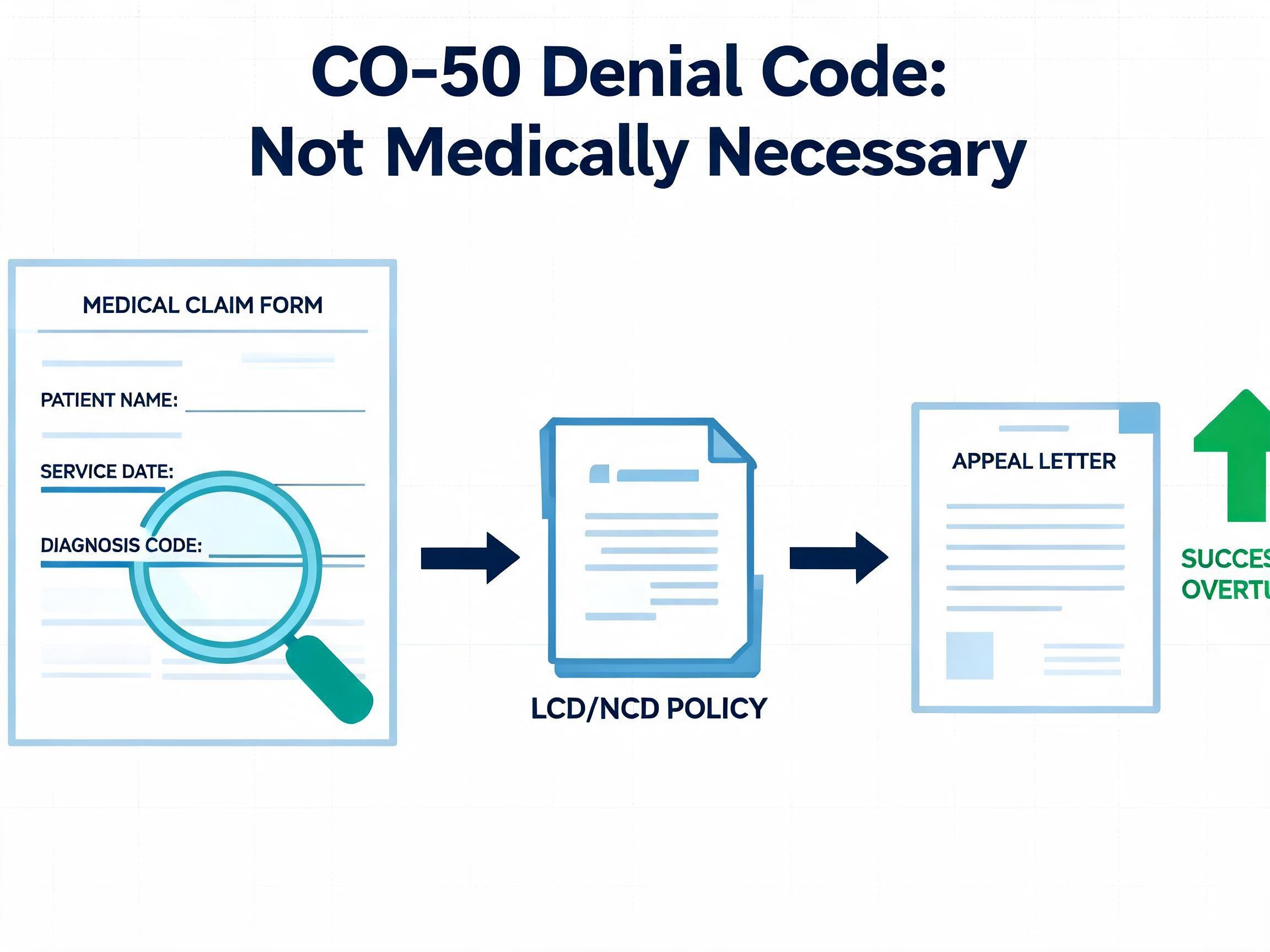
The CO-50 denial code carries the remittance language "These are non-covered services because this is not deemed a 'medical necessity' by the payer." Despite how it reads, CO-50 is rarely a clinical judgment about your patient. It is an automated comparison: the diagnosis on the claim was checked against the payer's written coverage criteria for that CPT code — for Medicare, the applicable NCD or LCD — and the pairing failed. Mechanical denials have mechanical fixes: a more specific supported diagnosis, a criteria-mapped appeal, or an ABN that assigns liability before the service is rendered.
This guide covers how LCDs and NCDs work, the ABN modifier system, pre-service prevention, an appeal packet checklist, the five Medicare appeal levels, and a worked dollar example.
What the CO-50 denial code means
Payers define "medically necessary" in policy documents that pair each service with the clinical conditions, frequency limits, and prerequisite treatments that justify it. When a claim's diagnosis codes don't satisfy that policy — wrong condition, unspecified code, exceeded frequency, missing documented conservative therapy — the claim denies with CARC 50. The group code matters: CO puts the loss on the provider, while a properly executed ABN can shift the denial to patient responsibility (PR) instead. Commercial payers run equivalent medical-policy engines, with the plan's medical policy standing in for the LCD. For how these codes appear on remittances, see our CARC/RARC guide.
LCD vs NCD: whose rulebook applies
| Feature | NCD (National Coverage Determination) | LCD (Local Coverage Determination) |
|---|---|---|
| Issued by | CMS, nationally | Each Medicare Administrative Contractor (MAC) |
| Scope | Binding on every MAC nationwide | Only the issuing MAC's jurisdiction |
| Covers | Whether Medicare covers an item/service at all, and under what conditions | Reasonable-and-necessary criteria where no NCD controls; covered ICD-10 lists live in companion billing-and-coding articles |
| Conflict rule | NCD controls | LCD fills gaps the NCD leaves open |
| Where to find | Medicare Coverage Database (MCD) | Medicare Coverage Database, filtered by your MAC |
The practical consequence: the same test can be payable in one state and denied in another, because different MACs wrote different LCDs. Always pull your MAC's policy and its billing-and-coding article — that is where most CO-50 denials are actually decided.
Common CO-50 causes and fixes
Medical-necessity denials get expensive fastest in per-day inpatient settings, where one adverse determination repeats for every day of the stay. In the NICU, a payer that downgrades neonatal critical care (99469) to weight-based intensive care (99478–99480) on documentation grounds is re-pricing every day of a stay that can run weeks — which is why neonatology billing services treat daily care-level justification as a documentation program, not a claim-by-claim appeal.
| Cause | What happened | Fix |
|---|---|---|
| Unspecified ICD-10 code | Chart documents a covered, specific condition but a vague code was billed | Submit a corrected claim with the specific, documented code |
| Diagnosis outside the covered list | The condition genuinely isn't on the LCD/NCD covered list | Appeal with clinical evidence, or use an ABN pre-service next time |
| Frequency limit exceeded | Service repeated sooner than policy allows | Appeal with documentation of the clinical change that justified repetition |
| Screening vs diagnostic mismatch | Diagnostic CPT billed with a screening diagnosis, or vice versa | Verify intent in the order and documentation; correct and rebill |
| Missing prerequisite treatment | Policy requires documented conservative therapy first | Appeal citing the documented failed-treatment history; strengthen templates going forward |
| Experimental/investigational service | Service not recognized as proven for the condition | Confirm coverage and authorization before furnishing; consider ABN/GA |
One rule overrides all of these: the diagnosis must reflect what the clinician documented. If the chart supports a more specific covered code, correcting the claim is legitimate coding. If it doesn't, changing the code to match a covered list is false-claims exposure — the answer there is an appeal, an ABN, or a write-off, never a "friendlier" diagnosis. A disciplined medical coding process keeps that line bright.
The ABN and the GA/GX/GY/GZ modifiers
For Medicare, liability for a denied service is decided before the service happens. When coverage is doubtful, issue an Advance Beneficiary Notice of Noncoverage (ABN) and append the matching modifier:
| Modifier | Meaning | Who pays if denied |
|---|---|---|
| GA | Required ABN issued and on file (coverage doubtful under reasonable-and-necessary rules) | Patient — denial converts to patient responsibility |
| GX | Voluntary ABN issued for a service that is statutorily excluded | Patient — notice was a courtesy |
| GY | Statutorily excluded / not a Medicare benefit; no ABN required | Patient |
| GZ | Denial expected but no ABN was obtained | Provider — claims are typically auto-denied and non-billable to the patient |
GZ is the modifier of honesty and loss: it tells Medicare you expected the denial and failed to protect yourself. Every GZ on a remittance is a process failure worth tracing back to scheduling or intake.
Pre-service prevention: check the policy before you order
- Before scheduling a policy-sensitive service (advanced imaging, injections, wound care, sleep studies), pull the NCD or your MAC's LCD and billing-and-coding article from the Medicare Coverage Database. Sleep testing is a textbook case — NCD 240.4 and HSAT-first payer policies turn an in-lab study ordered out of sequence into a CO-50, which is why our sleep medicine billing services clear coverage criteria before the study is scheduled.
- Compare the documented diagnosis — as charted — against the covered-diagnosis list, frequency limits, and prerequisite-treatment requirements.
- If criteria are met, make sure the specific supporting diagnosis actually appears in the order and the claim.
- If criteria are not met and the clinician still recommends the service, issue an ABN with a genuine cost estimate, and bill with GA.
- Load covered-diagnosis edits into your scrubber so mismatches are caught before submission, not on the remittance.
How to appeal a CO-50 denial
CO-50 appeals are won on mapping, not rhetoric. A generic "this was medically necessary" letter loses; a document that quotes each LCD criterion and cites the exact chart entry satisfying it wins. Build this packet:
- Copy of the remittance showing the CO-50 denial and claim details
- The applicable LCD/NCD identified by policy number, with the relevant criteria quoted
- A criteria-to-documentation map: each requirement paired with the note, date, and finding that satisfies it
- Physician letter of medical necessity — specific to this patient, signed, referencing the policy criteria
- Progress notes, test results, and orders supporting the diagnosis
- Documentation of failed conservative treatment where the policy requires it
- Corrected diagnosis coding, if the original claim under-coded a documented condition
For Medicare, the appeal ladder runs five levels: redetermination by the MAC (file within 120 days of the remittance; decisions generally within 60 days), reconsideration by a Qualified Independent Contractor (180 days to file), ALJ hearing before the Office of Medicare Hearings and Appeals (60 days to file; at least $200 in controversy for CY2026, per the Federal Register), Medicare Appeals Council review, and federal district court (at least $1,960 in controversy for CY2026). Most CO-50 money is recovered at redetermination when the packet is complete. Commercial payers run their own one- or two-level processes with deadlines commonly between 90 and 180 days — our step-by-step appeal guide walks the full process for both.
Worked example: $980 injections denied for a vague code
Illustrative numbers. A pain practice bills a $980 lumbar epidural steroid injection to Medicare with M54.50 (low back pain, unspecified). The MAC's coverage policy requires a radicular diagnosis and documented failure of conservative therapy — the claim denies CO-50. The chart, it turns out, documents lumbar radiculopathy (M54.16) and six weeks of failed physical therapy: everything the policy wants, none of it on the claim.
The biller submits a corrected claim with the specific documented diagnosis; it pays at the allowed $612, with Medicare paying $489.60 and $122.40 patient coinsurance. The same template gap had produced 14 identical denials that quarter — roughly $13,700 in suspended charges that a covered-diagnosis scrubber edit would have prevented. That pattern is exactly what a denial management program is built to find.
Quick Answers
What does the CO-50 denial code mean? CO-50 means the payer determined the service was not medically necessary for the diagnosis submitted, based on its written coverage policy — for Medicare, the applicable NCD or LCD. It is a policy-match failure, not a judgment on care quality.
How do I appeal a CO-50 denial? Pull the exact LCD or NCD, map each coverage criterion to the specific chart documentation that satisfies it, and file a redetermination with progress notes, test results, and a physician letter of medical necessity within 120 days of the remittance.
What is the difference between an LCD and an NCD? An NCD is issued by CMS and binds every MAC nationwide; an LCD is issued by an individual MAC and applies only in its jurisdiction, typically with covered-diagnosis lists in a companion billing-and-coding article. Where both exist, the NCD controls.
Does an ABN protect against CO-50 losses? Yes, when executed before the service. A required ABN billed with modifier GA shifts a medical-necessity denial to patient responsibility. Without one, modifier GZ applies and the provider absorbs the loss.
Is CO-50 usually worth appealing? Often, yes — many stem from unspecified coding rather than genuine non-coverage. Triage first: fix coding errors with corrected claims, appeal true criteria disputes, and write off only what policy clearly excludes.
What to check before billing
- NCD or MAC-specific LCD and billing-and-coding article reviewed for policy-sensitive services
- Billed diagnosis is the most specific code the documentation supports — no unspecified codes where specificity exists
- Frequency limits and prerequisite-treatment requirements verified against the chart
- ABN issued and GA appended whenever coverage is doubtful; GX/GY for statutory exclusions
- Prior authorization obtained where required — remembering that auth does not override medical-necessity criteria
- Scrubber edits current with the latest LCD covered-diagnosis lists
Related denial codes and guides
CO-50 sits in a family of policy denials: CO-97 bundles a service into another payment, while CO-16 flags missing claim information that sometimes masquerades as a necessity problem. If medical-necessity denials cluster in one specialty or one ordering pattern, the fix is upstream — in templates, orders, and scrubber rules — not in the appeals queue.
Frequently asked questions
Very often a coding problem: the chart documents a covered, specific condition, but an unspecified ICD-10 code went on the claim and failed the payer's covered-diagnosis list. Review the documentation first — if it supports a more specific code, a corrected claim resolves the denial faster than an appeal.
For Medicare, the first-level redetermination must be filed within 120 days of the remittance advice date, and the MAC generally decides within 60 days. Commercial payer deadlines vary by contract, commonly between 90 and 180 days, so check the plan's provider manual before the window closes.
Only if the clinical documentation genuinely supports the more specific code — that is legitimate corrected coding. Selecting a covered diagnosis the chart does not support is coding for coverage, which creates false-claims liability. When documentation doesn't meet criteria, the options are appeal, ABN, or write-off.
A criteria map: the LCD or NCD cited by policy number with each coverage requirement paired to the exact progress note, test result, or treatment record that satisfies it, plus a patient-specific physician letter of medical necessity. Generic appeal letters without policy mapping rarely overturn medical-necessity denials.
It helps for services that require it, but authorization is not a guarantee of payment — medical-necessity criteria still apply at claim adjudication, and payers may deny if the billed diagnosis doesn't meet policy. Verify both the authorization and the covered-diagnosis pairing before submitting.