
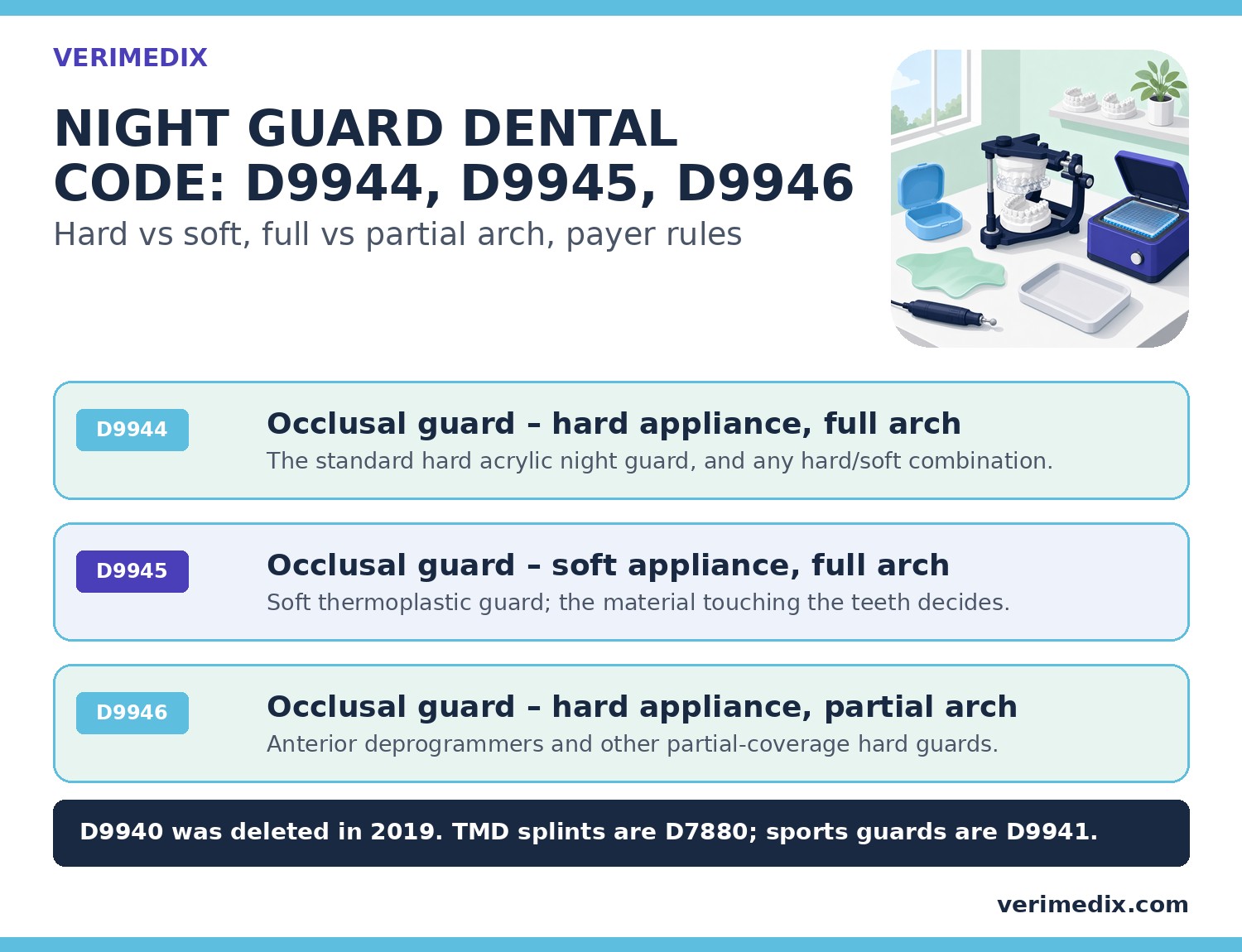
- The night guard dental code is D9944 (occlusal guard – hard appliance, full arch), D9945 (soft appliance, full arch) or D9946 (hard appliance, partial arch). CDT publishes no other night guard code and no soft partial-arch code.
- The ADA’s own guidance settles the mixed-material question: the material that contacts the occlusal surface decides, so a guard with both hard and soft components is reported as a hard appliance (D9944 or D9946).
- D9940 (occlusal guard, by report) was deleted effective January 1, 2019. A claim carrying it in 2026 is rejected as an invalid code, not denied on the merits.
- Aftercare has its own lines: D9943 adjustment, D9942 repair and/or reline, and the new CDT 2026 code D9936 for cleaning and inspection of an occlusal guard, per appliance.
- Coverage is written around bruxism and tooth protection. UnitedHealthcare’s 2026 clinical policy excludes occlusal guards for TMD, headaches and sports; TMD splints belong under D7880 and athletic mouthguards under D9941. Pairing the wrong diagnosis with D9944 is the most avoidable denial in this family.
What is the night guard dental code?
“Night guard” is what patients and front desks call it; the CDT Code calls the appliance an occlusal guard and splits it three ways by material and coverage. The codes arrived with CDT 2019, and the old catch-all D9940 – occlusal guard, by report was deleted at the same time. The New York State Medicaid dental program’s procedure code change notice effective January 1, 2019 records the swap in one line: D9940 removed, D9944, D9945 and D9946 added.
| Code | CDT nomenclature | What it describes in practice |
|---|---|---|
| D9944 | Occlusal guard – hard appliance, full arch | The standard lab-processed hard acrylic night guard covering every tooth in one arch. Also the code for a hard/soft laminate, because the hard layer meets the opposing teeth. |
| D9945 | Occlusal guard – soft appliance, full arch | A flexible thermoplastic guard covering the full arch, whether vacuum-formed in the office or lab-made. |
| D9946 | Occlusal guard – hard appliance, partial arch | A hard appliance that covers only part of the arch; an anterior-only design is the common example. |
The ADA published a short guide, Documenting Occlusal Guards with Hard and Soft Components, when the codes were introduced. Two sentences from it do most of a biller’s work: the three codes “are intended to provide specificity and eliminate the need to prepare and submit a supporting claim narrative”, and “the key determinant of reporting a hard vs. soft appliance is the material that contacts the occlusal surface.” Everything else here is a payer’s rule layered on that baseline.
Hard or soft, full or partial arch: how do you pick between D9944, D9945 and D9946?
Two questions, answered from the appliance in the delivery bag rather than from the chart note.
What touches the opposing teeth? Hard acrylic means D9944 or D9946. A soft thermoplastic surface means D9945. For a dual-laminate guard — soft inner layer against the patient’s teeth, hard outer layer against the opposing arch — the ADA guide is explicit that “an appliance containing both hard and soft components would be properly documented and reported as a hard appliance (e.g., D9944 or D9946).” Reporting a laminate as D9945 because it “feels soft” understates the appliance and usually the fee (the Cigna schedule below prices D9945 at about half of D9944).
How much of the arch does it cover? Every tooth in the arch is full arch. Anything less is partial arch, and the only partial-arch code CDT publishes is the hard one, D9946. A soft appliance that covers part of an arch has no code of its own; do not force it into D9946 (the material is wrong) or D9945 (the coverage is wrong) without the payer’s written instruction, and expect the payer to ask what was delivered.
Two habits keep this clean. Record the material and coverage in the lab prescription and the delivery note in the words CDT uses, and report one line per arch with the arch identified — an upper and a lower guard delivered together are two lines, not one D9944 with a quantity of two. The diagnosis never changes the code: a bruxism guard and a guard protecting natural teeth from opposing porcelain crowns are both D9944 if they are hard, full-arch appliances.
Which codes are not the night guard code: D7880, D9941, D9947 and the aftercare codes
Many occlusal guard denials trace to a code from this table used in place of, or alongside, D9944–D9946. Nomenclature is from the ADA’s CDT code list (the CDT-2022 list hosted by Delta Dental of Colorado is the public copy) and, for D9936, from the CDT 2026 change summary published by Delta Dental of Kansas.
| Code | CDT nomenclature | Use it when |
|---|---|---|
| D9936 | Cleaning and inspection of occlusal guard – per appliance | New in CDT 2026; excludes adjustments. Delta Dental of Kansas classes it “generally denied” unless contracted, and the State of Oklahoma PPO lists it as denied, so quote it to the patient. |
| D9942 | Repair and/or reline of occlusal guard | A cracked, worn-through or loose guard that is repaired or relined rather than remade. |
| D9943 | Occlusal guard adjustment | Selective grinding or polishing of an existing guard at a later visit. |
| D9941 | Fabrication of athletic mouthguard | A sports guard. UnitedHealthcare’s and Unicare’s 2026 policies both exclude sports protection from D9944–D9946. |
| D7880 | Occlusal orthotic device, by report | A TMD splint. Anthem’s dental clinical policy 07-800 says these devices “reposition or stabilize the jaw for the treatment of temporomandibular disorders (TMD)” and are typically medical in nature. Adjustment is D7881. |
| D9947 | Custom sleep apnea appliance fabrication and placement | A mandibular advancement device for obstructive sleep apnea, with D9948 (adjustment) and D9949 (repair). On a medical claim the custom OSA appliance is HCPCS E0486. |
| D9951 / D9952 | Occlusal adjustment – limited / complete | Work on the patient’s own teeth, not on an appliance; never a substitute for D9943. |
Delta Dental’s PPO and Premier clinical criteria (effective January 1, 2025) put the boundary in one sentence: occlusal guards are “not to be reported for any type of sleep apnea, snoring or TMD appliances.” When the treatment plan says TMD, the claim is a D7880 claim — and often a medical claim, which is where our medical vs dental cross-coding guide picks up.
What do payers actually cover for D9944, D9945 and D9946?
Occlusal guards sit in the adjunctive services section of most plans, which means coverage, frequency and age rules vary by contract far more than for a filling or a crown. The published policies below are the ones a biller can cite; the frequency and waiting-period limits on a specific member’s plan still have to come from the eligibility and benefits verification before the impression.
| Payer document (dated) | What it says about occlusal guards |
|---|---|
| UnitedHealthcare Dental Clinical Policy DCP019.13, Occlusal Guards (effective January 1, 2026) | Indicated for “bruxism or clenching, either as a nocturnal parasomnia or during waking hours, resulting in excessive wear or fractures of natural teeth or restorations,” and to protect natural teeth from opposing ceramic or porcelain restorations. Not indicated for orthodontic tooth movement, “for treatment of temporomandibular disorders,” “for treating headaches or other pain disorders,” or “as a mouthguard to protect the dentition during sports.” Lists D9936 and D9942–D9946. |
| Unicare (Elevance Health) Dental Clinical Policy 09-400, Occlusal Guard (published January 1, 2026) | Covers guards that protect natural teeth from an opposing dentition likely to cause wear, minimise sensitivity from clenching or bruxism, or relieve occlusal stress after periodontal therapy. Requires “a narrative with rationale for treatment.” States that “partial arch occlusal guards may not be a covered service, contract dependent.” Excludes TMD, athletic mouthguards, orthodontic tooth movement, obstructive sleep apnea, and whitening or medicament delivery. |
| Delta Dental Premier, PPO and Medicare Advantage Clinical Criteria (effective January 1, 2025) | Defines occlusal guards as removable appliances “designed to minimize the effects of bruxism or other occlusal factors” and adds: “Not to be reported for any type of sleep apnea, snoring or TMD appliances.” |
| Cigna Dental Care (DHMO) patient charge schedule WAOV9 (dated November 2021) | Lists D9944, D9945 and D9946 each at “limit 1 per 24 months,” with patient charges of $285, $145 and $170 respectively, and D9943 adjustment at $0. A DHMO copay schedule, so the figures are that plan’s; treat the 24-month window as an example, not a rule. |
| New York State Medicaid dental fee-for-service (code change notice effective January 1, 2019) | Adopted D9944–D9946 on the day D9940 was deleted, at $145.00 each at that time. Medicaid coverage is state-specific; check the state manual. |
Read together, the policies agree on three things. Bruxism, clenching and protection of natural teeth are the covered indications. None of the three treats TMD as an occlusal guard indication, and sports, orthodontic movement and sleep apnea appliances are excluded wherever they are mentioned. And a partial-arch guard can be perfectly coded and still not a benefit, so D9946 deserves a pre-treatment estimate more than the other two.
What documentation and diagnosis codes support a night guard claim?
The ADA designed D9944–D9946 to make a narrative unnecessary, but Unicare’s 2026 policy asks for one anyway, and reviewers pend a guard when the record is thin. A defensible note names the arch, the material, the coverage and the clinical finding that justifies the appliance — wear facets, fractured cusps or restorations, sensitivity, reported grinding, or the opposing ceramic restoration the guard protects against — and intraoral photographs of the wear are worth more than a paragraph. Diagnosis codes go in the diagnosis-code fields of the ADA Dental Claim Form. From the FY 2026 ICD-10-CM code set (effective October 1, 2025):
| ICD-10-CM | Title | Note for occlusal guard claims |
|---|---|---|
| G47.63 | Sleep related bruxism | The night-time grinding diagnosis. Excludes1 with F45.8, so never report both. |
| F45.8 | Other somatoform disorders | Carries “teeth grinding” in its applicable-to list; G47.63 excludes psychogenic bruxism to it, and the two are Excludes1 with each other. |
| K03.0 | Excessive attrition of teeth | The “excessive wear” finding UnitedHealthcare’s policy names; K03.1 (abrasion of teeth) and K03.81 (cracked tooth) are the neighbours. |
| M26.60- | Temporomandibular joint disorder, unspecified | Sixth character for side (M26.601 right, M26.602 left, M26.603 bilateral, M26.609 unspecified). A TMD diagnosis supports D7880, not D9944–D9946, and triggers the TMD exclusion in every policy above. |
One coding error is common enough to name: a claim that reports D9944 with an M26.6- diagnosis because the dentist wrote “TMJ” in the note. The payer reads that as an occlusal guard for TMD and denies it on policy. If the appliance really is a bruxism guard, the diagnosis should say so; if it really is a TMD orthotic, the code should be D7880 and the claim probably belongs on the medical side.
Why do occlusal guard claims get denied, and how do you fix them?
| Denial or rejection | Cause | Fix |
|---|---|---|
| Invalid procedure code | D9940 still in the fee schedule or a template from before 2019. | Retire D9940 in the practice management system; resubmit by material and coverage. |
| Not a covered benefit – TMD / pain | M26.6- or a TMD narrative attached to D9944–D9946. | If bruxism, correct the diagnosis and resubmit with wear documentation; if TMD, rebill as D7880 and evaluate the medical plan. |
| Frequency limitation | A guard already paid within the plan’s window (24 months on the Cigna DHMO schedule above; other plans differ). | Verify history first; a replacement inside the window needs a documented reason and a signed patient estimate. |
| Partial arch not covered | D9946 on a contract that excludes partial-arch guards. | Pre-treatment estimate for every D9946; do not recode it as D9944 to get it paid. |
| Pended for records | No narrative, no photographs, no arch identified. | Send the delivery note, wear photographs and a two-sentence rationale; identify the arch on every line. |
| Aftercare denied | D9936, D9942 or D9943 billed on a plan that bundles or excludes them. | Check adjunctive benefits at verification; quote D9936 to the patient unless the plan confirms it. |
Appeals in this family are documentation appeals, not coding arguments, and they follow the same packet logic as any other dental claim denial: the policy language, the clinical finding that meets it, and the photograph that proves it.
What does miscoding night guards cost a practice? A worked example (illustrative)
Take a two-doctor general practice delivering ten occlusal guards a month, with an office fee of $450 for a hard full-arch guard and an average allowed amount of $300 on covered guards. All figures are illustrative; use your own fee schedule.
- Two guards a month go out as D9940 from an old template. Both are rejected as invalid codes and sit 30–45 days before anyone notices: $600 of reimbursement delayed every month, about $7,200 a year, and a rejection nobody works becomes a timely-filing write-off.
- One guard a month is a dual-laminate coded as D9945 instead of D9944. If the plan allows $180 on a soft guard and $300 on a hard one, that is $120 a month, $1,440 a year, left on the table for correctly delivered work.
- One guard a month is a D9946 delivered without a pre-treatment estimate to a member whose contract excludes partial-arch guards: a $450 write-off or a collections conversation, up to $5,400 a year.
The fixes cost almost nothing: a template purge, a material-and-coverage checkbox on the delivery note, and a rule that every D9946 gets an estimate first.
How to keep occlusal guard claims clean: a seven-point checklist
- Delete D9940 from every fee schedule, template and quick-code button; it has not been valid since January 1, 2019.
- Verify the occlusal guard benefit, the frequency window, any age limit and any waiting period at the eligibility step, and record whether partial-arch guards and the D9936/D9942/D9943 aftercare codes are covered.
- Choose the code from the appliance: hard or soft by the surface that contacts the opposing teeth; full or partial by coverage; laminates are hard.
- Report one line per arch with the arch identified, and put the tooth numbers, wear findings and rationale in the narrative even when the payer does not ask.
- Pair the diagnosis with the appliance: G47.63 or F45.8 for bruxism, K03.0 for attrition; keep M26.6- for D7880 claims.
- Send a pre-treatment estimate for every D9946 and for any replacement inside the frequency window.
- Work rejections within a week. An invalid-code rejection never reached adjudication, so the timely filing clock keeps running.
Steps 2 and 7 are the ones that slip when the front desk is short, and they are the reason practices outsource this work. Our dental billing services page covers how Verimedix runs verification, claim submission and denial management for dental practices, and our dental billing services pricing guide explains what a percentage-of-collections or per-claim fee buys.
Quick Answers
What is the dental code for a night guard? CDT D9944 for a hard full-arch occlusal guard, D9945 for a soft full-arch guard, and D9946 for a hard partial-arch guard; the code follows the appliance, not the diagnosis.
Is D9940 still valid? No. D9940 (occlusal guard, by report) was deleted effective January 1, 2019 and replaced by D9944, D9945 and D9946.
Is D7880 a dental or a medical code? D7880 is a CDT (dental) code, “occlusal orthotic device, by report,” used for TMD splints; because TMD treatment is typically a medical benefit, the appliance is often billed to the medical plan instead.
Is there a CPT code for a night guard? No. A bruxism occlusal guard is billed on the ADA claim form with D9944–D9946; the custom oral appliance medical plans recognise is the obstructive sleep apnea device, HCPCS E0486 (D9947 on a dental claim).
Frequently asked questions
D9944 is the CDT code for an occlusal guard – hard appliance, full arch: a hard acrylic guard covering every tooth in one arch, worn to protect the teeth from bruxism or clenching. The ADA’s documentation guide adds that a guard with both hard and soft components is also reported as a hard appliance, because the material that contacts the occlusal surface decides the code.
Material and coverage. D9944 is a hard appliance covering the full arch, D9945 a soft appliance covering the full arch, and D9946 a hard appliance covering only part of the arch. There is no CDT code for a soft partial-arch guard. Each is reported once per arch delivered.
D7880 is a dental (CDT) code: occlusal orthotic device, by report, with D7881 for its adjustment. It describes a splint that repositions or stabilises the jaw for temporomandibular disorders, which is why occlusal guard policies exclude TMD and why the appliance is often billed to the patient’s medical plan under its TMD policy instead of to the dental plan.
Verify the occlusal guard benefit, frequency window, age limit and waiting period before the impression; document the clinical finding the policy names — bruxism or clenching with wear, fractures or sensitivity, or natural teeth opposing ceramic restorations — with photographs; report the code that matches the appliance with the arch identified; and pair it with a bruxism or attrition diagnosis, not a TMD code. Send a pre-treatment estimate for a partial-arch guard, which some contracts exclude.
No. A bruxism night guard is reported with CDT D9944, D9945 or D9946 on the dental claim form, and a sports mouthguard with D9941; CPT has no code for either. The custom oral appliance medical plans recognise is the obstructive sleep apnea device, HCPCS E0486, which dental claims report as D9947.
D9943 for an occlusal guard adjustment, D9942 for a repair and/or reline, and D9936 — new in CDT 2026 — for cleaning and inspection of an occlusal guard, per appliance. D9936 does not include adjustments, and the 2026 Delta Dental plan documents we checked list it as denied unless contracted, so confirm coverage or quote it to the patient.