- Oral surgery straddles two claim systems: CDT codes on the ADA dental claim form versus ICD-10 + CPT (or accepted CDT) codes on the CMS-1500 medical form — with different rules for necessity, authorization and appeal.
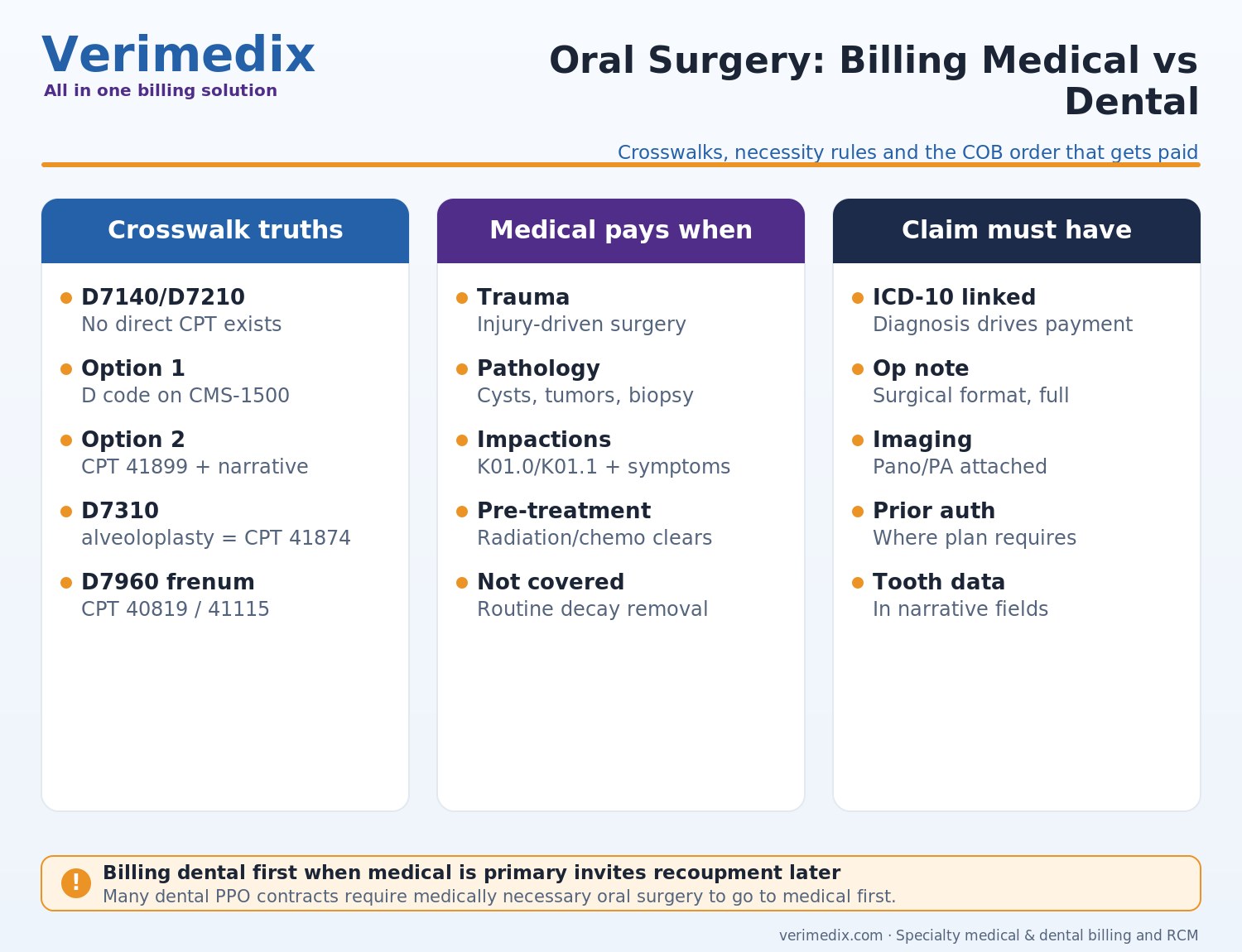
- D7140 (extraction, erupted tooth or exposed root) and D7210 (surgical extraction requiring bone removal and/or sectioning) have no direct CPT crosswalk; medical claims use the D code where accepted or CPT 41899 (unlisted, dentoalveolar) with an operative narrative.
- Medical plans pay for oral surgery when a medical condition drives it — trauma, infection, pathology, treatment-related extractions (e.g., pre-radiation), or impactions with symptoms — not for routine dental breakdown.
- Medical necessity lives in the documentation: linked ICD-10 diagnoses, an operative note that reads like surgery, radiographs, and prior authorization where required.
- Coordination of benefits decides everything downstream: when medical is primary for a medically necessary procedure, billing dental first creates denials and recoupments later.
- Cross-coded claims fail most often on form mechanics — wrong claim form, missing tooth numbers on medical claims, no narrative with 41899 — not on clinical grounds.
One surgery, two insurance systems
Every other dental specialty mostly argues with dental payers. Oral surgery argues with both sides at once — and each side would prefer the other pay. A dental plan sees a $450 surgical extraction; a medical plan sees a minor surgical procedure that might belong on the dental side; and in the gap between them, claims bounce for months. The practices that win at this decide before treatment which system should pay, verify both coverages, and build documentation to the medical standard, which is stricter.
The structural differences run deeper than the form. Dental claims are procedure-driven — the CDT code and tooth number mostly speak for themselves. Medical claims are diagnosis-driven: the ICD-10 code establishes why the procedure was necessary, and the procedure code means little without it. Our comparison of dental billing vs medical billing covers these mechanics in depth.
When medical insurance pays for oral surgery
Medical plans generally consider oral surgery covered when a medical condition causes or necessitates the procedure. The well-established categories, always subject to plan policy: Cross-coding is where specialist support pays for itself: dental billing partners such as Verimedix handle both the CDT claim and the medical-side CMS-1500 submission, matching documentation to each payer's medical-necessity standard.
- Trauma: extractions, alveolar fracture care and repairs following accidental injury.
- Infection and pathology: abscesses extending beyond the tooth, cysts and tumors, biopsy of suspicious lesions.
- Impactions: many medical plans cover removal of bony impacted teeth, particularly with symptoms or documented pathology (ICD-10 K01.0 embedded teeth, K01.1 impacted teeth); policies vary on asymptomatic third molars.
- Medically driven extractions: teeth removed in preparation for radiation therapy, chemotherapy, transplant or cardiac surgery clearance.
- Congenital and skeletal conditions: orthognathic surgery, cleft-related procedures — usually with strict prior authorization.
- TMJ and obstructive sleep apnea procedures: coverage exists but is among the most policy-restricted areas in medical dentistry.
What medical plans do not pay for: routine extractions of carious or periodontally hopeless teeth without a driving medical condition. Billing those to medical “because dental benefits ran out” is a denial at best and a false-claim problem at worst.
The D7140/D7210 crosswalk question (verified)
The most-searched crosswalk in oral surgery billing has an unsatisfying but verifiable answer: CPT contains no specific code for a routine or surgical tooth extraction. The workable options, confirmed across payer guidance and cross-coding references:
| CDT code (ADA descriptor, abbreviated) | Medical claim option | Notes |
|---|---|---|
| D7140 — extraction, erupted tooth or exposed root (elevation and/or forceps removal) | CDT code on CMS-1500 where accepted, or CPT 41899 unlisted with narrative | Many medical payers accept CDT codes for dental-in-nature procedures; confirm per payer |
| D7210 — extraction, erupted tooth requiring removal of bone and/or sectioning of tooth, including elevation of mucoperiosteal flap | Same: D code where accepted, else 41899 + operative note | The operative note must document flap, bone removal or sectioning — that detail defends both code choice and payment level |
| D7220/D7230/D7240 — impacted tooth removal (soft tissue / partially bony / completely bony) | D code where accepted, else 41899; link K01.0/K01.1 ICD-10 | Impactions are the most commonly medically covered extractions |
| D7310/D7311 — alveoloplasty with / without extractions | CPT 41874 (alveoloplasty, each quadrant) is the closest true CPT match | One of the few areas with a genuine CPT counterpart |
| D7960 (frenectomy) | CPT 40819 (excision of frenum, labial or buccal) or 41115 (excision of lingual frenum) by site | True crosswalks exist here; choose by anatomic site |
When you use 41899, expect manual review: unlisted codes require a narrative describing what was done, why, and a comparison procedure for pricing. Attach the operative note and radiograph up front — unlisted claims submitted bare are essentially requests for a development letter. For the clinical distinction underlying the extraction codes themselves, see our guide to D7140 vs D7210 simple vs surgical extraction billing.
Medical-necessity documentation that survives review
Medical reviewers do not read tooth charts; they read operative notes. The file that gets paid contains:
- A linked diagnosis: the ICD-10 code(s) establishing the medical condition — K01.1 for impaction, trauma codes for injury, infection codes where cellulitis or abscess extends beyond the tooth — listed in the correct claim positions and pointed to the procedure line.
- An operative note in surgical format: preoperative diagnosis, indication, anesthesia, technique (flap design, bone removal, sectioning, closure), findings and complications. “Ext #17, difficult” is a denial.
- Imaging: the panoramic or periapical radiograph documenting the impaction, pathology or trauma.
- Prior authorization where the plan requires it — common for orthognathic, TMJ and some impaction surgery. An approved auth number on the claim short-circuits most necessity reviews.
- Form mechanics: CMS-1500 for professional medical claims with the rendering provider’s NPI and taxonomy; the current ADA claim form for dental. Medical claims for dental-in-nature work may still need tooth numbers and quadrants in the narrative fields.
Coordination of benefits: who pays first
When a patient has both coverages, order of payment is not optional. If the procedure is medically necessary, most dental plans are secondary by their own contract language — many dental PPOs explicitly require medically necessary oral surgery to be billed to medical first and will recoup payments made in error. The clean workflow: verify both plans, determine primacy for the specific procedure, bill primary, then submit the primary EOB with the secondary claim. Skipping straight to the dental plan because “it pays faster” creates recoupment risk months later.
Worked example: an impacted third molar case (illustrative)
Illustrative numbers. A patient with medical + dental coverage needs removal of a symptomatic, partially bony impacted #17 (D7230), office fee $650.
- Path A — dental only: dental plan pays 80% of a $420 PPO allowance = $336; patient owes $84; $230 is a contractual write-off. Practice receives $420.
- Path B — medical primary, dental secondary: medical processes the cross-coded claim (D7230 accepted on CMS-1500 with K01.1 and pericoronitis diagnosis), allows $510 against the medical deductible-met plan at 80% = $408; dental secondary coordinates up to its allowance, adding $60–$84 depending on COB method. Practice receives roughly $470–$490 and the patient owes less.
The spread — here $50–$70 on one tooth, often far larger on full-bony impactions, biopsies and orthognathic work — is why oral surgery practices that build a cross-coding workflow out-collect those that default everything to dental. Multiply across a surgical schedule and the annual difference funds a staff position.
Common oral surgery denials and fixes
| Denial | Root cause | Fix |
|---|---|---|
| “Not medically necessary” | Missing or unlinked ICD-10; note documents dentistry, not surgery | Resubmit/appeal with linked diagnosis, full operative note and imaging |
| Unlisted code (41899) pended or denied | No narrative or comparison procedure submitted | Attach op note, describe procedure, name a comparable CPT for pricing |
| “Dental in nature — not covered” | Procedure billed to medical without a driving medical condition | Confirm category (trauma/pathology/impaction); if truly dental, bill dental — do not re-argue |
| COB denial / recoupment | Dental billed first when medical was primary | Bill medical, then dental with the medical EOB; refund and rebill in correct order |
| Missing tooth/quadrant data on medical claim | CMS-1500 lacks dental fields; data omitted entirely | Report tooth numbers and quadrant in the narrative/notes field per payer instructions |
| Prior authorization absent | Auth-required procedure performed without approval | Retro-auth request where the plan allows; build auth checks into scheduling |
Quick Answers
What is cross-coding in oral surgery billing? Cross-coding is billing a dental procedure to a medical plan — translating the CDT procedure into the medical claim format (CMS-1500) with ICD-10 diagnoses and either an accepted CDT code or a CPT code such as 41899 when no specific CPT exists.
What is the CPT code for D7140 or D7210? There is none — CPT has no specific code for routine or surgical tooth extraction. Medical claims either carry the CDT code itself (many medical payers accept D codes) or CPT 41899, the unlisted dentoalveolar procedure code, with an operative narrative attached.
When does medical insurance cover tooth extraction? When a medical condition drives it: trauma, infection extending beyond the tooth, pathology, symptomatic or bony impactions (per plan policy), or extractions required before radiation, chemotherapy or transplant. Routine removal of decayed teeth stays on the dental side.
Which insurance is primary for oral surgery? For medically necessary procedures in a dually insured patient, the medical plan is usually primary and many dental contracts explicitly require medical be billed first. Verify both plans and confirm order before submitting anything.
What documentation does a cross-coded claim need? A linked ICD-10 diagnosis, a surgical-format operative note, supporting radiographs, prior authorization where required, and tooth/quadrant details reported in the medical claim’s narrative fields.
Frequently asked questions
No. Medical coverage follows medical necessity, not dental benefit exhaustion. Billing routine dental extractions to medical because dental benefits ran out invites denials and, if a pattern, payer audits. The question is always whether a medical condition drove the procedure — not which plan has money left.
Many do for procedures they classify as dental in nature — HIPAA transaction standards accommodate CDT codes on professional claims — but acceptance is payer-specific. Check each medical payer's companion guide or provider manual; where D codes are rejected, CPT 41899 with a narrative is the fallback.
Often not. Many medical policies cover impacted third molar removal when there are symptoms, infection, cysts or documented pathology, and are more restrictive for prophylactic removal of asymptomatic impactions. Read the specific plan's clinical policy before promising the patient medical coverage.
IV sedation and general anesthesia billed to medical plans typically need their own codes, time documentation and sometimes separate provider enrollment, and coverage frequently hinges on the underlying procedure being medically covered. Verify anesthesia benefits and documentation requirements separately — an approved surgery with denied anesthesia is a common partial-payment surprise.
If you routinely perform trauma, pathology, impaction or hospital-adjacent work, yes — out-of-network medical claims face higher patient responsibility and unpredictable allowables. Medical credentialing takes a few months per payer, so start with the plans your referral base carries most.