
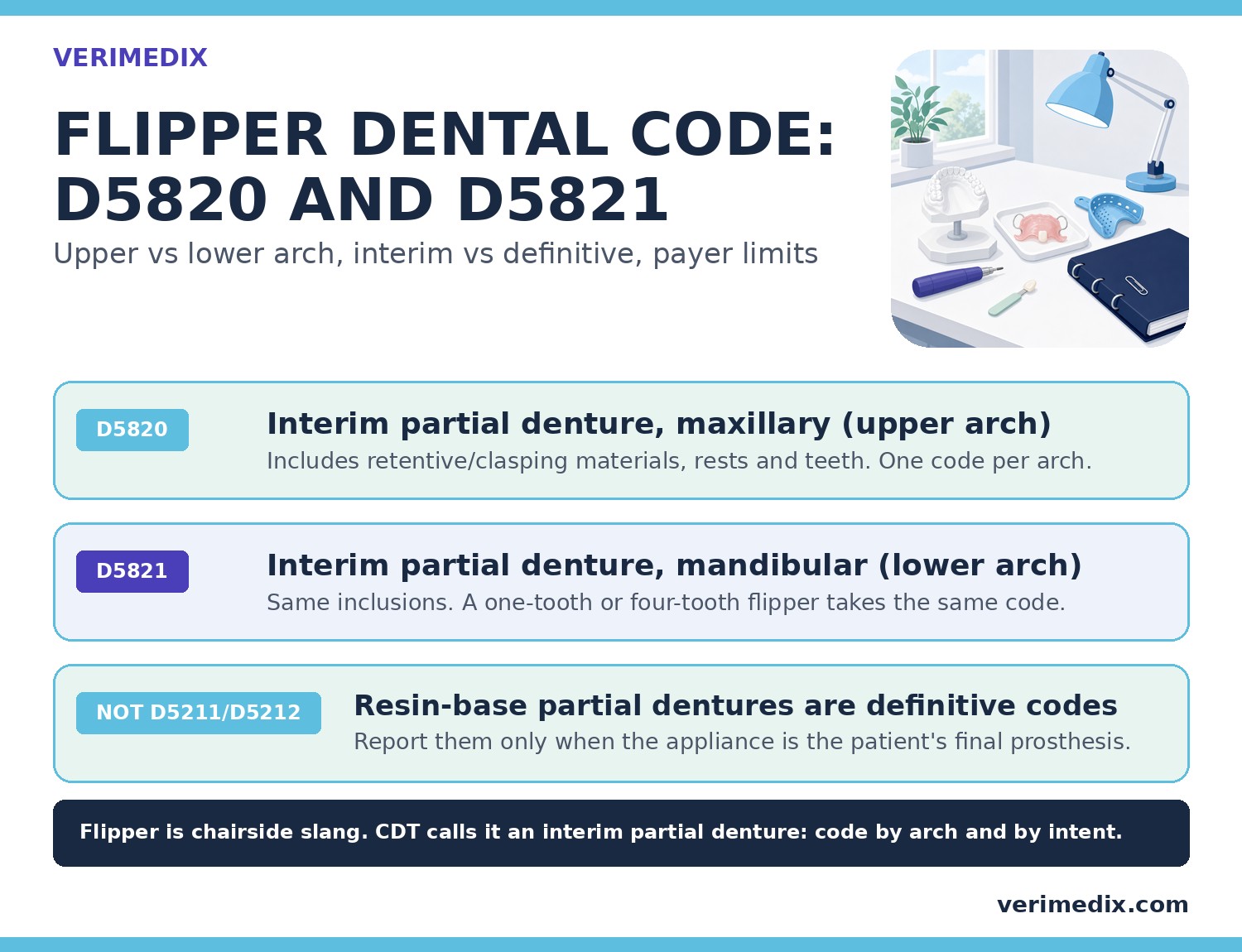
- The flipper dental code is CDT D5820 for an upper (maxillary) interim partial denture and D5821 for a lower (mandibular) one. “Flipper” is chairside shorthand; the CDT nomenclature is “interim partial denture (including retentive/clasping materials, rests, and teeth)”.
- The arch picks the code, not the tooth count. A one-tooth flipper and a four-tooth flipper in the same arch are both one line of D5820 or D5821; a flipper in each arch is one line of each.
- D5211/D5212 (resin-base partial dentures) are definitive codes. Reporting them for a temporary appliance — or D5820 for the patient’s final partial — is the error behind most flipper denials and pends.
- Coverage is plan-specific: the published examples here run from “once per 12 months per arch” to “once per tooth per lifetime” to Medicaid age brackets. Verify the interim-denture benefit and any missing tooth clause before the impression.
- The narrative matters. UnitedHealthcare’s 2026 commercial claim-review guideline asks for the dates of planned extractions on D5820/D5821; every reviewer wants the same story — what was extracted, what is planned, why the appliance is interim.
What is the flipper dental code?
A flipper is a removable acrylic appliance carrying one or more artificial teeth on a resin base, usually held by thin wire clasps, worn while a socket heals or an implant or bridge is made. CDT does not use the word “flipper”. The appliance is an interim partial denture, and the two codes read identically in the ADA CDT-2022 Code on Dental Procedures and Nomenclature, in UnitedHealthcare’s Removable Prosthodontics dental clinical policy (DCP020.17, effective January 1, 2026) and in Hawaii Dental Service’s 2024 removable prosthodontics guidelines:
| Code | CDT nomenclature | Plain-English use |
|---|---|---|
| D5820 | Interim partial denture (including retentive/clasping materials, rests, and teeth), maxillary | Upper-arch flipper, any number of teeth |
| D5821 | Interim partial denture (including retentive/clasping materials, rests, and teeth), mandibular | Lower-arch flipper, any number of teeth |
Three things follow from that wording. First, clasps, rests and denture teeth are inside the code: no separate line for a wire clasp on a new interim partial. Second, there is no per-tooth interim code, so a “single tooth flipper” and a “two tooth flipper” are coded the same way; the tooth numbers go in the narrative and the claim’s tooth field. Third, the ADA’s Glossary of Dental Clinical Terms defines interim as “a restoration or prosthesis designed for use over a limited period of time”, and UnitedHealthcare’s policy describes an interim prosthesis as a prosthesis “designed for use over a limited period of time. Also referred to as a temporary removable Denture.” Intent to replace the appliance later is what makes it interim — not its material, size or price.
Interim, immediate or definitive: which removable partial code applies?
Most flipper claim problems begin with a code from the wrong family. CDT’s removable prosthodontics section separates appliances by intent (interim vs definitive), timing (immediate vs conventional) and construction (resin, cast metal, flexible, unilateral). The table is abbreviated; confirm full nomenclature in the current CDT book before billing.
| Code(s) | What it describes | When it is the right code for a “flipper” question |
|---|---|---|
| D5820 / D5821 | Interim partial denture, maxillary / mandibular | The temporary appliance: healing after extraction, holding space for an implant or bridge, conditioning tissue before a definitive partial |
| D5810 / D5811 | Interim complete denture, maxillary / mandibular | Fully edentulous arch only; a flipper replacing a few teeth is never a complete denture |
| D5211 / D5212 | Maxillary / mandibular partial denture – resin base (including retentive/clasping materials, rests and teeth) | The definitive acrylic partial; wrong for a flipper even though the material is the same |
| D5213 / D5214 | Partial denture – cast metal framework with resin denture bases | Definitive cast partial; not a flipper |
| D5225 / D5226 | Partial denture – flexible base | Definitive flexible (nylon-type) partial; not a flipper |
| D5221 / D5222 | Immediate maxillary / mandibular partial denture – resin base | A partial constructed for placement at the extraction visit and intended as the patient’s prosthesis, not a stopgap (cast-metal and flexible-base immediate variants also sit in the D5220s) |
| D5282–D5286 | Removable unilateral partial denture, one piece (cast metal, flexible base or resin) | Definitive one-sided partial; not a flipper |
| D5899 | Unspecified removable prosthodontic procedure, by report | Only when nothing above fits; by report with lab invoice, materials, tooth numbers and chair time |
Same-day flippers. The most-asked question is what to bill when the flipper is seated at the extraction appointment. The ADA glossary separates the families by intent, not by the calendar: an immediate denture is a “prosthesis constructed for placement immediately after removal of remaining natural teeth”, while definitive means a prosthesis “intended to retain form and function for an indefinite time”. A flipper delivered on extraction day that the treatment plan says will be replaced by an implant crown or a bridge is still an interim partial (D5820/D5821); an acrylic partial delivered that day that the dentist intends the patient to keep is an immediate partial (D5221/D5222). If the chart does not say which, ask the dentist before the claim goes out and state the intent in the narrative rather than letting a reviewer decide it.
What do payers actually allow for D5820 and D5821?
There is no single “insurance rule” for flippers. The same two codes are handled differently in each published document below, which is why a benefits check must ask specifically about interim dentures rather than “partials”.
| Payer / program (document) | Published rule for D5820 / D5821 |
|---|---|
| UnitedHealthcare dental clinical policy DCP020.17 (effective Jan 1, 2026) | Interim complete and partial dentures are indicated “while tissue is healing following extractions”, for “maintenance of a space for future permanent treatment such as an implant, bridge, or definitive fixed prosthesis”, “to condition teeth and ridge tissue for optimum support of a definitive removable Partial Denture” and “to maintain established jaw relation until all restorative treatment has been completed” |
| UnitedHealthcare National Standardized Dental Claim Review Guidelines (commercial, effective Jan 1, 2026) | Documentation for D5820/D5821: “Narrative indicating dates of planned extractions” |
| Hawaii Dental Service procedure code guidelines (revised Jan 1, 2024) | “Interim partial denture is allowed once per 12 months per arch and limited to once per tooth per lifetime.” Separately: complete or partial dentures (immediate dentures excepted) include any reline, rebase, adjustment or repair within 6 months of insertion |
| DeltaCare USA, State of Maryland schedule of benefits (copayment plan) | D5820 and D5821 each “limited to 1 in any 12 consecutive months” |
| New York State Medicaid dental policy and procedure code manual (update dated Nov 17, 2023) | “Partial dentures can be considered for ages 15 years and above; an ‘Interim Prosthesis’ (procedure codes D5820 and/or D5821) can be considered for individuals 5 to 15 years of age.” Reimbursement limited to once per year for that age band; “Codes D5820 and D5821 are not to be used in lieu of space maintainers”; all claims pended for professional review |
| Oklahoma Health Care Authority (SoonerCare) prosthodontics guideline (effective Dec 21, 2021; last review Jul 7, 2022) | D5820/D5821: “One (1) per every five (5) years for members five (5) years to twenty-five (25) years of age. One (1) per every seven (7) years is available for members twenty-five (25) years of age and over”; prior authorization required |
Read those side by side and the verification script writes itself: is an interim partial denture a covered benefit at all; what is the frequency, and is it per arch, per tooth or per lifetime; is there an age limit; is prior authorization or a pended review expected; and does the plan apply a missing tooth clause? That last one bites flippers in particular: a plan with a missing tooth clause can exclude replacement of a tooth lost before the member’s coverage began, and an interim partial is a replacement prosthesis, so a flipper for a tooth extracted under a previous carrier may be excluded even where D5820 is otherwise a benefit. Anything the plan will not confirm in writing is a patient-pay risk and belongs on the estimate as such. Verimedix runs this check through its insurance eligibility verification service before prosthetic appointments.
What documentation supports a D5820 or D5821 claim?
Interim dentures are routinely pended because the claim never explains why the appliance is temporary. Build the record so a reviewer can answer that in one read:
- Arch and tooth numbers. The code is per arch; the narrative and the claim’s tooth fields should name every tooth the flipper replaces.
- Extraction dates, completed and planned. UnitedHealthcare’s commercial claim-review guideline asks for a narrative “indicating dates of planned extractions”. If the tooth is already out, give the date of service and the extraction code billed (our D7140 vs D7210 extraction billing guide covers that side of the claim).
- The definitive plan. One sentence: “interim appliance during healing; implant crown planned for tooth 8”. This is what separates D5820 from D5211 in a reviewer’s mind, and it mirrors the indications in the UnitedHealthcare policy.
- Radiograph or photo of the edentulous space when the plan asks for one or prior authorization applies (Oklahoma Medicaid, for example).
- Verification notes: reference number, the interim-denture frequency quoted, any age limit and the missing tooth clause answer — the notes an appeal will need later.
- For D5899 only: Hawaii Dental Service’s by-report list — “materials used, tooth number, arch, quadrant, or area of the mouth, chair time, laboratory invoices, X-ray images or any other supporting information” — which is also a sound template for any prosthetic appeal.
Why do flipper claims get denied, and how do you fix them?
| Denial or pend | Usual cause | Fix |
|---|---|---|
| “Not a benefit” | Plan excludes interim prostheses, or applied a missing tooth clause | Check the verification record; a correct exclusion is patient responsibility per the signed estimate. A misapplied missing tooth clause (tooth lost after the effective date) is appealed with the extraction date |
| Frequency exceeded | Second interim in the same arch inside the plan’s window (12 months per arch, or once per tooth per lifetime, in the examples above) | Confirm the prior date of service; appeal only if the earlier appliance replaced a different tooth and the plan counts per tooth |
| Age limit | Medicaid programs that restrict D5820/D5821 to a child or young-adult band | Check the program manual before treatment; for an adult, ask whether a definitive partial is the covered path |
| Pended for narrative | No extraction dates or definitive plan on the claim | Send the narrative from the checklist above |
| Denied or downcoded as definitive | D5211/D5212 billed for what the chart calls a temporary, or a definitive partial billed months after D5820 on the same arch | Code by intent from the start; when the flipper is upgraded, bill the definitive code with its own narrative and expect the plan’s replacement frequency to apply |
If flipper denials recur on the aging report, the pattern is almost always a verification gap rather than a coding one — the kind a dental denial management service fixes at the front-desk script rather than with more appeals.
What does one miscoded flipper cost? A worked example (illustrative)
Assume an office fee of $500 for an upper single-tooth flipper (a round number for the arithmetic, not a fee recommendation) and a PPO plan that covers interim partial dentures at 50% after the deductible, once per 12 months per arch, with a five-year replacement frequency on definitive prostheses.
- Coded D5211 by habit. The plan pays a resin-base partial at its allowance and starts the five-year clock on the arch. When the definitive implant crown or partial is billed the following year, the prosthetic benefit is already spent on the wrong line; unwinding it means a corrected claim, a refund and re-adjudication — weeks of A/R work plus the patient conversation.
- Coded D5820, no narrative. The claim pends; the office sends the extraction date and implant plan three weeks later and the plan pays its $250 share. Cash is intact because the patient share was collected at delivery, but staff time went into a pend a two-line narrative would have avoided.
- Verified, coded D5820, narrative attached. Paid on first pass, patient portion quoted correctly, the arch’s prosthetic frequency untouched for the definitive work.
Across two or three flippers a month, the cost of the first scenario is not the $500 fee — it is the definitive prosthesis benefit consumed prematurely and the A/R time spent unwinding it. All figures are illustrative.
How to keep interim denture claims clean: a seven-point checklist
- Confirm in the chart that the appliance is interim (a definitive plan exists) before choosing D5820/D5821; otherwise use the definitive family.
- Pick the code by arch; never bill two interim codes for one arch, and bill one per arch when both arches get an appliance.
- Verify the interim-denture benefit by name: frequency basis (per arch, per tooth, per lifetime), age limit, prior authorization, missing tooth clause; record the reference number.
- Write the narrative before submission: teeth replaced, extraction dates completed and planned, definitive treatment planned, healing period.
- Attach the radiograph or photo where the plan requires it, and always when prior authorization applies.
- Quote the patient share from the verified benefit, not a “usually 50%” assumption; a flipper is exactly the small claim that becomes a write-off when the estimate was wrong.
- When the flipper is upgraded, bill the definitive prosthesis under its own code and narrative; never reuse the interim code for a replacement flipper without checking the frequency limit.
Practices that outsource to Verimedix dental billing services get this checklist built into the prosthetic workflow: verification before the impression, narrative templates at submission and follow-up on the small-dollar claims in-house teams tend to let age.
Quick Answers
What is the dental code for a flipper? CDT D5820 for an upper (maxillary) interim partial denture and D5821 for a lower (mandibular) one. Both include the retentive/clasping materials, rests and teeth.
Is a flipper D5820 or D5211? D5820 (or D5821 for the lower arch) when the appliance is temporary and a definitive restoration is planned. D5211/D5212 describe a definitive resin-base partial denture and should be used only when that acrylic partial is the patient’s intended prosthesis.
Is there a different code for a single-tooth flipper? No. There is no per-tooth interim code; a single-tooth or multi-tooth flipper in the same arch is one line of D5820 or D5821, with the tooth numbers in the narrative.
Does dental insurance cover a flipper? It depends on the plan. Published examples range from once per 12 months per arch (a DeltaCare USA schedule) and once per tooth per lifetime (Hawaii Dental Service) to Medicaid age bands (New York: ages 5–15). A missing tooth clause can exclude a flipper for a tooth lost before coverage began.
What code is used for a flipper placed the same day as an extraction? Still D5820/D5821 if it is an interim appliance while an implant, bridge or definitive partial is planned. The immediate partial denture codes (D5221/D5222 for resin base) describe a definitive partial constructed for placement at extraction.
Frequently asked questions
The ADA CDT codes are D5820, interim partial denture (including retentive/clasping materials, rests, and teeth), maxillary, and D5821, the same appliance for the mandibular arch. “Flipper” does not appear in CDT; it is the common name for an interim acrylic partial.
D5820 is the maxillary (upper) code and D5821 is the mandibular (lower) code. If the patient receives a flipper in each arch, report one line of each; never two lines of the same code for one arch.
Not when the appliance is temporary. D5211 and D5212 describe a definitive resin-base partial denture. A payer that pays D5211 for a flipper can apply its prosthetic replacement frequency to that arch and block payment on the definitive implant crown, bridge or partial that follows.
Only if the member’s plan covers interim prostheses, and the limits vary: Hawaii Dental Service allows an interim partial once per 12 months per arch and once per tooth per lifetime; a DeltaCare USA schedule limits each code to one in any 12 consecutive months; New York Medicaid considers D5820/D5821 for ages 5 to 15 only. A missing tooth clause can exclude the appliance regardless, so verify the interim benefit by name before treatment.
At minimum the teeth replaced, the extraction dates (completed and planned — UnitedHealthcare’s 2026 commercial claim-review guideline asks specifically for the dates of planned extractions), the definitive treatment planned and the expected healing period. That narrative is what distinguishes an interim partial from a definitive one for the reviewer.
Use the partial-denture repair and reline codes that match the work — for example D5611/D5612 to repair a resin partial denture base or D5630 for a broken clasp (repair or replace, per tooth) — but check the plan’s inclusion window first. Hawaii Dental Service, for instance, includes relines, rebases, adjustments and repairs within six months of insertion for non-immediate dentures, so an early repair on a flipper may not be separately payable.