
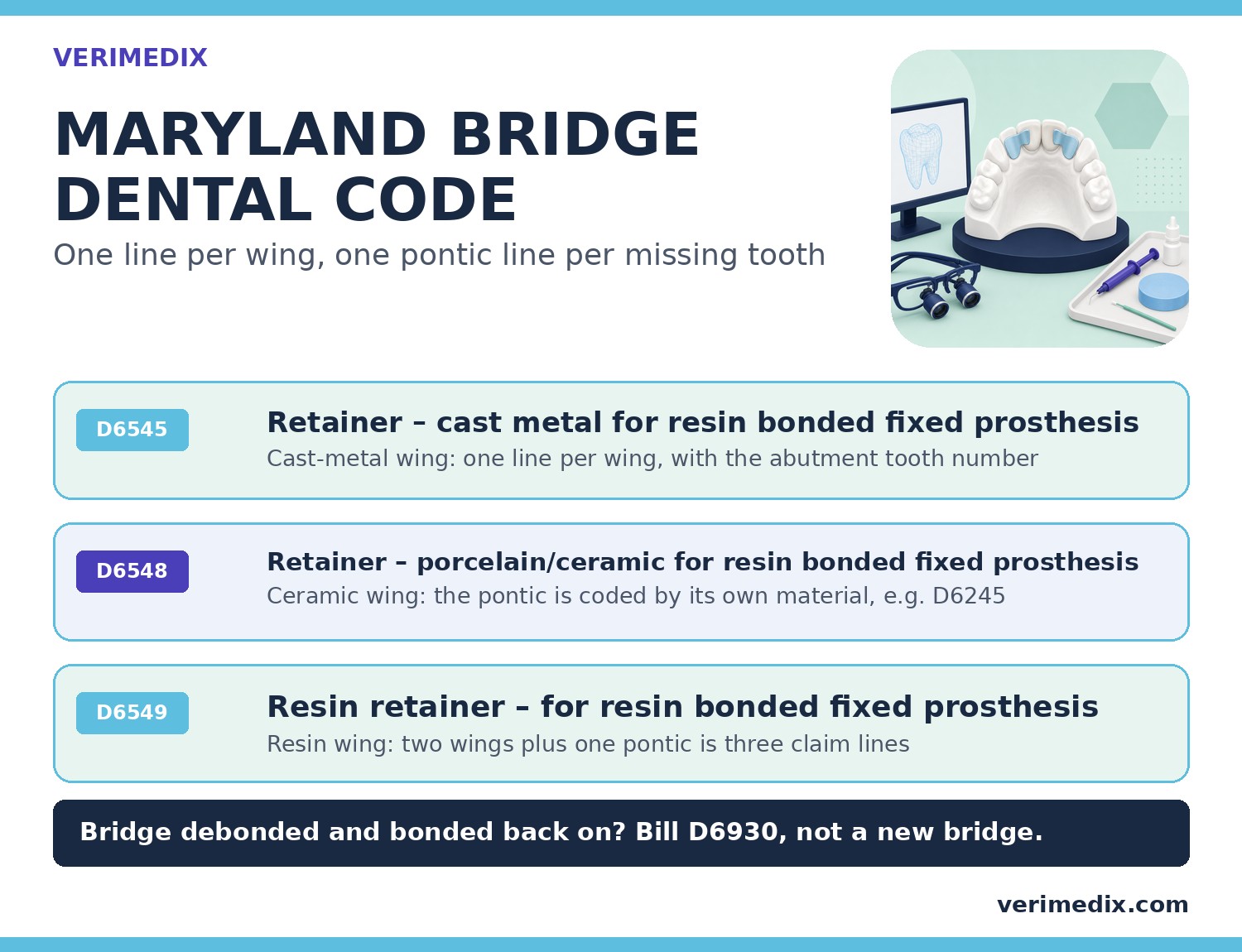
- CDT has no single “Maryland bridge” code. Each bonded wing is a resin-bonded retainer line — D6545 (cast metal), D6548 (porcelain/ceramic) or D6549 (resin) — and each replacement tooth is a separate pontic line.
- The pontic code describes the pontic’s own material: D6245 for porcelain/ceramic, D6240–D6242 for porcelain fused to metal by alloy class, D6250–D6252 for resin with metal, D6205 for indirect resin-based composite.
- Count lines from the design: two wings and one pontic is three lines; a single-wing (cantilever) design is two. The D67xx retainer crown codes describe crowned abutments and are wrong for bonded wings.
- A Maryland bridge that debonds and is bonded back on is D6930, re-cement or re-bond fixed partial denture — not a new bridge.
- Payer rules differ sharply: UnitedHealthcare’s policy indicates resin-bonded appliances for one missing tooth; New York Medicaid limits them to members under 21 (or whose pulpal anatomy rules out crown preparation), anterior sites, D6545 + D6251 and prior approval.
What is the dental code for a Maryland bridge?
The ADA’s Glossary of Dental Clinical Terms defines a Maryland bridge as “a resin-bonded fixed partial denture with wing like retainer(s) bonded to abutment teeth.” That definition is the coding map. The wings are retainers and the replacement tooth is a pontic (“an artificial tooth on a fixed partial denture”), and CDT reports them on separate lines. Resin-bonded retainers have their own three codes, which read word for word in UnitedHealthcare’s Fixed Prosthodontics dental clinical policy (DCP017.13, effective November 1, 2025) and in the PEHP 2026 CDT Code Guide:
| Code | CDT nomenclature | Wing it describes |
|---|---|---|
| D6545 | Retainer – cast metal for resin bonded fixed prosthesis | The classic cast-metal framework wing bonded to the lingual enamel of the neighboring tooth |
| D6548 | Retainer – porcelain/ceramic for resin bonded fixed prosthesis | A ceramic wing; the ADA glossary’s porcelain/ceramic covers “porcelains, glasses, ceramics, and glass-ceramics” |
| D6549 | Resin retainer – for resin bonded fixed prosthesis | A wing made of resin |
Two reporting rules follow. Each retainer goes on its own line with the abutment tooth number, and the pontic goes on its own line with the number of the missing tooth; New York Medicaid’s manual marks D6545 and every pontic code “(TOOTH)”, meaning a tooth must be specified. And the wing code is picked by the wing’s material on the lab prescription, not by what the office calls the bridge. Note the D6549 wording, too: it is a “resin retainer”, and the claim should carry that nomenclature rather than a paraphrase.
Which pontic code goes with a Maryland bridge?
The pontic is coded by the pontic, not by the wings. Read the lab invoice for two facts: what the replacement tooth is made of and, for any metal framework, its alloy class (the ADA glossary defines high noble, noble and predominantly base metal by noble-metal content). All of the pontic codes below appear in both the UnitedHealthcare policy and the PEHP guide; the New York Medicaid manual lists D6210–D6252 but not D6205.
| Pontic code(s) | CDT nomenclature | Typical Maryland design |
|---|---|---|
| D6245 | Pontic – porcelain/ceramic | All-ceramic bridge, usually with D6548 wings |
| D6240 / D6241 / D6242 | Pontic – porcelain fused to high noble metal / predominantly base metal / noble metal | Porcelain tooth on a cast-metal framework with D6545 wings; the alloy class picks the code |
| D6250 / D6251 / D6252 | Pontic – resin with high noble metal / predominantly base metal / noble metal | Resin-faced tooth on a metal framework; New York Medicaid directs D6251 for Maryland pontics |
| D6205 | Pontic – indirect resin based composite | Lab-made composite tooth, usually with D6549 wings |
A payer’s own pairing rule overrides the generic logic. The New York State Medicaid Dental Policy and Procedure Code Manual (version 2026, effective January 1, 2026) says Maryland abutments “should be billed using code D6545 and pontics using code D6251”, lists D6251 as “limited to the pontics for resin bonded fixed partial dentures”, and carries no fee for D6548 or D6549 at all. A ceramic Maryland bridge for a New York Medicaid member is therefore a prior-approval conversation before it is a coding one.
How many claim lines does a Maryland bridge need?
Count the wings and the replacement teeth, then write one line for each. The ADA glossary’s “retainer(s)” already allows for a one-wing design, and it defines a cantilever extension as the “part of a fixed prosthesis that extends beyond the abutment to which it is attached and has no additional support.” Tooth numbers below are illustrative.
| Design | Lines | Example claim (missing tooth in bold) |
|---|---|---|
| Two wings, one pontic (the usual design) | 3 | D6545 #6 · D6240 #7 · D6545 #8 |
| One wing, one pontic (cantilever) | 2 | D6548 #6 · D6245 #7 |
| Two wings, two adjacent pontics | 4 | D6545 #22 · D6251 #23 · D6251 #24 · D6545 #25 |
The four-line design is where payer policy starts to matter. New York Medicaid will consider two adjacent missing maxillary anterior teeth or two adjacent missing mandibular incisors, while UnitedHealthcare’s policy indicates resin-bonded appliances “for the replacement of one missing tooth and unrestored/undamaged Retainer/Abutment teeth”, so a two-pontic bonded bridge should be verified and pre-determined before the impression. Mark every missing tooth on the claim as well: UnitedHealthcare’s review guideline asks for dental charting of missing teeth when they are not visible on the radiograph.
Maryland bridge or conventional bridge: which code family applies?
A common Maryland miscoding is a family error rather than a wrong digit. The bonded design and the crowned design use different retainer codes, and the services that follow a bridge have their own codes too.
| Situation | Code(s) | Why |
|---|---|---|
| Wings bonded to minimally prepared abutments | D6545 / D6548 / D6549 | Resin-bonded retainers, one per wing |
| Abutments prepared for crowns that carry the pontic | Retainer crown codes such as D6740 (porcelain/ceramic) or D6750–D6752 (porcelain fused to metal) | Conventional fixed partial denture; see our dental codes for bridges guide |
| Bridge debonded and bonded back on | D6930 | Re-cement or re-bond fixed partial denture |
| Fractured wing or facing repaired | D6980 | Fixed partial denture repair necessitated by restorative material failure; excluded by some plans, e.g. PEHP (below) |
| Bridge cut through to remove part of it | D9120 | Fixed partial denture sectioning |
| Removable tooth worn while the space heals | D5820 / D5821 | Interim partial denture; see our flipper dental code guide |
| A design no code describes | D6999 | Unspecified fixed prosthodontic procedure, by report |
Watch the re-bond line. Billing a debonded Maryland bridge as a new D6545/D6251 set asks the plan to pay again for a prosthesis it already paid for and invites a replacement-frequency denial; D6930 states what happened.
What do payers publish about resin-bonded bridges?
There is no universal “insurance rule” for Maryland bridges. These four documents show the range a billing team meets:
| Payer / program (document) | Published rule |
|---|---|
| UnitedHealthcare dental clinical policy DCP017.13 (effective Nov 1, 2025) | Resin-bonded appliances are indicated for one missing tooth with unrestored, undamaged abutments. Cantilever and resin-bonded designs are not indicated with malocclusion, heavy occlusion or parafunctional habits such as bruxism, or with a pontic width discrepancy; resin-bonded appliances are also not indicated with compromised enamel or a deep vertical overlap |
| UnitedHealthcare National Standardized Dental Claim Review Guidelines DRG042.21 (commercial, effective Jan 1, 2026) | D6545, D6548, D6549 and pontic codes D6205–D6252: “Current dated full arch pre-operative radiographs” and charting of missing teeth not visible on the radiograph. D6930: no documentation listed. D6980: a narrative of necessity |
| PEHP 2026 CDT Code Guide (Utah public employees’ plan, dated Jan 23, 2026) | D6545, D6548, D6549 and pontics: one in a 5-year period, one fixed partial denture per arch in 5 years. A narrative documenting medical necessity, the date of tooth loss or extraction and radiographic findings. Re-cement or re-bond once per prosthesis in 3 years; D6980 not covered; a missing tooth exclusion and a six-month prosthodontic waiting period unless waived |
| New York State Medicaid manual (version 2026) | Fixed bridgework is generally beyond the program’s scope; Maryland bridges may be approved for members under 21, or whose pulpal anatomy precludes crown preparation, only for a single missing maxillary anterior tooth, two adjacent maxillary anterior teeth or two adjacent mandibular incisors, with the manual’s general fixed-bridge criteria still applying. Prior approval required; fee $146.46 per D6545 and $404.00 per D6251; D6930 $45.45 |
Read side by side, the verification script writes itself: are fixed prosthetics a benefit at all and at what coinsurance; what is the replacement frequency; is there a waiting period; does the plan apply a missing tooth clause to a tooth lost before coverage began; is prior authorization or a predetermination expected; and how often will the plan pay a re-bond? Plans can also apply alternate benefits to bridges, so ask how a resin-bonded bridge is paid, not just whether “bridges” are covered. Verimedix runs that check through its insurance eligibility verification service before prosthetic appointments.
What documentation supports a Maryland bridge claim?
- Tooth numbers on every line. Retainer lines carry the abutment teeth, pontic lines the missing teeth, and the claim marks every missing tooth.
- Current full-arch pre-operative radiographs, dated — UnitedHealthcare’s commercial review guideline lists them for D6545, D6548, D6549 and pontic codes D6205–D6252.
- A narrative giving the date of tooth loss or extraction, why a bonded design was chosen (unrestored abutments, a young patient) and the materials. PEHP asks for medical necessity, the date of tooth loss and radiographic findings in the remarks field, and allows one narrative to cover all the bridge’s lines.
- The lab prescription or invoice naming the wing material and, for metal, the alloy class — it is the evidence behind D6545 versus D6548 and D6240 versus D6242.
- The approval reference where prior approval or predetermination applies, with every billed code matching an approved code. New York Medicaid’s fixed prosthodontics section states that “the crown fabricated must correctly match the procedure code approved on the Prior Approval.”
- For a re-bond, the original seat date and a note that the same prosthesis was re-bonded, so D6930 is not read as a replacement.
Why are Maryland bridge claims denied, and how do you fix them?
| Denial or pend | Usual cause | Fix |
|---|---|---|
| “Not a benefit” or missing tooth exclusion | Tooth lost before coverage began, or fixed prosthetics excluded | Check the verification record; appeal with the extraction date if the tooth was lost after the effective date |
| Pended for records | No full-arch radiographs, charting or narrative | Send the documentation set above |
| Replacement frequency | A new bridge, or a re-bond billed as a new bridge, inside the plan’s window (5 years for PEHP prosthetics, 3 years for its re-bonds) | Re-bill a re-bond as D6930; for a true replacement, document why the earlier prosthesis failed |
| Code does not match the record | D6548 billed for a metal wing, or a metal pontic billed without the alloy class | Corrected claim from the lab invoice |
| Wrong code family | Retainer crown codes (D6740, D6750) billed for bonded wings | Corrected claim with D6545/D6548/D6549; in a prior-approval program, check the approved codes first |
| Repair denied | D6980 excluded by the plan (PEHP lists it as not covered) | Quote the repair as patient-pay before the visit |
When the same denial keeps returning, the gap is usually at verification or in the lab-invoice hand-off — the pattern denial management services trace to its source instead of appealing claim by claim.
What does a miscoded Maryland bridge cost? A worked example (illustrative)
A 16-year-old New York Medicaid member is missing tooth #7. The office requests prior approval for a two-wing cast-metal Maryland bridge with a resin-faced pontic, the pairing the program directs, and the manual’s 2026 fees apply.
- Coded as approved. D6545 #6 ($146.46) + D6251 #7 ($404.00) + D6545 #8 ($146.46) = $696.92, paid on one claim.
- Coded as a conventional bridge by habit. D6750 #6 + D6240 #7 + D6750 #8 does not match the approved codes, and the manual says “the crown fabricated must correctly match the procedure code approved on the Prior Approval.” Expect the lines to deny or come back for correction; the same $696.92 then arrives weeks later, after two rounds of staff time.
- Two years later the bridge debonds and is re-bonded. Billed as D6930 it is a $45.45 line. Billed as a second D6545/D6251 set it asks the program to pay for a prosthesis it has already paid for, and the honest fix is the same D6930 after a denial.
The dollars are small; the lesson is not. On a commercial plan with a five-year replacement clock, a re-bond billed as a new bridge can use up the arch’s prosthetic benefit and block the definitive implant crown or bridge that follows. All figures are illustrative except the published New York Medicaid fees.
How to keep Maryland bridge claims clean: a seven-point checklist
- Confirm the design from the chart and lab prescription: bonded wings (D654x) or crowned abutments (D67xx).
- Write one retainer line per wing and one pontic line per replacement tooth, each with its tooth number.
- Pick the wing code by wing material and the pontic code by pontic material and alloy class.
- Verify the fixed-prosthetic benefit by name: frequency, waiting period, missing tooth clause, alternate benefits, re-bond limit, predetermination.
- Attach dated full-arch radiographs, missing-tooth charting and a narrative with the date of tooth loss.
- In a prior-approval program, bill exactly the approved codes or get the approval amended first.
- Bill a debond as D6930 and a repair as D6980 after checking whether the plan covers it.
Practices that outsource to Verimedix dental billing services get this built into the prosthetic workflow: verification before the impression, line-by-line coding from the lab invoice, and follow-up on the pends that otherwise sit in aging.
Quick Answers
What is the dental code for a Maryland bridge? There is no single code. Each wing is D6545 (cast metal), D6548 (porcelain/ceramic) or D6549 (resin) for a resin bonded fixed prosthesis, and each replacement tooth is a separate pontic code such as D6245 or D6240.
Is D6545 billed per wing or per bridge? Per wing. A two-wing bridge has two retainer lines, each with its abutment tooth number.
What pontic code goes with D6548 wings? The pontic is coded by its own material; an all-ceramic Maryland bridge is usually D6548 wings with a D6245 porcelain/ceramic pontic.
What code is used to re-bond a Maryland bridge? D6930, re-cement or re-bond fixed partial denture.
Can a Maryland bridge be billed with D6740 or D6750? No. Those are retainer crown codes for crowned abutments of a conventional bridge; bonded wings use D6545, D6548 or D6549.
Frequently asked questions
A Maryland bridge is reported in parts. Each bonded wing is a resin-bonded retainer: D6545 (retainer – cast metal for resin bonded fixed prosthesis), D6548 (retainer – porcelain/ceramic for resin bonded fixed prosthesis) or D6549 (resin retainer – for resin bonded fixed prosthesis). Each replacement tooth is a separate pontic line coded by its material.
Per wing. Each retainer is its own line with the abutment tooth number, so a two-wing bridge replacing one tooth is two D6545 lines plus one pontic line. A single-wing cantilever design is one retainer line plus the pontic.
The one that matches the pontic on the lab invoice: D6245 for porcelain/ceramic, D6240, D6241 or D6242 for porcelain fused to high noble, predominantly base or noble metal, D6250–D6252 for resin with metal, or D6205 for indirect resin-based composite. Some programs set the pairing; New York Medicaid directs D6545 for the abutments and D6251 for the pontics.
D6930, re-cement or re-bond fixed partial denture. Do not bill a new set of retainer and pontic codes for the same prosthesis. Plans limit re-bonds too; the PEHP 2026 guide, for example, allows one re-cement or re-bond per prosthesis in three years.
It depends on the plan. UnitedHealthcare’s fixed prosthodontics policy indicates resin-bonded appliances for one missing tooth with unrestored abutments; PEHP allows one fixed partial denture per arch in five years with a narrative; New York Medicaid considers Maryland bridges only for members under 21, or whose pulpal anatomy precludes crown preparation, at specific anterior sites with prior approval. A commercial plan’s missing tooth clause can also exclude the bridge.
No. D6740 and D6750–D6752 are retainer crowns for a conventional bridge whose abutments are crowned. Bonded wings are resin-bonded retainers (D6545, D6548 or D6549); billing crown codes for them misstates the procedure and, in a prior-approval program, will not match the approved codes.