
- Dental bridge claims usually combine retainer-crown and pontic components; the material and missing-tooth unit determine the starting CDT questions.
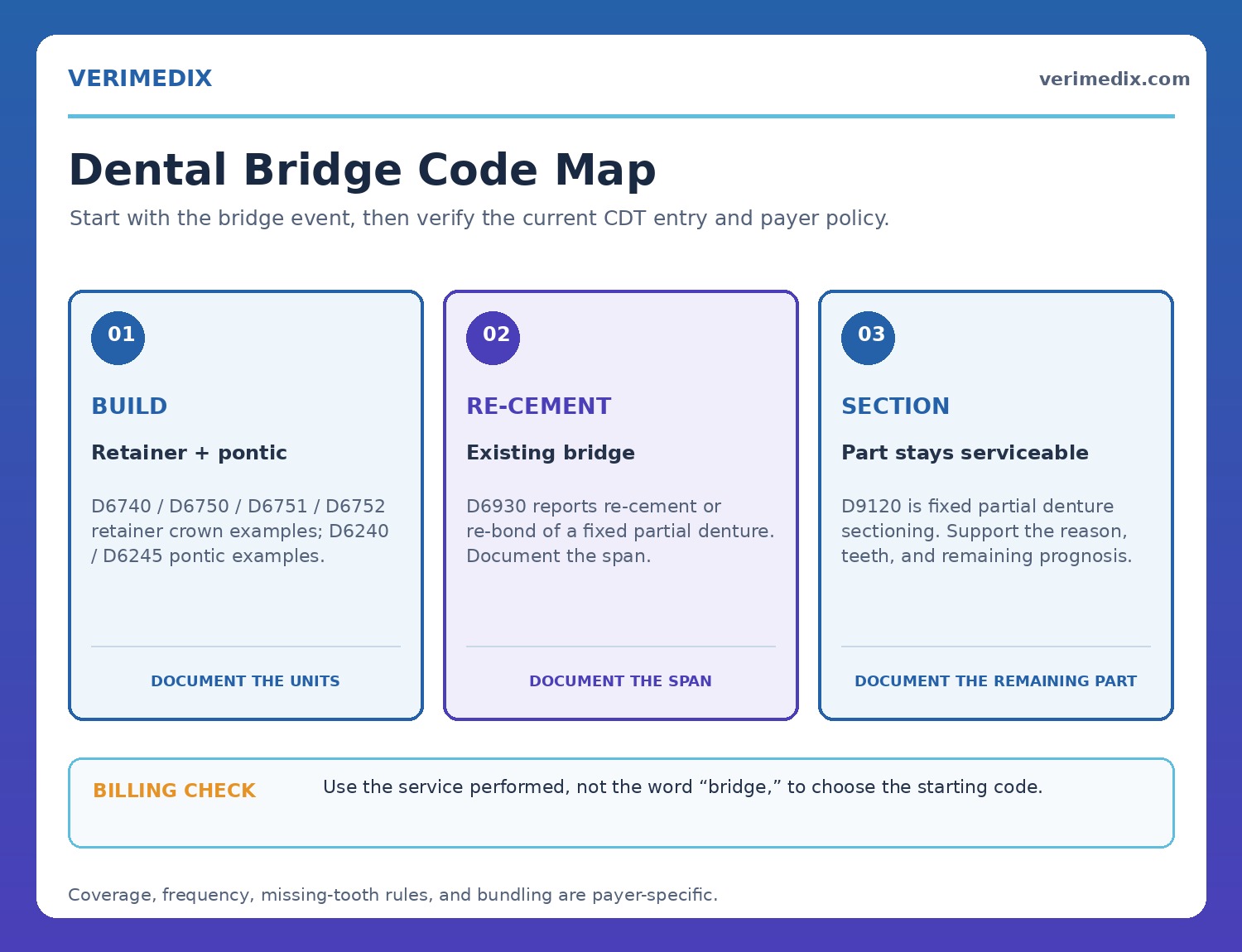
- D6740, D6750, D6751, and D6752 are retainer-crown examples; D6240 and D6245 are pontic examples documented in a 2026 payer guide.
- D6930 is the code to investigate for re-cementing or re-bonding an existing fixed partial denture; D9120 is for fixed partial denture sectioning when part of the restoration remains serviceable.
- Do not turn one payer’s frequency limit or coverage decision into a universal rule. Verify the member’s plan, effective CDT year, and claim instructions.
- Build the claim from the documented bridge event, material, tooth or pontic identification, narrative, and any required radiographs or treatment history.
What dental codes cover a fixed bridge?
There is not one universal “bridge code” for every visit. A fixed bridge is a prosthesis with retainer units supporting a pontic, so the claim begins with the service performed and the component being reported. For a new or replacement fixed partial denture, the biller typically reviews retainer-crown and pontic CDT entries. For an existing bridge that becomes loose or must be divided, the workflow changes to a follow-up procedure code.
The PEHP 2026 CDT code guide lists fixed partial denture codes in a payer-specific benefits table and identifies the relevant documentation fields. It is useful for showing how a current plan organizes the codes, but it does not replace the patient’s plan documents or the complete current CDT entry.
Which CDT codes describe bridge retainer crowns?
A retainer crown is the bridge unit that fits over an abutment tooth. The material determines which code entry the biller should investigate. The 2026 PEHP guide lists these retainer-crown examples:
| Code | Descriptor in the 2026 guide | Claim-control question |
|---|---|---|
| D6740 | Retainer Crown - porcelain/ceramic | Does the record identify the retainer unit and tooth? |
| D6750 | Retainer Crown - porcelain fused to high noble metal | Is the documented material consistent with the selected entry? |
| D6751 | Retainer Crown - porcelain fused to predominantly base metal | Does the laboratory or clinical record support the material? |
| D6752 | Retainer Crown - porcelain fused to noble metal | Are the retainer tooth and bridge relationship clear? |
These are component examples, not a shortcut to payment. A payer may impose a missing-tooth exclusion, replacement limitation, waiting period, or frequency rule. A claim can have a technically matched code and still be non-covered under the member’s contract, so check eligibility and benefits before treatment and compare the selected code with the clinical and laboratory record.
Which CDT codes describe bridge pontics?
The pontic replaces the missing tooth or tooth space in a fixed partial denture. The same 2026 guide lists pontic examples such as D6240 for a pontic made of porcelain fused to high noble metal and D6245 for a porcelain/ceramic pontic. It also lists D6210 for a cast high noble metal pontic. The correct choice depends on the actual material and the current code descriptor.
| Bridge component | Example codes from the 2026 guide | Documentation focus |
|---|---|---|
| Retainer crown | D6740, D6750, D6751, D6752 | Retainer unit and tooth identification; material |
| Pontic | D6210, D6240, D6245 | Pontic or missing-tooth identification; material |
| Existing bridge follow-up | D6930 or D9120, depending on the event | Span, reason for service, and what remains serviceable |
Do not select a pontic entry from the bridge’s nickname or a lab shorthand alone. Confirm whether the restoration is tooth-supported or implant-supported, identify the units and missing tooth, and make sure the claim narrative matches the material and design documented by the treating office.
When should a practice investigate D6930?
D6930 is listed in the PEHP 2026 guide as “Re-cement or re-bond fixed partial denture.” In plain workflow terms, investigate it when an existing fixed bridge is being re-cemented or re-bonded, rather than when a new bridge is being fabricated. The claim should identify the tooth numbers spanned by the fixed partial denture and explain the service performed.
The guide gives PEHP’s limit as once per prosthesis in a three-year period. That is a PEHP plan rule, not a universal frequency standard. Other carriers may use a different period, exclude the service, bundle it with another procedure, or apply a post-placement limitation. Verify the member’s plan before transferring a nonpayment to the patient.
When is D9120 the bridge sectioning code?
D9120 is identified in the 2026 guide as “Fixed partial denture (FPD) sectioning.” The service involves cutting a fixed partial denture to remove or modify part of the restoration without disturbing the entire prosthesis. The remaining portion must be documented as intact and serviceable when that distinction is relevant to the payer’s review.
The Northeast Delta Dental consultants’ guidance publishes the ADA descriptor for D9120 and explains that the procedure does not include sectioning splinted crowns without pontics. It also notes that a pre-operative radiograph and treatment-plan documentation may be requested, and that a separate fee may not be billable when the sectioning is integral to removing and replacing a fixed prosthesis. Those are payer guidance points; confirm the applicable plan’s policy rather than applying them to every claim.
What documentation prevents bridge-code denials?
Use the following as a pre-submit checklist, then apply the carrier’s exact requirements:
- Identify the event: new bridge, replacement, re-cement/re-bond, sectioning, repair, or another service.
- Identify the anatomy: abutment or retainer teeth, missing tooth or pontic, and the tooth numbers spanned by the fixed partial denture.
- Match the material: confirm the laboratory prescription and clinical record support the selected retainer-crown or pontic entry.
- Write the narrative: state medical necessity, the date of tooth loss or extraction when relevant, and radiographic findings when requested by the plan.
- Check history: review original placement, replacement frequency, waiting period, missing-tooth exclusions, and whether a prior service was bundled.
- Audit the claim: compare units, tooth numbers, narrative, attachments, and payer-specific benefit rules before transmission.
For fixed partial denture claims, the PEHP guide says narratives belong in the Remarks/Narrative area of the ADA claim form and that pontic and retainer claims need the applicable tooth identification. Its guide also says fixed partial denture component codes are payable only as part of an eligible bridge under that plan. Treat those requirements as a model for disciplined documentation, not as a nationwide rule.
How can a dental office prevent bridge billing denials?
The highest-value control is separating prosthesis construction from follow-up care in the practice-management system. A new bridge claim should not look like a re-cement claim, and a sectioning procedure should not be described as a routine removal. Add a required event type, tooth-span field, material field, and payer-benefit check before the claim leaves the queue.
Also flag the cases most likely to need review: a bridge delivered recently, a repeated re-cement, a missing-tooth exclusion, a plan that limits prosthodontics, or a sectioning service performed with replacement work. If a claim denies, read the EOB or ERA, determine whether the issue is coverage, documentation, coding, or bundling, and choose a corrected claim or appeal path accordingly.
For help with eligibility checks, claim submission, and dental denial follow-up, see Verimedix dental billing services and the dental billing pricing and services guide. The billing team can organize the workflow, but code selection still follows the documented service and the payer’s current policy.
Frequently asked questions
D6930 is the CDT entry to investigate for re-cementing or re-bonding an existing fixed partial denture. Confirm the current descriptor, tooth span, benefit history, and payer-specific frequency rules before submission.
D9120 is identified as fixed partial denture sectioning. The record should explain why part of the bridge was sectioned, identify the associated teeth, and document what remains serviceable when relevant to the payer.
The 2026 PEHP guide lists retainer-crown examples D6740, D6750, D6751, and D6752, plus pontic examples including D6210, D6240, and D6245. The material and bridge design must match the selected current CDT entry.
No. A code descriptor does not guarantee coverage. Frequency limits, waiting periods, replacement rules, missing-tooth exclusions, bundling, and plan contracts can change the result, so verify the member’s benefits.
Document the bridge event, retainer and pontic or missing-tooth identification, material, tooth span, medical necessity, and any radiographs or treatment history required by the plan. Match the narrative to the actual service rather than a template.