- Credentialing (verifying a dentist’s qualifications) and contracting (negotiating participation and fees) are separate steps — a provider can be credentialed but not yet in-network, and services differ in whether they handle both.
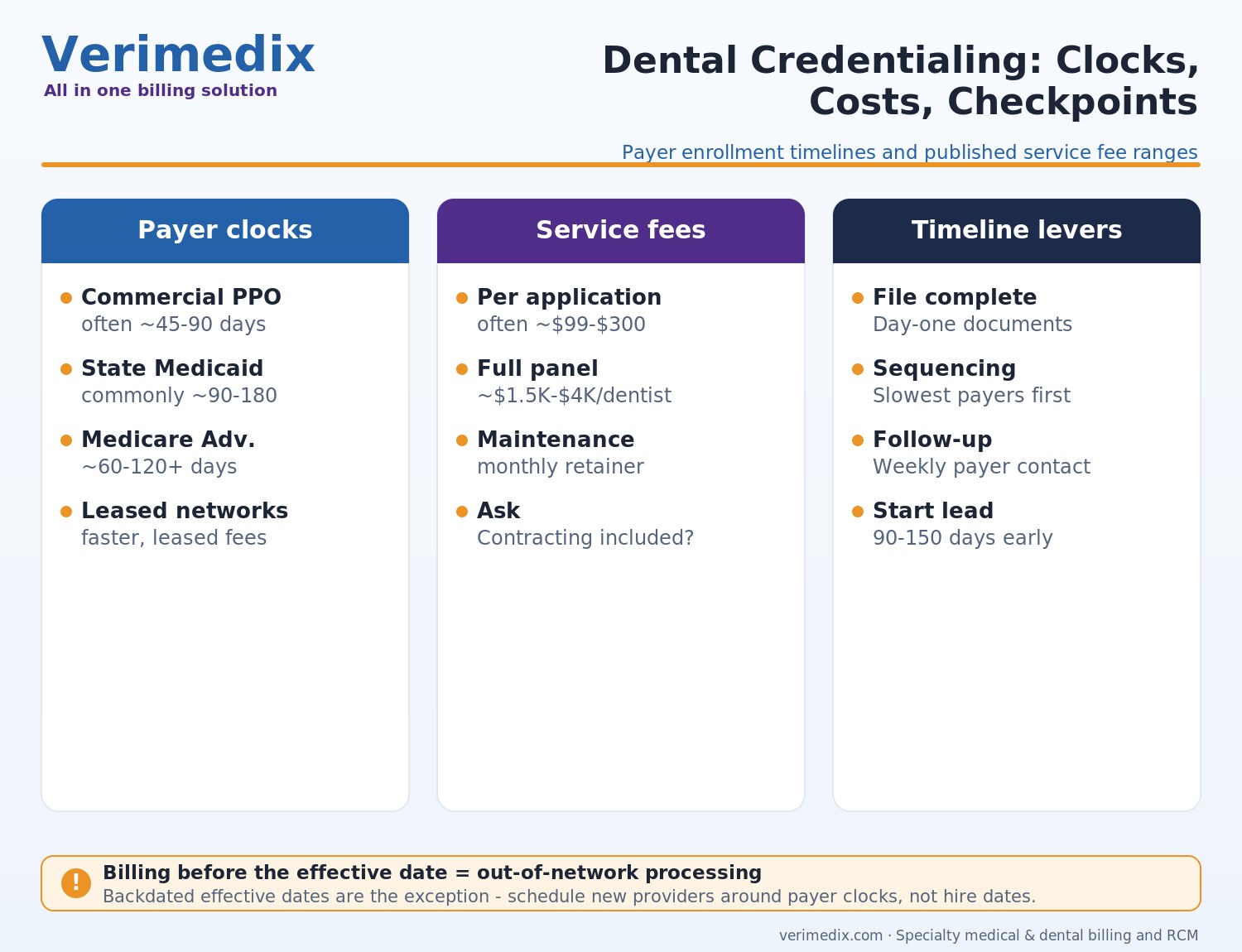
- Typical timelines by payer type: commercial PPOs roughly 45–90 days when files are complete; state Medicaid programs commonly 90–180 days with sanctions checks and sometimes site visits; Medicare Advantage dental networks frequently 60–120+ days.
- Published service fees often run roughly $99–$300 per application per payer per provider, with full panel-setup projects frequently landing around $1,500–$4,000 per dentist depending on payer count — confirm current quotes.
- Every week out-of-network has a revenue cost: patients rescheduled, claims paid at out-of-network rates, or treatment delayed — the worked example below puts numbers on it.
- Leased networks and umbrella agreements can shortcut some PPO participation, but they also set your fee schedule — understand which contracts a service is signing you into.
- Effective dates rule everything: services billed before the payer’s effective date are generally processed out-of-network, and backdating is the exception, not the rule.
What dental credentialing services actually handle
A credentialing engagement is project management against bureaucracy. The service collects the provider’s file once — license, DEA if applicable, malpractice coverage, NPI, work history, disclosures — then builds and submits payer-specific applications, tracks each one through processing, answers deficiency requests, and chases confirmations until effective dates and provider IDs arrive. Good services also calendar the follow-on obligations: recredentialing cycles (commonly every 2–3 years), Medicaid revalidation, and keeping directory data current.
Three distinctions determine what you are buying:
- Credentialing vs contracting: verification of qualifications versus negotiation of network participation and fee schedules. Some services stop at submitted applications; others manage through countersigned contracts and loaded fee schedules. The second is what actually lets you collect in-network.
- Initial enrollment vs maintenance: one-time panel setup versus ongoing monitoring of expirables, revalidations, and recredentialing deadlines — usually priced separately.
- Applications vs strategy: filling forms versus advising which networks are worth joining at all, including whether a leased-network arrangement helps or quietly locks in low fees.
The document-gathering half of this work is exactly what our provider credentialing checklist covers — run through it before engaging any service, because a complete file is the single biggest timeline accelerator regardless of who submits it.
PPO vs Medicaid vs Medicare Advantage: timelines and mechanics
Payer types process differently, and a service quoting one blended timeline is glossing over the part that matters for scheduling. Ranges below reflect commonly published industry experience; individual payers and states vary, and clean files move faster than the averages.
| Payer type | Common timeline | Process notes |
|---|---|---|
| Commercial PPO (national carriers) | Often ~45–90 days; some faster with complete files, some running 120 | Some dental payers use CAQH-style central profiles, many use proprietary applications; contracting and fee schedule loading can add time after approval |
| State Medicaid / managed care dental | Commonly ~90–180 days, state-dependent | Federal sanctions checks, state disclosures, revalidation cycles, sometimes site visits; managed-care plans may require separate enrollment on top of state approval |
| Medicare Advantage dental networks | Frequently ~60–120+ days | Traditional Medicare rarely covers routine dental, so MA plan networks are the practical Medicare pathway; each plan credentials separately, often via delegated entities |
| Leased / umbrella networks | Varies; can shorten multi-PPO access | One agreement grants participation across leasing carriers — at the leased fee schedule, which may undercut direct contracts |
Two planning rules follow. Start credentialing 90–150 days before a new dentist’s start date — for a Medicaid-heavy practice, closer to 180. And sequence by clock length: submit the slowest payers (Medicaid) first, not the easiest. The broader concepts — primary source verification, delegated credentialing, NCQA-style standards — are covered in our complete guide to medical credentialing; the mechanics apply to dentistry with the payer-type differences above.
What dental credentialing services cost
Published pricing clusters into three shapes; all figures are planning ranges from vendor-published 2025–2026 rates, and quotes vary with payer count and state complexity. For physician-side enrollment scope and rates, see our insurance credentialing services page.
| Fee structure | Typical published range | Notes |
|---|---|---|
| Per application (per payer, per provider) | Often ~$99–$300 | Medicaid and specialty networks frequently price higher than standard PPO apps because the workload genuinely differs |
| Full panel setup (per provider) | Frequently ~$1,500–$4,000 | Covers a defined payer list (often 10–15 networks); confirm whether contracting and fee schedule loading are included |
| Monthly maintenance | Varies; modest per-provider retainers | Expirables tracking, revalidations, recredentialing, directory updates |
Pricing questions that separate services: Is follow-up until effective date included, or just submission? Are deficiency responses and resubmissions extra? Who handles the contracting phase? And does the fee include loading negotiated fee schedules into your PMS — the step that makes the whole exercise billable? Practices bundling credentialing with billing setup can see how the pieces fit in our guide to billing and credentialing companies for new practices.
The cost of waiting: a worked example
Illustrative numbers. A practice hires an associate dentist expected to produce $60,000 a month, with 70% of patients carrying the practice’s major PPO and Medicaid plans. Credentialing starts on the associate’s first day instead of 120 days earlier.
- Months 1–3: the associate can see fee-for-service patients only, or in-network patients billed out-of-network. Assume half the expected schedule is lost or discounted: roughly $21,000/month of production affected.
- Over a 90-day average enrollment lag, that is approximately $63,000 in delayed, discounted, or lost production.
- Full-panel credentialing service fee for the associate: roughly $2,000–$3,500 at published ranges.
The service fee is noise next to the sequencing decision. The real ROI of a credentialing partner is rarely the paperwork hours saved — it is starting every clock on the earliest possible day and preventing dead months on the schedule. (Illustrative; substitute your own production and payer mix.)
How to choose a dental credentialing service: 7 questions
- Do you handle contracting and fee schedule loading, or applications only? The engagement should end at “billable in-network,” not “submitted.”
- What is your follow-up cadence? Weekly payer contact with a status log you can see; silence is how applications die in queues.
- Which states’ Medicaid programs have you enrolled dentists in recently? State idiosyncrasies are the hardest part of dental credentialing; demand direct experience in yours.
- How do you advise on leased networks? A good service explains the fee schedule trade-off, not just the faster access.
- What does the fee include — deficiency responses, resubmissions, appeals of network closures?
- How do you track expirables and recredentialing after setup? A missed recredentialing deadline can drop a provider from network silently.
- What is your average time-to-effective-date by payer type — and will you commit to reporting mine monthly?
Credentialing rarely lives alone: verification, billing, and credentialing data all feed each other, which is why many practices bundle it with revenue cycle support — see the scope options on our dental billing specialty page and the vetting framework in our dental billing services buyer’s guide. Dental billing partners that bundle credentialing — Verimedix among them — handle payer enrollment, CAQH upkeep, and re-credentialing alongside daily claims work, which prevents the enrollment gaps that stall new-associate revenue.
Quick Answers
What do dental credentialing services do? They manage payer enrollment end to end: assembling the provider’s file, submitting payer-specific applications to PPOs, Medicaid, and Medicare Advantage networks, chasing follow-up, and tracking recredentialing after approval.
How long does dental credentialing take? Commercial PPOs often complete in roughly 45–90 days with complete files; state Medicaid programs commonly take 90–180 days; Medicare Advantage dental networks frequently run 60–120 days or more. Start 90–150 days before a provider’s start date.
How much do dental credentialing services cost? Published rates often run about $99–$300 per application per payer, with full panel setup frequently in the $1,500–$4,000 range per dentist depending on payer count. Confirm current quotes and what “done” includes.
Can a dentist see patients before credentialing is complete? Yes, but claims are generally processed out-of-network until the payer’s effective date, and retroactive effective dates are the exception — so early visits mean discounted or patient-billed care.
Do dentists need Medicare credentialing? Traditional Medicare rarely covers routine dental care, so for most dentists the practical enrollment targets are Medicare Advantage plan dental networks, each of which credentials separately.
Frequently asked questions
Credentialing verifies the dentist's qualifications — license, education, malpractice history — against the payer's standards. Contracting is the separate business step: signing the participation agreement and fee schedule that make the dentist in-network. A provider can clear credentialing and still be out-of-network because the contract phase stalled, which is why engagements should be scoped through countersigned contracts.
Some do, but less uniformly than in medical credentialing. A number of dental carriers rely on proprietary applications or their own portals, and state Medicaid programs use their own enrollment systems entirely. A dental-experienced service maintains current application inventories per payer rather than assuming one central profile covers everything.
Leased or umbrella arrangements let one contract grant participation across multiple carriers that rent the network. The benefit is faster, broader access; the cost is that the leased fee schedule applies wherever the network is rented, sometimes below what a direct contract would pay. Review which carriers lease the network and compare fee schedules before signing.
Most commercial payers recredential every two to three years, and state Medicaid programs require periodic revalidation on their own cycles. Missing a deadline can silently drop a provider from the network, so ongoing maintenance — expirables tracking, revalidation calendars, directory updates — is where a credentialing service earns its retainer.
Rarely in any formal sense — payer queues are payer queues. What actually compresses timelines: a complete document file on day one, submitting the slowest payers first, responding to deficiency requests within days, and weekly follow-up contact. Some payers will backdate effective dates to the application or approval date, but treat that as an exception to request, never a plan.