- The dental code for a crown follows the documented restoration: D2740 is porcelain/ceramic, while D2750, D2751, and D2752 distinguish porcelain-fused-to-metal crowns by the metal coping.
- Do not choose a crown code from a patient’s shorthand, fee, or lab nickname. Confirm the material, natural-tooth versus bridge-retainer status, and current CDT entry.
- D2920 is the code to investigate for re-cementing or re-bonding an existing intact crown; it is not a new-crown code.
- D2950 is a core buildup when material is placed because tooth strength and retention are insufficient for the crown—not when the work only fills an undercut or preparation irregularity.
- Coverage, frequency, alternate benefits, bundling, and date-of-service rules are payer-specific. A correct code does not promise payment.
What is the dental code for a crown?
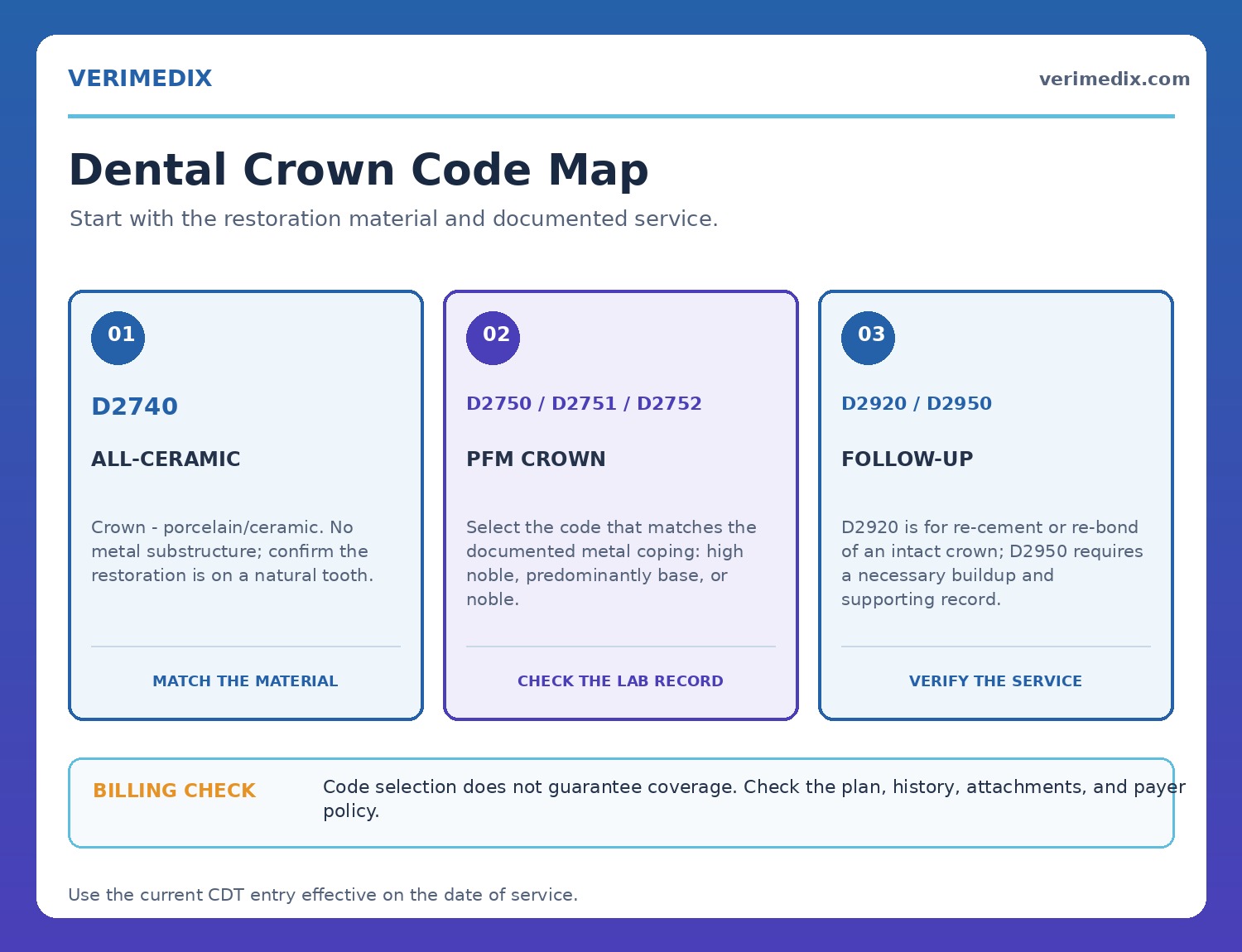
There is no single dental code for every crown. The starting code depends on the material and the service documented by the dental office. For a single-unit crown on a natural tooth, D2740 describes porcelain/ceramic, and D2750, D2751, or D2752 describe porcelain fused to different metal classes. A re-cemented existing crown and a necessary core buildup are separate service questions. The safest workflow is to read the current CDT descriptor effective on the date of service, compare it with the laboratory and clinical record, then verify the member’s plan.
“ADA code” is common office shorthand, but the reportable procedure code comes from the CDT code set maintained by the American Dental Association. The ADA’s CDT reference material lists the crown descriptors below. It is a code-reference starting point, not a guarantee that a patient’s benefit plan covers the service.
Which CDT codes describe crown materials?
Use the material actually delivered, not the material originally discussed if the laboratory prescription changed. The ADA reference lists these crown descriptors:
| Code | Descriptor | Control before submission |
|---|---|---|
| D2740 | Crown - porcelain/ceramic | Confirm no metal substructure and that the restoration is a single crown on a natural tooth. |
| D2750 | Crown - porcelain fused to high noble metal | Match the laboratory record to the high-noble metal coping classification. |
| D2751 | Crown - porcelain fused to predominantly base metal | Confirm the coping classification in the laboratory record. |
| D2752 | Crown - porcelain fused to noble metal | Do not substitute a high-noble or base-metal code without support. |
| D2790/D2791/D2792 | Full-cast high noble, predominantly base metal, or noble metal crowns | Use only when the documented restoration is full cast rather than porcelain fused to metal. |
The D2740–D2752 family is a material decision, not a clinical diagnosis. The claim record should identify the tooth, restoration type, date of service, and supporting laboratory or clinical documentation required by the payer. If the restoration is a bridge retainer rather than a single-unit crown, investigate the appropriate retainer-crown family instead of treating it as a D27xx single crown.
How do D2740, D2750, D2751, and D2752 differ?
D2740 is the all-ceramic or all-porcelain path. D2750, D2751, and D2752 are porcelain-fused-to-metal paths that differ by the metal coping. The coding distinction is not interchangeable: a porcelain crown with no metal is not a PFM crown, and a PFM crown should not be assigned a metal-class code without documentation of the coping.
| Decision point | What to ask | Why it matters |
|---|---|---|
| Restoration material | Is it all ceramic, or is porcelain fused to metal? | Separates D2740 from the D2750–D2752 PFM family. |
| Metal classification | If PFM, is the coping high noble, predominantly base, or noble? | Separates D2750, D2751, and D2752. |
| Support | Is this a single crown on a natural tooth or a bridge retainer? | Single crowns and retainer crowns use different CDT families. |
| Record match | Does the lab slip or clinical record support the selected material? | Prevents a material-code mismatch and an avoidable documentation denial. |
For a deeper comparison of ceramic and PFM crown billing, see Verimedix’s D2740 vs D2750 crown billing guide. That article covers the same material boundary alongside payer-specific documentation and alternate-benefit considerations.
When is D2920 the right crown code?
D2920 is the CDT entry to investigate when an existing crown has become dislodged and is re-cemented or re-bonded, rather than replaced with a newly fabricated crown. The restoration should be evaluated for integrity and fit, and the record should identify the tooth and service performed. The dental coding reference for D2920 reproduces the re-cement or re-bond descriptor and distinguishes it from a new crown.
Do not use D2920 when the crown is broken, does not fit, or must be replaced. Also separate a single-unit crown from a fixed partial denture: a bridge follow-up is a different coding question. Check the payer’s global-period, frequency, and replacement rules before moving any patient balance to collections.
For the related periodontal procedure, see our D4249 crown lengthening code guide before coordinating restoration timing.
When does D2950 accompany a crown?
The ADA’s D2950 guidance defines the procedure as building up the anatomical crown when a restorative crown will be placed, whether or not pins are used, because tooth strength and retention are insufficient. It specifically says not to report D2950 when the procedure only fills an undercut, box form, or concave irregularity in the preparation.
That distinction changes the claim record. Document the condition that required the buildup, the tooth, the restoration plan, and the clinical reason the material improved retention or strength. Do not treat a payer’s common threshold or bundling practice as a universal ADA rule. If a plan denies or bundles D2950, read the explanation of benefits, compare it with the contract and submitted documentation, and follow the plan’s correction or appeal process.
What documentation supports a crown claim?
Use a pre-submit checklist, then apply the carrier’s exact instructions:
- Identify the service: new crown, re-cement/re-bond, buildup, replacement, or another restoration event.
- Identify the tooth and support: tooth number, natural tooth versus retainer or implant-supported restoration, and relevant surfaces or units.
- Match the material: record the laboratory material and metal classification where applicable.
- Document the reason: describe the structural loss, fracture, recurrent decay, failed restoration, or other indication supporting the service.
- Check history: review prior crown date, replacement limitations, waiting periods, alternate benefits, and global or bundling rules.
- Attach what is requested: radiographs, intraoral photographs, laboratory records, narrative, or predetermination response, using the payer’s channel.
The claim should tell one consistent story: what the tooth looked like, what restoration or follow-up service was performed, what material was used, and why the line item is separately reportable under the plan. A code alone cannot supply missing documentation.
How can practices prevent crown-code denials?
Make the material and service decision explicit in the practice-management workflow. Require the team to select the restoration family, record the tooth, upload the lab slip when material matters, and verify the plan before filing. For D2920, confirm that the existing crown is intact and usable. For D2950, confirm the record supports a necessary buildup rather than routine preparation cleanup.
Then audit the high-risk cases: a replacement inside a frequency window, a posterior crown subject to an alternate benefit, a PFM claim without alloy documentation, a buildup submitted without supporting records, or a service whose preparation and seating dates are handled differently by the payer. Correct the root cause instead of resubmitting an unchanged claim.
For help with eligibility checks, claim submission, and dental denial follow-up, see Verimedix dental billing services and the dental billing pricing and services guide. The billing team can organize the controls, but the code still follows the documented service and current payer guidance.
Frequently asked questions
D2740 is the CDT descriptor for a crown - porcelain/ceramic. Confirm that the restoration is the documented material and that the claim follows the current CDT entry and plan requirements.
D2740 describes porcelain/ceramic. D2750 describes porcelain fused to high noble metal. The laboratory and clinical record should support the material actually delivered.
D2751 describes porcelain fused to predominantly base metal, while D2752 describes porcelain fused to noble metal. Confirm the coping classification before selecting the code.
D2920 is the CDT entry to investigate for re-cementing or re-bonding an existing crown that is intact and usable. A new or damaged crown requires a different code review.
D2950 is used when a material buildup is needed because tooth strength and retention are insufficient for the planned crown. The ADA says not to report it for only filling an undercut, box form, or concave preparation irregularity.
No. Coverage, frequency limits, alternate benefits, bundling, documentation, and date-of-service rules are controlled by the specific plan and payer. Verify benefits before treatment and review the EOB after adjudication.