
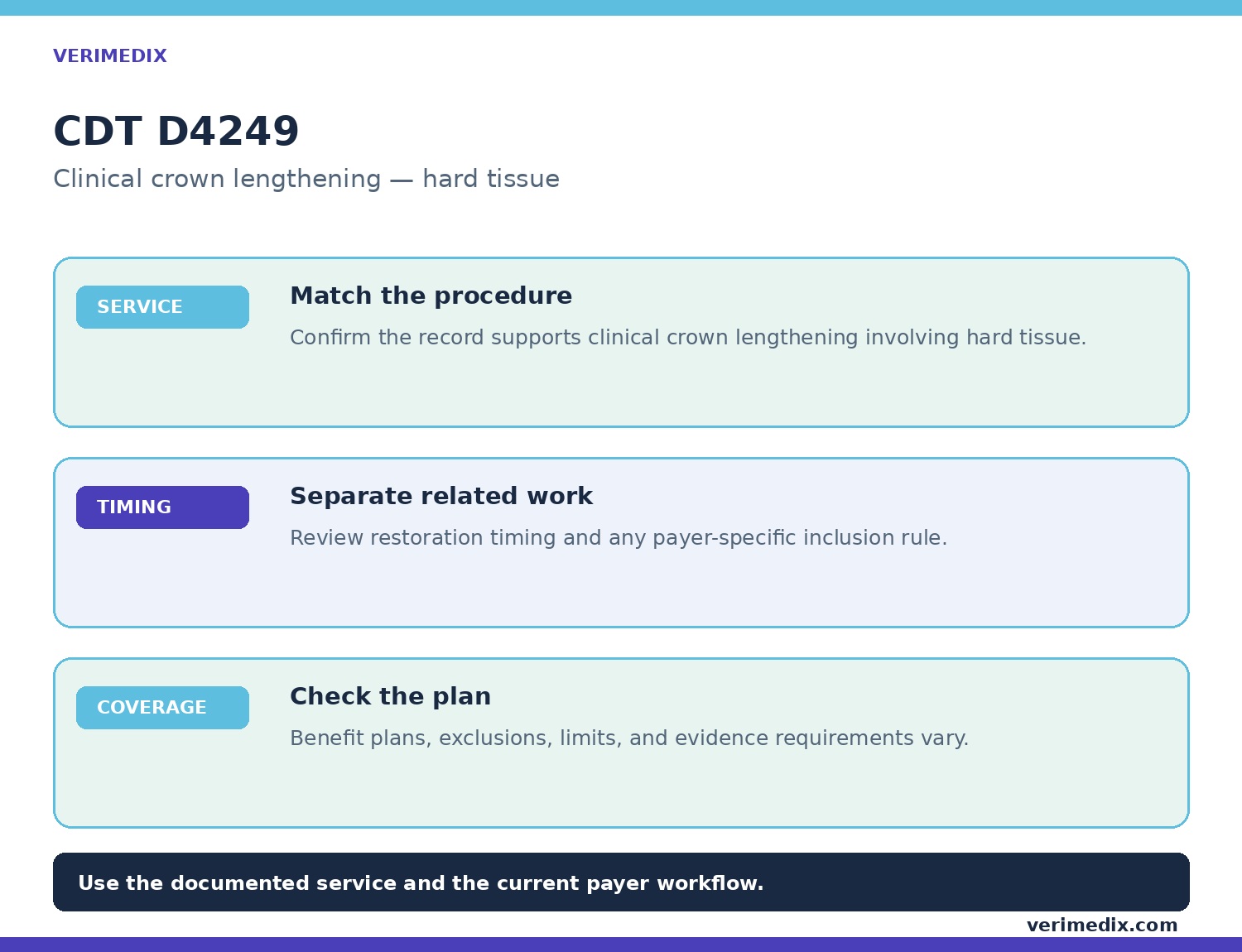
- CDT D4249 is the code to investigate for clinical crown lengthening involving hard tissue; Aetna lists the descriptor as “Clinical crown lengthening -- hard tissue.”
- Match the code to the actual procedure note, tooth site, tissue treated, restorative context, and date of service. A generic “crown lengthening” label is not enough.
- Aetna states that some periodontal-disease osseous-surgery situations treat crown lengthening as inclusive to the osseous surgery; that is a payer-policy statement, not a universal CDT rule.
- Delta Dental’s published claims article gives payer-specific inclusion and timing examples, including a separate-fee restriction when D4249 is performed the same day the crown is prepared and a four-week interval before completing a restoration.
- Benefits, exclusions, documentation requirements, and payment depend on the member plan and payer policy. Verify before promising coverage.
What is the D4249 crown lengthening code?
The Aetna Clinical Crown Lengthening policy lists CDT D4249 as “Clinical crown lengthening -- hard tissue.” It describes crown lengthening as removal of gingival and osseous tissue to expose more clinical tooth structure to the oral cavity. Use the current CDT reference and the treating dentist’s procedure note to determine whether the documented service matches that description.
Aetna’s policy says clinical crown lengthening is generally used to aid placement of a restoration when little or no tooth structure is exposed, while radiographic evidence of fracture or decay extending below or near the alveolar crest is the usual indication for necessity in that policy. Those are Aetna policy statements, not a universal diagnosis or coverage rule. Verimedix supports practices through dental billing services and dental billing workflow guidance.
When should a practice investigate D4249?
Investigate D4249 when the record shows clinical crown lengthening involving hard tissue and identifies the treated tooth or site. The claim should follow the service actually performed, not merely a plan to place a crown later. Review whether the procedure occurred in a healthy periodontal environment or in connection with osseous surgery, because payer policies may distinguish those situations.
| Review point | What the biller should confirm | Why it matters |
|---|---|---|
| Procedure | Clinical crown lengthening with hard-tissue involvement is documented | D4249’s descriptor is more specific than a generic crown or gum procedure |
| Site | Tooth or treated area is identified in the note and claim | Site detail supports review and payer attachments |
| Restoration context | Reason for exposing tooth structure and planned restorative sequence | The context helps distinguish crown preparation from periodontal services |
| Related surgery | Whether osseous surgery or another periodontal procedure was performed | Payer rules may treat related services as inclusive |
| Date and setting | Date of service, provider, location, and claim fields | Policies and benefit rules are date- and plan-sensitive |
Do not substitute a crown-preparation code or a periodontal code because the words appear together in a treatment plan. If the record does not establish the tissue treated or procedure performed, query the dentist and verify the current CDT entry before submission.
What documentation supports D4249?
A defensible D4249 claim connects the procedure, tooth site, hard-tissue work, restorative rationale, and payer evidence. Depending on the plan and workflow, keep:
- The tooth or treated site and date of service.
- The signed procedure note describing the crown-lengthening work and hard-tissue involvement.
- The restorative reason and planned sequence when documented by the treating dentist.
- Periodontal charting, radiographs, photographs, or narrative requested by the payer.
- Information showing whether related osseous or periodontal surgery was performed.
- Eligibility, benefit verification, authorization or predetermination, and the policy version used for the review.
Aetna’s policy says code selection should use the most appropriate code effective on the submission date and cautions that a medically necessary service is not automatically a covered benefit. The ADA CDT resource explains that the CDT Code supports consistency in documenting dental treatment; individual code descriptions should be checked in the current licensed reference.
How do timing and payer inclusion rules affect D4249?
Payer instructions can change how a crown-lengthening claim is handled when related restorative work occurs. Delta Dental’s published claims article states that when D4249 is performed on the same day the crown is prepared, a separate fee for D4249 may not be charged to the patient or Delta Dental. It also states that restoration should not be completed until after crown lengthening and gives a four-week interval example. Apply those statements to Delta Dental’s published policy context, not automatically to every payer.
Aetna separately states that clinical crown lengthening in conjunction with osseous surgery for periodontal disease is inclusive to the osseous surgery under its policy. Before filing, compare the actual sequence of services with the member’s plan, payer edits, and current CDT guidance. Do not use a neighboring payer’s timing rule as a universal modifier or bundling rule.
How do dental plans review D4249?
Dental plans can apply different benefit categories, exclusions, annual maximums, waiting periods, alternate benefits, documentation requirements, and frequency or timing rules. Aetna notes that each benefit plan defines covered and excluded services and that the member’s benefit plan governs if it differs from the policy. Verify eligibility, network status, plan exclusions, authorization or predetermination, and required radiographs or narratives before promising coverage to a patient.
When a plan requests records, send the evidence that answers its question: tooth site, hard-tissue procedure, restorative context, related surgery, dates, and the requested radiograph or narrative. Preserve the policy or reference used for the coverage decision so a denial analyst can reproduce the review. For related workflow support, review Verimedix’s dental claim denial prevention services.
What causes crown lengthening denials?
| Denial pattern | Likely control gap | Correction path |
|---|---|---|
| Descriptor mismatch | Generic crown or gum language was used | Compare the procedure note with the current D4249 descriptor |
| Missing hard-tissue evidence | Record does not show the tissue treated | Query the dentist and retain the requested radiograph or narrative |
| Inclusive-service edit | Related osseous or restorative work was not reviewed | Apply the member plan’s current bundling or inclusion rule |
| Timing dispute | Restoration sequence or date relationship was unclear | Reconcile service dates and payer-specific timing instructions |
| Benefit denial | Plan exclusions or limits were not checked | Verify benefits and submit the exact requested evidence |
Trend D4249 denials by payer, provider, tooth site, attachment type, and root cause. A repeated missing-radiograph denial needs a documentation control; an inclusion edit needs a payer-specific claim rule. Changing the code after a denial without resolving the underlying evidence can create a second error.
How can dental billing support reduce rework?
A dental practice can reduce D4249 rework by connecting procedure-note controls, site fields, CDT review, benefits verification, attachment preparation, and denial follow-up. Ask a billing partner to show how it distinguishes code selection from coverage, preserves the source behind a correction, and reports denials by payer and reason.
Frequently asked questions
CDT D4249 is the code to investigate for clinical crown lengthening involving hard tissue. Confirm the current CDT descriptor, procedure note, and payer requirements before submission.
D4249 is listed by Aetna as “Clinical crown lengthening -- hard tissue.” The actual record must support the service and identify the treated tooth or site.
Do not assume. Delta Dental’s published 2022 claims article states that when D4249 is performed the same day the crown is prepared, a separate fee may not be charged to the patient or Delta Dental. Other plans may differ.
Delta Dental’s published article gives a four-week interval example after clinical crown lengthening before completing a restoration. Treat that as payer-specific guidance and verify the member plan.
No. Benefits, exclusions, timing, attachments, plan limits, and payer-specific policies can affect payment even when the code and procedure are valid.