
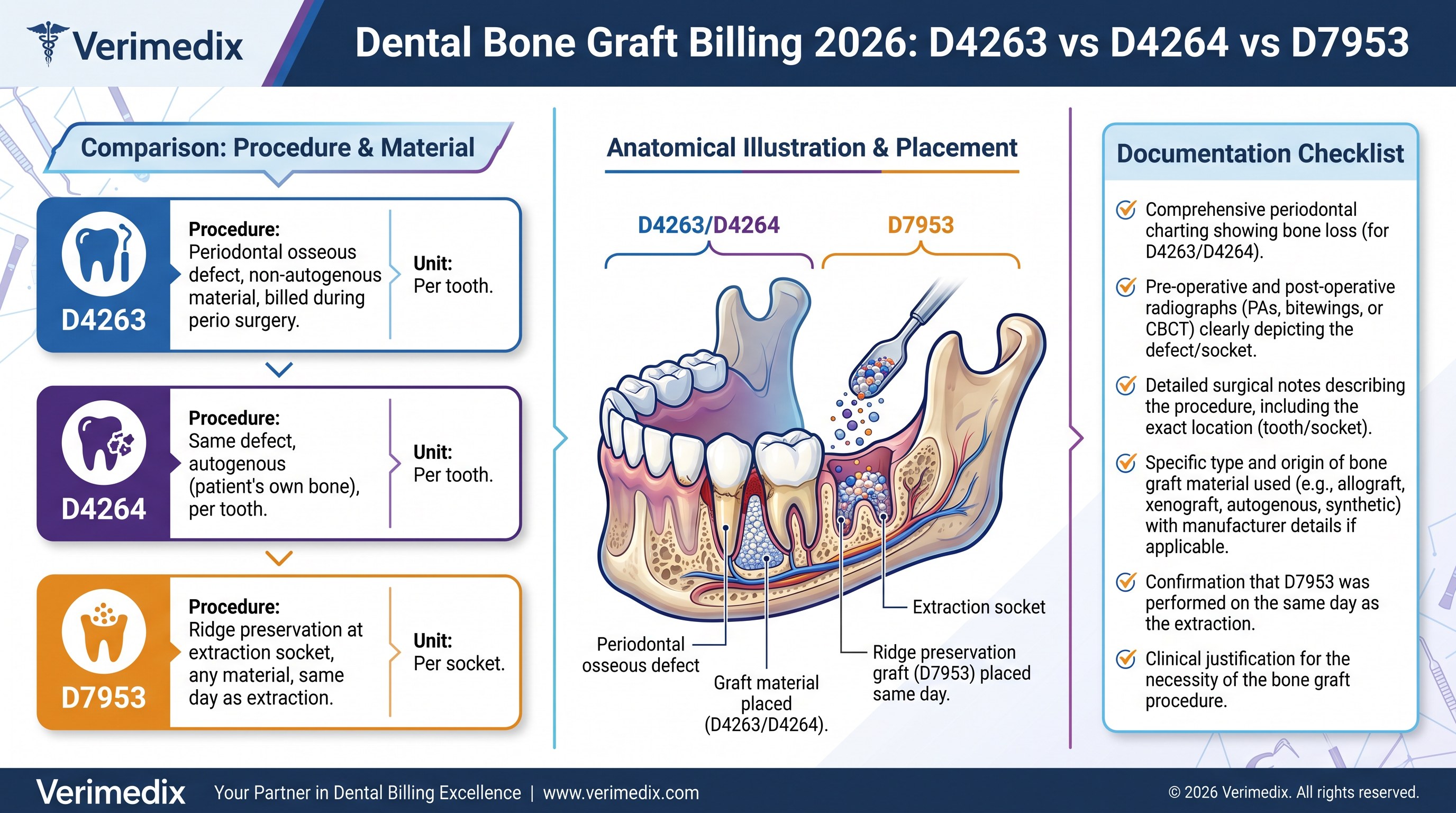
- D4263 = bone replacement graft, retained natural tooth, first site in quadrant. Used only with periodontal osseous surgery (D4260/D4261) or gingival flap procedures (D4240/D4241).
- D4264 = bone replacement graft, retained natural tooth, each additional site in quadrant. Always billed as an add-on to D4263, never as a standalone code.
- D7953 = bone replacement graft for ridge preservation, per site. Used at extraction or implant removal sites to preserve alveolar ridge integrity. Not for periodontal grafts around natural teeth.
- The most common error: billing D4263/D4264 for a socket preservation after extraction. The correct code is D7953.
- D4263/D4264 require a concurrent periodontal surgical procedure; D7953 is typically billed with an extraction code (D7140 or D7210).
The CDT manual assigns bone graft codes across four categories of service: endodontics (D3428, D3429), periodontics (D4263, D4264), implant services (D6103, D6104), and oral surgery (D7950–D7953). Each code is context-specific — the same physical graft material placed in a different clinical scenario requires a different code. Many payers run automated edits that compare the graft code against the accompanying procedure codes, so a context mismatch is frequently denied or pended at intake rather than reaching a human reviewer. How strictly that edit is applied varies by payer and by the plan's current policy.
D4263 and D4264: periodontal bone grafts
D4263 is billed for the first bone replacement graft site in a quadrant during periodontal surgery on a retained natural tooth. D4264 is billed for each additional graft site in the same quadrant during the same surgical visit. Both codes require that the graft be placed in conjunction with a periodontal surgical procedure — either osseous surgery (D4260 partial, D4261 complete) or a gingival flap procedure (D4240, D4241). Critically, these codes are restricted to natural teeth: the CDT descriptor states "not to be reported for an edentulous space or an extraction site." Submitting D4263 for a socket preservation at the time of an extraction is a context mismatch and should be expected to be denied or returned for review, because payers commonly check whether a natural tooth is present at the reported tooth number.
D7953: ridge preservation (socket graft)
D7953 is the CDT entry to investigate when bone replacement graft material is placed in an extraction or implant-removal site at the time of that removal to preserve ridge integrity. The clinical note must establish the site, removal timing, graft service, and reason for preservation; the phrase “bone graft” by itself is not enough. The American Dental Association’s 2026 graft-material guide states that obtaining graft material is not included in D7953 and that a membrane, when used, is reported separately under current CDT guidance. Verify the current CDT entry, claim form requirements, and plan policy before transmission.
Bone graft code selection at a glance
| Code | CDT category | When to use | Billed with |
|---|---|---|---|
| D4263 | Periodontics | First graft site in quadrant during perio surgery on retained natural tooth | D4260, D4261, D4240, or D4241 |
| D4264 | Periodontics | Each additional graft site in same quadrant, same visit as D4263 | D4263 (always an add-on) |
| D7953 | Oral Surgery | Socket preservation at extraction or implant removal site | D7140, D7210, or implant removal code |
| D6104 | Implant Services | Bone graft at time of implant placement | D6010 or another implant placement code |
| D6103 | Implant Services | Bone graft for repair of peri-implant defect | Peri-implantitis treatment codes |
Documentation requirements
If graft denials are already stacking up, denial management services can work the appeals while a dental billing services team fixes the intake process. For D4263/D4264, documentation should include: the periodontal charting with probing depths confirming active periodontitis; the surgical procedure narrative identifying the bony defect location, dimensions, and graft material type (e.g., freeze-dried bone allograft, xenograft, synthetic); and whether a barrier membrane was used (if so, the membrane may be separately billable as D4266 or D4267). For D7953, the narrative should state the extraction tooth number, that the socket was grafted at time of extraction to preserve ridge integrity, the graft material type, and the future prosthetic or implant plan that makes ridge preservation clinically indicated.
Common denials and fixes
| Denial | Cause | Fix |
|---|---|---|
| D4263 denied — no natural tooth at site | Payer sees an extraction at that tooth number; D4263 submitted for socket preservation | Recode to D7953; never use D4263/D4264 at an extraction site |
| D4264 denied as standalone | D4264 submitted without D4263 on the same claim | Add D4263 for the first graft site; D4264 is always an add-on |
| D7953 denied as not medically necessary | No narrative justifying ridge preservation; coverage is plan-specific | Submit a brief narrative: why the site requires preservation, planned implant or prosthetic outcome, and type of graft material |
| D4263 denied — perio surgery not on file | Osseous surgery (D4260/D4261) or flap (D4240/D4241) not billed or recorded | Ensure the periodontal surgical procedure code is on the same claim; without it, D4263 has no qualifying context |
| Non-surgical treatment not attempted first | Carrier requires documentation of prior SRP before covering surgical grafts | Include records of prior D4341/D4342 in the appeal; document the clinical rationale for proceeding to surgery |
Reference checks: Use the ADA CDT resource and the American Academy of Periodontology coding discussion to validate clinical context. These sources do not replace the current CDT manual or the member’s plan document. Coverage, frequency limits, attachments, and benefit exclusions remain payer-specific.
Frequently asked questions
D4263 is a periodontal bone replacement graft placed during periodontal surgery on a retained natural tooth. D7953 is a ridge preservation graft placed in an extraction or implant removal socket at the time of tooth removal. The key difference is clinical context: D4263 is for treating periodontal bone loss around a tooth you are keeping; D7953 is for preserving the ridge after a tooth is removed.
No. D4263 specifically states it is "not to be reported for an edentulous space or an extraction site." Socket preservation after extraction is D7953. Using D4263 for a socket graft is a context mismatch, and it should be expected to be denied or pended once the payer checks whether a retained natural tooth is present at that site.
No. D4264 is an add-on code for each additional graft site in the same quadrant beyond the first site. D4263 must always appear on the claim first. Most payers apply an add-on edit here, so a standalone D4264 without D4263 should be expected to deny as an orphan code.
A clinical narrative stating: the tooth number extracted, that bone graft material was placed in the extraction socket at the time of the procedure to preserve alveolar ridge integrity, the graft material type (allograft, xenograft, alloplast), and the planned restorative or implant outcome that makes ridge preservation clinically indicated. Radiographs showing pre-extraction bone anatomy are helpful for appeals.
No. Coverage depends on the member’s plan, periodontal benefit, exclusions, frequency rules, documentation, and the payer’s current policy. Verify the benefit before treatment and do not infer payment from the CDT code alone.