
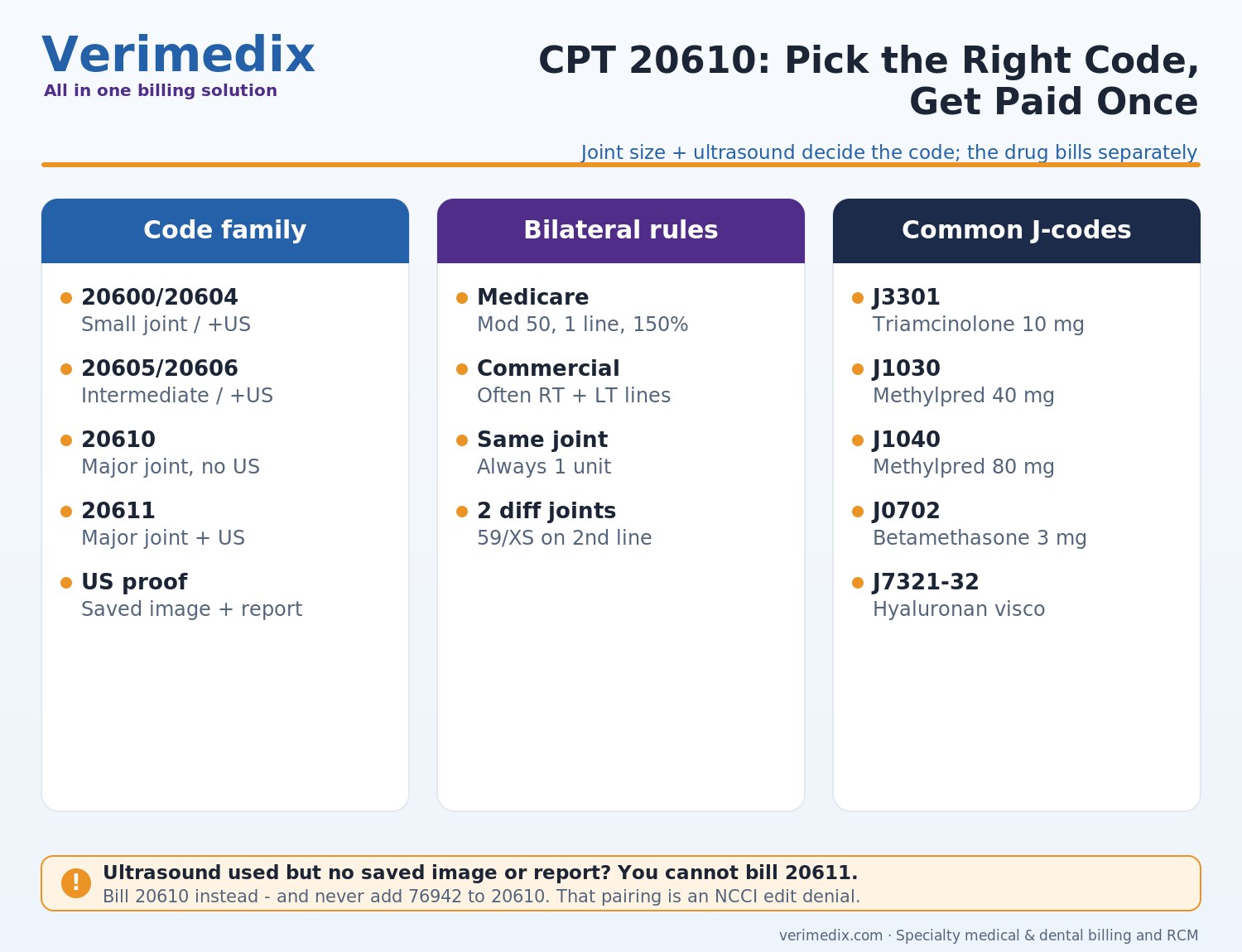
- CPT 20610 = arthrocentesis, aspiration and/or injection of a major joint or bursa (shoulder, hip, knee) without imaging guidance; 20611 is the same procedure with ultrasound guidance, saved image, and report.
- Never bill 76942 separately with 20610 — if ultrasound was used and documented, the correct code is 20611.
- Bilateral: Medicare wants one line with modifier 50 (paid at 150%); many commercial payers want two lines with RT and LT.
- The drug is never included — report the J-code (J3301, J1030/J1040, J7321–J7332) with correct units and NDC where required.
- Two different joints in one session need modifier 59 or XS on the second line plus laterality modifiers.
- A same-day E/M is payable only with modifier 25 and genuinely separate documented work.
Joint injections look simple on the schedule — a knee aspiration here, a shoulder steroid shot there — but the claims behind them fail at a surprising rate. Every 20610 encounter forces three separate decisions: which code matches the joint size and imaging used, how to report laterality when both sides are treated, and how to bill the drug as its own line item. Get any one wrong and the payer underpays, denies, or pays now and recoups in an audit.
This guide walks through each decision in order, with the payer nuances generic code descriptions leave out. It reflects AMA CPT definitions and CMS policy as of 2026; MACs and commercial payers apply their own edits, so confirm the specific payer's policy before standardizing a workflow.
What CPT 20610 covers — and what it does not
CPT 20610 describes arthrocentesis, aspiration and/or injection of a major joint or bursa: the shoulder (glenohumeral or acromioclavicular), hip, knee, or a large bursa such as the subacromial or trochanteric bursa. The code is the same whether the clinician aspirates fluid, injects medication, or does both through the same needle placement — report one unit per joint, per session, no matter how many services happened inside that joint.
What 20610 does not include:
- The drug. Corticosteroids and viscosupplements are reported separately with HCPCS J-codes. Skip the J-code and you gave the drug away free.
- Ultrasound guidance. That changes the procedure code entirely — to 20611.
- A separate E/M, unless the visit involved significant work beyond the decision to inject — then append modifier 25 to the E/M code, not to 20610.
Local anesthetic mixed into the syringe is integral to the procedure for most payers and not separately payable. Fluoroscopic or CT guidance, when used instead of ultrasound, may be reportable with 77002/77012 depending on payer policy — ultrasound is the only guidance baked into a combined code.
20610 vs 20611 — and the rest of the code family
The arthrocentesis codes sit on a simple grid: joint size on one axis, ultrasound guidance on the other.
| CPT code | Joint size | Guidance | Example sites |
|---|---|---|---|
| 20600 | Small | None | Fingers, toes |
| 20604 | Small | Ultrasound + image + report | Fingers, toes |
| 20605 | Intermediate | None | Wrist, elbow, ankle, TMJ |
| 20606 | Intermediate | Ultrasound + image + report | Wrist, elbow, ankle |
| 20610 | Major | None | Shoulder, hip, knee, subacromial bursa |
| 20611 | Major | Ultrasound + image + report | Shoulder, hip, knee |
Three elements must all be present to report 20611: ultrasound was used for needle guidance, a permanent image was saved, and the clinician wrote a brief guidance report. Missing any element — probe used but no image archived, say — the defensible code is 20610. Billing 20611 without the saved image is a classic audit finding; billing 20610 plus 76942 is an NCCI violation that denies or gets recouped.
Code-selection decision tree:
- Which joint? Small → 20600/20604. Intermediate → 20605/20606. Major → 20610/20611.
- Ultrasound used? No → unguided code. Yes → confirm saved image + report, then bill the guided code; missing either → unguided code.
- Fluoro or CT? Unguided arthrocentesis code; check whether the payer allows 77002/77012 separately.
- Same joint, both sides? Apply the bilateral rules below.
- Different joints same day? Separate lines, 59/XS on the second, distinct notes for each.
Bilateral injections: modifier 50 vs RT/LT
Both 20610 and 20611 carry a Medicare bilateral surgery indicator of 1, so same-joint bilateral injections (both knees, both shoulders) pay at 150% of the fee schedule when reported correctly:
- Medicare: one line, modifier 50, one unit, full charge for both sides. Do not add RT/LT or bill two units.
- Many commercial and Medicaid plans: two lines — 20610-RT and 20610-LT — one unit each; some want 20610-50 with two units instead. There is no universal commercial rule, which is why bilateral claims are a leading source of CO-4 denials.
Our guide to modifier 50 bilateral procedure billing covers payer formats and payment math in depth. Two injection-specific traps: aspirating and injecting the same knee is still one unit of 20610, never bilateral. And the right knee plus left shoulder is not bilateral at all — those are different joints, billed on two lines with laterality plus 59/XS on the second.
Pairing 20610 with the drug J-code
Every injection claim should carry at least two lines: the administration (20610 or 20611) and the drug. J-code units are calculated from the dose actually used, not the vial count. New to drug codes? Start with what a J-code is in medical billing.
| J-code | Drug | Billing unit | Example |
|---|---|---|---|
| J3301 | Triamcinolone acetonide (Kenalog) | 10 mg | 40 mg = 4 units |
| J1030 | Methylprednisolone acetate (Depo-Medrol) | 40 mg | 40 mg = 1 unit |
| J1040 | Methylprednisolone acetate | 80 mg | 80 mg = 1 unit |
| J0702 | Betamethasone acet. & sod. phos. (Celestone) | 3 mg | 6 mg = 2 units |
| J1100 | Dexamethasone sodium phosphate | 1 mg | 4 mg = 4 units |
| J7321–J7332 | Hyaluronan viscosupplements | Varies by product | Knee OA series; check each code |
Three drug-line rules to build into charge capture. Medicaid programs and many commercial plans require the 11-digit NDC, N4 qualifier, and quantity on the drug line. Medicare single-dose vial claims must carry a JW modifier (waste on a separate line) or JZ (zero waste) — our guide to JW and JZ drug wastage billing covers the mechanics and the claim edits live since late 2023. And viscosupplementation is heavily managed: most payers restrict it to knee osteoarthritis, cap series frequency (often no sooner than every six months, policy-dependent), and may require prior authorization.
For the most commonly paired steroid, unit math and NDC formatting have enough traps that we wrote a dedicated guide: J3301 Kenalog billing, units and NDC reporting.
What 20610 pays — a worked bilateral example
Under the Medicare Physician Fee Schedule, 20610 has generally paid roughly $60–$75 in the office setting in recent years, with 20611 typically $10–$20 higher — exact amounts vary by year and locality, so pull your MAC's current fee schedule. Commercial allowables often run higher. Medicare pays the drug separately at ASP + 6%.
Worked example (illustrative numbers only). A Medicare patient gets bilateral knee injections, 40 mg triamcinolone per knee, from two 1 mL single-dose Kenalog-40 vials with no waste:
| Line | Code & modifiers | Units | Illustrative payment |
|---|---|---|---|
| 1 | 20610-50 | 1 | $65 × 150% = $97.50 |
| 2 | J3301-JZ | 8 (80 mg) | 8 × $2.00 = $16.00 |
| Total | $113.50 | ||
The common miscoded version: two 20610 lines without modifier 50, no JZ, and J3301 billed as 80 units instead of 8. Result — one line denied as duplicate, the drug line returned unprocessable, and an MUE rejection on units. An encounter worth about $113 pays $65 and generates three rework touches.
Common 20610 denials and how to fix them
| Denial scenario | Typical code | Fix |
|---|---|---|
| Bilateral billed in wrong format | CO-4 / CO-97 | Keep a payer grid; rebill in the payer's format (see the CO-4 denial guide) |
| 20610 + 76942 same day | NCCI edit | Rebill as 20611 if image + report exist; otherwise 20610 alone |
| Second joint line denied | CO-97 | Append XS (Medicare-preferred) with laterality; document each joint separately |
| Drug line denied | CO-16 / MUE | Fix units to the HCPCS unit definition; add NDC and JW/JZ |
| E/M denied with injection | CO-97 | Bill E/M only with a separately documented problem; modifier 25 |
| Viscosupplement denied | CO-50 | Verify diagnosis (knee OA), interval, and prior auth before injecting |
High-volume injectors — orthopedics, rheumatology, and pain management — should audit a sample of 20610 claims quarterly against three questions: does guidance documentation match the code, does the bilateral format match each payer's rule, and do drug units reconcile to the dose in the note? Those checks catch most preventable leakage on this family. For broader context, see our orthopedic CPT code guide.
Quick Answers
What is CPT code 20610? Arthrocentesis, aspiration and/or injection of a major joint or bursa — shoulder, hip, knee, or major bursa — without ultrasound guidance. One unit per joint per session.
What is the difference between 20610 and 20611? 20611 is the same procedure with ultrasound guidance and requires a saved permanent image plus a written guidance report. Without both, bill 20610.
How do you bill 20610 bilaterally? For Medicare, one line as 20610-50 with one unit, paid at 150%. Many commercial payers instead want two lines with RT and LT — the format is payer-specific.
Does 20610 include the medication? No. Bill the drug separately with its J-code and correct units — 40 mg of triamcinolone is J3301 × 4 units — plus the NDC where required.
How much does Medicare pay for 20610? Roughly $60–$75 in the office setting in recent years, varying by locality and year, with the drug paid separately at ASP + 6%. Check your MAC's current fee schedule.
Frequently asked questions
No. They describe the same procedure with and without ultrasound guidance, so only one applies per joint per session. If ultrasound was used with a saved image and report, bill 20611; otherwise bill 20610. Billing both, or adding 76942 to 20610, triggers NCCI edit denials.
One unit per major joint injected or aspirated, even if the clinician both aspirates and injects the same joint. Different joints go on separate lines with modifier 59 or XS plus laterality modifiers. Medicare MUE limits cap daily units, so confirm the current NCCI MUE file before billing more than two.
Common supporting diagnoses include osteoarthritis (M17 knee, M16 hip), joint effusion (M25.4-), bursitis, and rheumatoid or crystal arthropathies, coded to laterality. Viscosupplementation typically requires a knee osteoarthritis diagnosis specifically. Check your MAC's LCD and the commercial payer policy, since covered-diagnosis lists differ.
Corticosteroid injections usually do not require prior authorization, but viscosupplementation (J7321–J7332) often does, and many payers cap the interval between series. Some Medicare Advantage plans apply auth rules that original Medicare does not. Verify benefits before the visit whenever a hyaluronan product is planned.
Generally no — local anesthetic mixed into the injection is considered integral to the procedure by most payers and is not separately payable. The corticosteroid or viscosupplement itself, however, is always separately billable with its J-code. Report waste from single-dose vials with the JW modifier where applicable.