
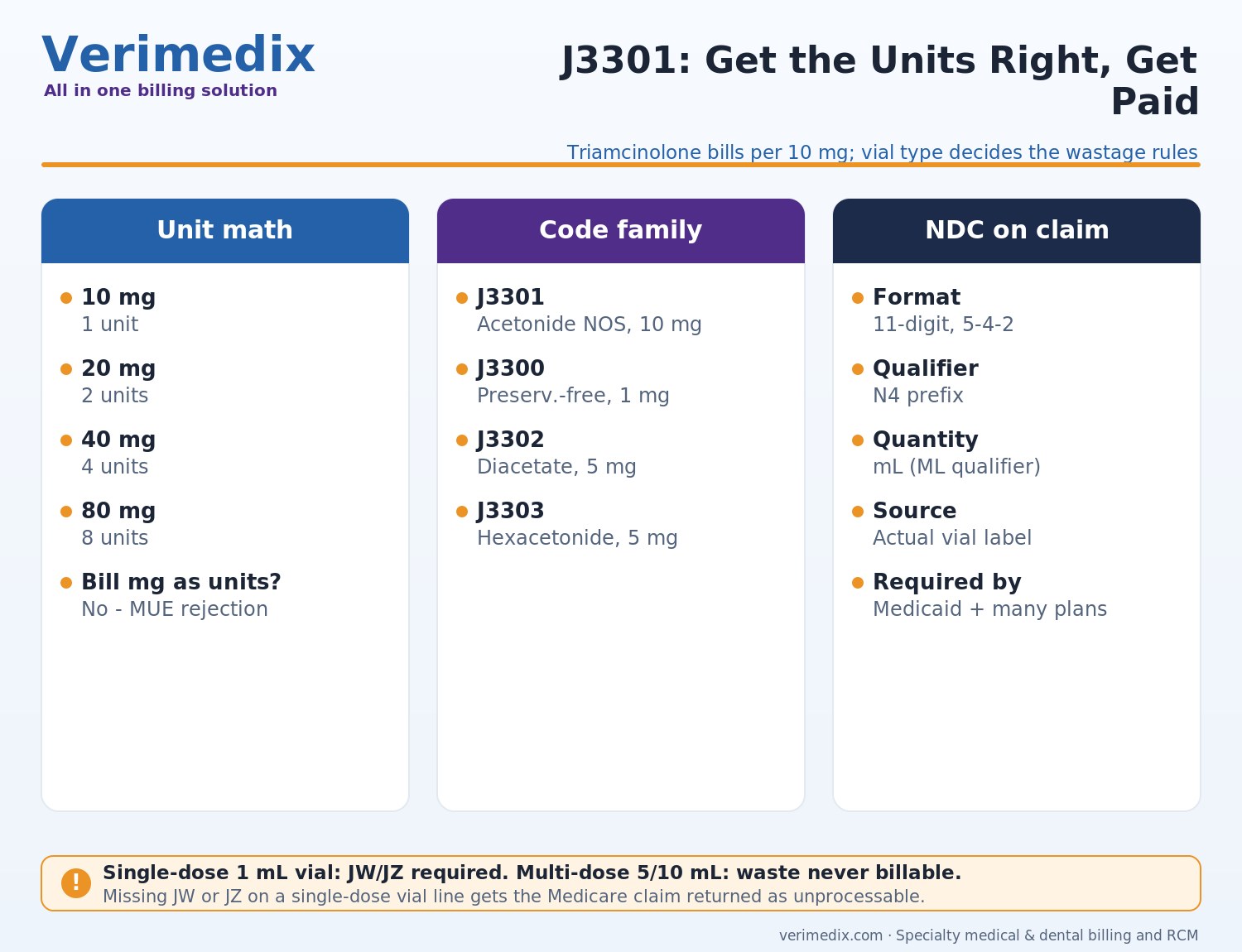
- J3301 is the HCPCS code for triamcinolone acetonide (Kenalog), not otherwise specified, per 10 mg — so a 40 mg dose is 4 units, never 40.
- Billing milligrams as units is the single most common J3301 error and triggers Medically Unlikely Edit (MUE) rejections.
- Medicaid and many commercial payers require the 11-digit NDC in 5-4-2 format with an N4 qualifier and quantity — taken from the actual vial, not a cached list.
- JW/JZ wastage modifiers apply only to single-dose vials (e.g., Kenalog-40 1 mL); waste from 5 mL and 10 mL multiple-dose vials is not billable and takes no modifier.
- J3301 is a drug-only code — always pair it with the administration CPT (20610/20611 joints, 20550/20551 tendon, 11900/11901 lesions, 96372 IM).
- Do not confuse J3301 with J3300 (preservative-free, per 1 mg), J3302 (diacetate), or J3303 (hexacetonide).
Few drug codes generate as much quiet revenue leakage as J3301. The dollar amounts per claim are small — a few dollars per 10 mg unit under Medicare's ASP methodology — which is exactly why unit errors, missing NDCs, and skipped wastage modifiers slide through unnoticed for months. Multiply a systematically wrong Kenalog line across every joint injection, trigger-point session, and dermatology visit in a year, and the leakage plus rework cost becomes real money.
Below is the complete billing logic for triamcinolone acetonide: how the 10 mg unit works, how J3301 differs from its look-alike codes, what NDC reporting actually requires on the claim, when JW and JZ apply, and which administration codes it pairs with. Payer specifics vary, so treat every threshold here as a default to verify against your MAC and commercial policies.
What HCPCS code J3301 covers
J3301 is defined as "Injection, triamcinolone acetonide, not otherwise specified, 10 mg." It covers the branded Kenalog products and their generics — the same code applies regardless of manufacturer or concentration:
- Kenalog-10 — 10 mg/mL, typically used for intralesional dermatology work.
- Kenalog-40 — 40 mg/mL, the workhorse for joint, bursa, and intramuscular injections; supplied in a 1 mL single-dose vial and in 5 mL and 10 mL multiple-dose vials.
- Generic triamcinolone acetonide suspension from multiple manufacturers.
The concentration changes the volume drawn, not the code or the units — 40 mg is 4 units whether it came from 4 mL of Kenalog-10 or 1 mL of Kenalog-40. J3301 is a drug-only code: it never pays for the injection work itself, which is reported with a separate administration CPT code (see the pairing table below). If J-codes are new territory, our primer on what a J-code is in medical billing and the broader HCPCS Level I and Level II guide cover the fundamentals.
One family of look-alike codes causes regular miscoding:
| Code | Drug form | Billing unit | Typical use |
|---|---|---|---|
| J3301 | Triamcinolone acetonide, NOS (Kenalog) | 10 mg | Joints, bursae, IM, intralesional |
| J3300 | Triamcinolone acetonide, preservative-free | 1 mg | Specific PF preparations |
| J3302 | Triamcinolone diacetate (Aristocort) | 5 mg | Different salt — different code |
| J3303 | Triamcinolone hexacetonide (Aristospan) | 5 mg | Long-acting intra-articular form |
Note the unit sizes: J3300 is per 1 mg and J3302/J3303 are per 5 mg. Pulling the wrong code from a favorites list quietly multiplies or divides your reimbursement — and a preservative-free product billed under J3301 (or vice versa) is a compliance mismatch against the NDC on the claim.
Unit math: 1 unit = 10 mg
Divide the milligrams actually administered (plus documented single-dose-vial waste, billed per the JW rules below) by 10. That is the entire formula — yet unit errors remain the top J3301 denial driver because EHR charge tickets often default to "1" or let clinicians enter milligrams directly.
Five-point unit checklist before the claim goes out:
- Dose in the note? The exact mg administered must appear in the procedure note, not just "Kenalog injected."
- Units = mg ÷ 10? 20 mg → 2 units; 40 mg → 4; 80 mg → 8. Never bill the mg number itself.
- Multiple sites summed? Two knees at 40 mg each is one J3301 line with 8 units (the admin code carries the laterality logic, not the drug line).
- Waste handled? Single-dose vial with leftover → separate JW line; no leftover → JZ on the drug line; multiple-dose vial → administered amount only, no JW/JZ.
- Dose below 10 mg? A 5 mg intralesional dose still bills 1 unit — CMS guidance treats a partial billing unit as one unit, with no JW for the sub-unit remainder.
MUE limits cap how many units of J3301 a payer will accept per day; billing 40 units for a 40 mg dose blows straight through that ceiling and rejects. Check the current NCCI MUE file rather than assuming a specific value, since CMS updates it quarterly.
NDC reporting: the format payers actually want
Medicaid programs require NDC data on professional drug claims essentially universally (it drives federal drug rebate reporting), and a growing share of commercial payers now reject drug lines without it. The claim line needs four elements:
- The 11-digit NDC in 5-4-2 format. Vial labels print 10-digit NDCs; you add a leading zero to whichever segment is short. Example: a label reading 0003-0293-28 becomes 00003-0293-28.
- The N4 qualifier preceding the NDC in the supplemental field (box 24A shaded area on the CMS-1500, or the LIN segment electronically).
- Quantity and unit of measure — for Kenalog suspensions, typically milliliters (ML qualifier). Note the mismatch trap: HCPCS units are in 10 mg increments while NDC quantity is usually in mL. One mL of Kenalog-40 is 4 HCPCS units but an NDC quantity of 1 ML.
- The NDC from the vial actually used. Manufacturers and package sizes rotate; billing a cached NDC that does not match inventory is a denial and an audit flag. Verify against the label or FDA DailyMed.
Wastage: when JW and JZ apply to J3301
Medicare requires every separately payable drug line from a single-dose container to carry either JW (an amount was discarded — billed on its own line) or JZ (nothing was discarded). Claims missing both have been returned as unprocessable since late 2023. The vial type decides everything for triamcinolone:
- Kenalog-40 1 mL single-dose vial: JW/JZ rules apply in full. Administer 20 mg and discard 20 mg → line 1: J3301 × 2 units; line 2: J3301-JW × 2 units. Administer all 40 mg → one line, J3301-JZ × 4 units.
- Kenalog-40 5 mL or 10 mL multiple-dose vials: no JW, no JZ, and no billing for waste at all — bill only what was administered. Discarded remainder from a multi-dose vial is a practice cost, which is why high-volume injection practices often standardize on the vial size that matches their typical dose.
Document the administered amount, the discarded amount, and the vial size in the record every time — the JW line is only defensible if the note supports it. The full mechanics, attestation rules, and denial scenarios are in our companion guide to JW and JZ drug wastage billing.
Pairing J3301 with the right administration code
The drug line and the administration line travel together; a J3301 claim without an admin code (or vice versa) is incomplete. Common pairings:
| Setting | Admin CPT | Notes |
|---|---|---|
| Major joint or bursa (knee, shoulder, hip) | 20610 / 20611 | 20611 when ultrasound-guided with image + report — see our CPT 20610 joint injection billing guide |
| Intermediate joint (wrist, elbow, ankle) | 20605 / 20606 | Same guidance logic as the major-joint pair |
| Tendon sheath / ligament | 20550 / 20551 | Per site rules apply; check NCCI for multiples |
| Trigger points | 20552 / 20553 | Code by number of muscles, not injections |
| Intralesional skin (keloids, alopecia, acne cysts) | 11900 / 11901 | 11900 up to 7 lesions; 11901 for more than 7 |
| Therapeutic IM injection (e.g., NOS uses) | 96372 | Watch payer coverage — some uses are non-covered |
Diagnosis linkage matters as much as the pairing: the ICD-10 code on the claim must support steroid injection at that site (osteoarthritis, bursitis, tenosynovitis, keloid, etc.), and some indications — notably allergy uses of triamcinolone — are covered inconsistently, with several payers treating seasonal-allergy Kenalog shots as not medically necessary. Verify the payer policy before the visit rather than after the CO-50.
What J3301 pays — and a worked example
Medicare pays J3301 at ASP + 6%, recalculated quarterly; in recent quarters that has generally worked out to roughly $1–$3 per 10 mg unit. Commercial payers typically pay somewhat more. Small numbers — but the admin code, drug units, and clean-claim rate together decide whether injection visits are profitable.
Worked example (illustrative numbers only). A patient receives 60 mg of triamcinolone into the shoulder, drawn from two 1 mL single-dose Kenalog-40 vials (80 mg opened, 20 mg discarded):
| Line | Code | Units | Illustrative payment |
|---|---|---|---|
| 1 | 20610 (admin) | 1 | $65.00 |
| 2 | J3301 (administered) | 6 (60 mg) | 6 × $2.00 = $12.00 |
| 3 | J3301-JW (discarded) | 2 (20 mg) | 2 × $2.00 = $4.00 |
| Total | $81.00 | ||
The frequent miscoded versions of this claim: 60 units billed instead of 6 (MUE rejection), no JW/JZ on the drug lines (returned unprocessable by Medicare), or a missing NDC (Medicaid/commercial CO-16 — see our CO-16 denial guide). Each one converts a $16 drug payment into a rework loop that costs more to fix than the line is worth, which is why the fix belongs in charge-entry rules, not in follow-up.
Quick Answers
What is J3301? J3301 is the HCPCS Level II code for injection of triamcinolone acetonide (Kenalog and generics), not otherwise specified, billed per 10 mg.
How many units of J3301 for 40 mg of Kenalog? Four units. Divide the milligrams administered by 10 — 20 mg is 2 units, 40 mg is 4, 80 mg is 8. Billing the mg number as units causes MUE rejections.
Does J3301 require an NDC on the claim? Medicaid programs require it essentially universally, and many commercial payers do as well: the 11-digit NDC in 5-4-2 format with an N4 qualifier and the quantity in the correct unit of measure, taken from the vial actually used.
Do JW and JZ modifiers apply to J3301? Only when the drug came from a single-dose vial, such as the 1 mL Kenalog-40. Waste from 5 mL or 10 mL multiple-dose vials is not billable and takes no wastage modifier.
What CPT code goes with J3301 for a knee injection? CPT 20610 (or 20611 with documented ultrasound guidance) for the injection itself, with J3301 on a separate line for the drug.
How much does Medicare pay for J3301? ASP + 6%, updated quarterly — recently in the rough range of $1–$3 per 10 mg unit. Check the current quarterly ASP pricing file for the exact rate.
Frequently asked questions
Yes — J3301 covers triamcinolone acetonide regardless of concentration or manufacturer, branded or generic. The concentration changes the volume drawn, not the code or units: 40 mg is 4 units whether it came from 4 mL of Kenalog-10 or 1 mL of Kenalog-40. The NDC on the claim, however, must match the specific vial used.
Almost always because milligrams were entered as units — 40 units for a 40 mg dose instead of 4. J3301 is billed per 10 mg, and payer MUE edits cap plausible daily units well below typical mg amounts. Correct the units to mg ÷ 10 and resubmit.
Bill 1 unit. CMS guidance treats a partial billing unit as one unit, and the JW modifier is not used for the sub-unit remainder — the line is reported with JZ when the drug came from a single-dose container. Document the actual mg administered in the note.
No. Discarded amounts are only billable from single-dose containers, using the JW modifier on a separate line. Waste from 5 mL or 10 mL multiple-dose Kenalog vials is a practice cost, and no JW or JZ modifier is reported on multi-dose vial claims.
The code itself applies, but coverage is payer-specific — several payers consider IM triamcinolone for seasonal allergic rhinitis not medically necessary and deny it. Verify the payer's policy and covered diagnoses before administering, and obtain an ABN from Medicare patients when coverage is doubtful.