
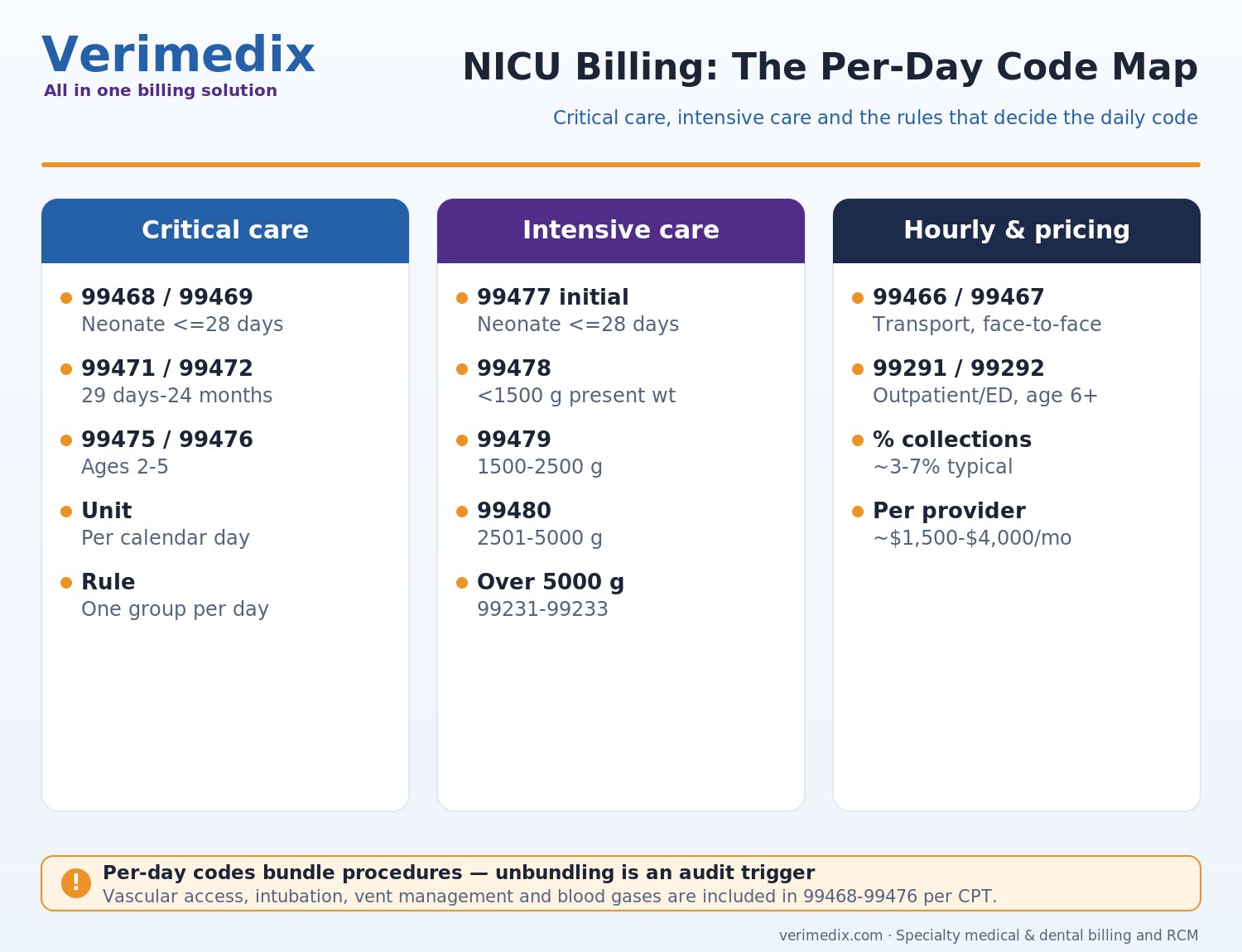
- NICU professional billing runs on per-day (global) codes: 99468/99469 for neonatal critical care (28 days of age or younger), 99471–99476 for older critically ill infants and children, and 99477–99480 for intensive but non-critical care.
- Per-day codes follow calendar-day logic (midnight to midnight), are billable once per day per patient, and generally by only one physician or group per day — shift-based double billing is a top audit trigger.
- Subsequent intensive care codes are weight-banded by present body weight: 99478 (<1500 g), 99479 (1500–2500 g), 99480 (2501–5000 g); the day the infant crosses a band, the code changes.
- Hourly critical care (99291/99292) still applies in specific settings, and 99466/99467 cover face-to-face interfacility transport.
- The per-day codes bundle many procedures (vascular access, intubation, ventilator management, blood gas interpretation), so unbundling them is a compliance risk, not extra revenue.
- Outsourced neonatology billing commonly prices at roughly 3–7% of professional collections or per-provider retainers; vet vendors on daily-code audits and newborn eligibility work.
Why NICU billing follows different physics
Most physician billing counts encounters; neonatology counts days. Once a neonate is admitted in critical condition, the entire day of physician work — rounds, vent changes, family conferences, 2 a.m. deterioration calls — collapses into a single per-day code. That design simplifies documentation but concentrates risk: pick the wrong daily code, or let two providers bill the same day, and a 60-day NICU stay unravels.
The second oddity is eligibility. Newborns are typically covered under the mother's policy for an initial window (commonly the first 30 days, varying by state and plan), and enrollment lag means claims often release before the baby has an ID number. NICU stays also straddle plan years and involve Medicaid-pending decisions, which is why coordination-of-benefits denials are endemic — our CO-22 denial guide covers the fix pattern. Verimedix's dedicated neonatology billing services page describes our specialty offering; this article is the buyer's guide for administrators comparing options.
What complete NICU billing support covers
Beyond standard revenue cycle work (charge capture, scrubbing, submission, posting, appeals, reporting), a NICU-competent vendor should provide:
- Daily level-of-care validation — checking that documentation supports critical (99468/99469) vs. intensive (99477–99480) vs. subsequent hospital care (99231–99233), since the level can change day to day.
- Weight-band tracking — applying present body weight to select 99478/99479/99480 and switching codes when thresholds are crossed.
- Newborn eligibility workflow — baby-under-mom claim setup, enrollment follow-up, Medicaid-pending tracking, and state-specific newborn coverage rules.
- One-biller-per-day reconciliation — deconflicting group members and consultants so only the appropriate provider reports the per-day code.
- Bundling protection — blocking separately billed procedures that CPT includes in the per-day codes.
Pricing models for NICU billing
Neonatology groups are often hospital-affiliated with high average daily revenue, which shapes pricing. All ranges are illustrative industry figures; confirm quotes in writing.
| Model | Typical range | Best fit | Watch-outs |
|---|---|---|---|
| Percentage of collections | ~3–7% of professional collections | Independent groups billing their own professional fees | Define collections precisely; exclude hospital subsidy payments |
| Per-provider monthly retainer | ~$1,500–$4,000 per neonatologist | Groups with stable census | Confirm appeals and eligibility chasing are in scope |
| Per-claim / hybrid | ~$4–$10 per claim plus project fees for old AR | Groups keeping some functions in-house | NICU claims are low-count, high-value — appeals matter more than throughput |
The neonatal code map: 99460–99480
| Code(s) | Service | Unit | Key rule |
|---|---|---|---|
| 99460–99463 | Normal newborn care (initial, subsequent, same-day admit/discharge) | Per day | Well-baby services in hospital or birthing center |
| 99464 / 99465 | Attendance at delivery / newborn resuscitation | Per event | Not reported together |
| 99466 / 99467 | Critical care during interfacility transport, patient 24 months or younger | Hourly (30–74 min, then each addl 30) | Face-to-face transport time only |
| 99468 / 99469 | Initial / subsequent inpatient neonatal critical care, 28 days of age or younger | Per calendar day | Once per day; generally one physician or group per day |
| 99471 / 99472 | Initial / subsequent pediatric critical care, 29 days through 24 months | Per calendar day | Chronological age at admission |
| 99475 / 99476 | Initial / subsequent pediatric critical care, 2 through 5 years | Per calendar day | Age 6+ moves to hourly 99291/99292 |
| 99477 | Initial hospital intensive (non-critical) care, 28 days of age or younger | Per day | Intensive observation, frequent interventions, not critically ill |
| 99478 / 99479 / 99480 | Subsequent intensive care by present body weight: <1500 g / 1500–2500 g / 2501–5000 g | Per day | Code follows today's weight; recovering infant over 5000 g moves to 99231–99233 |
Descriptors are abbreviated — verify against the current CPT® manual before billing.
Per-day vs hourly: the rules that generate denials
Calendar day, not 24-hour shift. The per-day codes reset at midnight. An admission at 11 p.m. earns the initial code for that first short day and a subsequent code the next day. Groups that bill by shift create duplicate-day denials that look like double billing to payers.
One reporting provider per day. CPT designed 99468–99476 to capture all critical care by the reporting physician or group for the day. Partners covering different shifts do not each bill; the group reports once. A consultant of a different specialty managing a separate problem may be able to report hourly critical care (99291/99292) or other E/M, depending on payer policy.
Where hourly codes still live. Critical care for a neonate in an outpatient setting (such as the ED before admission) is reported with 99291/99292 under many payer policies; when the same group then admits the child, guidance often folds the day into the per-day code — policies differ, so this is where a specialty biller earns their fee. Interfacility transport uses 99466/99467 for face-to-face time.
Bundled procedures. The per-day neonatal codes include services a general biller might reflexively bill separately — umbilical and other vascular access, endotracheal intubation, ventilator management, blood gas interpretation, lumbar puncture, bladder catheterization, gastric tube placement, and more per the CPT bundling list. Unbundling these is a refund letter waiting to happen; verify genuinely separate services against the CPT list and NCCI edits.
Critical vs. intensive is a documentation call. The revenue gap between 99469 and 99478 is substantial, and the deciding factor is whether the note supports critical illness — high-complexity decision making with vital organ system failure or imminent risk — versus intensive observation of a recovering infant. Downcoding out of caution leaks revenue; upcoding without documentation invites audits. A NICU-literate coder reviews this daily, not at discharge.
Common NICU denials and fixes
| Denial pattern | Root cause | Fix |
|---|---|---|
| Duplicate per-day code | Two group members billed the same calendar day | Group-level day reconciliation before submission |
| Newborn not eligible / no ID | Enrollment lag; baby-under-mom window missed | Newborn enrollment tracking; hold-and-release rules; see CO-22 fixes |
| Medical necessity on 99468/99469 | Note doesn't support critical status that day | Daily validation; appeal with flowsheet evidence; see the CO-50 guide |
| Wrong weight-band code | 99478–99480 chosen from birth weight, not present weight | Automate present-weight capture from the daily note |
| Timely filing on long stays | Claims held for discharge instead of interim-billed | Bill per payer interim-claim rules; track a timely filing calendar |
How to choose a neonatology billing partner: 8 questions
- How do you validate critical vs. intensive level of care each day — and who does it (coder credential)?
- What is your process when present body weight crosses a 99478/99479/99480 band?
- How do you reconcile which provider reports the per-day code across a group?
- What is your newborn eligibility workflow for baby-under-mom and Medicaid-pending accounts?
- Which procedures do you treat as bundled into 99468–99476, and what is your exception list?
- What share of your current clients are neonatology or pediatric critical care groups?
- What are your appeal turnaround SLAs and overturn rates on medical-necessity denials?
- What KPIs come monthly — days in AR, clean claim rate, denial rate by CARC, collections per patient-day?
Worked example (illustrative only). A four-physician NICU group covers 500 patient-days per month at an illustrative blended allowable of $320/day — about $160,000/month collected. A 5% fee costs $8,000/month. If daily level-of-care review upgrades 15 defensible days per month from intensive to documented critical care at an illustrative $150/day difference, that is $2,250/month; add four rescued newborn-eligibility day-claims (~$1,280) and the specialty vendor covers nearly half its fee versus a generalist — before AR speed. Actual allowables vary widely by payer and region.
Quick Answers
What are the NICU critical care codes? 99468 (initial) and 99469 (subsequent) for inpatient neonatal critical care of infants 28 days of age or younger, billed per calendar day; 99471/99472 cover 29 days through 24 months, and 99475/99476 cover ages 2 through 5.
How do 99477–99480 differ from critical care codes? They cover intensive but non-critical care: 99477 is the initial day for a neonate 28 days or younger, while 99478–99480 are subsequent days selected by present body weight (<1500 g, 1500–2500 g, 2501–5000 g).
Can two doctors bill NICU critical care on the same day? Generally no — the per-day codes are reported once per day by one physician or group. A physician of a different specialty managing a distinct problem may be able to report separately, depending on payer policy.
When are hourly critical care codes used for neonates? For outpatient/ED critical care before admission (99291/99292 under many payer policies) and for face-to-face interfacility transport of patients 24 months or younger (99466/99467).
What does NICU billing support cost? Commonly about 3–7% of professional collections or a per-provider retainer of roughly $1,500–$4,000/month, depending on scope — illustrative ranges; get written quotes.
Frequently asked questions
The neonatal critical care codes use chronological age — 28 days of age or younger at the time of admission to critical care. Gestational age matters clinically and for ICD-10 coding of prematurity, but the CPT code family selection runs on days since birth; verify edge cases such as readmissions against current CPT guidance and payer policy.
Once a recovering infant no longer requires intensive care services or exceeds the 5000-gram band for 99480, subsequent days are typically reported with standard subsequent hospital care codes 99231–99233. The transition day should be documented clearly, since payers compare the code against the recorded daily weight.
Often yes — 99464 (attendance at delivery) or 99465 (newborn resuscitation) may be reported in addition to the initial per-day code when documentation supports both services, though 99464 and 99465 are not reported together. Payer edits vary, so modifier and sequencing rules should be checked per plan.
Because the patient frequently does not exist in the payer's system yet. Newborns ride the mother's policy for an initial window (commonly 30 days, varying by state and plan), and enrollment paperwork lags long stays. A billing service that tracks newborn enrollment and holds claims until an ID is active prevents most of these denials.
Largely yes — CPT bundles a defined list of services into 99468–99476, including many vascular access procedures, intubation, ventilator management, and blood gas interpretation. Billing them separately is an unbundling error; the accurate move is knowing the CPT inclusion list and the narrow exceptions that remain separately reportable.