
- CO-22 means the payer's coordination of benefits (COB) file shows another plan should pay first — a sequencing denial, not a coverage or coding problem.
- Primary coverage follows standard rules: a subscriber's own plan beats dependent coverage, the birthday rule sequences dependent children, and Medicare Secondary Payer (MSP) rules govern working-aged, disabled, and ESRD patients.
- The fastest fix is often the patient calling the denying payer — most payers only update other-coverage files on member confirmation.
- Bill in strict sequence: primary first, wait for the EOB/ERA, then bill the secondary with the primary's adjudication attached.
- Appeal only after the patient has confirmed no other coverage exists — attach the confirmation reference number.
- Checking eligibility and COB at every visit — not just intake — prevents most repeat CO-22 denials.
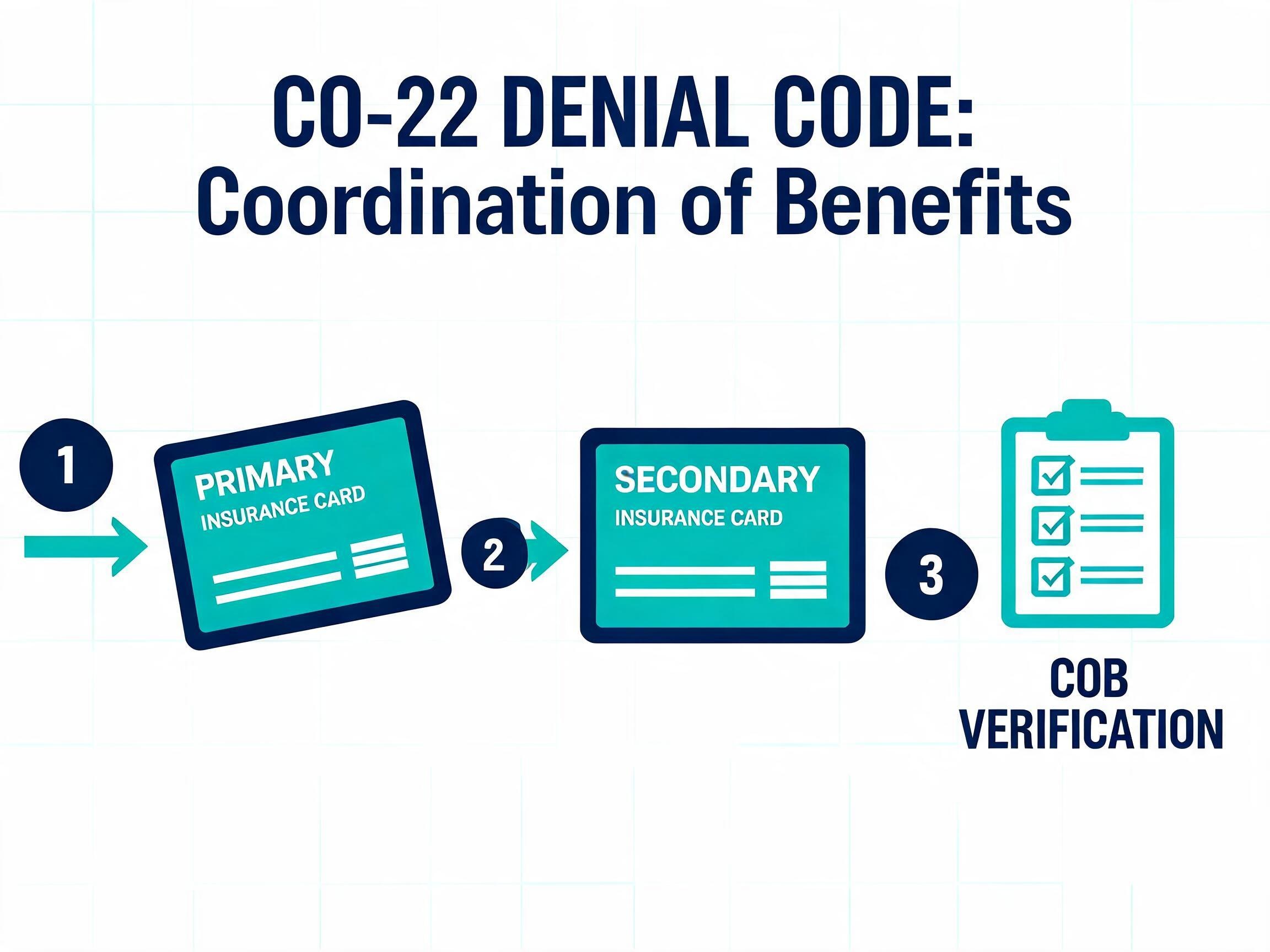
The CO-22 denial code carries the remittance message "This care may be covered by another payer per coordination of benefits." In plain terms: the payer you billed as primary checked its records, found evidence of other active coverage, and declined to adjudicate until the payer order is proven or corrected. Nothing about the CPT code, the diagnosis, or the medical necessity of the service is being questioned. That makes CO-22 one of the most fixable denials on the CARC list — and one of the most preventable, because nearly every CO-22 traces back to an eligibility or intake step that was skipped or has gone stale.
This guide covers how COB determines who pays first, the scenarios that trigger CO-22, a front-desk workflow that prevents it, and the rebilling sequence that resolves it — with a worked dollar example and a patient script your staff can use today.
What the CO-22 denial code means
CARC 22 is a coordination of benefits denial. When a patient holds more than one active policy, COB rules decide which plan adjudicates first (primary) and which pays on the balance (secondary). Payers maintain other-coverage files built from enrollment data, employer reporting, and — for Medicare — the CMS Benefits Coordination & Recovery Center's records. When the payer you billed believes its file shows another plan ahead of it in line, it returns CO-22 rather than paying.
Note that the denial reflects what the payer's COB file says — which may be outdated, such as a terminated spousal plan never reported. Payers may pair CARC 22 with group code CO or OA and often add a remark code pointing to the primary insurer. Either way, the fix is the same: establish the true payer order, then rebill in that order. For a refresher on how adjustment codes are structured, see our CARC and RARC guide.
Who pays first? The COB order-of-benefits rules
Most CO-22 confusion comes down to not knowing — or not documenting — which plan is primary. The table below summarizes the standard rules used across commercial plans (largely following the NAIC model COB regulation) and the federal Medicare Secondary Payer statute.
| Situation | Usually primary | Notes |
|---|---|---|
| Patient has own employer plan plus coverage as a spouse's dependent | Patient's own (subscriber) plan | Subscriber coverage beats dependent coverage. |
| Dependent child covered by both parents' plans | Plan of the parent whose birthday falls earlier in the calendar year | The "birthday rule" (month/day, not year); same birthday — longer-held plan wins. |
| Dependent child, parents divorced or separated | Whatever a court decree specifies | Absent a decree, plans commonly put the custodial parent's plan first — confirm each plan's rule. |
| Age 65+, patient (or spouse) actively working, employer has 20+ employees | Employer group health plan | MSP "working aged" rule; under 20 employees, Medicare is generally primary. |
| Under 65, Medicare due to disability, family member works for employer with 100+ employees | Large group health plan | MSP disability rule, per CMS MSP provisions. |
| Medicare entitlement based on ESRD, first 30 months | Group health plan | The 30-month ESRD coordination period applies regardless of employer size, per CMS. |
| Medicare plus COBRA continuation coverage | Medicare (generally) | COBRA typically pays secondary to Medicare. |
| Medicare plus retiree plan | Medicare | Retiree coverage is not "current employment"; MSP does not apply. |
| Work-related injury or accident claim | Workers' compensation, no-fault, or liability insurer | For related diagnoses only; Medicare may make conditional payments subject to recovery. |
| Any coverage plus Medicaid | The other coverage | Medicaid is by law the payer of last resort. |
Common CO-22 scenarios: cause and fix
One COB scenario deserves its own note because it produces some of the largest denied balances in healthcare: the newborn. Coverage normally shifts from the mother’s policy to the infant’s own policy during the hospitalization, and until the baby is formally added, NICU claims come back as CO-22 or as an outright no-coverage denial. Federal and state rules generally require automatic newborn coverage for the first 30–31 days when the enrollment request is made in time, so these are appealable — which is why our neonatology billing services work enrollment and COB as a tracked queue rather than a write-off category.
| Cause | What happened | Fix |
|---|---|---|
| Stale COB file | Payer's records show old or terminated other coverage the patient no longer has | Patient calls the payer, confirms sole coverage; document the reference number, then rebill |
| MSP order ignored | Medicare billed first for a working-aged patient whose employer plan is primary | Rebill the group health plan first; send Medicare the secondary claim with the primary remittance |
| Secondary billed too soon | Secondary claim submitted before the primary adjudicated | Wait for the primary EOB/ERA, then resubmit with primary payment fields completed |
| Dependent order wrong | Child's claim sent to the parent plan that is secondary under the birthday rule | Re-sequence payers in the PM system and rebill the correct primary |
| Accident-related care | Injury diagnosis triggers the payer's subrogation/COB edit | Determine whether workers' comp, auto, or liability coverage applies; bill that carrier first or document that none applies |
| No COB questionnaire on file | Payer periodically requests member COB updates; the member never responded | Have the patient complete the payer's COB questionnaire; claims often release after processing |
The front-desk workflow that prevents CO-22
Because CO-22 is a data problem, prevention lives at check-in:
- Run eligibility on every visit — job changes, turning 65, and plan terminations happen mid-care. A structured eligibility verification process catches payer-order changes before the claim goes out.
- Ask the two COB questions out loud: "Do you have any other insurance coverage — through a spouse, a parent, a retiree plan, or Medicare?" and "Is today's visit related to any accident or injury?"
- Screen Medicare patients for MSP: employment status (patient and spouse), employer size, ESRD, accidents.
- Record both plans with effective dates and sequence them in the practice management system using the rules table above.
- Collect a COB questionnaire annually from dual-coverage patients and after any life event.
- Flag dual-coverage accounts so the billing team confirms the primary EOB is in hand before any secondary claim releases.
A patient script that works: "Your insurance company's records show another active insurance plan, and they won't process our claim until that's cleared up. Could you call the member services number on your card, tell them which plan is primary — or that the old plan ended — and give us the reference number? It takes about ten minutes and keeps this from becoming a bill to you."
Step-by-step: fixing a CO-22 denial
- Read the full remittance — group code, CARC 22, and any remark codes naming the other payer.
- Re-verify eligibility for the date of service and pull any other-coverage details the 271 response or payer portal reveals.
- Interview the patient about other coverage, employment, and accidents; apply the order-of-benefits rules.
- If the denying payer's file is wrong, have the patient confirm sole or corrected coverage directly with that payer, capture the reference number, then resubmit the claim.
- If another plan truly is primary, bill that plan first, wait for its EOB or ERA, then submit the secondary claim with the primary's payment details in the COB loops (or attach the EOB on paper).
- Watch the clock — rebilling the correct primary does not pause its timely filing limit; diary these accounts.
- Appeal only as a last resort, with the patient's confirmation reference number and completed COB questionnaire attached.
Worked example: a $1,840 claim billed in the wrong order
Illustrative numbers. A 67-year-old patient has Medicare and an employer group health plan through her current job at a 500-employee company. The practice bills Medicare first for a $1,840 outpatient procedure. Because the MSP working-aged rule makes the employer plan primary, the claim comes back with CARC 22 — $1,840 sits in AR.
The biller re-sequences the payers and bills the employer plan as primary. It allows $1,240 under contract and pays 80 percent, or $992, leaving $248. The secondary claim then goes to Medicare with the primary remittance attached; in this illustration Medicare's secondary payment covers $182, leaving a $66 patient balance. The practice collects $1,174 — roughly 45 days late, after touching the claim three times. Multiply that rework across every dual-coverage patient and the case for COB checks at check-in makes itself; persistent backlogs are a job for dedicated denial management.
Quick Answers
What does the CO-22 denial code mean? CO-22 means the payer believes another insurance plan is primary under coordination of benefits and will not adjudicate the claim as primary until the payer order is confirmed or corrected. It is a sequencing denial, not a coverage or coding denial.
How do I know which insurance is primary? Apply standard COB rules: a person's own subscriber plan pays before a plan covering them as a dependent, the birthday rule sequences dependent children's plans, and MSP rules make employer coverage primary for working-aged patients at employers with 20+ employees.
What is the birthday rule? For a child on both parents' plans, the parent whose birthday falls earlier in the calendar year (month and day, not year) holds the primary plan. Court decrees override it.
Should I appeal a CO-22 denial? Usually not first — CO-22 is fixed by confirming COB and rebilling in order. Appeal only if denials continue after the patient has confirmed no other coverage, citing the confirmation reference number.
Can Medicare patients get CO-22 denials? Yes — most often via the MSP working-aged rule: when the patient or spouse still works for an employer with 20+ employees, the group plan pays first.
What to check before billing: COB checklist
- Eligibility run for the actual date of service, on every visit
- Other-coverage questions asked and answers documented
- MSP screening completed for every Medicare patient (employment, employer size, ESRD, accident)
- Payer order sequenced in the PM system per COB rules, with effective dates
- COB questionnaire on file for dual-coverage patients, refreshed annually
- Primary EOB/ERA in hand before any secondary claim releases
- Timely filing dates diaried for both payers on re-sequenced accounts
Related denial codes and guides
CO-16 flags claims missing information — including absent primary-payer details on secondary claims — while CO-109 means you billed a payer with no jurisdiction at all. For the bigger picture, see our CARC/RARC guide.
Frequently asked questions
When a dependent child is covered under both parents' plans, the plan of the parent whose birthday falls earlier in the calendar year — comparing month and day only, not birth year — pays primary. If both parents share the same birthday, the plan that has been in force longer is primary, and a court decree for divorced or separated parents overrides the rule entirely.
Not initially. CO-22 is returned so the payer order can be corrected, and the practice should resolve it by confirming COB and rebilling. Depending on payer policy, balances may shift to the patient if they refuse to complete a required COB questionnaire or confirmation, which is why involving the patient early is the fastest path.
Yes, most often under Medicare Secondary Payer rules. When a beneficiary or their spouse is actively working and the employer has 20 or more employees, the group health plan pays primary and Medicare denies claims billed to it first. Disability (100+ employees) and the 30-month ESRD coordination period create the same sequencing.
Wait for the primary payer's EOB or ERA, then submit the secondary claim with the primary's allowed amount, paid amount, adjustments, and adjudication date reported in the claim's COB fields — or attach the primary EOB to a paper claim. Secondary claims sent before primary adjudication are a common CO-22 trigger.
Verify eligibility at every visit, ask about other coverage and accident involvement out loud, screen every Medicare patient for MSP situations, and have dual-coverage patients complete a COB questionnaire annually. Sequencing both plans correctly in the practice management system before the first claim goes out prevents most CO-22 denials.