
- Medicare allows 12 months (365 days) from the date of service to file an initial claim — the most generous major-payer window.
- Commercial payers are far tighter: Cigna publishes 90 days from the date of service for participating providers (180 out of network), while Aetna and UnitedHealthcare leave the number to each provider agreement and state law.
- Medicaid timely filing varies by state, often 90–180 days, with some states allowing up to a year.
- A missed window returns CARC CO-29, and the only reliable appeal is documented proof of timely filing — usually a clearinghouse acceptance report.
- Claims rejected at the clearinghouse were never received by the payer, so an unworked rejection queue is the most common cause of unappealable write-offs.
- Your contract overrides every published number: maintain a payer-by-payer deadline matrix and re-verify it annually.
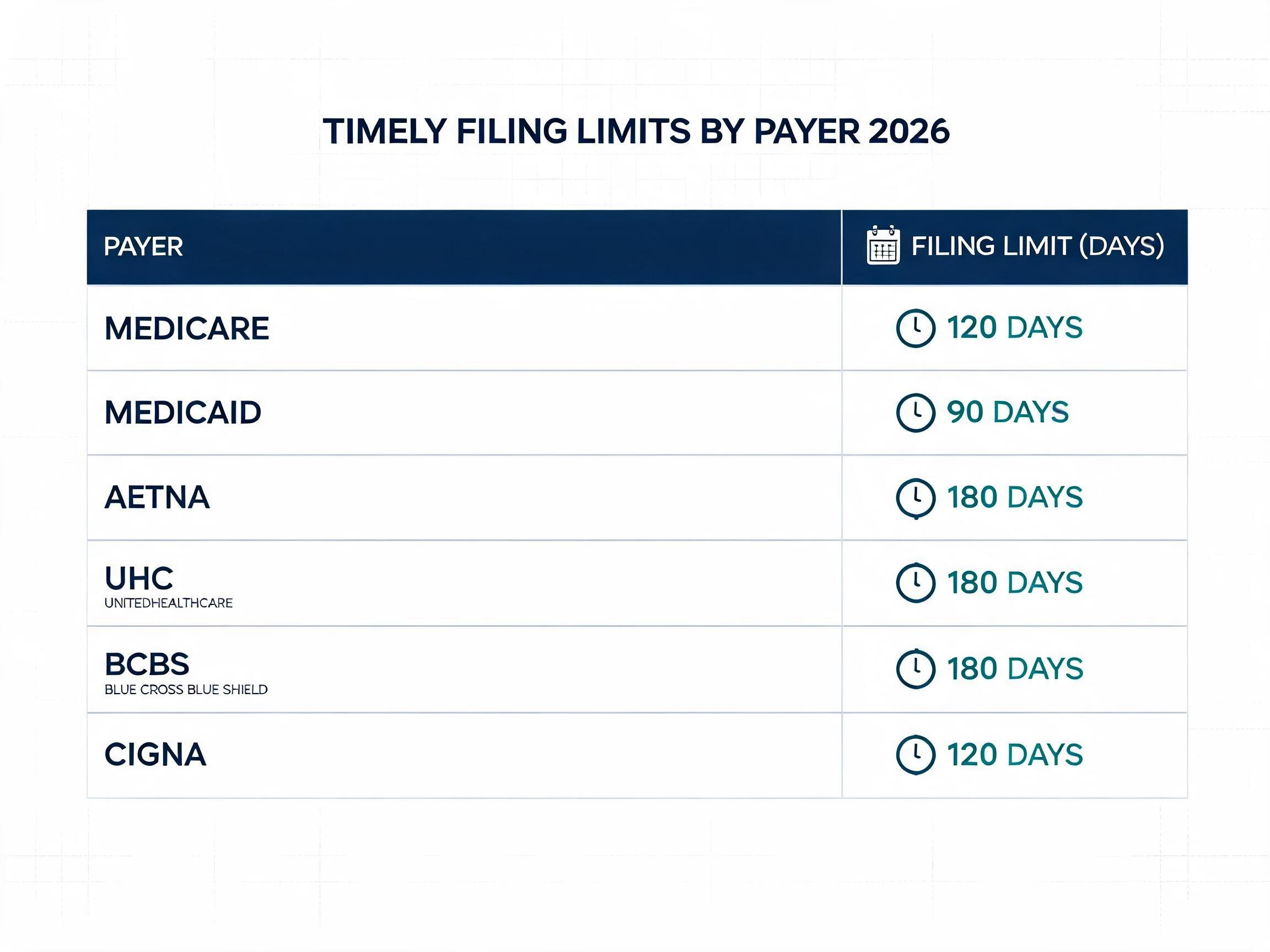
Few denials are as final as a timely filing denial. Most claim problems can be corrected and resubmitted; a claim that arrives after the payer’s deadline is dead on arrival, and the write-off comes straight out of practice profit. The deadlines are wildly inconsistent — a full year for Medicare, 90 days for a participating Cigna provider, whatever the agreement says at Aetna and UnitedHealthcare, and anywhere from 60 days to two years across Blue plans — which is why practices juggling ten payer contracts need a reference table and a prevention workflow, not tribal memory. This guide provides both, plus the appeal path for the rare CO-29 that can be overturned.
What a timely filing limit is — and which clock it runs on
A timely filing limit is the contractual or regulatory deadline for submitting a claim, measured from the date of service (or discharge for inpatient claims). Three clocks matter, and conflating them causes most misses. The initial-claim clock runs from the date of service. The appeal and reconsideration clocks typically run from the date of the original determination or remittance, not the DOS — so a denied claim usually still has a dispute path even when the initial window has passed. The corrected-claim clock is different: UnitedHealthcare, for one, holds a corrected claim to the original days-from-service limit (see corrected claims below). For secondary claims, many contracts start the clock at the primary payer’s EOB date. Verify each clock in your contract rather than assuming they match.
Aetna timely filing limit and every other payer: 2026 table
The table below reflects commonly published 2026 windows. Every commercial figure is contract-dependent — your participation agreement and the payer’s current provider manual override anything printed here.
| Payer | Typical initial-claim limit | Typical appeal / reconsideration window |
|---|---|---|
| Medicare (all parts) | 12 months (365 days) from DOS | Redetermination: 120 days from remittance; MA plan appeals commonly ~60 days |
| Medicaid | Varies by state; often 90–180 days, up to 1 year in some states | Varies by state program |
| Aetna | Set by your Aetna agreement and state law (New York: 120 days from DOS) | Reconsideration: 180 calendar days from the claim decision; appeal: 60 days from the reconsideration decision |
| UnitedHealthcare | Set by your Participation Agreement (no general figure in the 2026 guide; capitated/delegated arrangements: at least 90 days participating, up to 180 days non-participating commercial) | Reconsideration and appeal: 12 months in total from the original EOB or remittance |
| Cigna | 90 days from DOS (participating); 180 days out of network | Appeals: 180 calendar days from the payment or denial notice |
| BCBS plans | Varies widely by state plan — from ~90 days to 1–2 years | Commonly ~180 days, plan-specific |
| Humana | Commonly 90–180 days depending on contract and plan type | Commonly ~180 days |
Two patterns are worth internalizing. Government programs are generous and commercial plans are not — a practice calibrated to Medicare’s 12 months will routinely blow through 90-day commercial windows. And the same payer name does not mean the same deadline: BCBS is a federation of independent state plans, and national carriers vary limits by product line (commercial vs Medicare Advantage vs Medicaid managed care).
What is the Cigna timely filing limit in 2026?
Cigna publishes its limits on its provider claims page: a participating provider has 90 days after the date of service and an out-of-network provider 180 days. For services on consecutive days, such as a hospital confinement, the limit is counted from the last date of service. The same page lists the exceptions — a longer filing period required by applicable law, extra time written into your provider agreement, coordination-of-benefits claims (timed from the processing date on the primary carrier’s EOB or EOP), and extraordinary circumstances such as a natural disaster, for which Cigna may ask for evidence.
Two Cigna rules catch practices out. A claim filed on time that Cigna asked you to resubmit with additional information is an exception to the limit, but a resubmission that is neither a Cigna request nor an appeal is held to the filing limit. And your Cigna contract prohibits balance billing the patient for a claim denied as untimely. If you believe the denial is wrong, Cigna’s appeals and disputes policy asks for the appeal within 180 calendar days of the initial payment or denial notice (or of the last payment adjustment) — and what wins it is the evidence behind any CO-29 appeal with proof of timely filing.
What is the Aetna timely filing limit in 2026?
Aetna’s provider manual (June 2026 edition) prints no day count for initial claims, so the window that binds you is the one in your Aetna agreement, subject to state law. The 120-day figure that circulates for Aetna matches New York’s rule: Aetna’s state supplement (July 2026 edition) says New York providers must initially submit claims within 120 days after the date of service, unless a more favorable time frame was agreed or a different one is required by law. In New York, a participating provider may also ask Aetna to reconsider a claim denied solely as late: with proof of an unusual occurrence and a pattern of timely submissions Aetna must pay it, though it may reduce the payment by up to 25%, and the right does not apply to a claim submitted 365 days after the service.
Disputes run on Aetna’s own published clocks. A reconsideration — the first-level review of reimbursement and coding decisions and of claims that need reprocessing — is due within 180 calendar days of the initial claim decision, and an appeal of the reconsideration decision within 60 calendar days. Issues that go straight to appeal, such as decisions based on medical necessity or a payment policy, allow up to 180 days for Medicare and commercial plans and up to 65 days for Medicare non-contracted providers, and Aetna lists state exceptions to its 180-day dispute standard for fully insured plans. Aetna Better Health Medicaid plans publish their own state-specific windows; give each one its own row in your deadline matrix.
What is the UnitedHealthcare timely filing limit in 2026?
UnitedHealthcare’s 2026 Care Provider Administrative Guide for Commercial, Individual Exchange and Medicare Advantage sends you to your Participation Agreement for the limit and repeats that timely filing limits “vary based on state requirements and contracts.” The main guide sets no day count of its own.
Its capitation and delegation supplement does. That supplement covers risk-based providers in a capitation or delegated risk arrangement, or in a market that includes capitation, for members assigned to or who chose a capitated provider. There, UnitedHealthcare or its capitated provider allows at least 90 days for participating providers, commercial plans allow up to 180 days from the date of service for non-participating providers, and when UnitedHealthcare or the capitated provider is not the primary payer, the claim gets at least 90 days from the primary payer’s payment, contest, denial or notice. The same section notes that Medicare Advantage plans are required to allow non-contracted providers 365 days from the through date of service.
Outside those arrangements, the number is the one in your agreement or a default printed in your plan’s own supplement: the Oxford commercial supplement, for example, lists Connecticut 90 days, New Jersey 90 or 180 days and New York 120 days from the date of service, and an Oxford agreement with its own filing deadlines governs instead.
Two more UnitedHealthcare rules decide a late-claim dispute. A rejected claim is not proof of timely filing: the guide requires confirmation that the claim was received and accepted within your limit, shown with an EDI report, a billing or accounting software statement, or an EOB, another carrier’s denial or a dated eligibility rejection letter sent with a resubmission form (see proof of timely filing below). And the dispute clock is long: a claim reconsideration and appeal must reach UnitedHealthcare within 12 months of the original EOB or provider remittance advice, unless law or your agreement says otherwise, and the 12 months cover both steps together, not each one. Medicare non-network providers follow a separate appeal and dispute process.
Does the timely filing clock restart for a corrected claim?
Not at UnitedHealthcare: its 2026 guide says the number of days in your agreement “also applies to submission of corrected claims,” and gives its own example: with a last date of service of May 1 and a 90-day limit, every correction must be received no later than 90 days after May 1. At Cigna, the one resubmission-specific exception is a claim filed on time that Cigna asked you to resubmit with more information; any other resubmission that is not an appeal is held to the filing limit. Here is what each payer’s own documents say.
| Payer | Corrected-claim clock | Source |
|---|---|---|
| UnitedHealthcare | The same days-from-service limit as the original claim; send the replacement with frequency code 7 and the original claim number, at least 48 hours after the first submission | 2026 Administrative Guide, ch. 10: corrected (replacement) claim submissions; timely filing of corrected claims |
| Cigna | A claim filed on time that Cigna asked you to resubmit with more information is an exception; any other resubmission that is not an appeal is held to the 90-day (participating) or 180-day (out-of-network) limit | Cigna “When to File Your Claims” exceptions |
| Aetna | No separate corrected-claim window printed in the June 2026 manual (corrected and voided claims can be sent on Availity); plan on the initial window in your agreement, and use a reconsideration (180 days) to dispute a decision | Aetna provider manual, June 2026; Aetna disputes and appeals overview |
| Medicare (A/B MAC) | Changes to a processed claim are reopenings: a party may request one within 1 year of the initial determination for any reason, or within 4 years for good cause | 42 CFR 405.980(c) |
The practical rule: treat the original filing deadline as the correction deadline unless a payer document in hand says otherwise. That makes charge lag and denial turnaround, not appeal skill, the things that decide whether a correction is still payable — and they are what full-service medical billing should be measured on.
Medicare and Medicaid: the government clocks
Medicare’s 12-month limit, set under the Affordable Care Act, applies uniformly to professional and institutional claims. CMS recognizes only four narrow exceptions: administrative error by Medicare or its contractor, retroactive Medicare entitlement, retroactive entitlement where a Medicaid state agency recouped payment, and retroactive disenrollment from an MA plan. Outside those, a late Medicare claim is not payable and — importantly — the patient cannot be billed for it.
Medicaid runs on state law, and the spread is dramatic: some programs require submission within 90 days, many allow 180, and a few permit up to a year, with separate rules for crossover claims and retroactive eligibility. Treat every state program and managed-care plan as its own row in your deadline matrix.
The CO-29 denial: what it means and why it is nearly final
CARC CO-29 (“the time limit for filing has expired”) is a contractual-obligation denial: the balance is written off, and member cost-sharing generally cannot be transferred to the patient. Unlike a coding or missing-information denial, resubmitting a corrected claim accomplishes nothing — the resubmission is even later than the original. The realistic paths are narrow: prove the claim was actually filed on time, document a qualifying exception (retroactive eligibility, payer system error, incorrect payer information supplied by the member), or absorb the loss. That is why timely filing is fundamentally a prevention problem, not an appeals problem — the same logic that separates it from denials like CO-109 (wrong payer), which are routinely recoverable by redirecting the claim.
Proof of timely filing: the only appeal that reliably works
Payers do sometimes deny claims as late that were submitted on time — misrouted EDI batches, payer ID changes, and adjudication backlogs all happen. There, a proof-of-timely-filing appeal has a genuinely good success rate, but only with acceptance evidence. The two clearinghouse statuses are not equivalent: a claim accepted by the payer (999/277CA acknowledgment) counts as received; a claim rejected at the clearinghouse never reached the payer and proves nothing.
| Evidence | What it shows | Strength |
|---|---|---|
| Clearinghouse acceptance report (277CA) with payer claim number | Payer received and accepted the claim on a specific date | Strongest — the standard for CO-29 appeals |
| EDI batch/999 acknowledgment | File reached the payer’s gateway | Strong supporting evidence |
| Payer portal submission confirmation (screenshot with date and claim ID) | Direct submission on a given date | Strong |
| Certified mail or fax confirmation for paper claims | Delivery date of paper submission | Acceptable |
| Practice-management “claim sent” timestamp alone | Only that your system generated a claim | Weak — usually insufficient |
The appeal packet itself is simple: (1) cover letter stating the original submission date and citing timely submission; (2) the acceptance report highlighting the claim; (3) a copy of the original claim; (4) the remittance showing the CO-29; (5) submission within the payer’s appeal window — which is its own deadline. Our step-by-step appeal guide covers packet structure in detail.
Worked example: how a $4,800 write-off happens (illustrative)
Illustrative scenario. A dermatology practice submits 12 Cigna claims averaging $400 for services performed March 3–5. The clearinghouse rejects all 12 on March 6 for an invalid billing taxonomy — a 30-second fix — but no one works the rejection queue, and the error surfaces in a July aging review, about 120 days after service and past Cigna’s 90-day window for participating providers. The resubmissions return CO-29. Because the originals were rejected before reaching Cigna, no acceptance report exists and a proof-of-timely-filing appeal has nothing to stand on. Result: 12 × $400 = $4,800 written off — lost to an unworked queue, not a coding error. Multiply by a year of unmonitored rejections and timely filing becomes one of the largest controllable leaks in the revenue cycle.
Prevention workflow: never rely on memory
- Build the deadline matrix. One row per payer/plan/state with initial, corrected, and appeal windows; load the shortest applicable deadline into your PM system’s claim-scrubbing rules.
- Track charge lag daily. Days from service to claim submission should average under 3–5 business days; a rising trend is your earliest warning.
- Work the rejection queue every day. Clearinghouse rejections are the top source of unappealable CO-29s — assign ownership and require same-day rework.
- Run a weekly unbilled/held-claims report. Flag anything unsubmitted at 15 days and escalate at 30.
- Age claims against the payer clock, not a generic 30/60/90. A 75-day-old Cigna claim is near death; a 75-day-old Medicare claim is fine. Days-in-AR targets should reflect that — see our guide to days in A/R.
- Re-verify limits annually. Payers revise windows in contract and policy updates, and a team still calibrated to an old 180-day window will miss a 90-day one.
Quick Answers
What is the Medicare timely filing limit? Twelve months (365 days) from the date of service for all claim types, with only narrow exceptions such as retroactive entitlement or contractor error.
What is the Aetna timely filing limit? The one in your Aetna agreement, subject to state law — Aetna’s June 2026 provider manual prints no national day count. New York law sets 120 days from the date of service, and reconsiderations are due within 180 calendar days of the claim decision.
What is the Cigna timely filing limit for 2026? 90 days after the date of service for participating providers and 180 days for out-of-network providers, per Cigna’s provider claims page, with appeals due within 180 calendar days of the payment or denial notice.
What is the UnitedHealthcare timely filing limit? The number in your Participation Agreement; the main 2026 Administrative Guide sets no figure of its own. Its capitation and delegation supplement sets at least 90 days for participating providers and up to 180 days for non-participating providers on commercial plans in capitated arrangements, plan supplements such as Oxford’s list their own deadlines, and a corrected claim must arrive within the same limit as the original.
Is a CO-29 denial appealable? Rarely — only with documented proof of timely original submission (typically a clearinghouse acceptance report) or a qualifying exception like retroactive eligibility.
Does Medicaid timely filing vary by state? Yes, significantly: windows commonly range from 90 to 180 days, some states allow up to a year, and managed-care plans may impose their own limits.
What to check before you write anything off
- Confirm the actual contract deadline — not the payer’s generic published number.
- Pull the clearinghouse history: was the claim accepted (appealable) or rejected (prevention failure)?
- Check which clock applies — appeals and reconsiderations run from the denial or remittance date and secondaries often from the primary EOB date, but a corrected claim can stay on the original days-from-service clock, as it does at UnitedHealthcare.
- Screen for exceptions: retroactive eligibility, payer-supplied misinformation, system outages.
- Verify the appeal window has not also expired before assembling the packet.
- Log every CO-29 by root cause so the same leak cannot reopen.
Related denial codes and guides
CO-29 sits alongside denials that look similar but behave differently: CO-109 means the claim went to the wrong payer, and refiling with the correct one usually resolves it if done inside that payer’s window. For the broader remittance vocabulary, see our CARC and RARC guide; for structural fixes, a denial management program pays for itself fastest on preventable categories like this one.
Frequently asked questions
Aetna's provider manual (June 2026 edition) prints no national day count for initial claims, so the limit is the one in your Aetna agreement, subject to state law. In New York, Aetna's state supplement sets 120 days from the date of service. To dispute a decision, file a reconsideration within 180 calendar days of the initial claim decision, then an appeal within 60 calendar days of the reconsideration decision.
Cigna's provider claims page sets 90 days after the date of service for participating providers and 180 days for out-of-network providers, counted from the last date of service when services run on consecutive days. Coordination-of-benefits claims are timed from the processing date on the primary carrier's EOB, and appeals are due within 180 calendar days of the payment or denial notice.
The number in your Participation Agreement - the main 2026 Administrative Guide prints no general day count. Its capitation and delegation supplement (members assigned to a capitated provider) sets at least 90 days for participating providers and up to 180 days from the date of service for non-participating providers on commercial plans, and notes that Medicare Advantage plans must allow non-contracted providers 365 days. Reconsiderations and appeals have 12 months in total from the original EOB or remittance advice.
Only in narrow circumstances. The reliable path is a proof-of-timely-filing appeal backed by a clearinghouse acceptance report or payer acknowledgment showing the claim was received inside the window. Exceptions like retroactive eligibility or payer error can also qualify, but a claim that genuinely missed the deadline is usually a permanent write-off.
The gold standard is a clearinghouse acceptance report (277CA) showing the payer accepted the claim on a specific date, ideally with the payer's claim number. EDI batch acknowledgments, payer portal confirmations, and certified mail receipts also work. A practice-management timestamp alone is usually rejected because it only proves the claim was generated, not received.
Not at UnitedHealthcare: its 2026 Administrative Guide applies the same days-from-service limit to corrected claims, so with a 90-day limit and a last date of service of May 1, every correction must arrive within 90 days of May 1. Cigna treats a claim filed on time that it asked you to resubmit with more information as an exception, but holds any other resubmission that is not an appeal to the filing limit. Appeal and reconsideration windows, by contrast, usually run from the denial or remittance date.
Many contracts start the secondary-claim clock at the primary payer's EOB date, since the secondary cannot adjudicate until the primary pays. Slow primary processing can still consume the window, so submit secondaries immediately on receipt of the primary remittance and keep the primary EOB as supporting documentation.