Interventional radiology billing mixes component coding—reporting the procedure separately from its imaging guidance and its supervision and interpretation (S&I)—with inclusive codes that already contain that imaging, so every IR claim starts with knowing which model a code family follows, then applying catheter hierarchy rules, site-of-service modifiers and NCCI edits. Verimedix ensures your IR claims are coded completely and paid correctly.
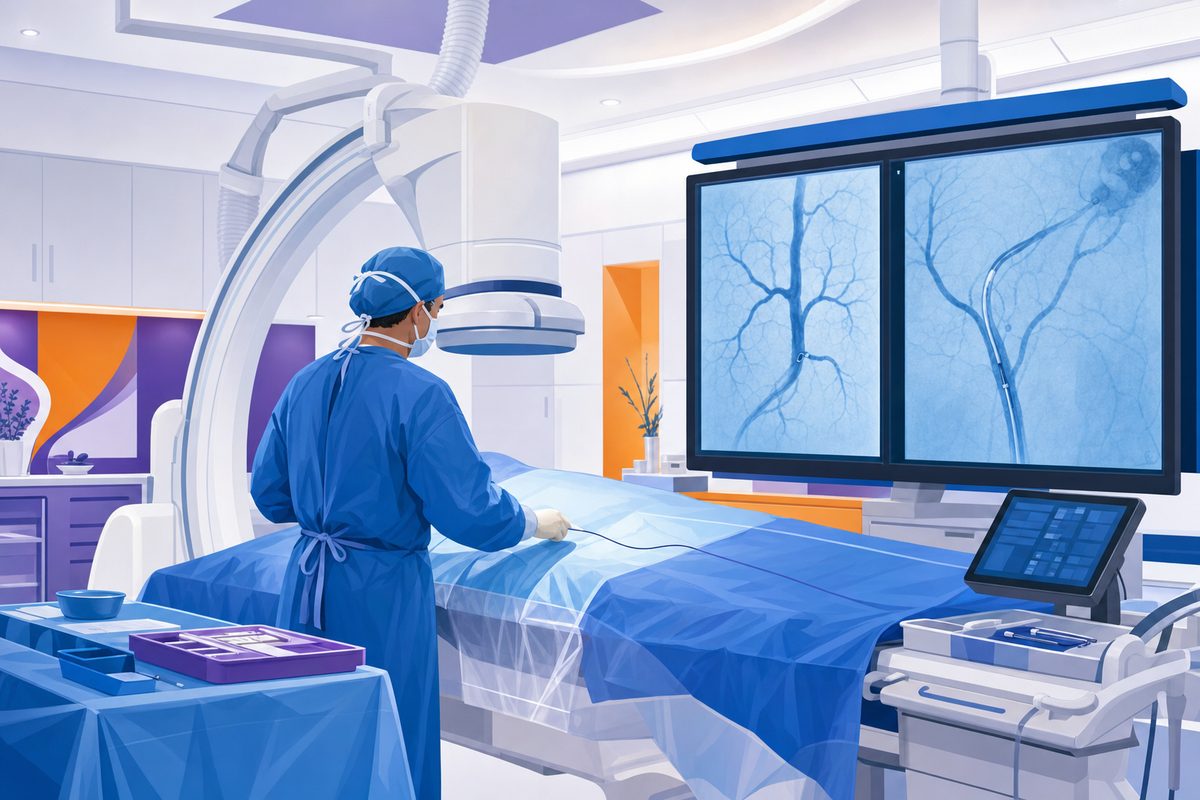
Interventional radiology (IR) coding mixes two models, and the first decision on every claim is which one a code family follows. Under component coding, the procedure and its imaging are reported separately: a percutaneous liver biopsy is 47000 plus the guidance actually used (76942 ultrasound, 77002 fluoroscopy, 77012 CT or 77021 MR), and diagnostic angiography pairs a catheter placement code with a supervision and interpretation (S&I) code such as 75710. Under inclusive coding, imaging is part of the procedure code: image-guided fluid collection drainage (49405–49407), vascular embolization (37241–37244) and the lower-extremity revascularization codes introduced in 2026 (37254–37299) already include the imaging guidance and S&I for the intervention itself, so 75989, 76942, 77002, 77003, 77012 and 77021 are not reported with a 49405–49407 drainage. Adding a guidance or S&I code for work the inclusive code already covers is unbundling (ultrasound guidance for vascular access, 76937, is still reportable with 37241–37244 when documented); missing one on a component-coded procedure is lost revenue. Whether the separately reported imaging codes go out globally or with modifier -26 depends on the site of service, covered below.
Catheter placement procedures involve a hierarchy of coding based on the level of vessel selectivity. CPT defines the levels: non-selective (a catheter in the aorta, 36200), then first-order, second-order and third-order or more selective placement — 36245–36248 for abdominal, pelvic and lower-extremity branches and 36215–36218 for thoracic and brachiocephalic branches. The highest order of selectivity reached in each vascular family determines the code, and each first-order branch of the aorta starts its own family, so the right and left iliac systems are coded separately. Some vessels have dedicated inclusive codes instead: renal angiography is reported with 36251–36254, which already include the catheter placement, contrast injection and S&I. Operators must document catheter advancement through each vessel to support the code assigned. Contrast injections, roadmapping and completion imaging that are part of an intervention are not a separate diagnostic angiogram; the narrow cases where a same-session diagnostic study is billable are covered in the FAQs below.
Place of service and technical component billing in IR require careful attention. IR procedures may be performed in a hospital inpatient setting (POS 21), an outpatient hospital department (POS 22 on campus, POS 19 off campus), an ASC (POS 24), or an office-based lab (OBL, POS 11). On an IR claim, modifier -26 belongs only on codes that have both a professional and a technical component — the imaging and S&I codes (PC/TC indicator 1, such as 75710, 76942, 77012, 76937 and 77001). Procedure codes such as 36245, 36247, 47000, 49405, 37243 and 36558 carry PC/TC indicator 0, so -26 and -TC cannot be appended to them; the setting changes their payment through the facility versus non-facility rate instead. In the hospital, Medicare pays the hospital for the technical component of imaging and the IR physician reports the imaging codes with -26.
In an OBL owned by the IR group, the practice reports imaging codes globally and is paid the non-facility rate for procedures, which carries the room, staff, equipment and supply cost the practice now bears: for 49405 the 2026 Medicare non-facility total is 25.08 RVUs against 4.99 in a facility. That gap is why OBL financial modeling is a key revenue strategy, and why OBL operations need compliance infrastructure: equipment, any state licensure the OBL requires, and payer-specific coverage policies.
Below are commonly billed codes our certified coders manage for interventional radiology practices. Always confirm payer-specific coverage and current code values.
| Code | Description | Billing note |
|---|---|---|
36245 | Selective catheter placement, arterial system; each first order abdominal, pelvic, or lower extremity artery branch, within a vascular family | Vascular catheter hierarchy; document vessel selectivity in the procedure note; code the highest order reached in each vascular family (thoracic and brachiocephalic branches use 36215–36218) |
36247 | Selective catheter placement, arterial system; initial third order or more selective abdominal, pelvic, or lower extremity artery branch, within a vascular family | Highest-order catheterization within a vascular family; document each vessel catheterized with fluoroscopic images |
49405 | Image-guided fluid collection drainage by catheter (eg, abscess, hematoma, seroma, lymphocele, cyst); visceral (eg, kidney, liver, spleen, lung/mediastinum), percutaneous | Imaging guidance is included — do not add 75989, 76942, 77002, 77003, 77012 or 77021; peritoneal or retroperitoneal collections are 49406 (percutaneous) or 49407 (transvaginal or transrectal); document catheter size and final position |
75710 | Angiography, extremity, unilateral, radiological supervision and interpretation | S&I code; bill with -26 in hospital setting; global in OBL setting; pair with appropriate catheter placement code |
37243 | Vascular embolization or occlusion, inclusive of all radiological supervision and interpretation, intraprocedural roadmapping, and imaging guidance necessary to complete the intervention; for tumors, organ ischemia, or infarction | Includes the S&I and imaging guidance for the embolization itself; selective catheter placement, a qualifying diagnostic angiogram (59/XU) and 76937 access guidance are reported separately when documented; document target vessel and embolic agent |
47000 | Biopsy of liver, needle; percutaneous | Component coding: add the imaging guidance used (76942 ultrasound, 77002 fluoroscopy, 77012 CT or 77021 MR); document the imaging guidance modality |
37258 | Revascularization, endovascular, open or percutaneous, iliac vascular territory, with transluminal stent placement, including transluminal angioplasty when performed … within the same artery, unilateral; straightforward lesion, initial vessel | New for 2026: CPT 37220–37235 were deleted on January 1, 2026; 37258 includes angioplasty, access and selective catheterization, crossing the lesion, and the imaging guidance and S&I for the stent in the same artery; complex lesions use 37260, and each additional vessel adds 37259 (straightforward) or 37261 (complex) |
36830 | Creation of arteriovenous fistula by other than direct arteriovenous anastomosis (separate procedure); nonautogenous graft (eg, biological collagen, thermoplastic graft) | Dialysis access creation; 90-day global period in the 2026 Medicare fee schedule; document graft vs. fistula: 36825 is an autogenous graft, 36821 a direct arteriovenous anastomosis |
Our standard operating procedures for interventional radiology revenue cycle management — the step-by-step workflow we follow on every claim:
These are the issues we see most often in interventional radiology billing — and exactly how we resolve them:
IR practices frequently perform and document imaging guidance but fail to code it separately (when separately payable). Fix: implement a charge capture checklist for each procedure type listing all billable components; tie the checklist to the procedure note template so coders can verify each element was performed and documented.
Billing third-order selective catheterization (36247) without a procedure note that documents each vessel catheterized invites audit denial and recoupment. Fix: require that the procedure note list each vessel navigated with angiographic confirmation; use standardized IR report templates that include vessel-level catheterization documentation.
Contrast injections, roadmapping and completion images taken for an intervention are part of it, and a same-session diagnostic angiogram is separately billable only when it meets the CPT criteria the NCCI Policy Manual adopts (see the FAQs below); if the intervention code's descriptor includes diagnostic angiography, no angiography code is added. A different diagnosis alone does not justify modifier 59 or XU, and after a complete diagnostic angiogram on an earlier day, a second one cannot be billed for the dye injections the intervention needs. Fix: before 59 or XU goes on the diagnostic angiogram code, make sure the report documents the criterion that applies: no usable prior study and the decision to intervene rested on this one, or, when a prior study exists, why it had to be repeated (a changed condition, inadequate visualization, or a clinical change during the procedure).
For hospital patients (POS 21, 22, 19 or 23) Medicare pays the hospital for the technical component of imaging, and the MAC cannot pay it on the IR physician's claim; a technical component paid during an inpatient stay is recouped. In an ASC (POS 24), imaging guidance and S&I codes such as 75710, 76942, 77001 and 77012 are packaged into the ASC's payment, and the MAC denies a technical-component bill for them from anyone other than the ASC (CARC 171) and a global bill (CARC 4). Fix: configure your billing system to apply -26 to the imaging guidance and S&I codes when POS is 21, 22, 19, 23 or 24, and never to the procedure codes themselves.
Office-based labs report imaging codes globally and are paid the higher non-facility rate for procedure codes, and that billing is under federal scrutiny: a May 2026 HHS-OIG review (OEI-01-24-00250) found peripheral vascular procedures shifting from hospital outpatient departments to OBLs, flagged OBL payments that may indicate medically unnecessary procedures, and CMS agreed to monitor that billing. Fix: document medical necessity for every OBL procedure, including the conservative treatment tried first where guidelines call for it, and keep an OBL compliance calendar for state licensure renewals, equipment service logs and the facility's payer credentialing.
Verimedix works inside the systems interventional radiology practices already use, including:
Component coding means billing the procedural intervention and the imaging supervision and interpretation (S&I) as separate CPT codes. For example, a liver biopsy bills the biopsy code (47000) plus an imaging guidance code (76942 for ultrasound or 77012 for CT). Some code families include the imaging guidance and S&I for the intervention itself, so no guidance or S&I code is added for that work: embolization (37241–37244), image-guided drainage (49405–49407) and the lower-extremity revascularization codes introduced in 2026 (37254–37299). With embolization, selective catheter placement, a qualifying diagnostic angiogram (modifier 59 or XU) and ultrasound guidance for vascular access (76937) are still reported separately when documented.
Catheter placement is coded by the level of selectivity: non-selective (36200 for a catheter in the aorta), then first-order selective (36245), initial second-order (36246) and initial third-order or more selective (36247) in the abdominal, pelvic and lower-extremity families, with 36248 for each additional second- or third-order vessel in the same family; thoracic and brachiocephalic branches use 36215–36218. You code the highest level achieved in each vascular family. Each first-order branch of the aorta is its own family, so the right and left iliac systems are coded separately. Renal angiography has its own codes, 36251–36254 (unilateral or bilateral, first-order or superselective), which already include the catheter placement, contrast injection and S&I.
A diagnostic angiogram at the same session as an intervention is billable only when it meets the CPT criteria that the NCCI Policy Manual adopts: no prior catheter-based angiographic study is available, a full diagnostic study is performed, and the decision to intervene is based on it; or a prior study exists and the record documents that the patient's condition has changed since it, that visualization of the anatomy or pathology was inadequate, or that a clinical change during the procedure required evaluation outside the target area. Append modifier 59 or XU to the diagnostic angiography S&I code. Contrast injections, roadmapping, vessel measurement and completion angiography performed as part of the intervention are included in it, not a separate study.
An OBL is an IR procedure suite located outside the hospital setting and owned by the physician practice (POS 11). Because the practice owns the equipment and bears the staff and supply cost, it reports imaging codes globally (without -26) and is paid the Medicare non-facility rate for procedure codes, which is several times the facility rate for many IR procedures. Procedure codes such as 36245 or 49405 cannot take modifier -26 in any setting (PC/TC indicator 0); what changes is the facility versus non-facility payment. OBLs need any state licensure the state requires, payer contracts and credentialing that cover the office setting, and procedure-by-procedure coverage checks.
Yes, many IR procedures are on the ASC covered procedure list (e.g., vascular access, dialysis interventions, certain embolizations). The ASC bills the facility fee; the IR physician reports the procedure codes without modifier -26 (they have no professional/technical split) and adds -26 only to separately reportable imaging codes. Not all payers cover all IR procedures in the ASC—verify coverage by procedure and payer before scheduling.
A tunneled central venous catheter without a port is CPT 36558 for patients age 5 or older; a tunneled device with a subcutaneous port is 36561 for patients age 5 or older (36560 if younger than 5). Add imaging guidance when it is performed and documented: 76937 for ultrasound guidance of the venous access (it requires evaluation of potential access sites, documentation of the selected vessel's patency, real-time visualization of the needle entry and a permanent recorded image) and 77001 for fluoroscopic guidance of the catheter placement. In a hospital setting, apply -26 to the imaging codes. Ultrasound vessel mapping before dialysis access creation is a separate duplex study (93985 or 93986), not 76937.
Verimedix handles the entire interventional radiology revenue cycle — coding, submission, denials, and A/R — so your team can focus on patients.