
- Staffing agencies place coders three ways — contract, temp-to-hire, and direct hire. On contract placements the agency is the employer of record and bills you an hourly rate with a built-in markup.
- Published staffing-industry surveys put contract markups anywhere from roughly 25% to 75% over the coder's pay rate; direct-hire placement fees are commonly quoted at 15-30% of first-year salary.
- Match credentials to setting: AAPC CPC or COC for outpatient and professional-fee work, AHIMA CCS for inpatient facility coding. A mismatched credential is an audit risk, not a bargain.
- Get the replacement guarantee, temp-to-perm conversion fee schedule, offshore disclosure, and a signed BAA in writing before any coder touches a chart.
- Agencies shine for backlogs, leaves, and one-off hires. For ongoing multi-seat volume, a flat-rate white-label workforce usually beats paying an hourly markup forever.
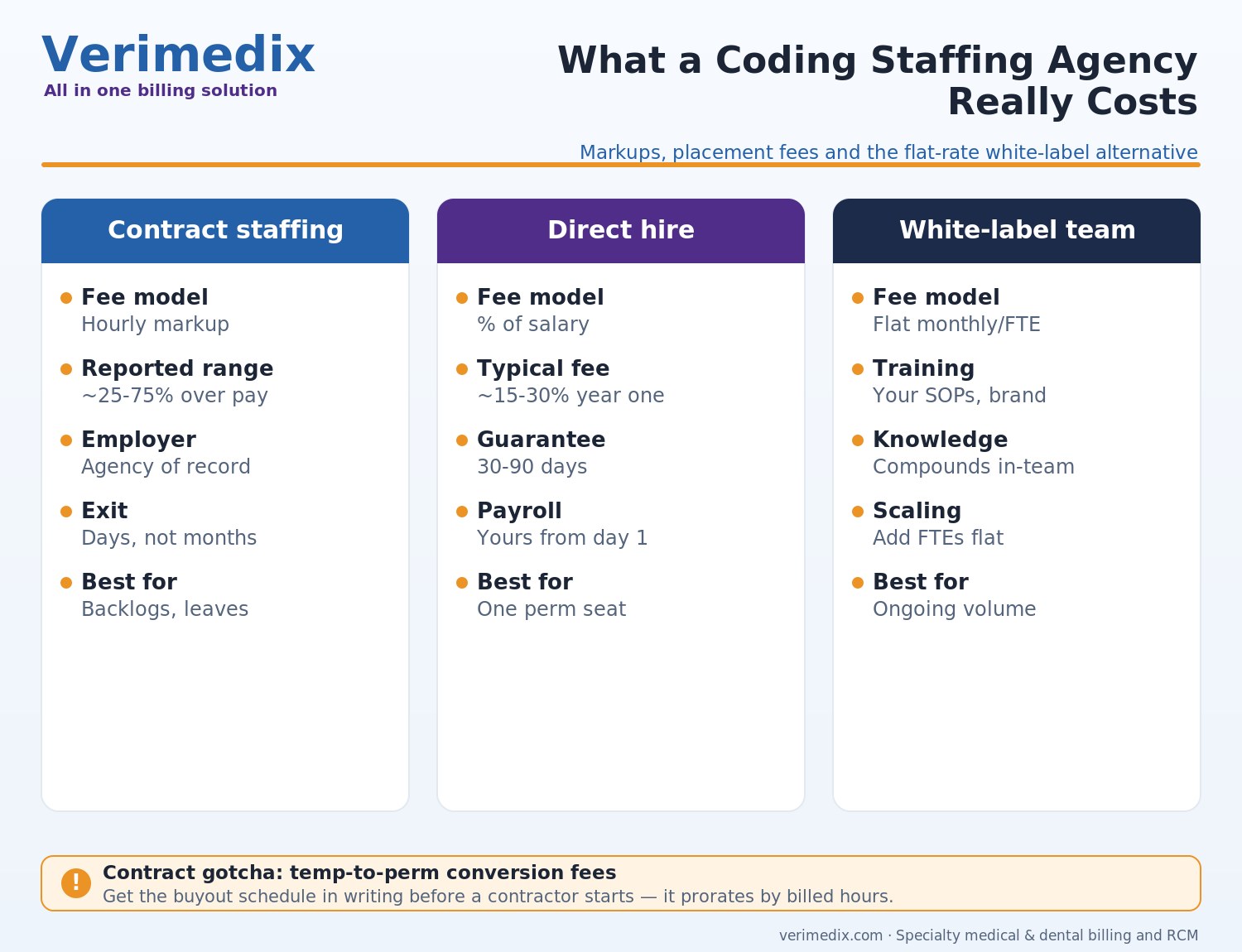
How medical coding staffing agencies work
A coding staffing agency sits between your practice and the coder: it recruits, screens, and (in most engagements) employs the coder, then rents that capacity to you by the hour or places the person on your payroll for a fee. Under that employer-of-record structure the agency carries payroll taxes, workers' compensation, unemployment insurance, and recruiting cost — and recovers all of it, plus margin, through the bill rate.
Agencies offer three engagement types, and the economics differ sharply between them:
- Contract (temporary) staffing. The coder is the agency's W-2 employee assigned to you; you pay an hourly bill rate, direct the daily queue, and can end the assignment on short notice. Temp-to-hire adds a pre-agreed option to convert the coder to your payroll, usually via a conversion (buyout) fee that prorates with billed hours.
- Direct hire. The agency runs the search and hands you a permanent employee; you pay a one-time placement fee, typically a percentage of first-year salary.
One distinction worth pinning down early: a staffing agency sells people by the hour, while a coding outsourcing company sells completed work — coded charts at a per-chart or per-line rate with the vendor managing productivity and QA. Both can be right; they solve different problems. If your real need is throughput rather than a seat, start with our guide to outsourced medical coding costs and models, and for the broader staffing picture across billing roles, the RCM staffing guide maps every role to a build-or-buy decision.
Agency fee structures and typical markups
Agencies rarely publish rate cards, but the mechanics are consistent across the industry. Here is how each model is typically priced, using ranges reported in general and healthcare staffing-industry surveys. A middle path between agency placements and traditional outsourcing is the white-label staffing model: Verimedix, for example, recruits, trains, and manages dedicated coding staff who work entirely inside the client's environment, with the provider handling continuity and replacement risk.
| Engagement model | How you pay | Commonly reported range | Watch for |
|---|---|---|---|
| Contract / temp | Hourly bill rate = coder pay + markup | Markups of roughly 25-75% over the pay rate in published staffing surveys; specialized inpatient or auditing roles can run higher | Ask what the markup covers (taxes, insurance, benefits) and how overtime is billed |
| Temp-to-hire | Hourly markup, then a conversion fee to hire | Conversion fees often prorate down as billed hours accumulate | Get the buyout schedule in writing before day one |
| Direct hire | One-time placement fee | Commonly 15-30% of first-year salary | Guarantee period — 30 to 90 days is typical; push for a free replacement, not a credit |
The frequently repeated "20-30% markup" figure is best read as the direct-hire fee band plus the low end of contract markups. Whatever an agency quotes, ask them to decompose it — a transparent agency will state the coder's pay rate without drama.
Worked example: what a $28/hour coder really costs (illustrative)
Say an agency pays an experienced outpatient CPC $28/hour and applies a 50% markup. Your bill rate is $42/hour.
- 12-week backlog project: 480 hours × $42 = $20,160 — and the meter stops the day the backlog clears. No severance, no benefits, no recruiting spend.
- Full-year contract seat: 2,080 hours × $42 = $87,360. Compare a direct employee at a $58,240 salary ($28/hour) plus a typical 25-30% benefits-and-burden load — roughly $73,000-76,000 all-in, before recruiting and turnover costs.
- Direct-hire route: a 20% placement fee on that $58,240 salary is $11,648 one time, then normal employment costs.
These figures are illustrative, not quotes, but the pattern generalizes: agency contract labor is expensive per hour and cheap to exit. The longer a "temporary" seat stays filled, the worse the math gets versus hiring — or versus a flat-rate dedicated-team model, covered below. For the employee-side comparison, our breakdown of the true cost to hire a medical biller walks the same loaded-cost math step by step.
Coder credentials to demand — and match to your setting
"Certified coder" is not one thing. AAPC credentials skew outpatient and professional-fee; AHIMA credentials skew inpatient and facility. An agency that shrugs at the difference is telling you something.
| Credential | Issuing body | Setting focus | Notes |
|---|---|---|---|
| CPC | AAPC | Outpatient / physician pro-fee | The default physician-practice credential |
| COC | AAPC | Hospital outpatient | APC and OPPS familiarity |
| CIC | AAPC | Inpatient facility | ICD-10-PCS and MS-DRG focus |
| CCS | AHIMA | Inpatient / facility | Widely preferred by hospitals |
| CCS-P | AHIMA | Physician-based | AHIMA's pro-fee counterpart |
| CRC | AAPC | Risk adjustment / HCC | Essential for MA and ACO work |
Also verify credentials are active — both bodies require continuing education, and a lapsed certification is a common resume landmine that agencies with weak screening miss.
10 vetting questions to ask before signing
Ask every agency the same questions and score each answer 0 (vague), 1 (adequate), or 2 (specific and verifiable). Under 14 of 20, keep shopping.
- How do you verify credentials? The right answer involves primary-source verification with AAPC/AHIMA, not "we check resumes."
- How do you test specialty fit? Look for specialty-specific coding assessments.
- What accuracy standard do your coders carry? 95% is the widely used industry benchmark; ask how it's measured and by whom.
- What is your QA cadence on placed coders? Ongoing audits, not just a placement-week check.
- What is the replacement guarantee? Days to replace, and whether unproductive ramp hours are billed.
- Decompose the bill rate. Pay rate vs markup, and what the markup includes.
- What are the conversion terms? Exact buyout schedule if you want to hire the coder later.
- Where do coders sit — onshore, offshore, blended? Either can work; undisclosed offshoring is the red flag. Confirm HIPAA training and a signed BAA.
- What productivity standard do you commit to? Charts per day by chart type, in writing.
- Which clients look like us? Same specialty, similar size, reachable references.
Staffing agency vs white-label workforce vs full outsourcing
Practices usually compare agencies against hiring. The more useful comparison is against the other two sourcing models, because each is built for a different problem:
| Factor | Staffing agency | White-label workforce | Full coding outsourcing |
|---|---|---|---|
| Pricing model | Hourly bill rate with markup | Flat monthly rate per dedicated FTE | Per chart / per line |
| Who manages daily work | You | You (they work inside your systems and SOPs) | The vendor |
| Branding | Agency's employee, your floor | Operates under your practice's brand | Vendor's name on the relationship |
| Ramp and training | Re-train every placement | Trained once on your SOPs; knowledge stays with the team | Vendor's internal process |
| Scaling a seat up/down | Fast, at a premium | Fast, at flat cost per added FTE | Automatic with volume |
| Best for | Backlogs, leaves, single perm hires | Ongoing multi-role volume at predictable cost | Pure throughput, spiky chart volume |
The middle column is the model practices most often haven't priced. With white-label medical billing staffing, you get dedicated coders (and billers, AR callers, or verifiers) who work your queues, in your systems, under your brand — at a flat monthly rate instead of a perpetual hourly markup. If you're weighing that against simply recruiting your own coder, our hiring guide for medical coders covers salaries, certifications, and when each alternative wins.
How to choose: a quick decision path
Run your situation down this tree:
- Short-term gap (backlog, FMLA leave, EHR migration crunch) → contract staffing. Pay the markup; buy the exit flexibility.
- One permanent seat, and you want them on your payroll → direct hire via agency, or recruit yourself if your market has candidates.
- Ongoing volume across coding plus billing/AR, with cost pressure → white-label dedicated team; flat cost, your SOPs, no markup meter.
- Volume that swings month to month and you only want finished charts → per-chart coding outsourcing.
Hybrids are common: many groups keep one in-house lead coder for escalations and route steady production to a dedicated external team.
Quick Answers
How much do medical coding staffing agencies charge? Contract placements are billed hourly at the coder's pay rate plus a markup — commonly reported anywhere from about 25% to 75% in staffing-industry surveys. Direct-hire placements typically cost a one-time fee of roughly 15-30% of first-year salary.
What does the agency markup pay for? Employer payroll taxes, workers' compensation, unemployment insurance, recruiting and screening costs, any benefits the agency offers, and the agency's margin. Transparent agencies will break the bill rate down on request.
Is a staffing agency the same as a coding outsourcing company? No. An agency rents you a person by the hour whom you manage; an outsourcing company sells completed coded charts at per-chart rates and manages its own coders and QA.
What credentials should an agency coder have? Active AAPC (CPC, COC, CIC, CRC) or AHIMA (CCS, CCS-P) credentials matched to your setting — outpatient pro-fee practices generally want CPC or CCS-P; inpatient facility work generally wants CCS or CIC.
What is a temp-to-perm conversion fee? A buyout the agency charges if you hire its contractor onto your payroll, usually prorated down as billed hours accumulate. Always get the schedule in writing before the assignment starts.
Frequently asked questions
It depends on the engagement type. Contract coders are billed hourly at the coder's pay rate plus a markup that staffing-industry surveys commonly report between roughly 25% and 75%. Direct-hire placements usually run a one-time fee of about 15-30% of the coder's first-year salary, with a 30-90 day guarantee period.
Published benchmarks for contract healthcare staffing cluster in the 25-50% range over the pay rate, with specialized inpatient, auditing, or risk-adjustment roles quoted higher. The markup covers employer taxes, insurance, recruiting cost, and agency margin — ask the agency to break it down.
For short gaps, agencies win because you can exit quickly. For steady ongoing volume, per-chart outsourcing or a flat-rate dedicated white-label team is usually cheaper, because you stop paying an hourly markup and stop re-training every new placement.
Active, setting-matched credentials: AAPC CPC or AHIMA CCS-P for outpatient professional-fee coding, AHIMA CCS or AAPC CIC for inpatient facility work, and AAPC CRC for risk-adjustment coding. Confirm the agency verifies certifications at the primary source and that they haven't lapsed.
At minimum: the bill-rate breakdown, a written replacement guarantee, the temp-to-perm conversion fee schedule, onshore/offshore disclosure, a signed HIPAA business associate agreement, and a committed productivity and accuracy standard (95% accuracy is the common industry bar).