
- RCM staffing spans 12 roles across front-end, mid-cycle, back-end, and support functions.
- Role-based pricing: $500–$700/month (admin/front-desk), $1,000+/month (billing/RCM execution), $1,000–$1,500+/month (specialized/senior roles like coders and denial specialists).
- Minimum engagement for embedded white-label staffing is typically 2 dedicated resources.
- Build (hire in-house) means full recruiting, training, and turnover risk; buy (white-label/staffing) transfers that risk to the provider.
- Optional managed oversight (a team lead) is available for larger pods, quoted based on pod size and scope.
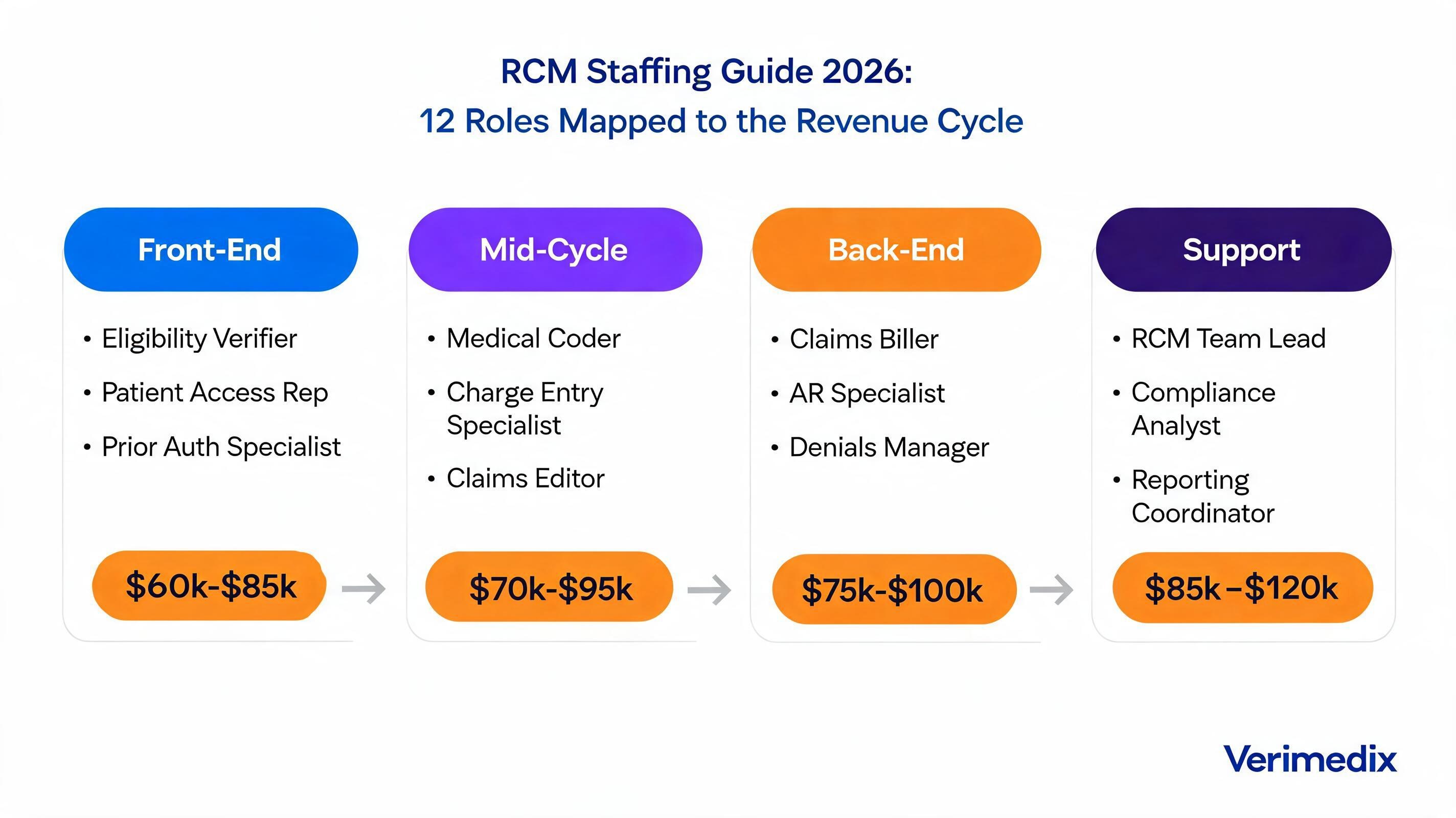
The 12 RCM Roles, Mapped to the Revenue Cycle
| Stage | Roles | Starting price tier |
|---|---|---|
| Front-End | Eligibility & benefits reps, prior authorization specialists, virtual front desk/VAs | $500–$700/mo (admin) to $1,000+/mo (specialized) |
| Mid-Cycle | Medical billers, medical coders, dental billers | $1,000+/mo to $1,000–$1,500+/mo |
| Back-End | AR follow-up specialists, aging specialists, denial management specialists, payment posters | $1,000–$1,500+/mo |
| Support | Credentialing support staff, team leads/managed oversight | $1,000–$1,500+/mo; oversight quoted |
Build vs Buy: Should You Hire In-House or Staff Externally?
| Factor | Build (in-house) | Buy (white-label RCM staffing) |
|---|---|---|
| Time to productive staff | Weeks to months | Days to a few weeks after scoping |
| Recruiting & HR burden | Falls on your team | Handled by the provider |
| Turnover risk | Restarts hiring cycle each time | Provider manages replacement and continuity |
| Systems fit | Staff trained from scratch | Staff placed for fit with your existing systems/SOPs |
| Brand control | In-house by default | Stays with you — 100% under your brand |
| Minimum commitment | Full-time hire, benefits, overhead | Minimum 2 resources, role-based and flexible |
Why RCM Staffing Is a High-Intent Buyer Term
RCM staffing is the exact term billing companies, MSOs, and group practices search when deciding how to add billing-side capacity — not a job-seeker term. Providers of white-label medical billing staffing such as Verimedix place dedicated, trained staff across all 12 roles who work inside the client's systems under the client's brand, starting at two resources, which is why the term maps directly to a buy decision rather than a hiring-page click.
Which Role to Add First: a Symptom-to-Role Map
Most teams don't need all 12 roles — they need the one that relieves the current constraint. Map the symptom to the hire:
- Denials keep arriving for eligibility and coverage reasons → add an eligibility & benefits rep at the front end; every avoided denial saves rework downstream.
- Procedures delayed or written off for missing auths → prior authorization specialist.
- Claims go out clean but cash arrives slowly → AR follow-up specialist; the gap is in working the queue, not creating it.
- The over-90 bucket keeps growing → aging specialist focused exclusively on backlog recovery.
- Denial rate is rising and nobody can say why → denial management specialist doing root-cause work, not blind resubmission.
- Payments posted late or misapplied → payment poster; posting errors quietly corrupt every downstream AR report.
- Coding questions bottleneck on one person → certified coder aligned to your specialty mix.
- Provider onboarding stalls revenue for months → credentialing support.
Start with one constraint role plus one adjacent role (the 2-resource minimum maps naturally to this), then re-measure before adding the third.
When a Pod Needs Managed Oversight
Two or three embedded resources coordinate fine through your existing leads. The oversight question arises around four or more, when task allocation, QA sampling, and coverage planning become a real weekly workload. An optional team-lead layer — quoted by pod size and scope — gives the pod a single point of coordination and gives you one throat to choke instead of four status threads. The practical test: if your operations manager spends more than a few hours a week routing work to the pod, the oversight layer costs less than the management time it replaces.
Real-World Example
A dental billing company used RCM staffing to add a dedicated aging specialist rather than build an internal hire — the resource worked inside the client's existing systems under the client's brand and measurably improved the aging position without disrupting client relationships.
Frequently asked questions
Twelve roles across front-end (eligibility, prior auth, front desk), mid-cycle (billers, coders, dental billers), back-end (AR, aging, denial, payment posting), and support (credentialing, team leads).
No — staffing (especially white-label staffing) places staff inside your own systems and brand; traditional outsourcing routes work through the vendor's own process.
Role-based: $500–$700/month for admin roles up to $1,000–$1,500+/month for specialized roles, with a 2-resource minimum engagement.
Yes — roles can be staffed individually or combined into an embedded pod with optional team-lead oversight for coordination.
Timelines depend on role complexity and system access; providers scope a specific timeline once role and platforms are confirmed.