
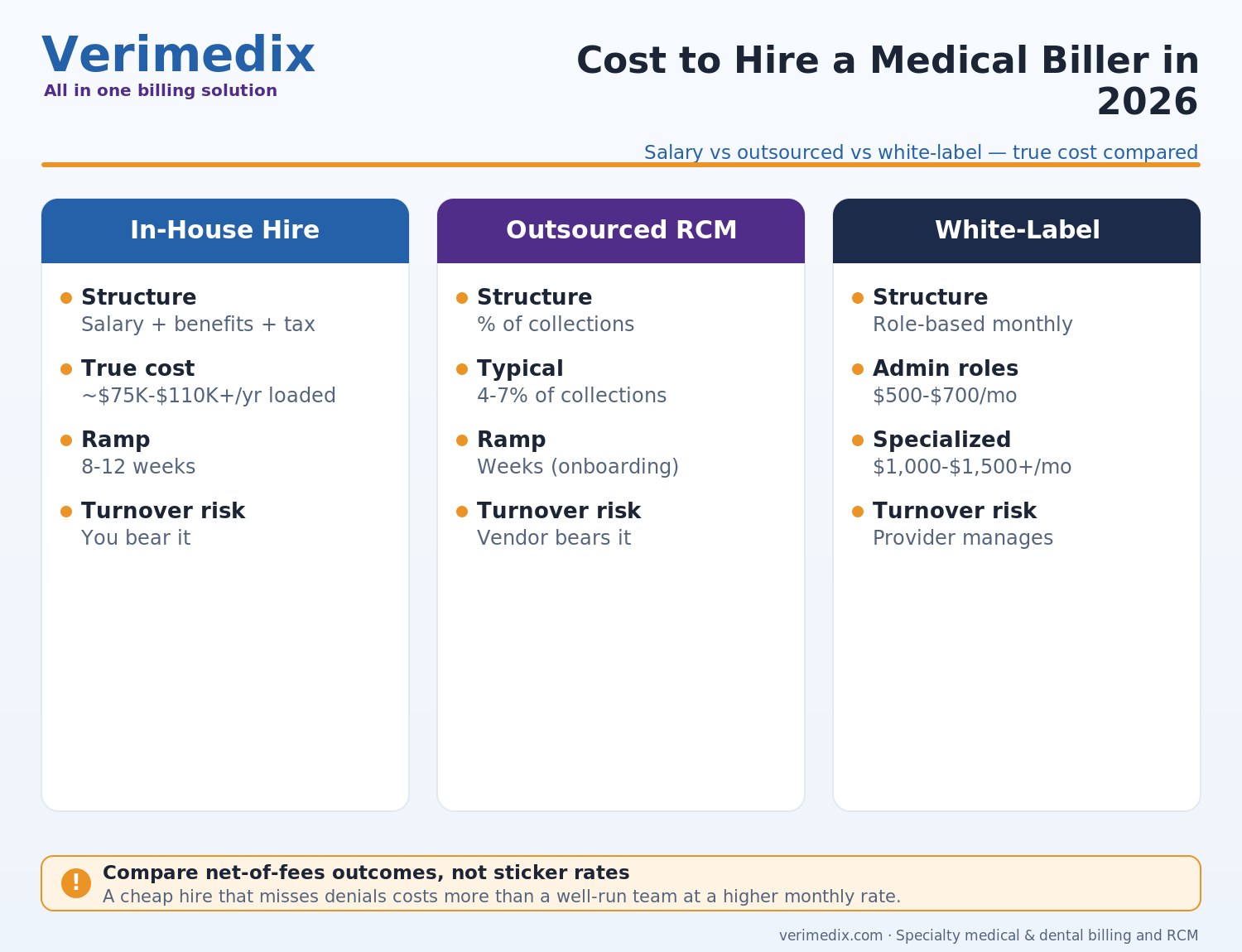
- Fully loaded in-house biller cost: base salary ~$45,000–$62,000 plus 30–36% for benefits and payroll tax, plus software, training, and turnover risk — totaling roughly $75,000–$110,000+/year.
- Traditional outsourced RCM runs 4–7% of collections (solo/small practices often 6–9%).
- A dedicated white-label specialist (biller, coder, AR specialist) starts around $1,000–$1,500+/month, with admin roles from $500–$700/month — minimum 2 resources.
- Turnover is the hidden in-house cost: replacement runs $4,000–$8,000 plus 2–3 months of reduced productivity during ramp-up.
- Staffing agencies for medical billing/coding roles typically charge placement fees or markup on top of salary, separate from white-label's flat role-based pricing.
The Real Cost of Hiring In-House
The advertised salary is never the full cost. A solo in-house biller costs roughly $75,000–$110,000+ fully loaded per year once benefits, payroll tax, software and clearinghouse fees, training, coverage, and supervision time are counted. Turnover compounds this: a practice collecting $800,000 that loses a biller can see roughly $92,000 in reduced billing throughput during a 10-week ramp-up at 60% productivity.
Cost Comparison: Salary vs Outsourced vs White-Label
| Model | Structure | Typical annual/monthly cost | Who bears turnover risk |
|---|---|---|---|
| In-house hire | Salary + benefits + tax + software | ~$75,000–$110,000+/year fully loaded | You |
| Medical billing staffing agency (contract placement) | Hourly or salaried placement + agency fee | Varies; often markup over base wage | Shared/agency-managed |
| Full outsourced RCM | % of collections | 4–7% of collections (solo 6–9%) | Vendor |
| White-label dedicated resource | Role-based monthly rate, min. 2 resources | $500–$700/mo (admin) to $1,000–$1,500+/mo (specialized) | Provider manages continuity |
When Each Model Makes Sense
In-house hiring can make sense at high, stable claim volume (25,000–30,000+ claims/year) with low turnover. Full outsourcing fits practices wanting to hand off the entire revenue cycle. White-label billing workforce providers such as Verimedix place dedicated, trained billers who work inside the client's systems under the client's brand, starting at two resources — the fit when you already have a process and just need dedicated billing staff under your brand without hiring overhead or a full outsourcing handoff.
The Full First-Year Math, Worked
Take a realistic mid-range case: a practice hires an experienced biller at a $52,000 base salary.
- Benefits and payroll tax (30–36%): roughly $15,600–$18,700 on top of base.
- Recruiting: job-board fees, screening time, and interviews commonly run $2,000–$4,000 in hard and soft cost — more if you use a placement agency charging a percentage-of-salary fee.
- Software and seats: PMS/EHR user licenses, clearinghouse access, and tooling often add $1,500–$3,000+/year per seat depending on your stack.
- Ramp-up: even experienced billers typically need 8–12 weeks to reach full productivity on a new payer mix and system. At 60% average productivity for 10 weeks, a practice collecting $800,000/year absorbs meaningful throughput loss — commonly tens of thousands of dollars in delayed or reduced billing output.
- Supervision and coverage: someone senior reviews the new hire's work and covers PTO — real hours that rarely appear in the budget line.
Add it up and the realistic first-year figure lands in the $75,000–$110,000+ range for one productive biller — which is why the salary-only comparison against a $1,000–$1,500/month dedicated resource understates the true gap.
The Hidden Costs Most Practices Miss
Three costs recur in every in-house model and none of them show up on a payroll report. First, turnover risk is a when, not an if: replacement typically costs $4,000–$8,000 directly, plus another ramp-up cycle. Second, single-point-of-failure coverage: one biller means AR follow-up simply stops during vacations and sick leave, and aging compounds daily. Third, retraining on payer churn: payer policies and code sets change annually, and keeping one isolated employee current is your problem — in a staffing model, it's the provider's. When comparing models, price all three explicitly rather than discovering them in year two.
Real-World Example
A dental billing company needed dedicated AR capacity without pulling internal staff off active work or absorbing a full in-house hire's fixed cost. Verimedix placed a trained resource focused on aging follow-up, working inside the client's own systems and brand — filling the exact cost gap between "hire someone" and "outsource everything."
Frequently asked questions
For most small-to-mid billing companies, a white-label resource is cheaper on a fully loaded basis: $1,000–$1,500+/month specialized vs $75,000–$110,000+/year in-house, with no recruiting or turnover cost.
Rates vary by agency and role; most charge either an hourly markup or a placement fee on top of salary, distinct from white-label's flat role-based monthly pricing.
Recruiting, placement, management, and continuity/replacement are handled by the provider — the client only manages workflow and output.
Timelines depend on role complexity and system access; providers scope a specific timeline once the role and platforms are confirmed.
No — white-label staff operate entirely under the client's brand.