
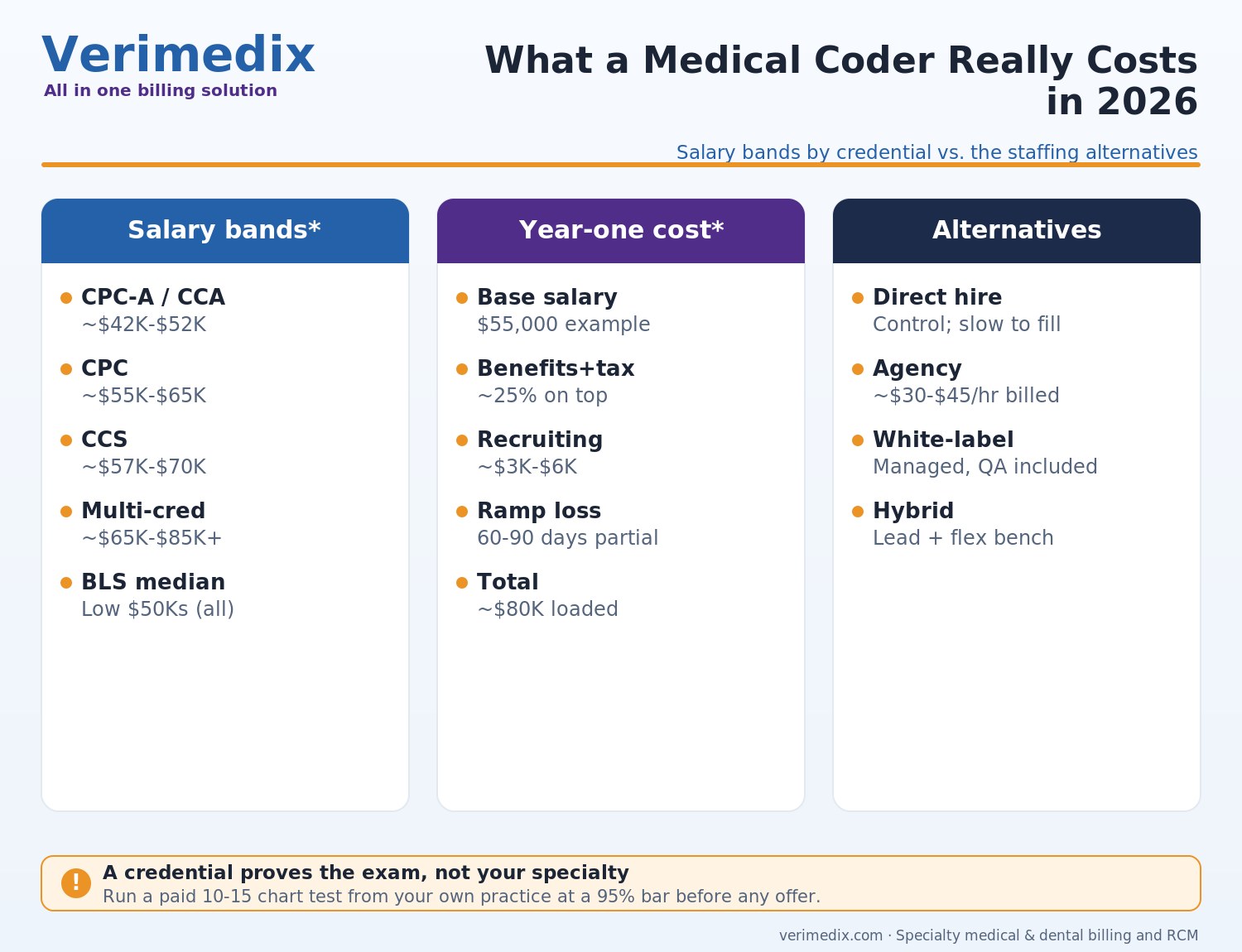
- Budget roughly $45,000–$70,000 base salary for a certified medical coder in 2026 depending on credential, specialty and market; AAPC's most recent salary survey places the average CPC near $60,000, with multi-credentialed coders reporting $70,000 and up.
- The BLS tracks coders under "medical records specialists," with a national median in the low $50,000s — a useful floor, but certified coders with specialty experience price above it.
- A credential proves which exam a candidate passed, not whether they can code your specialty — always run a paid test on 10–15 de-identified charts from your own practice before extending an offer.
- The fully loaded year-one cost of a $55,000 coder lands closer to $80,000 once payroll taxes, benefits, recruiting, software and ramp time are counted (illustrative math below).
- Direct hire, staffing agency and white-label team solve different problems; pick by weekly chart volume and management bandwidth, not by hourly rate alone.
- Below roughly half an FTE of true coding work, a fractional or outsourced model usually beats a full-time hire on both cost and consistency.
What you are actually hiring: coder vs. biller
Before a job posting goes live, separate two functions that practices habitually merge into one listing. A medical coder reads clinical documentation and assigns ICD-10-CM diagnoses, CPT and HCPCS procedure codes, and the modifiers that make them payable — work that determines whether a claim is compliant before it ever leaves the building. A medical biller takes those coded encounters and manages submission, payment posting, denials and follow-up. In small practices one person often wears both hats, which works until volume grows and one half of the job starts quietly starving the other.
If the gap in your team is really claim submission and AR follow-up, price that role separately — our breakdown of the cost to hire a medical biller in 2026 covers it — and for remote candidates, see our guide to hiring a remote biller. This article focuses on the coding seat: what it costs, what the letters after a candidate's name mean, and the alternatives when a full-time hire does not pencil out.
Medical coder salary bands by credential (2026)
Two public sources anchor coder pay. The Bureau of Labor Statistics groups coders under "medical records specialists," a category with a national median in the low $50,000s — but it mixes certified and uncertified staff across every setting. AAPC's annual salary survey is more granular: its recent editions put the average CPC near $60,000, CCS holders in a similar-to-higher band, and coders holding multiple credentials at $70,000–$84,000. AAPC has also reported that certified coders out-earn non-certified peers by roughly 16%. Treat every figure below as a directional range — metro, specialty and remote-vs-onsite all move offers by thousands.
| Credential | Issuer | Typical base range (2026)* | What it signals |
|---|---|---|---|
| No credential | — | ~$38,000–$48,000 | On-the-job experience only; certified peers earn roughly 16% more per AAPC survey data |
| CPC-A / CCA | AAPC / AHIMA | ~$42,000–$52,000 | Entry level; exam passed but apprentice status until supervised experience is logged |
| CPC | AAPC | ~$55,000–$65,000 | The standard physician-office / pro-fee credential; survey averages cluster near $60K |
| CCS | AHIMA | ~$57,000–$70,000 | Hospital inpatient and outpatient coding; facility employers often pay a premium |
| COC / CIC | AAPC | ~$58,000–$72,000 | Outpatient facility (COC) and inpatient facility (CIC) settings |
| CPMA / CRC / multi-credential | AAPC / AHIMA | ~$65,000–$85,000+ | Auditing, risk adjustment and dual-credential coders top the survey bands |
*Illustrative ranges assembled from AAPC salary survey averages and BLS medical records specialists data; verify against current surveys and your local market before setting an offer.
What the certifications actually mean
The alphabet soup breaks down into two issuing bodies. AAPC credentials dominate physician-practice hiring: CPC (Certified Professional Coder) is the pro-fee workhorse; CPC-A is the same exam with an apprentice flag that clears after documented experience; COC covers outpatient facility coding, CIC inpatient facility, CRC risk adjustment (HCC) coding, and CPMA auditing. AHIMA credentials skew toward hospitals and health information: CCA is entry level, CCS is the respected inpatient/outpatient coding specialist mark, and RHIT/RHIA are broader health-information credentials rather than pure coding certificates.
Match the credential to your setting rather than ranking them in the abstract: a physician office or specialty group should shortlist CPC holders (plus CRC if you take Medicare Advantage risk contracts); a hospital or ASC coding seat points to CCS, COC or CIC. And remember what no certification proves — that the candidate knows your payers, your specialty's NCCI edit traps and your documentation style. That is what the chart test in the next section is for.
Interview questions that separate real coders from resume coders
Coding interviews fail when they stay theoretical. Every question below pairs with what a strong answer actually sounds like — and the most useful screen of all is a paid, timed test on 10–15 de-identified charts from your own practice, scored against a 95% accuracy bar with an explanation required for each code choice.
| Ask this | A strong answer sounds like |
|---|---|
| "Walk me through coding this note." (hand them a real de-identified chart) | Works through MDM elements or time, checks bundling before adding codes, asks what payer it is — because payer policy changes the answer |
| "What do you verify before appending modifier 59 or 25?" | Names NCCI PTP edits, distinct-service documentation, and the audit risk of using modifiers to force claims through |
| "Which coding changes hit our specialty in the last year?" | Cites specific annual CPT/ICD-10 updates — proves they actually maintain CEUs rather than just holding a card |
| "What was your audited accuracy rate, and who measured it?" | Quotes a number from external or QA audits (95%+ is the common industry bar) and explains the audit methodology |
| "A provider insists on a level 5 the documentation doesn't support. What do you do?" | Describes a provider query and education loop, and escalation to compliance — never silently up- or down-coding |
Direct hire vs. staffing agency vs. white-label team
Once you know the salary bands, the real comparison is between three staffing models — and the sticker salary is the least honest number in that comparison, because it excludes taxes, benefits, recruiting, tooling and the ramp months where you pay full rate for partial output.
| Dimension | Direct hire (W-2) | Staffing agency contractor | White-label / outsourced team |
|---|---|---|---|
| Year-one cost (illustrative) | ~$80,000 fully loaded on a $55K salary | ~$30–$45/hr billed (~$62K–$94K annualized) | Often materially below a loaded U.S. FTE; typically priced per FTE or per chart |
| Time to productive | 30–60 days to fill, then 60–90 day ramp | Days to weeks | Days to weeks, with QA layer included |
| Management burden | All yours: QA, CEUs, PTO, reviews | Yours for QA and direction | Vendor manages supervision and quality audits |
| Coverage & continuity | Single point of failure; PTO and resignation risk | Contract-length continuity only | Bench coverage; no single-person dependency |
| Scaling | Step-function (whole FTEs) | Flexible but pricey at scale | Fractional up or down with volume |
| Best for | Stable volume of one FTE or more, in-house RCM culture | Gaps, leaves, backlog projects | Sub-FTE volume, fast growth, or hard-to-hire specialties |
Worked example (illustrative). A $55,000 coder actually costs about: $55,000 base + $13,750 payroll taxes and benefits (~25%) + $4,500 recruiting (job ads plus screening and interview hours) + $1,400 credential dues, CEUs and encoder tools + roughly $5,500 in ramp-period productivity loss (first 90 days at ~60–70% output). Year-one total: ~$80,150, or about $6,680/month — before any resignation resets the clock. Against that, an agency contractor at $38/hr costs a comparable ~$79,000 per full-time year with no bench behind them, while a managed white-label medical billing staffing arrangement prices per FTE or per chart, includes supervision and QA, and flexes with volume — the model comparison in our guide to outsourced medical coding costs and models runs those numbers in detail. If you are leaning toward a recruiter instead, vet them against the checklist in our medical coding staffing agencies guide first.
The 60-second decision checklist
Run these five checks in order; the first "no" tells you which model fits.
- Volume: Do you have 400–500+ charts a week of true coding work (roughly one FTE)? If not, fractional or outsourced wins on math alone.
- Durability: Will that volume persist 12+ months? Temporary spikes are agency or overflow work, not headcount.
- Management: Does someone in-house have time to QA-audit, maintain CEUs and cover PTO? If not, buy the management layer with the coder.
- Specialty depth: Can your local market actually produce a coder in your specialty? Surgical, oncology and risk-adjustment coders are chronically scarce in many metros.
- Risk tolerance: Can revenue survive a 6–10 week vacancy if this one person resigns? If that answer scares you, build redundancy into the model you choose.
Practices that need coding capacity without a six-month hiring cycle can also engage a white-label staffing provider: Verimedix places credentialed coders who work inside the practice's own systems under its brand, with the provider absorbing recruiting, training, and turnover risk.
Quick Answers
How much does it cost to hire a medical coder in 2026? Plan on roughly $45,000–$70,000 base salary depending on credential and market, and closer to $80,000 fully loaded in year one for a mid-band CPC once benefits, recruiting, tools and ramp time are included.
What certification should a medical coder have? For a physician practice, CPC (AAPC) is the standard; hospitals and facilities look for CCS, COC or CIC; risk-adjustment work points to CRC. The credential should match your care setting.
Is a CPC-A worth hiring? Often yes for practices with a strong QA layer — CPC-As typically cost $10,000–$15,000 less and the apprentice flag clears with experience — but never as your only coder without audit oversight.
Is it cheaper to outsource medical coding than to hire? Below about one FTE of chart volume, usually yes: outsourced and white-label models price fractionally and include supervision, while a full-time hire carries a fixed loaded cost regardless of volume.
How long does it take to hire a coder? Expect 30–60 days to fill the seat in most markets, plus a 60–90 day ramp to full, audited productivity — roughly a quarter from posting to reliable output.
Frequently asked questions
CPC (from AAPC) is the standard credential for physician-office and professional-fee coding, while CCS (from AHIMA) targets hospital inpatient and outpatient facility coding. Neither is universally better; the right one depends on your care setting. Facility employers often pay a modest premium for CCS holders.
Give a paid, timed test of 10-15 de-identified charts from your own practice and score it against a 95% accuracy bar. Require a short written rationale for each code and modifier so you can distinguish reasoning from guessing. A candidate who asks about payer mix during the test is usually a good sign.
Sometimes, but less than practices expect - coding is now a largely remote national labor market, so a remote posting exposes you to national salary bands rather than only local ones. The bigger gains from remote hiring are a wider candidate pool and faster time-to-fill, not a lower wage.
A 95% coding accuracy rate, verified by periodic external or internal QA audits, is the benchmark most organizations use. Ask how the candidate's previous accuracy was measured; self-reported numbers without an audit methodology behind them mean little.
A common threshold is when true coding work - not billing follow-up - consistently fills 35-40 hours a week, which for many specialties is roughly 400-500 charts weekly. Below that, a fractional, agency or white-label arrangement usually delivers better cost per chart with QA included.