
- Fully loaded cost of a direct-hire remote biller: roughly $75,000–$110,000+/year once benefits, payroll tax, software, and training are counted.
- Screen for specialty-specific coding experience (CPT, ICD-10, HCPCS), EHR/PMS familiarity, and denial-management track record — not just "billing experience."
- Red flags: no verifiable clean-claim-rate history, no experience with your specific payer mix or EHR, and inability to explain denial-management workflow.
- A white-label dedicated resource starts around $1,000–$1,500+/month for specialized roles, with recruiting, placement, and continuity handled by the provider.
- Remote medical biller is the highest-volume term in this cluster, with mixed employer and job-seeker intent — this guide targets the employer/buyer side.
Screening Questions for a Remote Medical Biller
- What specialties and payer mixes have you billed for, and what was your clean-claim-rate?
- Walk me through your denial-management process — how do you identify root cause vs. resubmit blindly?
- Which EHR/PMS platforms have you worked in (SimplePractice, Athenahealth, eClinicalWorks, AdvancedMD, DrChrono, Tebra, NextGen, Epic)?
- How do you handle claims approaching timely-filing deadlines?
- Can you produce a reference who can verify your reported collection and denial metrics?
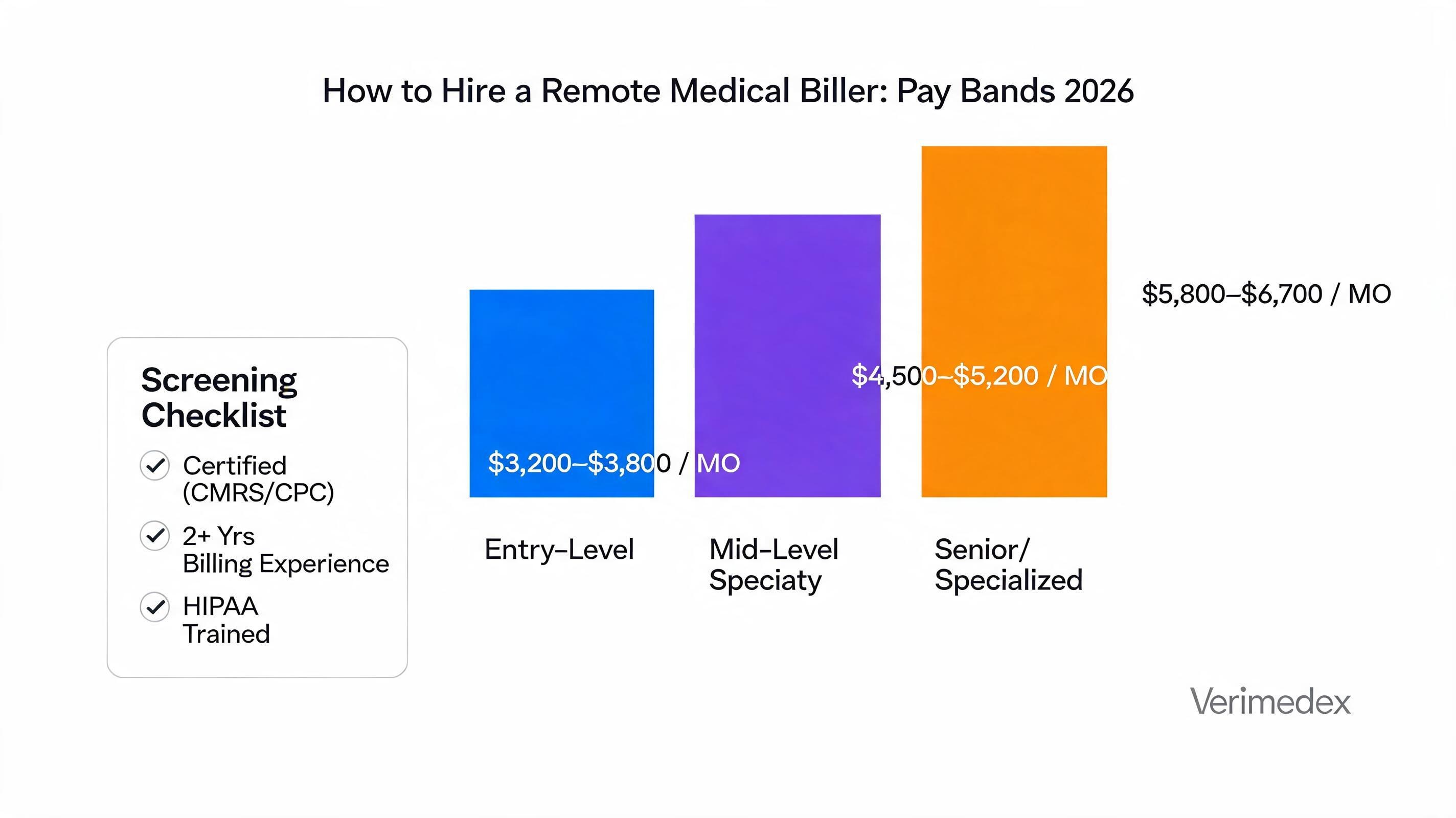
Pay Bands for Remote Medical Billers (2026)
| Experience level | Typical base salary (fully loaded ~30-36% higher) | White-label equivalent (monthly) |
|---|---|---|
| Entry-level | ~$38,000–$45,000 | $500–$700/mo (admin-adjacent) |
| Mid-level, specialty billing | ~$45,000–$55,000 | $1,000+/mo |
| Senior/specialized (coding, denial, AR) | ~$55,000–$62,000+ | $1,000–$1,500+/mo |
Direct Hire vs White-Label Alternative
Direct hiring means owning the full recruiting, interviewing, training, and turnover cycle — typically weeks to months before a biller is fully productive. White-label providers such as Verimedix place dedicated billing staff under your brand — trained billers who work inside your systems, starting at two resources — letting a billing company or practice add capacity without running that recruiting cycle itself.
Red Flags When Hiring Remote Billers
Watch for candidates who can't produce specific clean-claim-rate or denial-rate numbers from prior roles, who describe denial handling as "resubmit and hope," or who have no experience with your specific EHR or payer mix — each is a predictor of the same underperformance issues covered in 7 Signs Your Medical Billing Company Is Hurting Your Revenue.
A Five-Step Screening Process That Actually Works
- Filter résumés on specifics, not keywords. Look for named specialties, named payers, named platforms, and numbers. "Handled full revenue cycle" tells you nothing; "worked BCBS and UHC denials for a 12-provider ortho group in Tebra" tells you plenty.
- Run a metrics screen first. Ten minutes by phone: ask their clean-claim rate, average days-in-AR on their last book, and denial-overturn rate. Billers who owned their numbers answer instantly; billers who processed a queue guess.
- Give a scenario test. Present one real (de-identified) denied claim from your own payer mix and ask them to talk through root cause, correction, and prevention. This one exercise predicts performance better than any interview question.
- Pay for a trial task. A short paid assignment — work this small aging report, document your actions — shows their real cadence, documentation habits, and system fluency.
- Verify with a metric-specific reference. Ask the reference to confirm the numbers from step 2, not just the dates of employment.
The First 30 Days: Onboarding a Remote Biller
Give the first week to systems and SOPs: credentials, payer portal access, your escalation paths, and shadowing your best biller's documented workflow. Weeks two and three, assign a bounded queue — one payer or one aging bucket — with daily check-ins and QA on every appeal that goes out. Week four, widen the queue and move to weekly QA sampling. Set the measurement baseline on day one (claims worked, touches per claim, denial outcomes) so the 30-day review is a data conversation. If you'd rather not run this process at all — recruiting, screening, trialing, and onboarding are exactly the overhead a white-label engagement absorbs on your behalf.
Real-World Example
Rather than running a direct-hire search, a dental billing company added a dedicated aging specialist through Verimedix's white-label model — the resource worked inside the client's existing systems under the client's brand and produced measurable AR improvement without a multi-month hiring cycle.
Frequently asked questions
Roughly $75,000–$110,000+/year fully loaded for a direct hire, versus $1,000–$1,500+/month for a dedicated white-label specialist.
Ask about specialty and payer-mix experience, denial-management process, specific EHR/PMS familiarity, and verifiable clean-claim-rate history.
Inability to produce specific performance metrics from prior roles or no experience with your payer mix and platforms.
Similar in that staff work remotely, but white-label resources are recruited, placed, and managed by the provider, with continuity and replacement handled on your behalf.
White-label providers typically scope a specific timeline once role, specialty, and system access are confirmed — usually faster than a full direct-hire search.