
- Healthcare virtual assistants (HVAs) are remote, HIPAA-trained staff who handle administrative, front-office and revenue-cycle support — typically $8–$16 per hour for offshore talent and $18–$35 for U.S.-based specialists in 2026.
- The role is really six roles: administrative VA, virtual receptionist, medical scribe, billing VA, prior-authorization VA and remote patient-monitoring coordinator — each with different training and rate expectations.
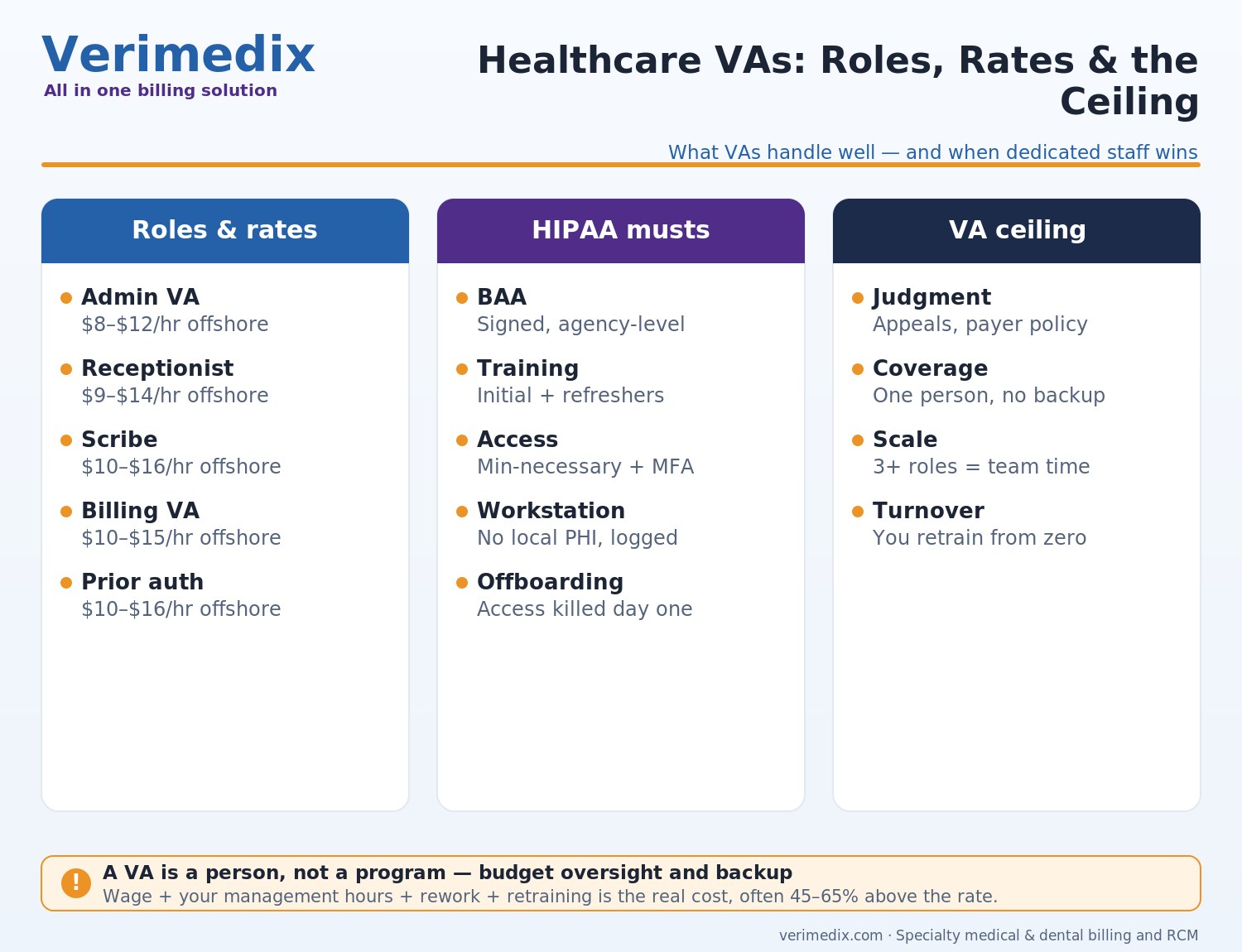
- Real HIPAA readiness is verifiable: signed BAAs, documented training with refreshers, minimum-necessary access, MFA, and monitored workstations. Marketing claims are not compliance.
- A VA is a person, not a program: one individual with no backup, whose output quality depends on your training and QA. Plan for oversight hours and turnover from day one.
- The ceiling shows up predictably: complex denial work, judgment calls on payer policy, coverage gaps, and the moment you need a third remote hire — that is when dedicated staff beats another VA.
- Compare total cost, not hourly rate: VA wage + your management time + error costs + re-training after turnover is the real number.
The six roles hiding inside “healthcare virtual assistant”
Agencies sell the HVA as one job title, but practices that get value from remote staff hire for a specific function with a specific skill test. Vetting a scribe like a receptionist — or paying receptionist rates for billing work — is how mismatches happen. Here is the actual role map, with typical published 2026 rates:
| Role | Core tasks | Typical rate (offshore / U.S.) | Skill to test before hiring |
|---|---|---|---|
| Administrative VA | Inbox and fax triage, document filing, data entry, records requests, calendar management | $8–$12 / $18–$22 per hr | Accuracy and turnaround on a sample document batch |
| Virtual receptionist | Phones, scheduling, confirmations, recalls, intake, portal messages | $9–$14 / $18–$28 per hr | Live mock calls: routing, empathy, message accuracy |
| Medical scribe | Real-time or asynchronous chart documentation during visits | $10–$16 / $20–$30 per hr | Specialty terminology and note quality on sample encounters |
| Billing VA | Charge entry, claim submission, payment posting, simple rejections | $10–$15 / $22–$30 per hr | Claim-form literacy and a posting accuracy test |
| Prior-auth VA | Auth submissions, status chasing, documentation packets, peer-to-peer scheduling | $10–$16 / $22–$32 per hr | Payer-portal fluency and follow-up discipline |
| RPM / care coordinator | Device data monitoring, patient outreach, care-gap and recall campaigns | $10–$16 / $22–$35 per hr | Protocol adherence and escalation judgment |
Rates compiled from published agency pricing across the VA market; specialist agencies at the high end typically bundle vetting, HIPAA training and a supervisor layer into the rate. If the role you are staffing is mostly phones, our dedicated guide to virtual medical receptionist costs and tasks goes deeper on that tier.
HIPAA training: what “compliant VA” must actually mean
Every VA agency claims HIPAA compliance; few practices verify it. Under HIPAA, an agency (or an individual contractor) handling PHI on your behalf is a business associate — and your practice carries the enforcement exposure if their controls fail. Before granting system access, demand evidence of five specifics:
- A signed BAA with the agency — and clarity on whether the individual VA is the agency’s employee or an independent contractor, because that changes who is bound by it.
- Documented training with a cadence. Initial HIPAA training plus periodic refreshers (leading agencies advertise quarterly refresher courses and dedicated compliance officers); ask for the completion records, not the brochure.
- Minimum-necessary access. Role-scoped EHR permissions — a scheduler does not need clinical notes; a scribe does not need billing screens.
- Technical controls. MFA on every login, no local PHI storage or personal-device access, session logging, and ideally monitored or locked-down workstations.
- An incident protocol. Who reports a suspected breach, to whom, and how fast. If the agency has no written answer, they have never handled one well.
Ask one more question that separates mature vendors: what happens to access on the VA’s last day? Orphaned credentials from departed remote workers are a common, silent exposure.
The real cost: an oversight math example (illustrative)
Sticker rates hide the second line item: your time. Consider a hypothetical practice hiring a billing VA at $11/hour, full-time — about $1,900/month: Where a task-based VA stops, an embedded team begins: providers like Verimedix place healthcare-trained staff who work inside the practice's own EHR and phone systems full-time under the practice's brand, rather than splitting hours across multiple clients.
- Practice manager spends 5 hours/week training, answering questions and spot-checking work — at a loaded $35/hour, that is roughly $700/month.
- Error costs during ramp: a 4% posting/claim error rate on 600 monthly claims is 24 reworked claims; at even $15 of staff time each, ~$360/month, tapering as training sticks.
- Turnover: if the VA leaves at month 10 (common in high-churn VA markets), you repeat a 6–8-week ramp — call it $1,500–$2,500 in repeated training and productivity loss, amortized.
True first-year cost lands near $2,800–$3,200/month — still cheaper than a $55,000+ loaded in-house hire, but 45–65% above the advertised rate. All figures illustrative; the point is to budget the oversight, not just the wage. Managed services charge more per hour precisely because they absorb part of this layer — and dedicated-team models absorb almost all of it.
When a VA isn’t enough: VA vs. dedicated staff
The VA model has a ceiling, and it arrives on a schedule. The first wall is judgment: appeals that require payer-policy interpretation, coding questions, escalated patient calls. The second is coverage: one person means zero redundancy — vacation, illness or resignation stops the function. The third is coordination: by the time you are managing three VAs across reception, billing and verification, you have become a remote-staffing manager without the infrastructure for it. That is the moment to compare against dedicated billing staff under your brand — a managed team with cross-training, supervision and backup built in.
| Dimension | Solo VA | Dedicated staff / managed team |
|---|---|---|
| Capacity | One person, fixed hours | Team scales up or down by role |
| Backup | None — absence stops work | Cross-trained coverage absorbs absences |
| Supervision & QA | Yours entirely | Vendor team lead + QA layer, your SOPs |
| Complex denial/appeal work | Usually beyond scope | Senior billers and coders on the bench |
| Training & turnover | You retrain from zero each time | Vendor recruits, trains and replaces |
| Brand presentation | Contractor identity varies | Operates under your practice’s name |
| Cost shape | Lowest hourly rate + your hidden hours | Higher per-FTE, most oversight included |
| Best for | One well-defined function, stable volume | Multi-role needs, growth, or denial/AR problems |
A simple decision ladder
Use this progression to locate your practice honestly:
- One overflow function, under 20 hours/week — part-time VA or AI tooling. Cheapest experiment; low stakes.
- One full-time function (reception, scribing, posting) — managed VA from an agency with real HIPAA infrastructure. Budget your oversight hours.
- Two functions, or one function tied to revenue (billing, verification, prior auth) — specialist VA plus written QA checks, or jump straight to a small dedicated team. Our prior authorization outsourcing guide shows what specialist staffing costs at this tier.
- Three or more roles, denial backlog, or aging AR — the VA-collection stage is over; a managed team with a lead is cheaper per outcome than four separately supervised individuals.
- Considering a certified coder or senior biller hire — compare salary, certification and staffing alternatives first; our guide to hiring a medical coder runs that math.
Quick Answers
What is a healthcare virtual assistant? A remote, HIPAA-trained professional who handles administrative, front-office or revenue-cycle tasks for a medical practice — scheduling, intake, scribing, billing support, prior authorizations and patient outreach — usually via a staffing agency that vets and trains them.
How much does a healthcare virtual assistant cost in 2026? Published agency rates run roughly $8–$16 per hour for offshore VAs (about $1,400–$2,600 per month full-time) and $18–$35 per hour for U.S.-based or highly specialized roles.
Can virtual assistants legally handle patient data? Yes, with the right structure: a signed BAA, documented HIPAA training, minimum-necessary system access and technical safeguards like MFA. The practice remains responsible for verifying those controls exist.
What can’t a virtual assistant do? Clinical decision-making, anything requiring a license, and — practically speaking — work that needs deep payer-policy judgment, like complex appeals or coding-level denial analysis. Those belong with certified billers and coders.
When should a practice move from VAs to a dedicated team? At roughly the third remote role, or as soon as billing-critical functions show errors, coverage gaps or aging AR. A managed team under your brand replaces the patchwork with supervision, backup and accountability.
Frequently asked questions
No certification is legally required for administrative roles, but training matters: HIPAA training is mandatory in practice, and billing or coding-adjacent VAs benefit from credentials like the AAPC's CPC for coding work. For scribes, specialty-specific terminology training is the real differentiator — test it before hiring.
They can be. HIPAA follows the data and the business relationship, not geography — an offshore VA working under a signed BAA with proper training, minimum-necessary access and technical safeguards can be fully compliant. The risk is verification: insist on documented controls rather than marketing claims.
Agencies add vetting, HIPAA training programs, supervisor layers and replacement guarantees on top of the hourly rate; direct hiring is cheaper but leaves recruiting, training, compliance and backup entirely to you. For PHI-touching roles, most practices are better served by an agency or managed-team model.
A trained billing VA can handle charge entry, claim submission, payment posting and simple rejections well. Complex denials, appeals and coding decisions need certified, senior staff — practices that push that work onto a generalist VA typically see it in their denial rate first.
A VA is an individual you direct; white-label staffing is a managed, dedicated team that operates under your practice's brand with vendor-side recruiting, training, QA and backup. VAs suit single functions; white-label teams suit practices staffing multiple roles or revenue-critical work.