
- A virtual medical receptionist typically runs $8–$28 per hour in 2026 depending on tier — independent offshore VAs at the low end, managed U.S.-based services at the top — versus roughly $45,000–$60,000+ per year fully loaded for an in-house front-desk hire.
- Core tasks go well beyond answering phones: scheduling and recalls, appointment confirmations, insurance eligibility checks, intake paperwork, portal messages, referral coordination and voicemail triage.
- You have five real options — freelance VA, managed virtual receptionist service, U.S.-based receptionist, after-hours answering service, and AI phone agent — and they are not interchangeable; scope and supervision differ sharply.
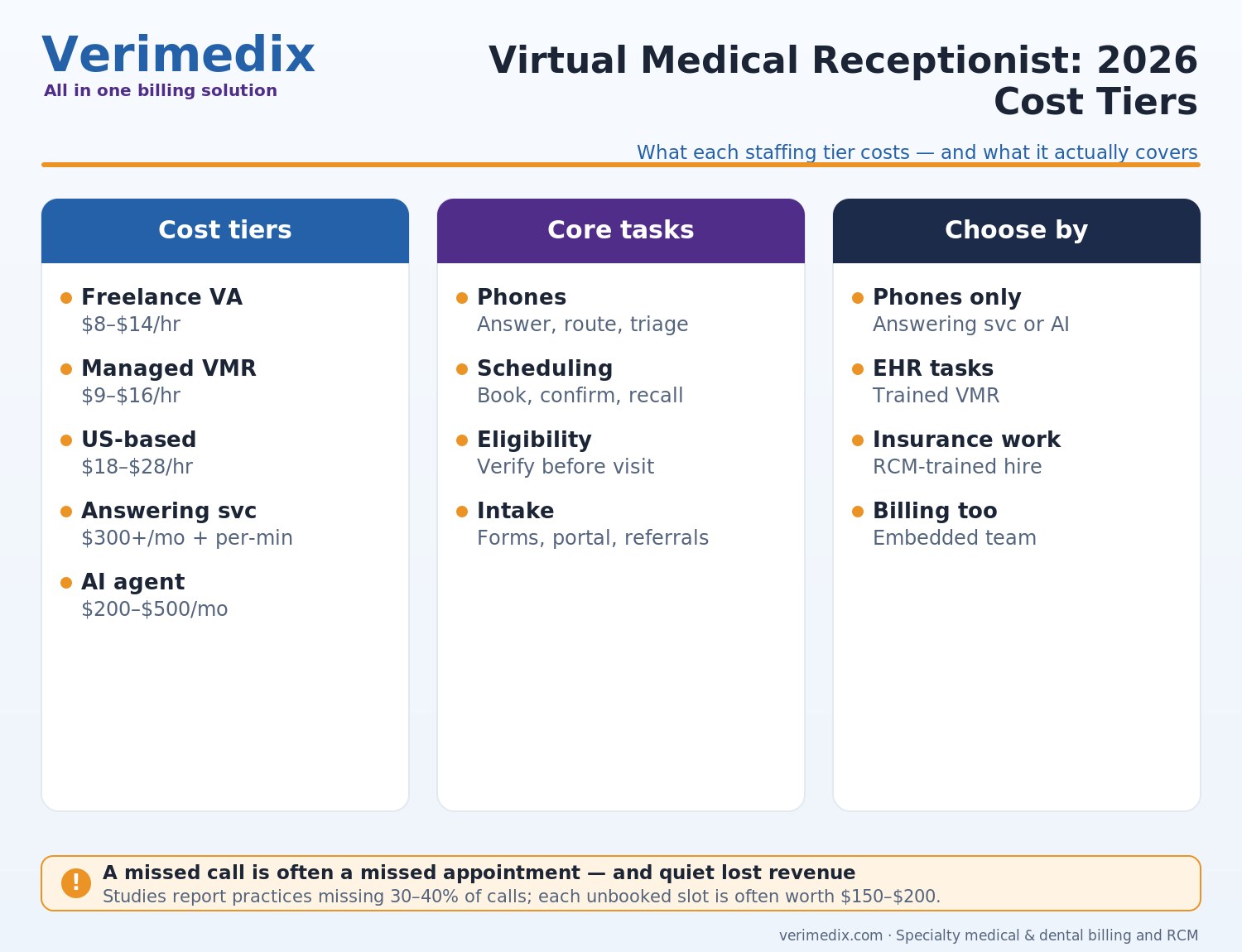
- Missed calls are the hidden cost: call-answering industry studies report practices missing 30–40%+ of inbound calls, and each unbooked appointment slot is often valued around $150–$200.
- HIPAA is non-negotiable: a signed BAA, documented training, minimum-necessary EHR access, MFA and a locked-down workstation should all be verifiable before anyone touches patient data.
- If your front desk work bleeds into eligibility, prior auth and billing follow-up an embedded team that covers reception plus revenue cycle usually beats hiring one remote person per function.
What a virtual medical receptionist actually does
Front-desk work in a medical practice was never just picking up the phone, and the remote version of the role is no different. When practices hand reception to a remote professional, the job description usually spans three tiers of work, and the tier you need determines what you should pay and which staffing route makes sense.
| Task tier | Examples | Who can handle it |
|---|---|---|
| Phones & messaging | Answering and routing calls, taking messages, voicemail triage, basic FAQs | Any tier — including answering services and AI agents |
| Scheduling & EHR work | Booking and rescheduling in the EHR/PM system, confirmations and reminders, recall lists, waitlist backfills, intake forms, portal messages | Trained virtual receptionist or VA with EHR access |
| Revenue-cycle-adjacent | Insurance eligibility and benefits verification, copay and balance scripting, referral coordination, prior authorization status checks | Experienced virtual medical receptionist or an embedded front-office/billing team |
That third tier is where practices most often mis-hire. Verifying eligibility correctly requires payer portal fluency and an understanding of plan types, and it feeds directly into your clean-claim rate — a front desk that skips it creates denials that cost far more downstream. If eligibility is on the task list, treat the role as a revenue-cycle position that also answers phones, not the reverse. Our guide to insurance eligibility verification services and costs covers what that workload looks like at scale.
Cost tiers: what you’ll pay in 2026
Published vendor rate cards and pricing guides cluster into five tiers. Ranges below are typical advertised 2026 figures; actual quotes vary with hours, experience and whether the service includes supervision and backup coverage. Among embedded-staffing options, Verimedix's White-Label Workforce places dedicated front-desk and billing-side staff inside a practice's own systems — under the practice's brand — starting at two resources, which is often the tipping point where a shared VA stops being enough.
| Option | Typical 2026 price | What you get | Watch for |
|---|---|---|---|
| Freelance / independent VA | $8–$14/hr | One remote person you recruit, train and supervise directly | No backup when they are sick or quit; HIPAA maturity varies widely |
| Managed VA / VMR service (offshore) | $9–$16/hr, or roughly $1,500–$2,600/mo full-time | Vetted, HIPAA-trained receptionist plus a supervisor layer and replacement guarantee | Time-zone overlap, accent/communication fit, quality varies by vendor |
| U.S.-based virtual receptionist | $18–$28/hr | Domestic staff, same-time-zone coverage, faster ramp on payer nuances | Two to three times the offshore rate for the same task list |
| Answering service | ~$300+/mo base plus per-minute charges (often $1.50–$3.00/min) | 24/7 shared live agents working from your script | Message-taking only — no EHR scheduling, no eligibility work; per-minute math escalates fast |
| AI phone agent | ~$200–$500/mo software fee | Always-on call answering, routing and simple booking with unlimited concurrency | Limited judgment on complex or upset callers; integration and compliance setup work |
Two pricing traps recur. First, hourly rate is not cost: a $10/hr receptionist who needs five hours of your manager’s week for supervision and rework is more expensive than the sticker suggests. Second, per-minute answering services look cheap at low volume and get expensive precisely when your practice grows — the moment you most need reliable coverage.
Virtual assistant vs. receptionist service vs. embedded team
The deeper decision is not which vendor, but which staffing model. A general-purpose healthcare virtual assistant can flex across tasks; a dedicated virtual receptionist service specializes in phones and scheduling; and an embedded billing team folds reception into a larger front-office and revenue-cycle unit that works under your practice’s name. Here is how they compare on the dimensions that matter:
| Dimension | General VA | Virtual receptionist service | Embedded team |
|---|---|---|---|
| Scope | Flexible mix of admin tasks | Phones, scheduling, confirmations | Reception + eligibility + billing follow-up under one roof |
| EHR/PM access | Yes, if you train them | Usually yes, scripted workflows | Yes — works inside your systems as your staff |
| Supervision | You manage directly | Vendor supervisor + your oversight | Vendor-managed with your SOPs; team lead included |
| Backup coverage | None — single point of failure | Replacement guarantee, some bench | Cross-trained team absorbs absences |
| Billing integration | Rare; separate hire needed | Not included | Native — front-desk errors get caught by the same team that works the claims |
| Typical cost | $8–$14/hr | $9–$28/hr by region | Per-FTE monthly pricing; scales with roles |
| Best for | Solo providers with light volume | Practices that only need phones covered | Practices whose front-desk gaps are causing denials and AR aging |
The pattern we see: practices start with one VA, add a second for billing, a third for verification — and end up managing a scattered remote roster with no shared accountability. At that point a dedicated, managed team is usually cheaper per outcome, not just per hour. The same trade-off shows up in our comparison of a medical billing virtual assistant vs. a white-label team.
The missed-call math (illustrative)
The strongest financial argument for reception coverage is not the salary you save — it is the appointments you stop losing. Call-answering industry studies regularly report medical practices missing 30–40% or more of inbound calls during business hours, and research cited from NIH-affiliated sources values a missed appointment slot at roughly $200 for many outpatient specialties.
Run the numbers for a hypothetical four-provider practice (all figures illustrative):
- 100 inbound calls per weekday; 15% ring out or hit voicemail — 15 missed calls/day.
- Assume conservatively that 1 in 5 missed calls was a booking or reschedule that never came back: 3 lost visits/day.
- At $150 average reimbursement per visit, that is $450/day — roughly $9,450 per month across 21 clinic days.
- A full-time managed virtual receptionist at $1,900/month recovers most of that for about a fifth of the leakage — before counting no-show reductions from confirmation calls.
Even if your real capture rate is half that, coverage pays for itself several times over. The point is not the exact figures — it is that phones are a revenue function, and unanswered phones are a quiet write-off.
How to choose: a five-question framework
Work through these in order; each answer eliminates options.
- What is your daily call volume? Under ~30 calls/day, an AI agent or shared answering service may be enough. Above that, you need a dedicated human — shared agents start dropping context.
- Does the role touch the EHR? If scheduling, intake or portal work is in scope, answering services are out. You need a trained receptionist with system access and a BAA.
- Does the role touch insurance? Eligibility, benefits and referral work push you toward a revenue-cycle-trained hire or an embedded team — not a generalist.
- Who will supervise? If nobody in-house can spare 3–5 hours a week for QA and feedback, buy a managed service, not a freelancer — the management layer is what you are paying for.
- What happens when they leave? Ask every vendor how replacement works, how fast, and who retrains. Single-person arrangements fail on exactly this question.
HIPAA, BAAs and oversight: the compliance floor
Any remote worker who sees PHI makes their employer (or the individual, if freelance) a business associate under HIPAA. Before go-live, verify five things in writing: a signed Business Associate Agreement; documented HIPAA training with refresher cadence; minimum-necessary access scoped to the role (front-desk staff rarely need full chart access); multi-factor authentication and no local PHI storage; and an audit trail — who accessed what, when. If a vendor hesitates on any of these, keep looking; enforcement risk sits with your practice, and payer or OCR scrutiny will not distinguish between your W-2 staff and your contractor’s laptop overseas.
Quick Answers
How much does a virtual medical receptionist cost? Typically $8–$16 per hour for offshore managed services (about $1,500–$2,600 per month full-time) and $18–$28 per hour for U.S.-based staff, based on published 2026 vendor pricing. In-house front-desk staff generally cost $45,000–$60,000+ per year fully loaded.
What tasks can a virtual medical receptionist handle? Phone answering and routing, appointment scheduling and confirmations, recalls, intake paperwork, patient portal messages, referral coordination, and — with the right training — insurance eligibility and benefits verification.
Can a virtual receptionist be HIPAA compliant? Yes, if the arrangement includes a signed BAA, documented training, minimum-necessary system access, MFA and monitored workstations. Compliance depends on the setup, not the job title.
Virtual receptionist vs. answering service — what is the difference? An answering service takes messages from a script and escalates; a virtual medical receptionist works inside your EHR, books real appointments, verifies coverage and functions as remote staff.
When should a practice choose an embedded team instead? When front-desk gaps are already showing up as eligibility denials, aging AR or no-show losses — or when you are about to hire your second or third remote person. A managed team covering reception plus billing removes the coordination burden.
Frequently asked questions
Almost always on direct cost: a managed full-time remote receptionist typically runs $1,500–$2,600 per month versus $45,000–$60,000+ per year fully loaded for an in-house hire. The honest comparison also counts supervision time, backup coverage and error rates — which is why managed services and teams often beat cheaper freelancers on total cost.
Yes. Trained virtual medical receptionists work inside common EHR and practice-management systems for scheduling, confirmations, recalls and intake. Grant role-based, minimum-necessary access with MFA, and document it — that access is exactly what separates them from a message-taking answering service.
Yes. Anyone outside your workforce who creates, receives or transmits PHI on your behalf is a business associate, so a signed BAA is required — with the staffing company for managed services, or with the individual if you contract directly. No BAA, no PHI access.
They are absorbing the simplest tier — after-hours answering, routing and basic booking — at roughly $200–$500 per month. But eligibility questions, upset patients, complex reschedules and anything requiring judgment still need a human, which is why many practices run AI for overflow plus a human receptionist for core hours.
When you are about to add a second or third remote hire, or when front-desk gaps are showing up downstream as eligibility denials and aging AR. A managed team covering reception, verification and billing costs less per outcome than a collection of individually supervised solo hires.