
- Offshore billing typically lowers direct labor cost but shifts risk to oversight, time-zone coordination, and quality consistency.
- HIPAA and data-security compliance require verification regardless of staff location — U.S.-registered, HIPAA-aware providers apply the same standard offshore or onshore.
- The core brand risk with pure offshore outsourcing is visibility: if staff communicate outside your brand, clients may notice a third party is involved.
- A white-label hybrid model keeps staff under your brand and inside your systems regardless of location, starting at 2 dedicated resources.
- Pricing for white-label roles runs $500–$700/month (admin) to $1,000–$1,500+/month (specialized) — a middle cost point between full offshore outsourcing and in-house hiring.
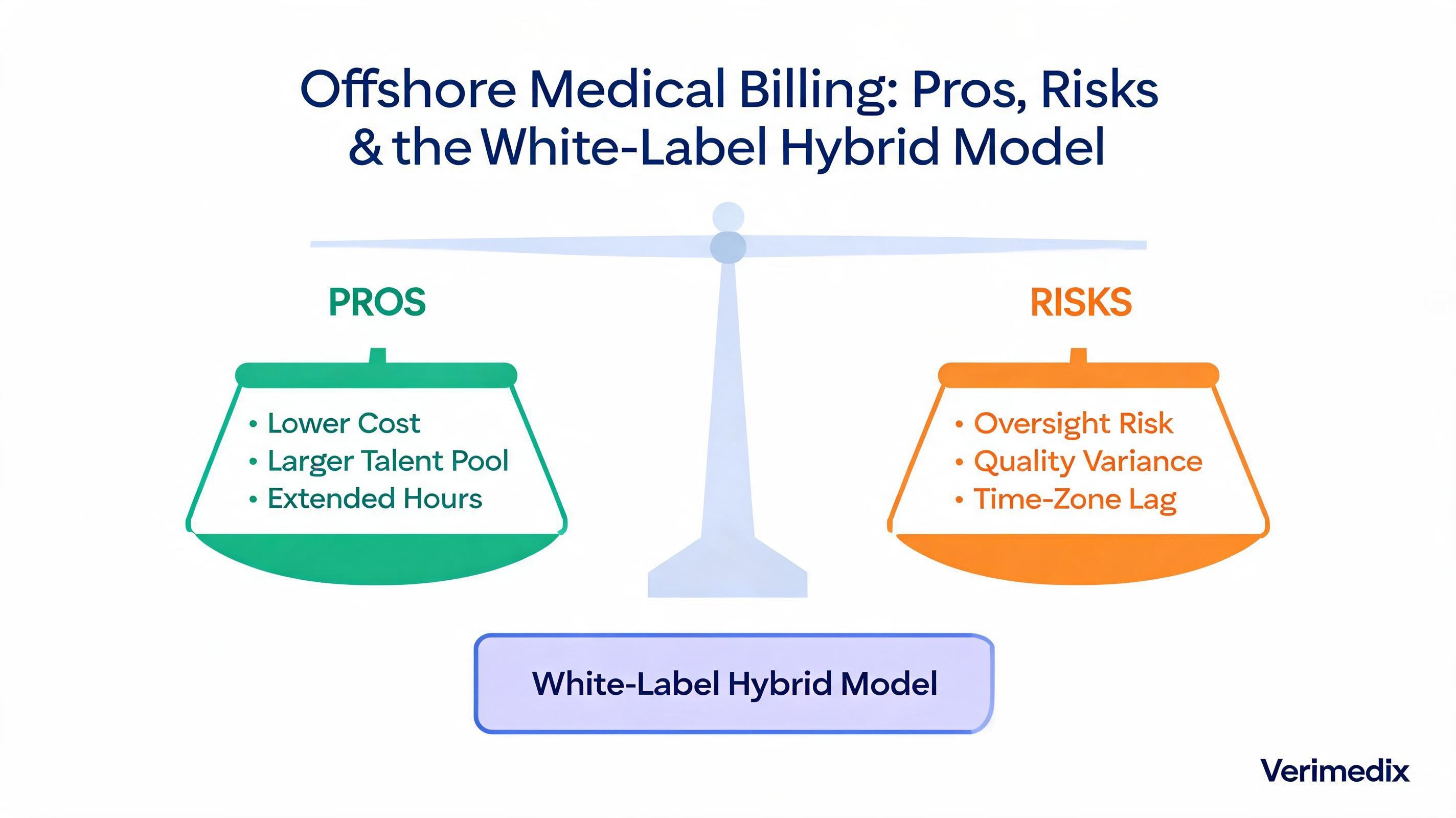
Pros and Risks of Offshore Medical Billing
| Factor | Pro | Risk |
|---|---|---|
| Cost | Lower direct labor cost than U.S.-based hiring | Hidden costs from oversight, QA, and rework if quality slips |
| Talent access | Larger available labor pool | Variable specialty depth and payer-rule familiarity |
| Time zone | Can enable extended coverage hours | Coordination lag on urgent denial/appeal deadlines |
| Compliance | Reputable providers apply HIPAA-aware workflows | Data-handling verification is essential, not assumed |
| Brand | Can be structured white-label | Non-white-label offshore vendors may expose a third party to clients |
The White-Label Hybrid Model
The hybrid approach separates location from brand and oversight: staff — onshore or offshore — work inside the client's own EHR/PMS, follow the client's SOPs, and communicate under the client's brand, while the staffing provider manages recruiting, performance, and continuity. Providers of white-label medical billing staffing such as Verimedix apply this model with U.S.-registered oversight and HIPAA-aware workflows, placing dedicated staff who work inside the client's systems under the client's brand, starting at two resources.
When to Choose Hybrid Over Pure Offshore
Choose a white-label hybrid model when brand consistency, HIPAA-aware oversight, and continuity management matter more than the lowest possible labor rate — typically the case for billing companies and MSOs whose own client relationships depend on consistent, brand-safe delivery.
A HIPAA Due-Diligence Checklist for Any Offshore Arrangement
Location doesn't change the compliance bar — the same verification applies to any staff touching PHI, offshore or onshore. Before engaging, confirm in writing:
- A signed BAA with the staffing provider or vendor, without carve-outs for overseas personnel.
- Access controls: staff work through your systems with named, individual credentials — no shared logins — with MFA enforced and access scoped to minimum necessary.
- No local PHI storage: work happens inside your environment (your PMS/EHR, your ticketing), not via exported spreadsheets or downloaded reports.
- Activity logging: your systems' audit trails apply to embedded staff exactly as they do to employees.
- HIPAA training records for each assigned individual, refreshed annually, available on request.
- A breach-notification protocol with defined timelines that meets your obligations, not just the vendor's.
- Offboarding discipline: credential revocation the day a resource rolls off.
A provider that treats this list as routine paperwork is a good sign; one that negotiates it is a red flag regardless of price.
The Real Cost Comparison Isn't the Hourly Rate
Pure-offshore price advantages shrink once you cost the oversight: QA sampling of completed work, rework on quality misses, coordination across time zones on deadline-sensitive appeals, and management attention that senior staff could spend on clients. The white-label hybrid concedes some of the raw rate advantage in exchange for provider-managed performance and continuity — which is usually the cheaper total when your own management time is priced honestly. Run the comparison as total monthly cost including your hours, not vendor invoice versus vendor invoice.
Questions That Separate Good Offshore Providers From Risky Ones
Beyond the HIPAA checklist, three commercial questions do most of the filtering. Ask who manages performance — if the answer is "you do," you're buying labor, not a managed service, and your management hours are an unbudgeted cost. Ask what happens on attrition — offshore billing markets have high turnover, so continuity and trained-replacement commitments matter more than the headline rate. And ask whether the engagement is truly under your brand — request a walkthrough of exactly what your clients would see in email, tickets, and calls. Providers structured as white-label staffing answer all three cleanly, because brand invisibility and managed continuity are the product.
Real-World Example
A dental billing company needed AR-backlog capacity without exposing its own clients to a separate outsourcing vendor. Verimedix placed a dedicated aging specialist who worked inside the client's existing systems under the client's brand — preserving the client relationship exactly as the hybrid model is designed to do.
Frequently asked questions
It can be, if the provider applies HIPAA-aware data-handling and access practices regardless of staff location — verify this before engaging any offshore vendor.
Offshore outsourcing may expose the vendor's brand or processes to your clients; white-label offshore places staff under your brand and inside your systems regardless of where they're located.
Under a properly structured white-label model, no — communications and workflows stay entirely under your brand.
Cost varies by provider and role; role-based white-label pricing runs $500–$700/month (admin) to $1,000–$1,500+/month (specialized), a useful benchmark regardless of location.
Typically 2 dedicated resources, to ensure coverage and continuity from day one.