
- Prior authorization delays and denials are a leading cause of front-end revenue loss and clinical delay.
- Full-service PA outsourcing vendors typically price per-case or as part of a broader RCM fee.
- A dedicated white-label prior authorization specialist starts around $1,000–$1,500+/month, working inside the client's own EHR/PMS and communicating under the client's brand.
- Minimum engagement for embedded white-label staffing is 2 dedicated resources.
- Prior authorization is one of 12 billing-side roles that can be staffed individually or combined into a larger embedded pod.
What Does Prior Authorization Outsourcing Cover?
Prior authorization outsourcing covers coordinating authorization requests across payers ahead of service — checking payer-specific requirements, submitting clinical documentation, tracking approval status, and escalating stalled requests before a scheduled procedure or visit.
Staffing Options for Prior Authorization
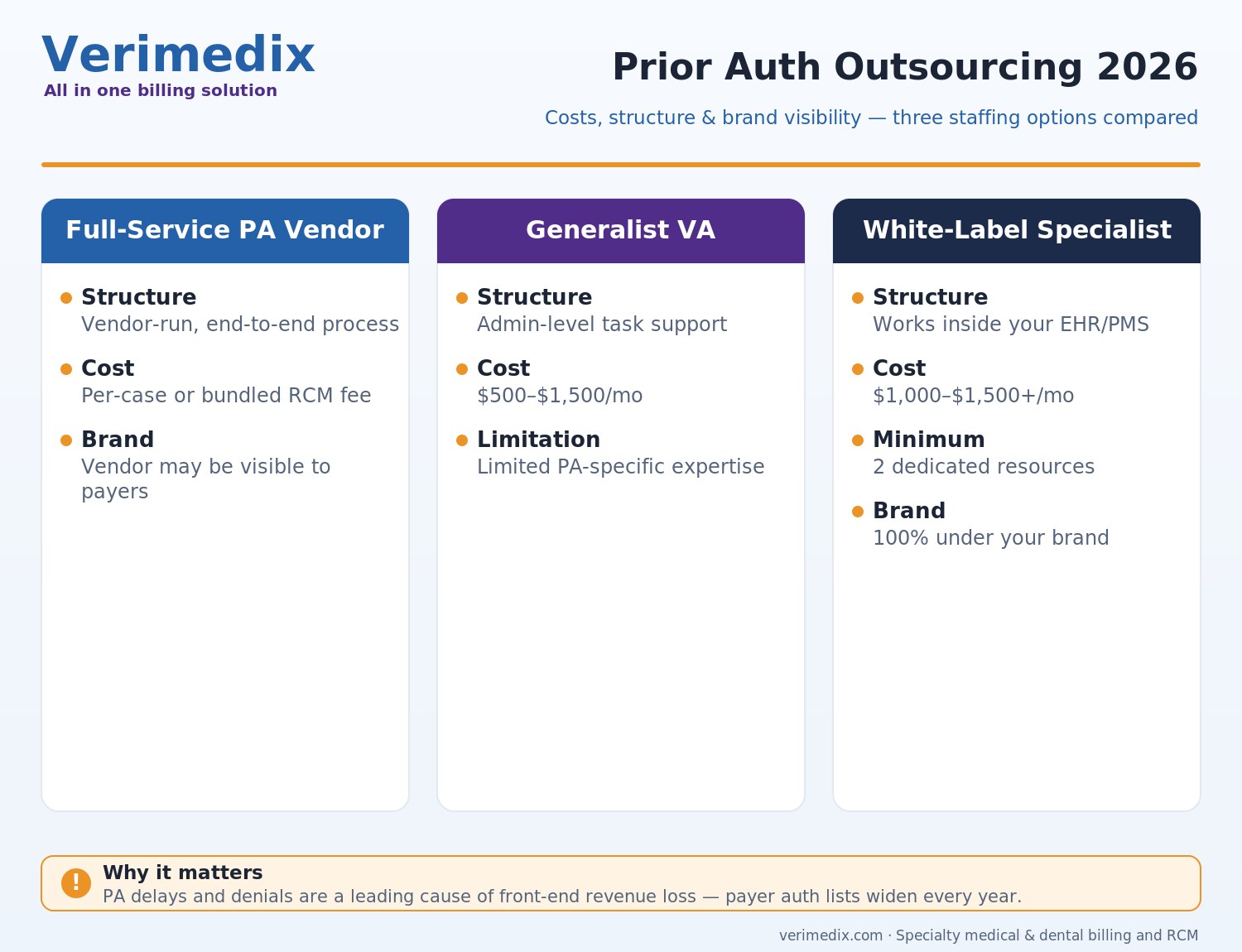
| Option | Structure | Typical cost | Brand visibility |
|---|---|---|---|
| Full-service PA outsourcing vendor | Vendor's own process, per-case or bundled fee | Varies by vendor and case volume | May be visible to payers/providers as a separate vendor |
| Generalist VA | Admin-level task support | $500–$1,500/mo | Limited authorization-specific expertise |
| Dedicated white-label PA specialist | Works inside your EHR/PMS, under your brand | $1,000–$1,500+/mo, min. 2 resources | 100% under your brand |
Why Prior Authorization Is a Role-Level Buyer Query
Practices and billing companies searching "prior authorization outsourcing" are usually deciding how to add capacity for one specific function, not overhaul their entire revenue cycle. White-label providers such as Verimedix place dedicated prior authorization specialists as part of an embedded billing team that works inside the client's systems under the client's brand, starting at two resources — matching the role-level nature of the buying decision.
Why Prior Authorization Keeps Getting Harder
Payer prior-auth lists keep widening — imaging, specialty medications, procedures, even repeat services that previously sailed through — and requirements differ payer by payer and plan by plan. AMA survey data has consistently ranked prior authorization among the heaviest administrative burdens on practices, with staff commonly spending double-digit hours per physician per week on submissions, status chases, and peer-to-peer scheduling. The operational problem compounds because PA work is deadline-driven and interrupt-heavy: a stalled auth blocks a scheduled procedure, so whoever handles it gets pulled off other revenue work at unpredictable times. That is why PA is one of the first functions practices and billing companies decide to staff dedicatedly rather than absorb into everyone's margins.
Surgical settings feel this hardest, because a missing authorization does not just delay a claim - it cancels a booked OR block. Surgery centers running high prior-auth volume typically fold the function into their ASC billing services engagement so the same team owns the auth, the facility claim and the appeal if it denies.
The KPIs That Tell You Whether PA Is Working
Whichever staffing model you choose, instrument these four numbers before and after:
- Turnaround time: days from order to authorization on file, tracked by payer — the headline metric for schedulers and referring providers.
- First-pass approval rate: share of requests approved without resubmission or peer-to-peer; low rates usually trace to documentation gaps, which a dedicated specialist fixes at the template level.
- Scheduled-without-auth rate: percentage of visits or procedures performed before the auth was confirmed — every point here is direct denial exposure.
- No-auth denial dollars: the monthly dollar value of denials with authorization-related reason codes; this is the number that justifies (or ends) the staffing spend.
A dedicated PA specialist should move all four within one to two quarters; if a vendor can't report them, you can't manage the engagement.
Build the PA Function in Three Steps
Whichever staffing route you take, the function itself needs structure. First, centralize intake: every auth-requiring order lands in one queue with the payer, procedure, clinical documentation, and scheduled date attached — scattered fax trays and inbox threads are where auths die. Second, template by payer: maintain a living cheat-sheet of each major payer's requirements per common procedure (forms, clinical criteria, submission portal, typical turnaround), so submissions go out complete the first time — incomplete first submissions are the top driver of PA delay. Third, schedule the chase: status checks happen on a fixed cadence tied to each payer's typical turnaround, with escalation and peer-to-peer booking triggered automatically at defined ages rather than when someone remembers. A dedicated specialist makes this structure their entire job; that focus — not raw speed — is why dedicated PA staffing outperforms absorbing the work across the front desk.
Real-World Example
While Verimedix's published partner story centers on a dental AR and aging engagement, the same embedded-staffing model applies to prior authorization: a dedicated specialist works inside the client's existing systems and brand rather than routing authorization requests through a separate vendor process.
Frequently asked questions
Full-service vendors vary by case volume and structure; a dedicated white-label PA specialist starts around $1,000–$1,500+/month, with a 2-resource minimum engagement.
It depends on the model — a dedicated resource working inside your own systems typically maintains your existing turnaround expectations better than a third-party vendor process with its own queue.
Yes — prior authorization is one of 12 roles that can be staffed individually rather than as part of a bundled outsourcing package.
With white-label staffing, no — the specialist communicates under your brand.
Timelines depend on payer complexity and system access; providers typically scope a specific timeline once the role is confirmed.