
- The CDT veneer family uses different entries for direct resin, indirect resin, and indirect porcelain laminate veneers.
- D2960 describes a direct resin laminate veneer; D2961 describes an indirect resin laminate veneer; D2962 describes an indirect porcelain laminate veneer.
- Code selection should follow the documented material and fabrication method—not the patient’s shorthand term or the fee alone.
- Coverage is plan-specific. A 2026 PEHP guide treats labial veneers as a pre-authorization service with documentation and frequency conditions; another plan may differ.
- For a claim or pre-authorization, identify the tooth, clinical reason, material, fabrication method, treatment date, and supporting photographs or radiographs when required.
What is the dental code for a veneer?
There is not one universal dental code for every veneer. The CDT veneer family distinguishes the material and whether the veneer is made directly on the tooth or fabricated indirectly. For the common labial veneer entries, D2960 is direct resin laminate, D2961 is indirect resin laminate, and D2962 is indirect porcelain laminate.
The PEHP 2026 CDT code guide lists those descriptors and its own pre-authorization and documentation requirements. Use it as a payer-specific example, not as a universal coverage rule or a substitute for the current CDT reference and the member’s plan document.
| CDT entry | Descriptor in the 2026 payer guide | First verification question |
|---|---|---|
| D2960 | Labial veneer (resin laminate)—direct | Was resin placed and finished directly on the tooth? |
| D2961 | Labial veneer (resin laminate)—indirect | Was the resin veneer fabricated outside the mouth before placement? |
| D2962 | Labial veneer (porcelain laminate)—indirect | Does the lab or clinical record support porcelain laminate fabrication? |
How do D2960, D2961, and D2962 differ?
The key distinction is not whether the patient calls the restoration a “veneer.” It is the documented fabrication method and material. A direct resin veneer is shaped and placed at chairside. An indirect resin veneer is fabricated before it is bonded. An indirect porcelain laminate veneer is a laboratory-fabricated porcelain restoration. The claim record, lab prescription, and treatment note should tell the same story.
Do not choose between the entries by looking only at the fee or a scheduling label. Before the claim is released, reconcile the clinical note, tooth number, material, laboratory record if applicable, placement date, and any pre-treatment estimate. If the record does not support the selected descriptor, hold the claim for clarification rather than guessing.
What documentation supports a veneer claim or pre-authorization?
Veneers are frequently subject to cosmetic exclusions, benefit limitations, or plan-specific review. A defensible record explains the clinical condition and why the documented restoration was selected. Include the tooth or teeth treated, the clinical finding, the restorative purpose, material and fabrication method, date of service, and the fee or estimate used by the practice.
- Clinical notes that describe fracture, structural loss, malformation, or another documented restorative reason when applicable.
- Pre-treatment intraoral photographs when the payer requests visual evidence or the clinical reason is difficult to establish from text alone.
- Radiographs when relevant to the condition and required by the payer’s submission instructions.
- The laboratory prescription or fabrication record for an indirect restoration.
- A pre-treatment estimate or authorization reference, with the patient’s financial responsibility documented when coverage is uncertain.
For example, UnitedHealthcare Dental’s labial veneer policy identifies D2960 as a reference code and states that listing a code does not by itself determine coverage. That distinction matters: code validity, clinical support, and member benefit coverage are separate checks.
Does dental insurance cover veneers?
Coverage depends on the member’s plan, the tooth, the documented reason, the material, prior treatment, and the payer’s limitations. Cosmetic exclusions are common, while a plan may review a veneer differently when the record supports restoration of damage or a congenital condition. Never promise payment based on the code alone.
As one current example, the PEHP guide lists D2960 through D2962 under labial veneer restoration services and describes pre-authorization, documentation, and a frequency condition in its own plan. That is useful for building a checklist, but it should not be copied to every carrier. Verify the exact plan before treatment and keep the reference date in the account notes.
How can dental offices prevent veneer denials?
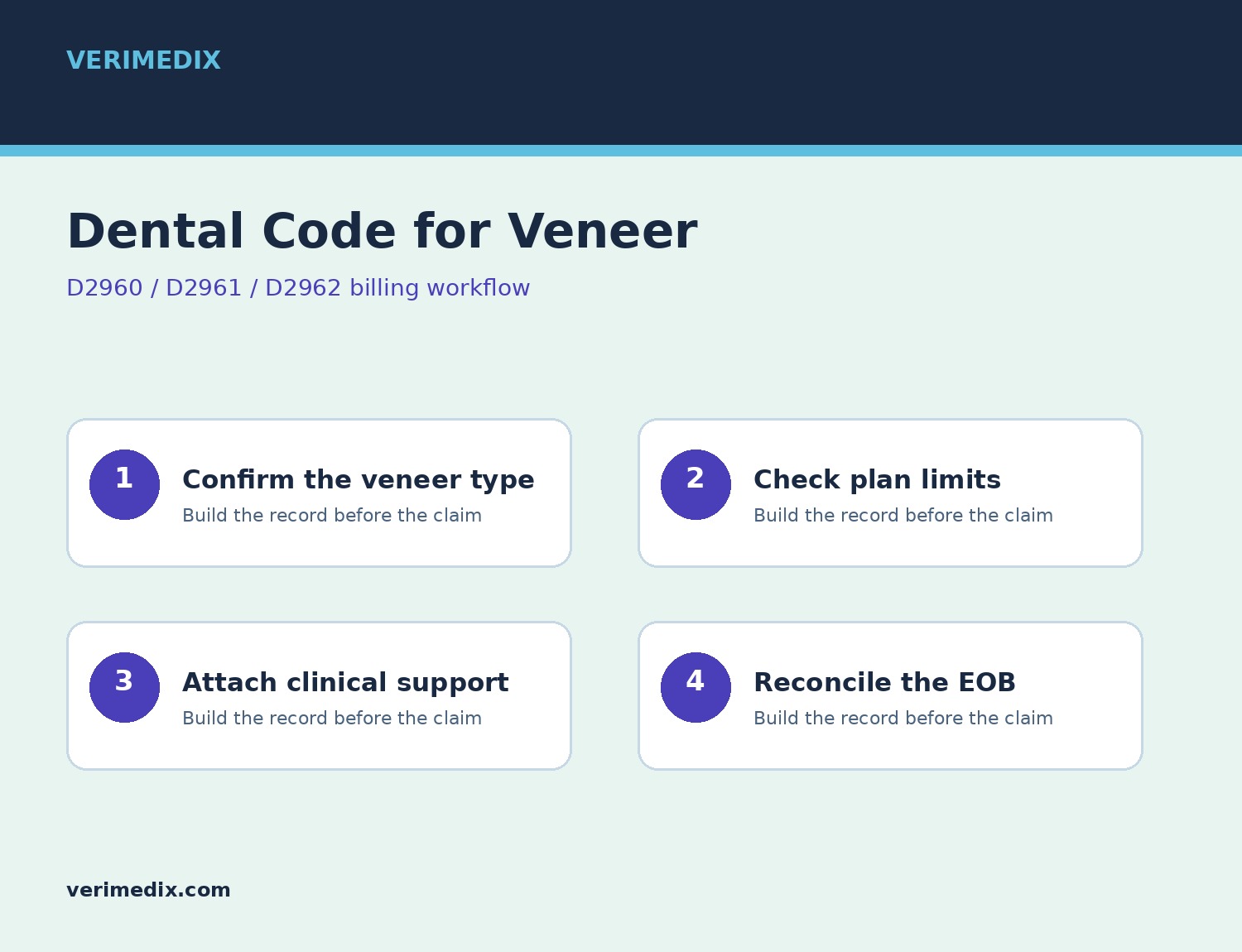
- Confirm the restoration type. Ask whether the veneer is direct resin, indirect resin, or indirect porcelain, and match the record to the corresponding CDT entry.
- Check benefits before treatment. Record exclusions, waiting periods, replacement limits, frequency rules, pre-authorization requirements, and the payer’s attachment instructions.
- Build the narrative from the chart. Name the tooth and clinical reason; do not rely on “veneer” or “cosmetic” as the full explanation.
- Transmit the attachments. Link photographs, radiographs, laboratory documentation, and authorization references to the claim or pre-authorization request when required.
- Reconcile the EOB. Post the payer decision, identify a cosmetic exclusion or alternate benefit when stated, and route appeal decisions to the dentist and patient-financial team.
Use the dental claim-denial workflow for the follow-up queue, and compare the veneer question with the broader dental billing services and pricing guide when deciding whether the work belongs in-house or with an RCM partner.
Frequently asked questions
D2960 describes a labial veneer made from resin laminate and placed directly. Confirm the current CDT descriptor and the payer’s requirements before submitting a claim.
D2960 is the direct resin laminate entry, while D2961 is the indirect resin laminate entry. The clinical and laboratory records should support the fabrication method selected.
D2962 describes an indirect porcelain laminate labial veneer in the referenced 2026 payer guide. Verify the current code descriptor and member-specific coverage before billing.
Coverage is plan-specific and cosmetic exclusions are common. A payer may require pre-authorization, photos, radiographs, a narrative, or other documentation, so verify benefits before treatment.
Document the tooth, clinical reason, material, fabrication method, date of service, and the supporting clinical or laboratory records. Send attachments through the payer’s required channel and retain the authorization or estimate reference.