
- CO-97 means the payer considers the billed service already included in the payment for another procedure on the claim — usually via an NCCI procedure-to-procedure (PTP) edit or the global surgical package.
- NCCI bundling and global-package bundling are different causes with different fixes: PTP edits respond to modifier 59/X modifiers; global-period denials call for 24, 25, 58, 78, or 79.
- Always check the pair’s modifier indicator first: 0 = no override possible, 1 = override allowed with documentation, 9 = edit deleted.
- Modifier 59 — or the more specific XE, XS, XP, XU — is appropriate only when services were genuinely distinct by encounter, structure, practitioner, or non-overlapping work.
- Appending 59 to force payment on a correctly bundled pair is a known audit target; correct bundling should be written off, not appealed.
- A repeatable lookup → distinctness test → correct/appeal/adjust workflow resolves most CO-97 denials in one touch.
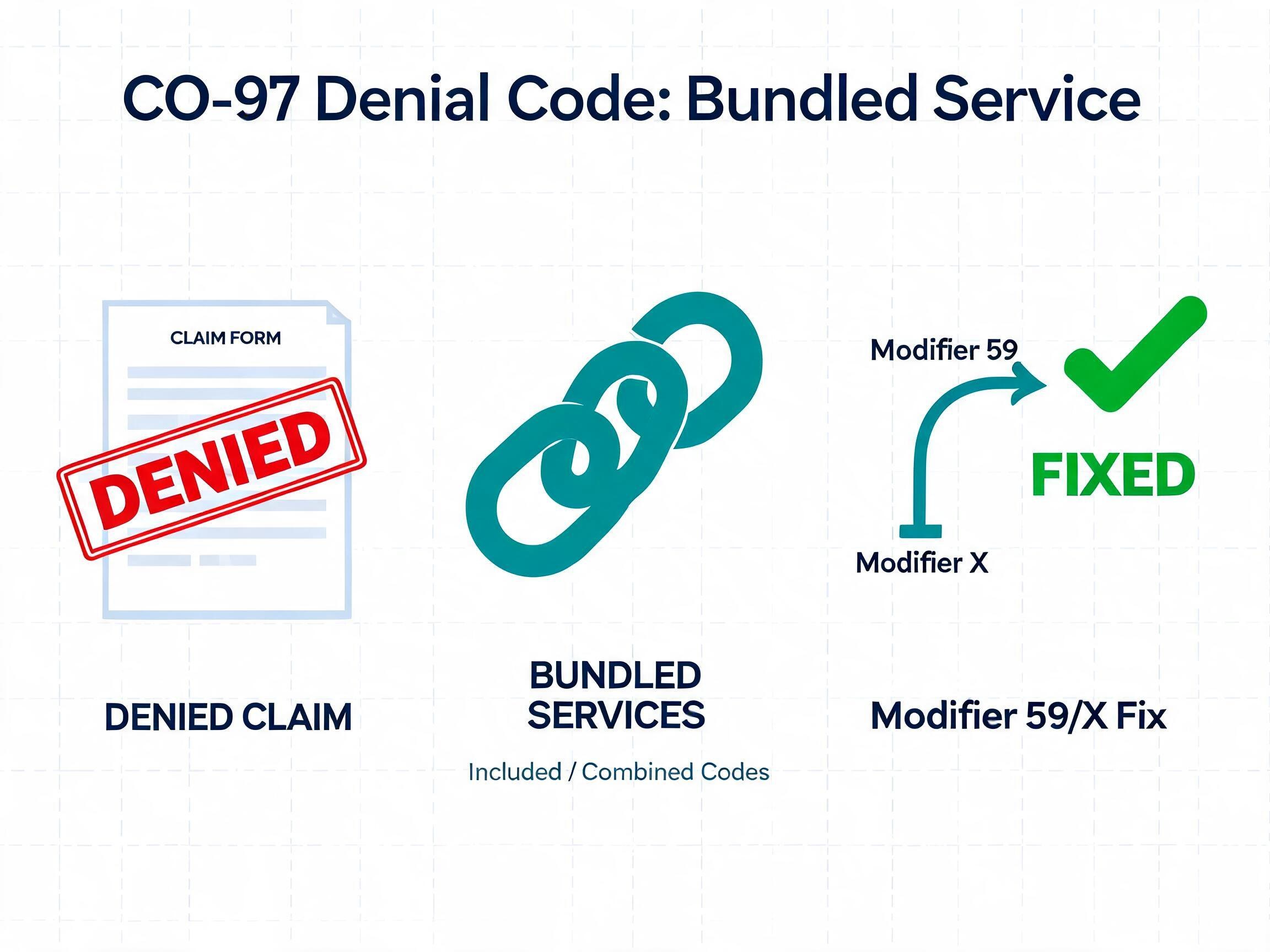
When a remittance line comes back with the co-97 denial code, the payer is not saying the service was unnecessary — it is saying the money for that line was already paid inside another line. CARC 97 reads: “The benefit for this service is included in the payment/allowance for another service/procedure that has already been adjudicated.” That one sentence covers two very different situations. Sometimes the bundling is wrong and a modifier or appeal recovers real revenue; just as often it is exactly what CMS intended, and the fastest correct move is a write-off. This guide covers both paths, the NCCI logic underneath them, and a workflow to run on every CO-97 without guessing.
What the CO-97 Denial Code Actually Means
CO-97 pairs group code CO (contractual obligation — a provider write-off unless corrected, never patient responsibility) with reason code 97. Payers usually attach a remark code (RARC) that narrows the cause: N19 (“procedure code incidental to primary procedure”) and M15 (“separately billed services/tests have been bundled”) point to NCCI-style bundling, while M144 (“pre-/post-operative care is included in the allowance for the surgery”) points to the global surgical package. Reading the RARC first tells you which rulebook the payer applied and often saves a full rework cycle. For how CARCs and RARCs fit together, see our CARC and RARC guide.
Two Different Causes: NCCI Edits vs the Global Surgical Package
The most common CO-97 mistake is treating every occurrence as an NCCI problem. Two distinct bundling mechanisms exist, and they take different modifiers:
- NCCI PTP bundling (same-day code pairs). The National Correct Coding Initiative, maintained by CMS and updated quarterly, pairs a comprehensive Column 1 code with a component Column 2 code. Billed together for the same date of service, the Column 2 code denies. The potential fix — where allowed — is modifier 59 or an X modifier on the Column 2 code.
- Global surgical package bundling (services across time). Procedures with a 010- or 090-day global period include routine pre-op visits, the surgery, and related post-op care. An E/M billed inside that window often returns CO-97 with M144. Modifier 59 does nothing here; the tools are modifier 24 (unrelated E/M in the global period), 25 (significant, separately identifiable E/M with a minor procedure), 57 (decision for major surgery), or 58/78/79 for staged, related, or unrelated returns to the OR.
Diagnosing which mechanism fired is step one. Applying a distinct-service modifier to a global-package denial is a common, completely ineffective rework pattern — the claim simply denies again.
How NCCI PTP Edits Work: Column 1, Column 2, and Modifier Indicators
Every PTP edit lists a Column 1 (comprehensive) code, a Column 2 (component) code, and a modifier indicator that controls whether the edit can be bypassed. Because CMS refreshes the files quarterly, a pair that paid last quarter may deny this quarter — sudden CO-97 spikes often trace to an NCCI update, not a coding change.
| Modifier indicator | Meaning | Your move |
|---|---|---|
| 0 | Edit can never be bypassed; Column 2 code is not separately payable with the Column 1 code. | No modifier, no appeal on distinctness. Write off (or fix genuinely wrong coding). |
| 1 | Edit may be bypassed when services were genuinely distinct and documented. | Append 59 or the specific X modifier and resubmit; appeal with records if the modifier was already present. |
| 9 | Edit deleted (often retroactively); indicator not applicable. | No modifier needed; resubmit or appeal citing current NCCI files. |
Checking the indicator before touching the claim is the highest-leverage habit in CO-97 work: 0 ends the conversation, and 1 defines exactly what your documentation must prove.
When Modifier 59 or an X Modifier Is Appropriate — and When It Is Not
Modifier 59 designates a distinct procedural service: different session, different site or organ system, separate lesion, separate incision, or separate injury. Because 59 is broad and historically overused, CMS created four specific X modifiers and asks that they be used instead whenever one fits; many payers now edit for them.
| Modifier | Distinct because of… | Illustrative example |
|---|---|---|
| XE | Separate encounter, same date | Morning procedure, unplanned return visit that evening |
| XS | Separate organ/structure | Lesions treated at two different anatomic sites |
| XP | Separate practitioner | Two clinicians performing distinct services same day |
| XU | Unusual non-overlapping service | Component work that does not overlap the primary procedure |
The compliance line is bright: if the note cannot show a different session, site, lesion, or encounter, the modifier does not belong on the claim — even if the payer would pay it. Unbundling with 59/X is a recurring OIG and payer-audit focus, and recoupments reach back years. See our guides to modifier 59, X modifiers, and NCCI unbundling and modifier 51 vs 59.
CO-97 Denial → Cause → Fix
| Scenario | Cause | Fix |
|---|---|---|
| Distinct service, no modifier on claim | PTP edit fired; 59/X omitted despite separate site or session | Confirm indicator 1, append the most specific X modifier, submit corrected claim |
| Modifier present, still denied | Documentation not submitted or insufficient | Appeal with operative/clinical notes proving distinctness |
| Indicator 0 pair | Correct, intentional bundling — no override exists | Write off; stop billing the pair together |
| E/M in global period (M144) | Global surgical package, not NCCI | Rebill with 24/25/58/78/79 if truly separate; otherwise adjust |
| Component test billed with lab panel | Test inherently included in the panel | Correct bundling — fix charge-entry logic |
Worked Example: A Two-Line Colonoscopy Claim (Illustrative)
A GI practice bills 45385 (colonoscopy with snare polypectomy) and 45380 (colonoscopy with biopsy) for one session — the snare removed a sigmoid polyp, and a biopsy came from a separate lesion in the ascending colon. Illustrative numbers: 45385 allows $350 and pays; 45380, billed at $212, returns CO-97 with N19 on the PTP edit.
The lookup shows modifier indicator 1, and the operative report documents two separate lesions in different segments — satisfying the separate-structure test. The practice submits a corrected claim with XS on 45380; the payer reprocesses under multiple-endoscopy pricing and pays $118 (illustrative), adjusting the rest contractually. A five-minute lookup recovered $118. Had the indicator been 0 — or both samples come from the same lesion — the right answer would have been a clean write-off and no appeal.
Step-by-Step CO-97 Resolution Workflow
- Read the full remit line — group code, CARC 97, and the RARC (N19/M15 vs M144) to identify NCCI vs global-package bundling.
- Run the PTP lookup against the current quarter’s CMS NCCI files; record the modifier indicator.
- Apply the indicator rule. 0: stop — write off or correct coding. 9: resubmit citing the deleted edit. 1: continue.
- Test distinctness against the note. Different encounter, structure, practitioner, or non-overlapping service? If none, write off.
- Append the most specific modifier (prefer XE/XS/XP/XU over 59) to the Column 2 code only.
- Correct vs appeal. Missing modifier → corrected claim. Modifier already present → formal appeal with records; a corrected claim will just re-deny.
- Log the outcome by code pair so charge entry stops generating the same denial — the discipline behind effective denial management.
CO-97 Appeal Packet Checklist
- Claim copy and remittance advice showing CARC 97 and the RARC
- NCCI PTP citation showing modifier indicator 1 for the pair on that date of service
- Operative report or note with the distinct site/session/lesion language highlighted
- One-paragraph cover letter mapping the documentation to the X-modifier definition used
- Payer appeal form, filed inside the appeal window (often 60–180 days, depending on payer)
- Reference to the payer’s own bundling policy where it permits overrides
Our step-by-step appeal guide covers timelines, levels, and escalation language.
Quick Answers
What does the CO-97 denial code mean? CO-97 means payment for the billed service is already included in the allowance for another adjudicated service on the claim — the service was bundled, usually under NCCI PTP edits or the global surgical package.
How do I fix a CO-97 denial? Look up the pair in the current CMS NCCI PTP files. If the modifier indicator is 1 and documentation shows a distinct site, session, or encounter, resubmit with modifier 59 or the specific X modifier; if it is 0, write it off.
Should I appeal every CO-97 denial? No. Appeal only when services were genuinely distinct and the record proves it. Appealing correct bundling wastes rework time, and forcing payment with modifier 59 creates audit exposure.
What modifiers fix CO-97 denials? For NCCI pair denials: 59 or XE, XS, XP, XU on the Column 2 code. For global-period denials: 24, 25, 57, 58, 78, or 79, depending on how the visit relates to the surgery.
Is CO-97 the patient’s responsibility? No. The CO group code marks the amount as a contractual obligation, so a CO-97 adjustment cannot be balance-billed to the patient.
What to Check Before Resubmitting
- Current-quarter NCCI PTP status and modifier indicator for the exact pair
- RARC on the remit — NCCI-type (N19/M15) or global package (M144)
- Explicit distinct-encounter/structure/practitioner language in the note
- Modifier placed on the Column 2 (component) code, not the comprehensive code
- Whether the payer follows CMS NCCI or proprietary bundling edits
- Claim history — confirm the line was not already paid inside another claim
Related Denial Codes and Guides
CO-97 often appears alongside other adjustment codes: CO-16 flags missing or invalid claim information — see our CO-16 denial guide — while CO-45 is the routine contractual adjustment when charges exceed the fee schedule. Reading the full CARC/RARC string together is what separates one-touch resolution from serial resubmission. Bronchoscopy performed alongside a thoracoscopic procedure on the same date is a frequent CO-97 trigger, and it is only separable when the indication and documentation stand on their own — thoracic surgery billing services check the specific NCCI pair before appending a distinct-service modifier.
Frequently asked questions
The X modifiers (XE, XS, XP, XU) are more specific versions of modifier 59 that state exactly why a service was distinct — separate encounter, structure, practitioner, or unusual non-overlapping service. CMS asks that the most specific X modifier be used when one applies, and many payers now prefer or require them over 59.
Yes, in most cases. Scrubbing claims against the current quarterly NCCI PTP files, appending the correct X modifier at charge entry when distinctness is documented, and blocking indicator-0 pairs from being billed together will prevent the large majority of CO-97 denials.
Not necessarily. Medical necessity does not override bundling logic — NCCI edits ask whether the services were distinct by site, session, lesion, or encounter, not whether each was justified. A necessary but integral component service still bundles into the comprehensive code.
An operative report or clinical note that explicitly describes the separate anatomic site, separate lesion, separate session, or separate encounter, plus the NCCI lookup showing a modifier indicator of 1 for the pair. A short cover letter mapping the note to the X-modifier definition strengthens the packet.
No. CO-97 appears anywhere bundling logic exists — laboratory panels and their component tests, E/M visits inside a surgical global period, and diagnostic services considered integral to a primary procedure all generate CARC 97 adjustments.